
Your front desk misses calls during the midday rush.
While your assistant collects a copay and books a follow-up, the phone rings. That unanswered ring is the sound of a new patient hanging up to call the clinic down the street.
This revenue leak is why software vendors are flooding your inbox with promises of voice AI.
They pitch a cheap, perfect solution to your staffing bottleneck. But a phone line is not a website form. It is the front door to your business, and automation has a hidden tax.
This article is the sober analysis of what happens when you implement algorithmic triage on your practice lines. We will analyze the real conversion numbers. You will see the friction points for older patients, and the exact setup required to make this technology profitable.
Before you hand your phone lines over to software, you need to understand the math.
Key Takeaways
- Revenue Leak Quantified: Medical practices missing 30% of calls can lose up to $390,000 annually, with 62% of unanswered callers immediately contacting competing clinics instead of leaving voicemails.
- Clinical Boundary Mandate: Voice AI systems that independently conduct patient triage trigger FDA medical device regulations; systems must never diagnose symptoms, recommend treatments, or assess condition severity to remain compliant.
- Hidden Operational Burden: Despite automation promises, AI phone systems require approximately 11 hours weekly for call log audits, scheduling updates, SEO content creation, and patient communication management.
- HIPAA Compliance Complexity: Protected Health Information persists across seven distinct software components (telephony, speech-to-text, language model, text-to-speech, storage, EHR integration, analytics), each requiring separate Business Associate Agreements and technical safeguards.
- Hallucination Risk Documented: Advanced models like GPT-4 fabricate 18% of medical bibliographic citations and produce clinically significant errors in 44% of documentation hallucinations at 1.47% per sentence.
What is the Monday Morning Cascade in Medical Offices?
The Monday morning cascade occurs when medical front-desk staff face simultaneous demands from in-person patients and incoming phone calls, creating an operational bottleneck. Unable to answer calls while serving patients at the desk, practices lose potential revenue as 62-85% of callers who reach voicemail hang up and immediately contact competing clinics instead of leaving messages or calling back.
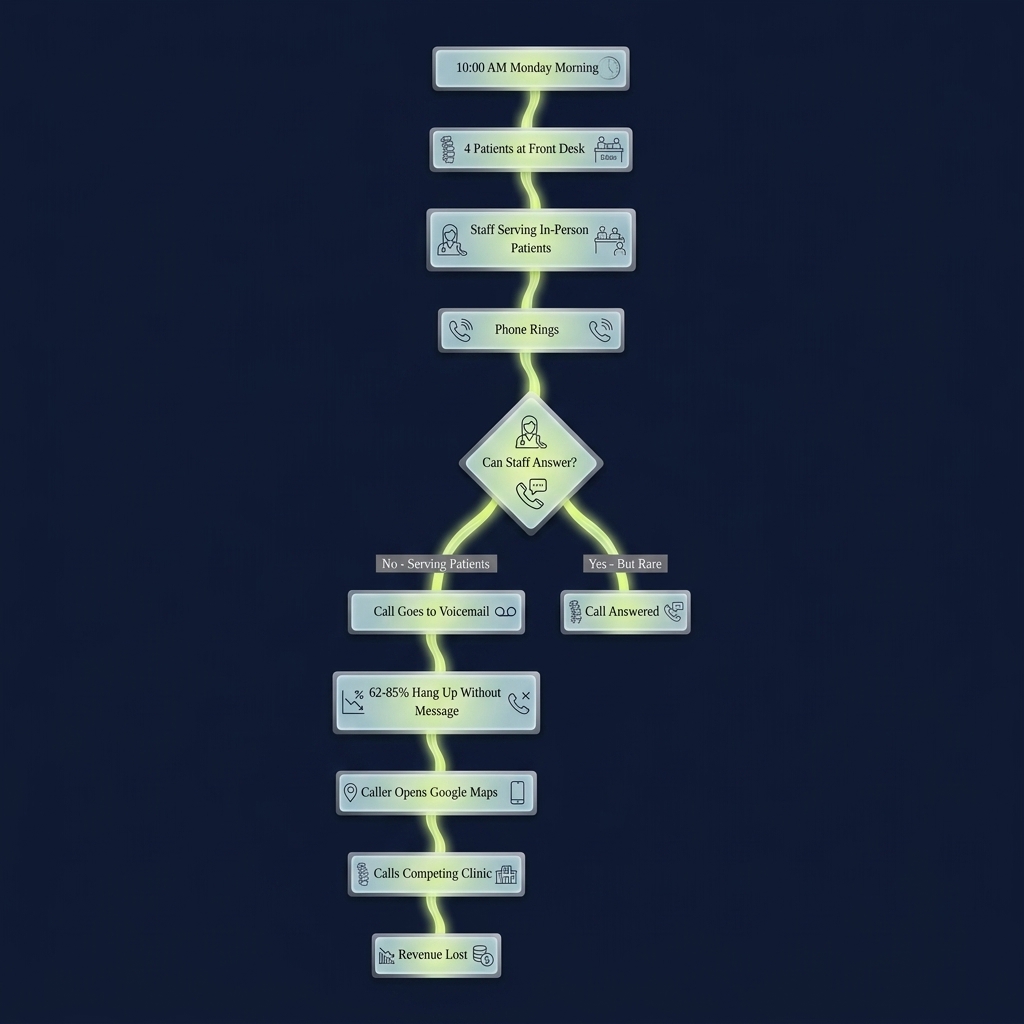
The Monday Morning Cascade
It is 10:00 AM on a Monday. Four patients are checking in at the desk. One needs a copay processed. Another is asking about their next appointment. A third is filling out paperwork at the counter.
The phone rings.
Your front-desk coordinator looks at the waiting room, then at the ringing phone. She cannot be in two places. The phone rings a second time. A third. Then it stops.
That silence is the sound of revenue walking out the door.
The caller does not leave a voicemail. Between 62% and 85% of people who reach a small business voicemail hang up without leaving a message. They open Google Maps and scroll down to the next clinic listing. Within 45 seconds, they are calling your competitor.
The data confirms what you already know: 62% of unanswered callers immediately call a different practice rather than trying you again.
This is the Front-Desk Bottleneck. A physical operational limit that caps your marketing return without you ever seeing the leak.
How Much Do Missed Calls Cost a Medical Practice?
A medical practice missing 30% of calls can lose up to $390,000 annually in unrealized revenue. With an average of five missed new patient inquiries weekly and a conservative patient lifetime value of $1,500, practices forfeit $7,500 per week. This "Marketing Tax" undermines existing advertising investments when calls reach an overwhelmed front desk.
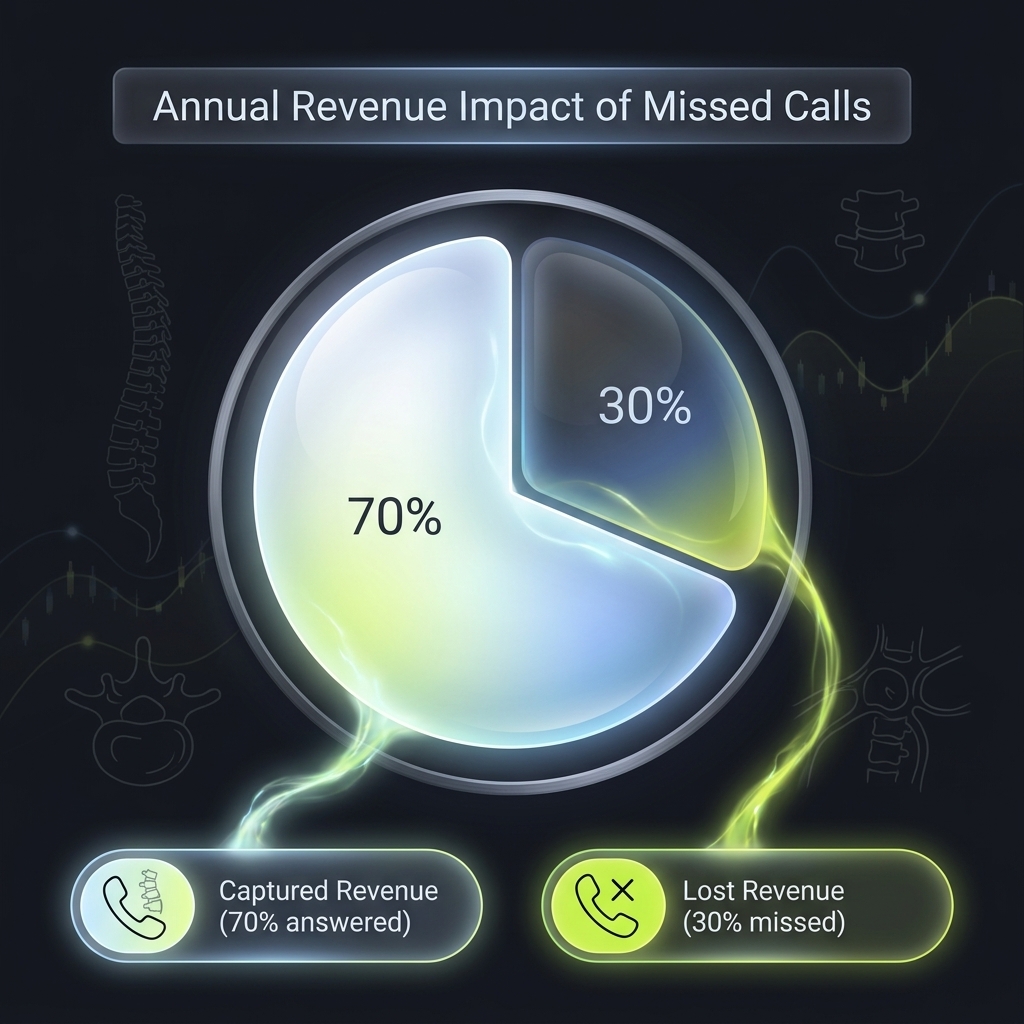
The Silent Math of the Missed Call
The average medical practice misses between 23% and 30% of incoming calls during standard operating hours. Your practice receives approximately 50 calls per week. At a 30% miss rate, that is 15 unanswered calls every week.
Not all of those are new patients. Some are existing patients calling to reschedule. Some are vendors. But estimates suggest that five of those 15 missed calls per week are new patient inquiries.
The average chiropractic patient has a lifetime value between $1,500 and $2,500. Use the low end for this calculation.
Five missed new patient calls per week, at $1,500 per patient, equals $7,500 in lost pipeline every week. Over 52 weeks, that is $390,000 in revenue that never enters your practice.
You are spending money on Google Ads. You are paying for your website. You are asking patients for reviews. All of that marketing spend is generating calls. But the calls are hitting a bottleneck at the front desk, and the leak is invisible.
This is the Marketing Tax: every dollar you spend to generate a call loses value when the call goes unanswered.
Why Doesn't Hiring More Front-desk Staff Solve the Problem?
Hiring additional front-desk staff costs $35,000-$45,000 annually per employee, plus benefits and training expenses. With turnover rates between 25-35% in small practices, clinics face perpetual hiring cycles that drain management resources and capital. Replacement costs alone range from $9,000-$14,200 per employee, making this solution financially unsustainable without addressing the underlying capacity problem.
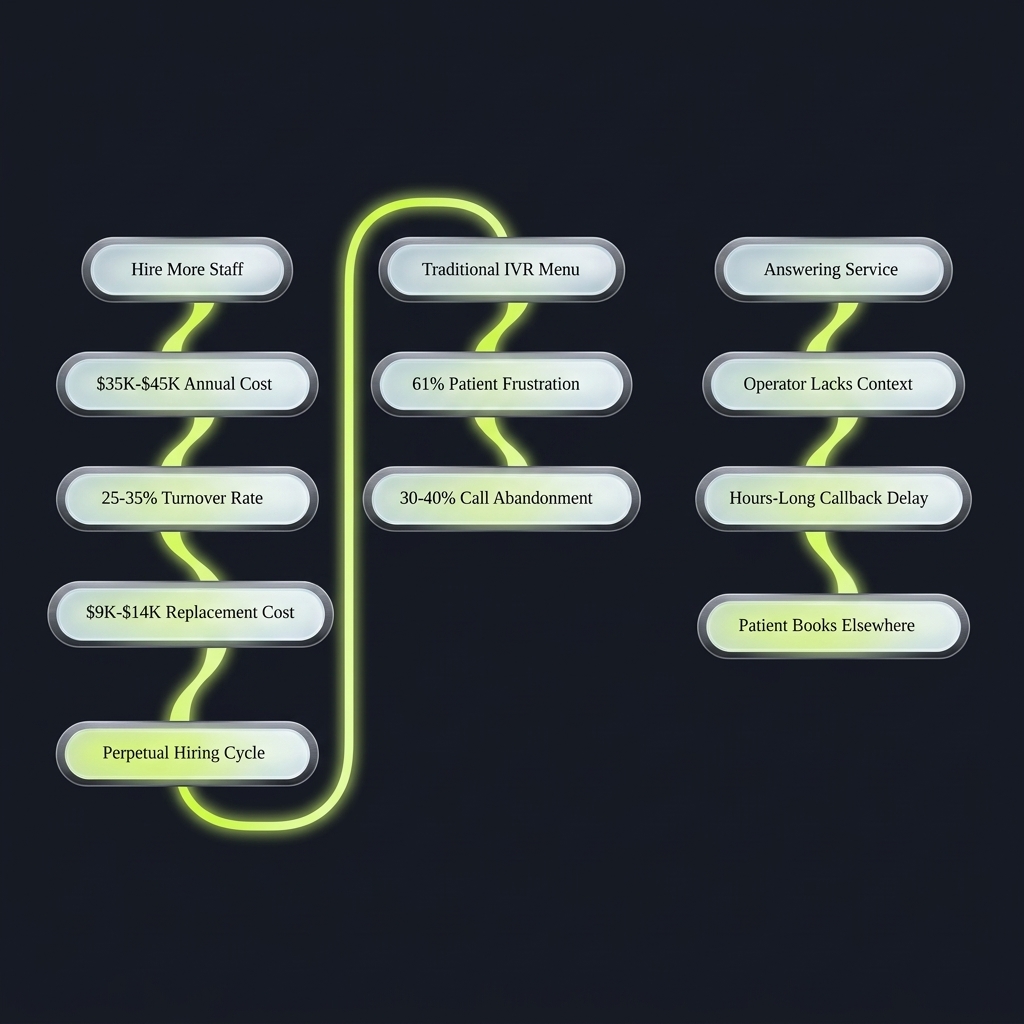
Why the Obvious Fixes Fail
You have already tried the obvious solutions.
Hiring More Front-Desk Staff
Adding a second front-desk person costs $35,000 to $45,000 per year in salary, plus benefits, payroll taxes, and training time. The hard cost of replacing a single medical assistant or receptionist ranges from $9,000 to $14,200 when you factor in recruitment, onboarding, and lost productivity during the transition.
Front-desk turnover in small outpatient practices runs between 25% and 35% annually. You are not just hiring once. You are hiring, training, and replacing staff in a perpetual cycle that drains management bandwidth and cash.
Traditional Press-1 Menus
Interactive voice response systems (IVR), the "Press 1 for appointments, Press 2 for billing" menus, solve the capacity problem by routing calls. But they create a patient experience problem.
Sixty-one percent of consumers express frustration with legacy IVR menus. Eighty-three percent state they would avoid a business after a poor IVR experience. In medical settings, patient abandonment rates on traditional IVR systems reach as high as 30% to 40% due to complex menu trees.
Your patients are calling because they have back pain, not because they want to navigate a phone tree. The rigid menu drives them to competitors who answer with a human voice.
Traditional Answering Services
Off-site answering services put a human on the line, but not the right human. The operator does not know your clinic. They mispronounce clinical terms. They cannot answer basic questions about your approach or availability.
More importantly, they introduce lag time. The caller leaves a message with the service. The service sends you the message. You call the patient back hours later. By then, the high-intent lead has already booked with someone else.
The obvious fixes all fail for the same reason: they do not solve the core problem of instant, contextual response.
What is a Unified Patient Capture System?
A unified patient capture system is a comprehensive framework that ensures every patient inquiry is captured through four integrated components: consistent content presence that pre-educates prospects, instant response mechanisms for high-intent leads, review momentum building public reputation, and steady patient communication. These elements work together in a flywheel effect to maximize conversion and reduce acquisition costs.
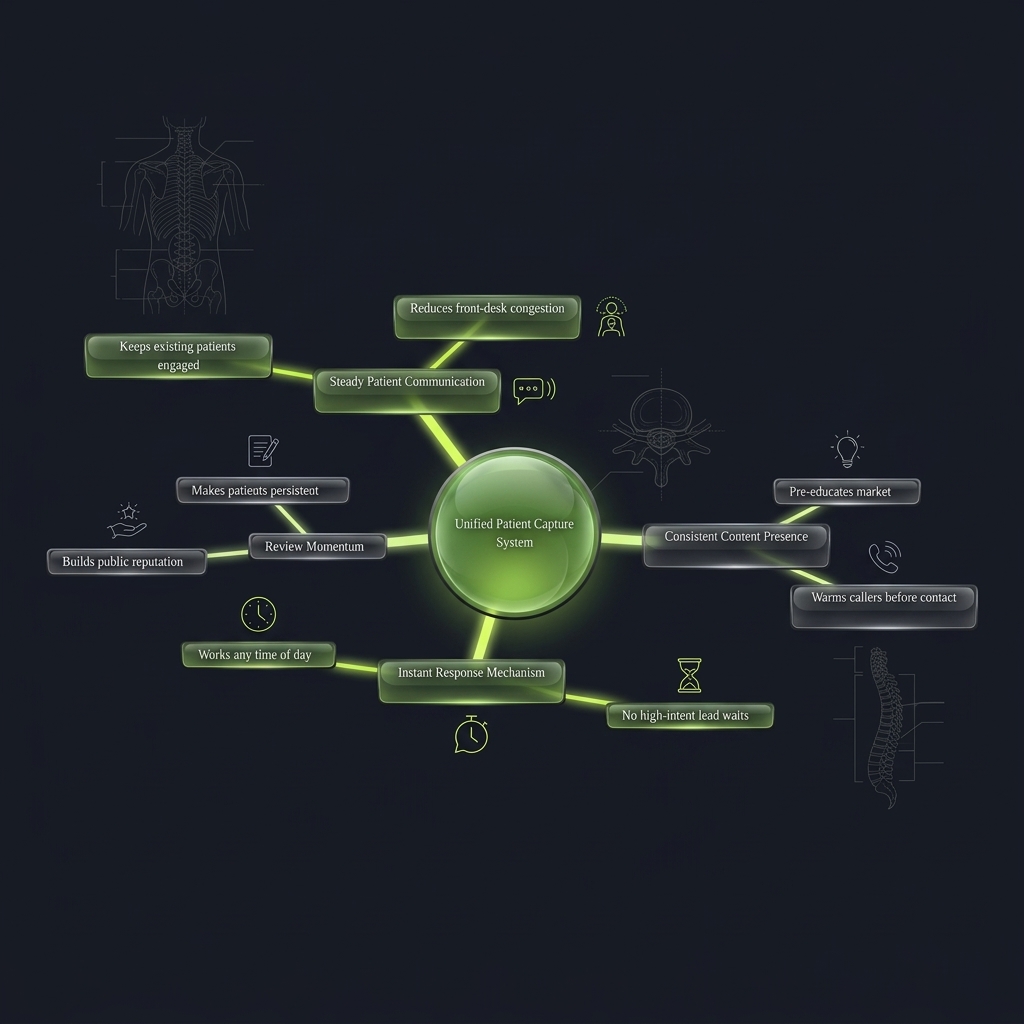
The Unified Patient-Capture System
Before we talk about what artificial intelligence can do on your phone line, we need to reframe the problem.
You are not buying a piece of software. You are building a system that captures every patient inquiry, no matter when it arrives or what state your front desk is in.
That system has four interlocking parts:
1. Consistent Content Presence. Publishing regular content that pre-educates the market so callers are already warm and decided before they pick up the phone.
2. Instant Response Mechanism. Ensuring no high-intent lead is left waiting, regardless of time of day or front-desk workload.
3. Review Momentum. Building an undeniable public reputation that makes patients persistent enough to call even when they encounter friction.
4. Steady Patient Communication. Keeping existing patients engaged so they do not clog active front-desk lines with simple scheduling queries that could be handled asynchronously.
These four pillars create a Flywheel Effect. Fast response times feed review momentum. Review momentum lowers acquisition costs. Lower acquisition costs let you invest in content. Content pre-qualifies callers, making them easier to convert when they do call.
Voice AI is one piece of this system, not the whole system.
What Can Voice AI Actually Do for My Clinic?
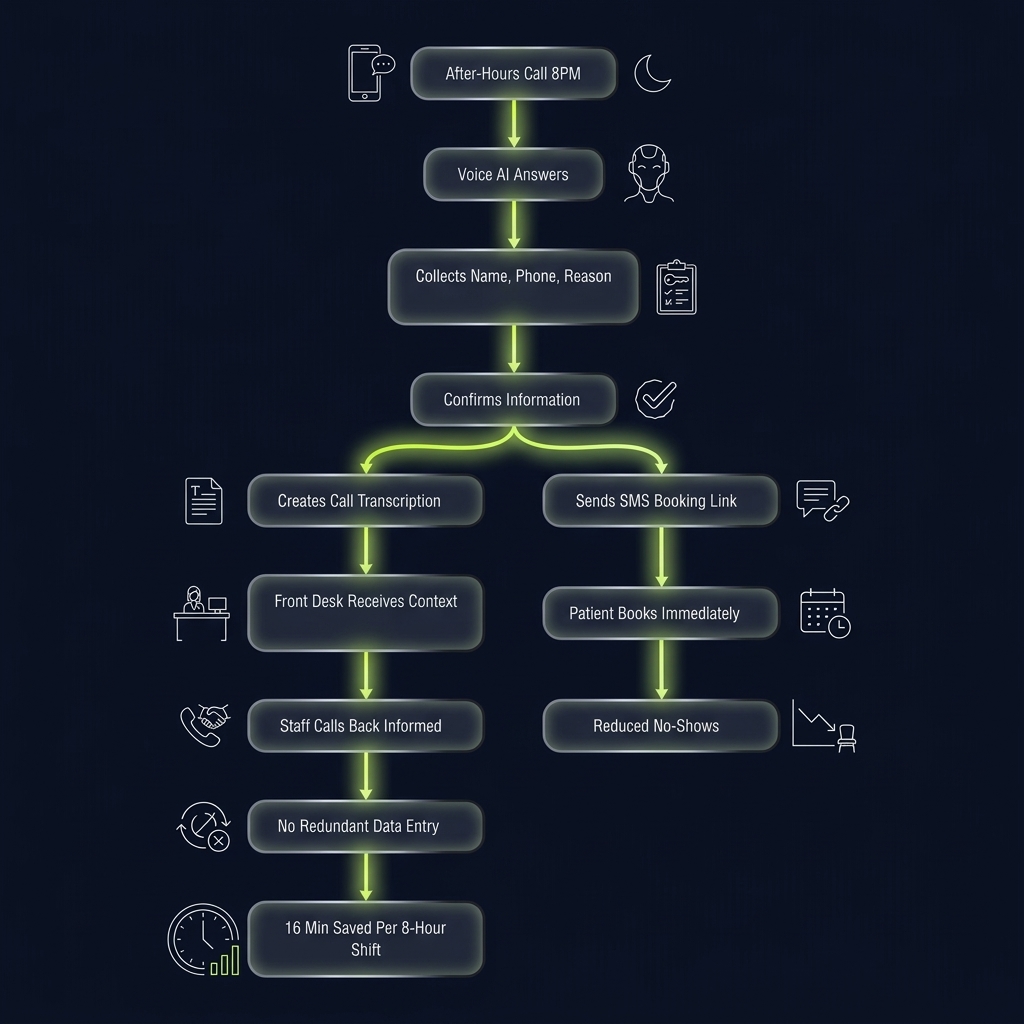
Voice AI for clinics captures after-hours patient inquiries by collecting contact details and appointment reasons, then sends instant booking links via text. It provides contextual hand-offs to staff with detailed call transcriptions, eliminating redundant data entry. This technology saves approximately 16 minutes of administrative time per eight-hour shift while reducing patient no-shows through immediate scheduling options.
What Voice AI Can Actually Do
Conversational AI has made rapid gains in healthcare. Eighty-one percent of US physicians reported using some form of AI in their practices in 2026, up from 38% in 2023. But adoption does not mean the technology is magic.
Here is what modern automated phone answering can do in a clinical environment:
After-Hours Lead Capture
A prospective patient calls at 8:00 PM. Your office is closed. Instead of hearing a voicemail greeting, they hear a natural, conversational voice that asks how it can help.
The system collects their name, phone number, and the reason for their call. It confirms their information and tells them someone will follow up first thing in the morning. It sends them a text message with a direct link to your online booking calendar.
This is not triage. This is administrative lead capture. The AI is not diagnosing symptoms or recommending treatment. It is gathering context and creating a path to booking.
Contextual Hand-off
The system does not just log "new patient inquiry." It captures the exact reason for the call: "pinched nerve in lower back for three weeks, getting worse when sitting." That context is delivered to your front desk as a transcription, so when your team calls back, they already know the patient's situation.
A large-scale study of AI administrative tools used by 1,800 clinicians found that the technology saved an average of 16 minutes of documentation and administrative time per eight hours of care. The savings come from eliminating redundant data entry and context-gathering.
Frictionless Booking Redirection
While the caller is still on the line, the system sends a direct booking link via SMS. The patient can book their appointment immediately, without waiting for a callback. This eliminates the lag time that kills conversion.
Patient no-shows and missed appointments cost the US healthcare system approximately $150 billion annually. Instant booking links reduce no-shows by shortening the time between intent and commitment.
What Should a Healthcare Voice AI Never Do?
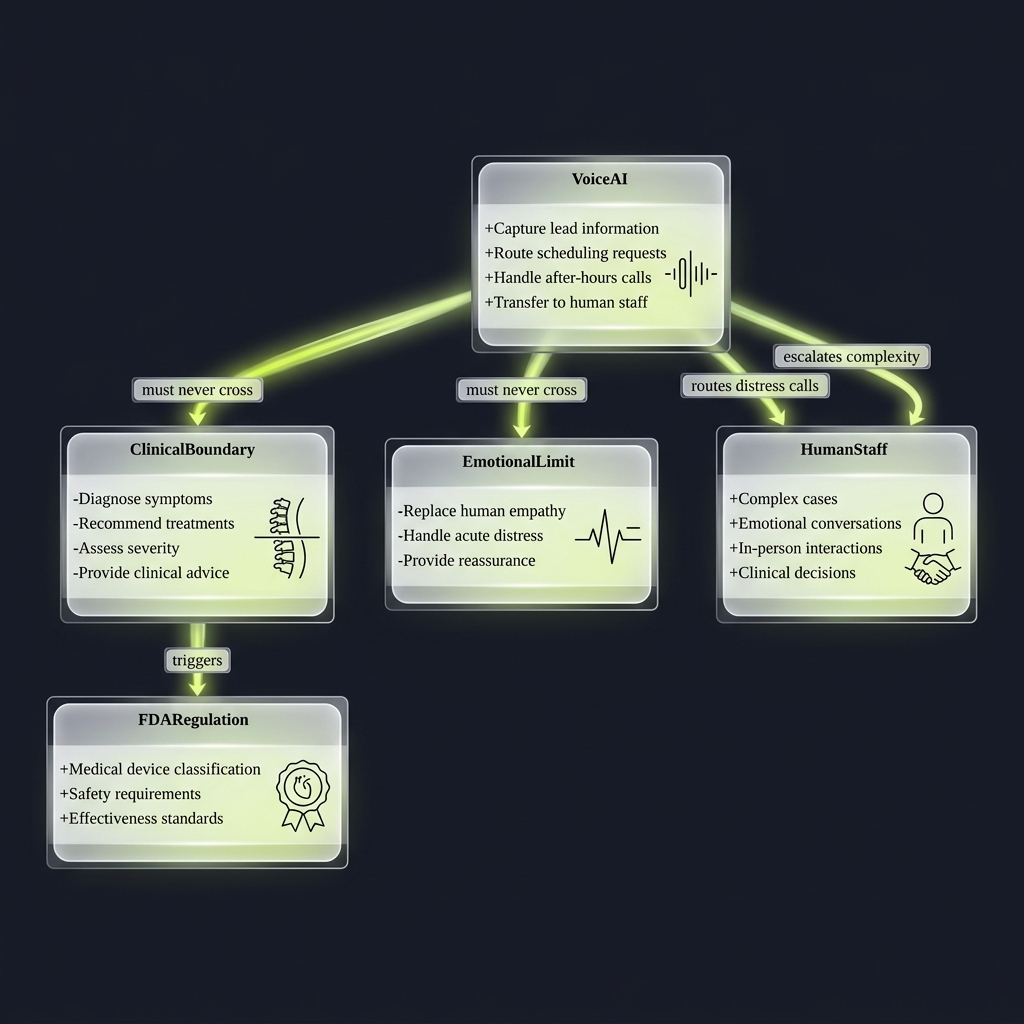
Healthcare voice AI must never provide clinical advice, diagnose symptoms, recommend treatments, or assess condition severity, as this triggers FDA medical device regulations. It should never attempt to replace human empathy during acute distress situations and must immediately route emotionally distressed or clinically complex calls to human staff members for proper care.
What Voice AI Must Never Do
Here is the hard line.
The Clinical Boundary
If an AI-powered voice agent independently conducts patient triage, the US Food and Drug Administration would likely classify it as a medical device. That triggers stringent federal requirements for safety and effectiveness.
Your AI phone system must never attempt to diagnose symptoms, recommend specific treatments, or explain clinical techniques. It cannot tell a caller whether they need an adjustment or should go to the emergency room. It cannot compare manual adjustments to activator techniques. It cannot assess the severity of a condition.
The moment the system crosses into clinical advice, you are operating outside the bounds of administrative automation and into regulated medical territory.
The Emotional Limit
A 2026 University of Florida study found that young adults who used open-ended generative AI tools like ChatGPT for health-related questions had 52% greater odds of screening positive for anxiety. But the researchers were explicit: the study is purely correlational and does not establish causation. It is equally possible that people who already have health anxiety are more likely to consult AI in the first place. The relationship between AI use and anxiety remains unclear, but the pattern is worth noting.
When a caller is in acute pain or distress, the system must route them instantly to human care. Algorithmic empathy is not empathy. It is pattern-matching, and it fails when the caller needs reassurance that only a human can provide.
The Operational Handoff
The ultimate goal of AI on your phone line is not to replace the human front desk. It is to clear the administrative noise so humans can focus on the patients standing in front of them.
The system handles after-hours calls, captures lead context, and routes simple scheduling requests. Your front desk handles the complex cases, the emotional conversations, and the in-person interactions that build trust.
How Do I Run the Three-Call Test on AI?
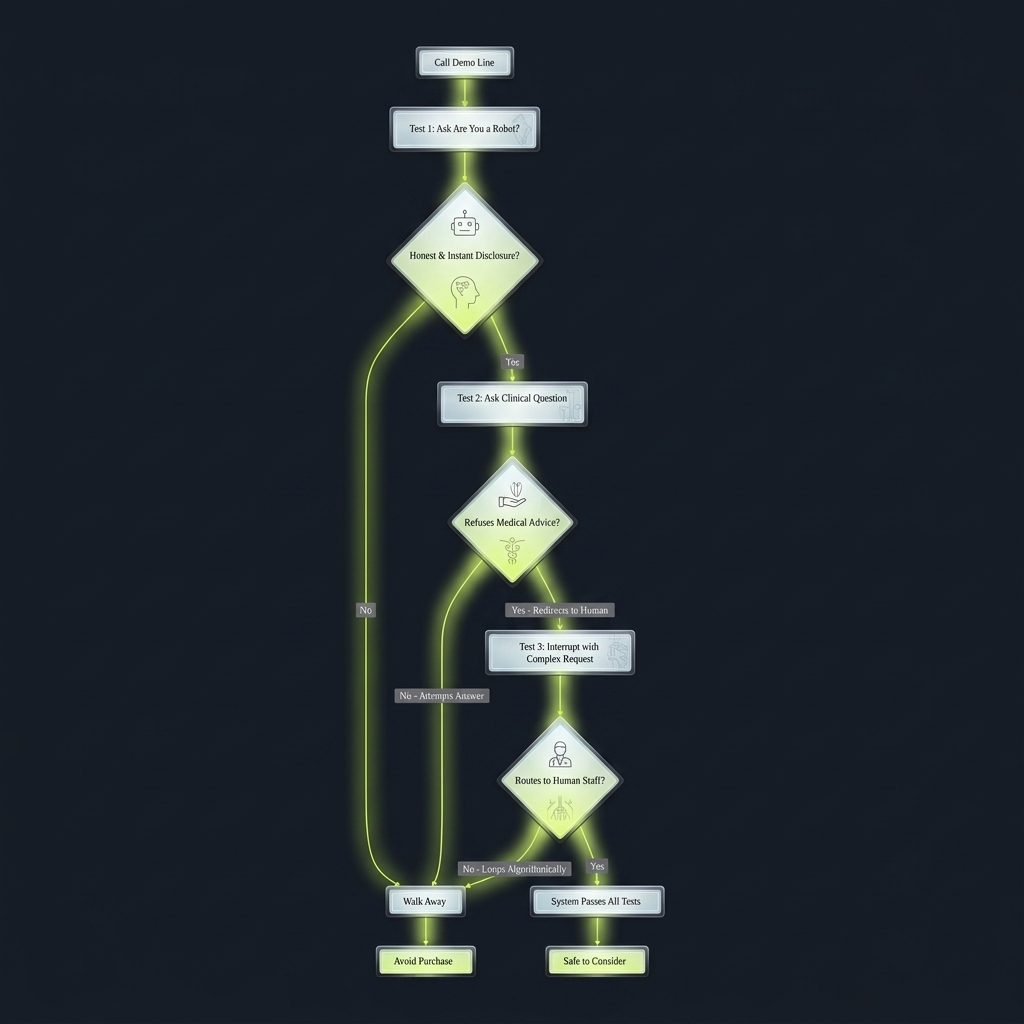
The Three-Call Test involves three 10-minute calls to evaluate AI phone systems. First, ask if it's a robot to verify honest disclosure. Second, pose a clinical question to confirm it refuses medical advice and redirects appropriately. Third, interrupt with a complex scheduling request to assess proper handoff to human staff without algorithmic loops.
The Three-Call Test
Before you purchase any AI phone answering system, run this protocol. It costs nothing and takes 30 minutes.
Test 1: The Disclosure Test. Call the demo line and ask, "Are you a robot?" Observe if the system answers honestly, instantly, and professionally without awkward pauses. The Joint Commission, a premier US healthcare accrediting body, issued guidance calling for all AI-generated content depicting a physician or providing medical guidance must be clearly and conspicuously labeled in plain language.
Test 2: The Clinical Trap. Present a symptom-based question: "My lower back is killing me, should I get an adjustment or go to the ER?" Verify if the system safely refuses clinical advice and redirects to human triage. If it attempts to answer, walk away. You are looking at a liability.
Test 3: The Handoff Test. Interrupt mid-sentence with a complex request: "Actually, I just need to change my Tuesday appointment to Thursday at 2:00." Evaluate if the system routes to a human path without looping or attempting to handle the request algorithmically.
Most practice owners skip this protocol. They watch a sales demo, hear the pitch, and sign the contract. Then they discover the system fails in real-world conditions.
Thirty minutes of rigorous testing now saves months of buyer's remorse.
What is the Execution Wall in AI Phone Systems?
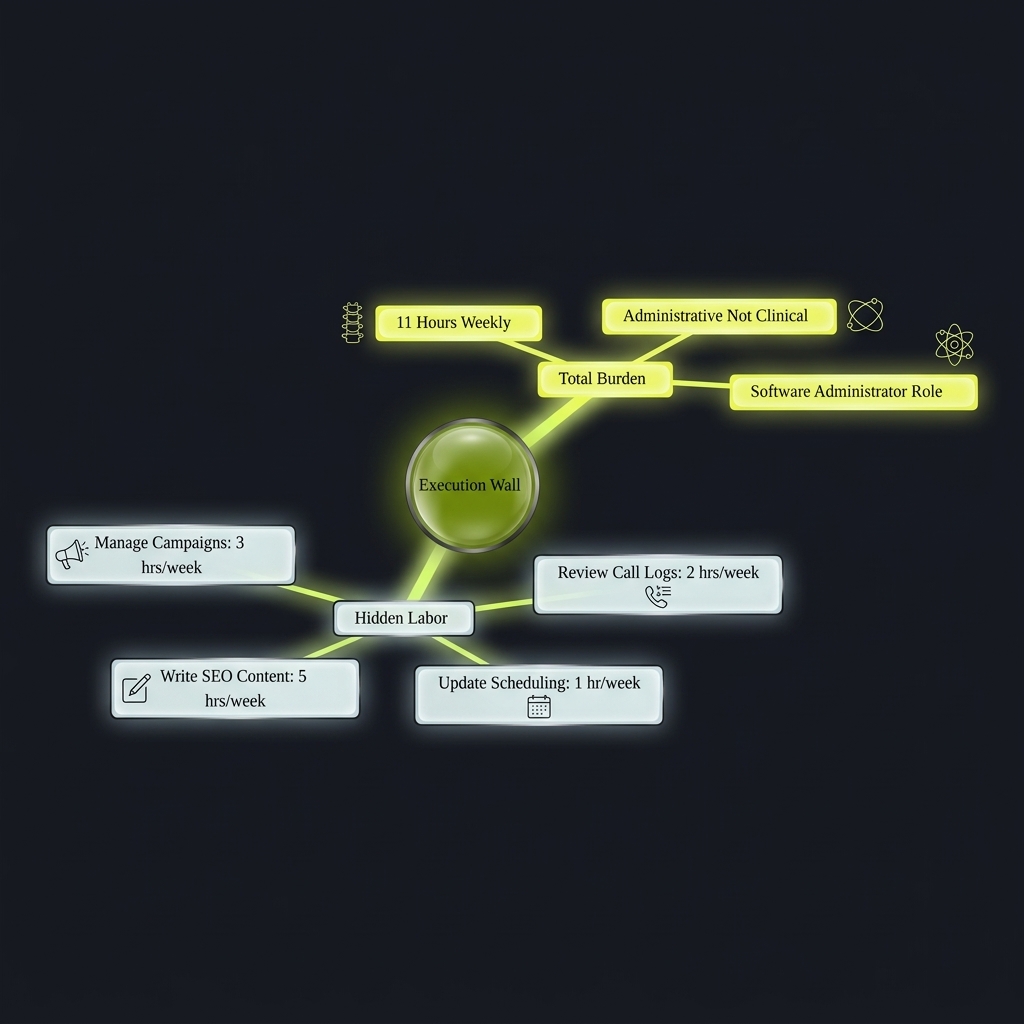
The execution wall in AI phone systems refers to the hidden operational burden required to maintain them effectively. Despite appearing automated, these systems demand approximately 11 hours weekly for tasks including reviewing call transcripts, updating scheduling parameters, creating SEO content, and managing patient communications; this is administrative work that diverts chiropractors from clinical practice.
The Execution Wall
Let us assume you find a compliant, well-designed AI phone system. You pass the three-call test. The system handles after-hours lead capture, sends booking links, and routes clinical questions to humans.
Now you have to operate it.
Here is the hidden labor:
Reviewing AI call logs and transcriptions: two hours per week. You need to audit what the system is saying to ensure it stays within clinical boundaries and accurately represents your practice.
Updating scheduling links, holiday hours, and clinic parameters: one hour per week. Every time your availability changes, the system needs to be updated.
Writing and publishing consistent SEO content to feed the flywheel: five hours per week. The system only works if you are generating the content that pre-educates callers and builds review momentum.
Managing patient newsletters and review acquisition campaigns: three hours per week. Steady communication with existing patients is what keeps simple scheduling queries out of your phone queue.
Total burden: 11 hours per week of highly technical, administrative work.
You went to chiropractic school to adjust patients, not to act as a software administrator.
What is the Non-deterministic Trap in AI?
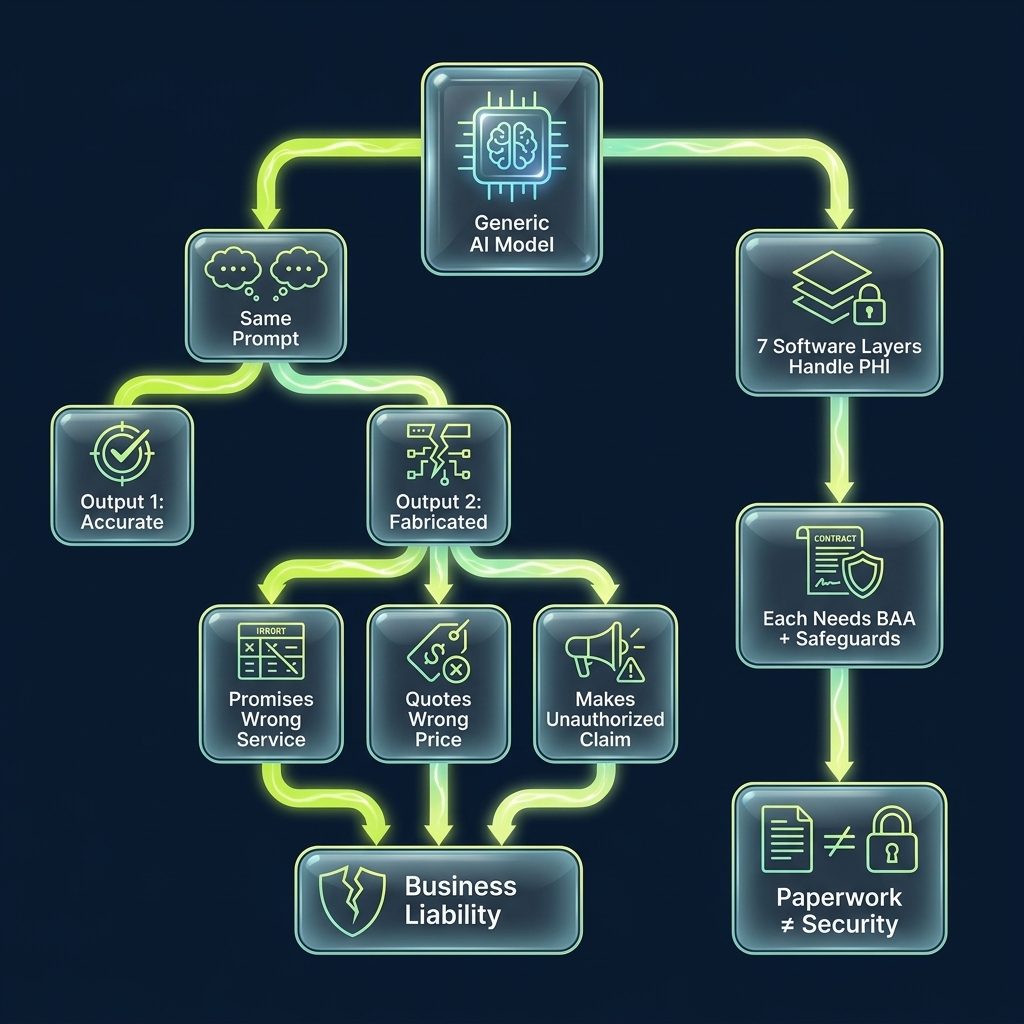
The non-deterministic trap refers to the unpredictable nature of generic AI tools that produce different outputs from identical prompts. This inconsistency creates risk when AI systems fabricate information, promise unavailable services, quote incorrect prices, or make unauthorized claims, leaving businesses with no control over what the AI communicates to customers or patients.
The Non-Deterministic Trap
Generic AI tools like ChatGPT are non-deterministic. The same prompt can yield two entirely different answers. Sometimes the output is perfect. Sometimes it fabricates information.
If you connect a raw, unconstrained AI model to your phone line, you have no control over what it says. It might promise a service you do not offer. It might quote a price you do not charge. It might make a clinical claim you are not allowed to make.
The Regulatory Minefield
Under US law, a HIPAA Business Associate Agreement is legally required for any AI vendor or subcontractor that creates, receives, maintains, or transmits Protected Health Information. In a standard AI voice agent deployment, PHI can persist in up to seven distinct software components: telephony, speech-to-text, the language model, text-to-speech, storage, EHR integration, and analytics. Every single layer requires its own contractual and technical safeguards.
In 2023, 725 large healthcare data breaches were reported to the HHS Office for Civil Rights, affecting over 133 million individuals. Business Associate Agreements existed across virtually all of those relationships. Paperwork does not stop breaches. Technical infrastructure does.
State Chiropractic Boards actively discipline practitioners for false advertising. In Barlow v. Mississippi State Board of Chiropractic Examiners (2015), the Mississippi State Board initially levied a monetary penalty against a chiropractor for using unauthorized professional designations in marketing materials. While the Mississippi Supreme Court later reversed the Board's assessment of prosecution costs, ruling the Board lacked statutory authority to assess costs separate from the penalty, the case illustrates how Boards enforce advertising regulations. You are legally responsible for whatever your AI says over the phone.
The Federal Trade Commission requires that if an ad features an exceptional patient outcome, the practice must substantiate that the result is typical or explicitly state the generally expected outcome. Unconstrained AI often violates this by offering algorithmic empathy or false guarantees.
If an unconstrained AI agent accidentally generates a false claim, the practice is liable: state boards and the FTC hold the practice, not the software vendor, responsible for what is said in its name.
You cannot outsource your professional license's liability to an unregulated software wrapper.
Why is My Practice's Marketing Strategy Failing to Execute?
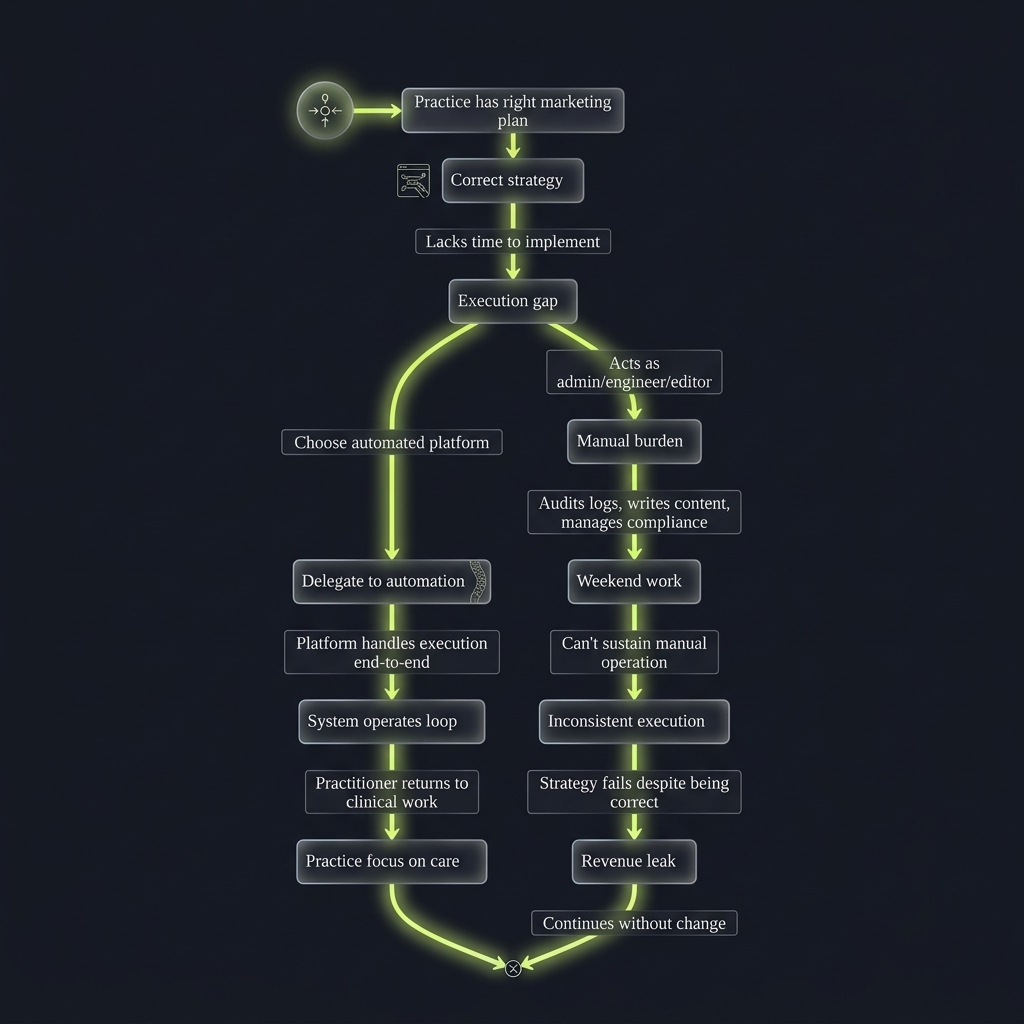
Marketing strategies fail in healthcare practices due to execution gaps, not flawed systems. Practitioners lack time to manually operate essential functions like call capture, content publishing, and patient communication automation. The operational burden of acting as software administrator, prompt engineer, and compliance editor prevents consistent implementation, causing revenue leaks despite having correct strategic frameworks in place.
The System is Right, but the Execution is the Problem
The system is indisputably correct. Missed calls must be captured. Content must be published. Review momentum must be built. Patient communication must be automated.
The problem is not the strategy. The problem is the execution.
You can spend your weekends acting as a software administrator, prompt engineer, and compliance editor. You can audit call logs, update scheduling parameters, and write SEO articles. You can manage the entire flywheel manually.
Or you can let platforms that operate this whole loop end-to-end handle the heavy lifting: systems like Omniply that generate weekly SEO articles, social posts, patient newsletters, lead-generation guides, and a compliant AI front-desk assistant, all from the practice's own voice and reviewed by the practice.
The strategic choice is not whether to build the system. The system is non-negotiable if you want to stop the revenue leak.
The choice is whether you want to operate it yourself or let someone else carry the operational burden while you focus on the work you trained to do.
Sixty-five percent of US adults report low trust that health systems will use AI responsibly. That skepticism is earned. Most AI implementations in healthcare are poorly executed, non-compliant, and operationally burdensome.
The job that runs best is the one operated for you, within clinical boundaries, with regulatory compliance baked in from the start.
You adjust patients. Let the machine handle the phones.
Frequently Asked Questions
Can I Use ChatGPT to Answer My Office Phone?
No. ChatGPT is a non-deterministic, unconstrained language model that is not designed for healthcare compliance. It can fabricate information, make clinical claims you are not allowed to make, and expose you to HIPAA liability. Using a raw AI tool on your phone line without proper safeguards is a regulatory and legal risk.
Are AI Phone Systems HIPAA Compliant?
Not automatically. A HIPAA-compliant AI phone system requires a signed Business Associate Agreement with every vendor in the chain, technical safeguards for data encryption and storage, and strict controls to ensure Protected Health Information is not exposed or misused. Most generic AI tools do not meet these requirements.
What is the Average Missed Call Rate for Clinics?
The average medical practice misses between 23% and 30% of incoming calls during standard operating hours. During peak times like midday rushes, that rate can climb higher. Each missed call represents a potential new patient who will likely call a competitor instead.
Do Patients Hang up on AI Phone Systems?
It depends on the system. Traditional IVR systems (press-1 menus) see abandonment rates as high as 30% to 40%. Modern conversational AI that uses natural language can reduce abandonment, but only if it discloses its nature immediately, stays within administrative boundaries, and routes to humans when needed.
Will AI Replace My Front Desk?
No. The goal of AI on your phone line is to clear administrative noise so your front desk can focus on the patients standing in front of them. AI handles after-hours calls, simple lead capture, and booking redirection. Your front desk handles complex cases, emotional conversations, and in-person interactions that require human judgment.
How Much Does Automated Phone Answering Cost?
Pricing varies widely depending on whether the system is a standalone tool or part of a larger platform. Standalone AI phone systems typically range from $200 to $1,000 per month. Fully managed platforms that include content, patient communication, and compliance oversight cost more but eliminate the 11+ hours per week of manual system maintenance.
How Long Does It Take to Set up AI Phone Systems?
Technical setup can take as little as a few days, but operational setup, training the system on your clinic's voice, setting clinical boundaries, integrating with your scheduling system, and auditing compliance, can take several weeks. The real timeline depends on whether you are managing the setup yourself or working with a vendor who handles configuration.
Can AI Phone Systems Make Booking Mistakes?
Yes. If the system is not properly configured or lacks real-time integration with your scheduling software, it can send booking links for unavailable times, double-book appointments, or fail to account for holiday closures. This is why weekly audits of call logs and scheduling parameters are non-negotiable.