
Your phone rings at 12:15 PM while your front-desk admin is handling a copay and a patient is asking for ice packs.
That ring is worth $180 in initial clinical revenue.
It just went to voicemail.
Voicemail is where new patients go to die.
You cannot simply hire your way out of this leak. Adding another $40,000 salary to your overhead destroys your clinic's operating margins. This is why modern practice owners turn to a virtual receptionist.
But handing your phones over to an algorithm is a liability if done wrong. Some tasks belong to software. Others require human clinical empathy. If you get the dividing line wrong, your schedule empties out.
This article defines that boundary. We will analyze the exact administrative tasks your automated front desk must handle, and the three critical areas you must never delegate to a machine.
Your bottom line depends on drawing this line correctly.
Let's look at the numbers.
The 9:15 PM Fracture
A high-intent prospect wakes at 2 AM with acute lower back spasms. She cannot get comfortable. She searches "chiropractor near me emergency" on her phone while sitting on the edge of her bed.
She finds your practice. Your reviews are excellent. Your website clearly lists your address and insurance providers.
She taps the contact form and types: "Severe lower back pain. Can you see me first thing tomorrow morning?"
The timestamp reads 2:17 AM. Your front desk team went home at 5:30 PM yesterday. The message sits in an inbox.
She keeps searching. Three minutes later, she finds a clinic four blocks away with an instant-response chat system. The system confirms availability, offers three morning slots, and books her into the 8:00 AM opening.
Your office manager arrives at 8:45 AM, sees the overnight inquiry, and sends a reply: "Good morning! We'd be happy to help. Do any of these times work for you?"
The prospect does not respond. She is already sitting in your competitor's adjustment room.
This scenario repeats five to seven times every week in the average chiropractic practice. Research from Harvard Business Review and MIT shows that contacting a lead within five minutes makes you 21 times more likely to qualify that lead compared to waiting 30 minutes. Seventy-eight percent of customers buy from the first company that responds.
Speed is not a customer-service nicety. It is the primary conversion mechanism in local healthcare.
The Arithmetic of Silent Attrition
Let's make the invisible cost visible with real practice numbers.
Start with baseline metrics. According to ChiroTouch's 2025-2026 practice benchmarks, a high-value chiropractic patient who completes a full care plan averages a Patient Lifetime Value (LTV) of $3,200 over two years. This includes the initial visit series, maintenance adjustments, and typical referrals.
Now count your after-hours inbound demand. Most practices receive five to seven high-intent inquiries per week outside business hours: texts, web chats, voicemail, contact forms.
Here is where the leak becomes a hemorrhage.
If your response system only captures one of those seven after-hours prospects due to latency, you lose six high-intent patients per week. That is 24 missed patients per month.
Do the math: 24 patients × $3,200 LTV = $76,800 in unrealized monthly revenue.
Annualized, your response-latency problem costs you $921,600.
The number feels absurd until you audit your inquiry-to-booking conversion rate and realize it is not.
There is a second, hidden cost. Your front desk staff spends the first 90 minutes of every morning chasing cold leads from overnight inquiries instead of serving the patients standing in front of them. This creates a backlog that compounds throughout the day, degrading service quality for your active patient base.
The emotional toll on staff is real. The financial toll is measurable.
Why the Obvious Fixes Fail
Most practice owners try three common solutions before they find one that works. All three fail for structural reasons.
Failed Fix 1: The 24/7 Live Answering Service
You hire a medical answering service with round-the-clock coverage. The monthly retainer runs $400 to $800, plus per-minute charges that push the real cost closer to $1,200.
The friction appears immediately. The offshore or generalist call agents do not understand chiropractic care. They cannot navigate your Electronic Health Record (EHR) system, whether you run Jane, ChiroTouch, or another platform. They misbook appointments into slots you reserve for existing patients. They give incorrect information about insurance coverage because they are reading from a script that is three months out of date.
Patients notice. The disconnect between the voice on the phone and the expertise they expect from your practice creates doubt before they ever walk through your door.
Failed Fix 2: The Static Auto-Responder
You set up an automatic email reply: "Thank you for contacting us. We will respond within 24 business hours."
This provides zero utility. It does not solve the patient's immediate problem. It simply signals that your business is closed, which prompts them to keep searching.
The prospect needed an answer or a booking link. You gave them a polite acknowledgment of receipt. That is not a conversion mechanism.
Failed Fix 3: Forwarding Calls to Your Personal Cell
You forward the clinic line to your mobile phone so you can answer after hours.
This is the fastest path to burnout. You are now fielding questions about parking instructions during family dinner and discussing insurance coverage at 11 PM. The boundaries between clinical work and personal time dissolve.
The quality of your responses degrades because you are rushed and context-switching. Patients sense it. Your family resents it. The system collapses within three months.
None of these fixes address the core problem: you need a system that provides instant, accurate, logistical responses without consuming human labor or crossing into clinical territory.
Key Takeaways
- Revenue Leak Quantified: Chiropractic practices lose $921,600 annually by missing six of seven after-hours inquiries worth $3,200 patient lifetime value each, while Harvard Business Review data shows responding within five minutes makes you 21 times more likely to convert leads.
- Virtual Receptionist Boundaries: Safe AI front desks automate only deterministic tasks, hours, location, insurance verification, EHR scheduling integration, and must refuse clinical questions about treatment safety or outcomes to maintain HIPAA compliance and avoid FTC/FDA violations.
- Generic AI Liability: Baseline ChatGPT models fabricate 55% of medical citations and lack Business Associate Agreements, exposing practices to regulatory penalties like the $9.9 million in HIPAA fines collected across 22 violations in 2024.
- SMS Conversion Advantage: Missed call text-back systems achieve 98% open rates with 90% read within three minutes versus 20-28% email open rates, while 80% of voicemail callers hang up without leaving messages and 85% never call back.
- Patient Preference Data: 89% of patients prioritize anytime digital scheduling ability and 80% say online booking influences provider choice, valuing AI for transactional logistics while expecting human interaction for clinical conversations.
What is an Integrated Patient Acquisition Flywheel?
An integrated patient acquisition flywheel is a unified system of four automated elements that compound growth: consistent educational content that builds search authority, instant frictionless booking that captures high-intent leads, automated review collection that strengthens local SEO, and steady patient communication that increases retention. Each element feeds the next, creating accelerating momentum without manual intervention.
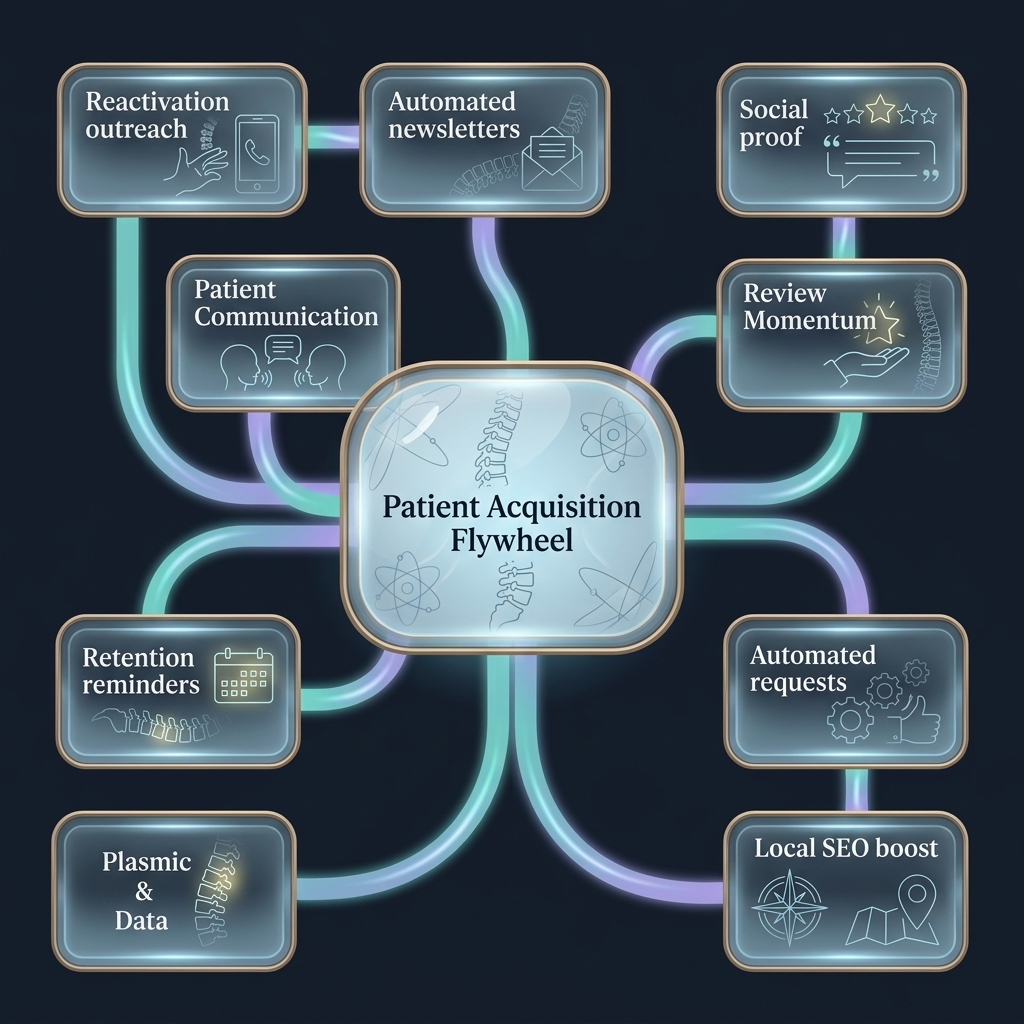
The Integrated Patient Acquisition Flywheel
The solution is not a single tool. It is a unified system where four elements operate as a compounding engine.
The Four-Part System
1. Consistent Content Presence
You educate your local community before they ever need care. Weekly articles on your website answer the questions prospects search for: "Can a chiropractor help with tension headaches?" or "What should I expect at my first adjustment?"
This builds authority in search results and positions your practice as the obvious choice when acute need strikes.
2. Instant, Frictionless Response
You capture the high-intent lead the exact second they decide to seek help. An automated system answers common logistical questions, hours, location, insurance, parking, and provides direct scheduling integration.
The prospect books an appointment at 2:17 AM without waiting for business hours.
3. Review and Reputation Momentum
You turn successful clinical outcomes into social proof. An automated system requests reviews from patients who complete care plans, feeding fresh testimonials into Google and Facebook.
This compounds your local SEO rankings, which drives more after-hours inquiries, which feeds more appointments into the top of the funnel.
4. Steady Patient Communication
You keep active and inactive patients engaged without manual staff intervention. Automated newsletters share seasonal health tips, announce new services, and remind lapsed patients to schedule maintenance adjustments.
This increases patient retention and reactivation without adding labor hours.
These four elements create The Compounding Flywheel. Immediate booking confirmation leads to higher arrival rates. Higher arrival rates lead to more completed care plans. More completed care plans generate more positive reviews. More reviews boost local SEO. Better SEO drives more after-hours inquiries. The cycle accelerates.
But only if each element operates continuously, not as a manual task your staff completes when they have spare time.
Why the AI Front Desk Must Have Boundaries
Here is the critical design principle most practices miss: the best feature of a specialized AI front desk is its refusal to enter clinical territory.
An AI receptionist is a logistical traffic controller, not a digital clinician.
It must handle three categories of tasks flawlessly:
What the AI Automates Perfectly:
- Hours of operation and holiday schedules
- Clinic location, parking instructions, and public transit directions
- Insurance providers accepted and verification procedures
- Direct scheduling integration with your practice management software
- Immediate callback coordination for complex questions
These are deterministic tasks with clear, factual answers. There is no judgment required. The information does not change based on context.
What the AI Must Refuse:
- "Can a chiropractic adjustment cure my sciatica?"
- "Should I use ice or heat for my neck pain?"
- "Is it safe to get adjusted while pregnant?"
These questions require clinical expertise, individualized assessment, and professional liability. An AI system that attempts to answer them exposes your practice to regulatory violations and malpractice risk.
The strategic refusal is the safety mechanism. When a prospect asks a clinical question, the AI responds: "That is a great question for Dr. [Name]. I have flagged this for immediate follow-up. Would you like to schedule a consultation to discuss this in detail?"
This maintains E-E-A-T (Experience, Expertise, Authoritativeness, and Trustworthiness) in the eyes of both patients and search engines. You demonstrate expertise by knowing the boundary between administrative convenience and clinical judgment.
You also maintain compliance with FTC, FDA, and state chiropractic board advertising regulations, which prohibit making non-compliant clinical claims about treatment outcomes.
The refusal is not a limitation. It is the feature that makes automation safe.
Why Do Medical Practices Struggle to Implement Instant Response?
Medical practices struggle to implement instant response because understanding the system differs fundamentally from operating it, creating an execution wall where most practices stall. Despite the availability of existing tools and relatively simple setup requiring only one to two hours of technical configuration, the gap between knowledge and implementation prevents most healthcare providers from capturing after-hours demand effectively.
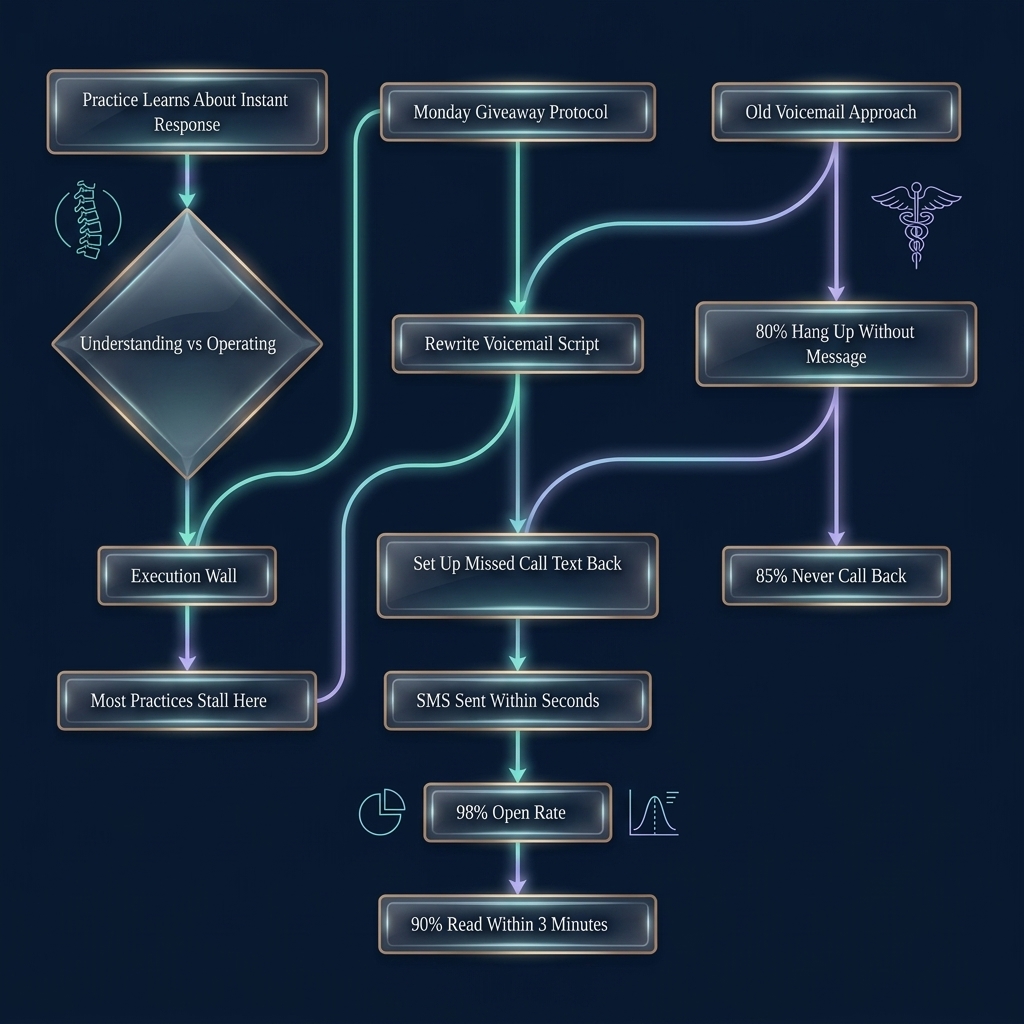
The Execution Wall and the Liability Trap
Understanding the system is not the same as operating it. This is where most practices stall.
The Monday Giveaway Protocol
You can implement a basic version of instant response this Monday using tools you likely already own. This captures the transactional half of after-hours demand.
Step 1: Rewrite Your Voicemail Script
Old script: "Thank you for calling [Clinic Name]. Our hours are Monday through Friday, 8 AM to 6 PM. Please leave a message and we will return your call."
New script: "Thanks for calling [Clinic Name]. We are currently with patients or away from the desk. If you are looking to book an appointment, we just sent a secure booking link directly to your mobile number via text. Simply click that link to reserve your spot instantly. Otherwise, leave a message and we will call you back within two hours."
Step 2: Set Up Missed Call Text Back
Most VoIP providers, Weave, Mango, RingCentral, offer automatic SMS triggers when a call goes unanswered. Configure the system to send this message:
"Hi, this is [Clinic Name]. We missed your call! If you would like to book an appointment, you can do so instantly here: [Your Booking Link]. How else can we help you today?"
Text wins on speed and visibility.
The Honest Arithmetic of the DIY Protocol:
Setup time: one to two hours of technical configuration and script recording.
This protocol captures the transactional prospects: those who just want a booking link and have no questions. It completely fails the conversational prospects: those wondering if you treat pregnant patients, those asking about parking validation, those who need a brief interaction before committing to an appointment.
Your staff still spends five to ten hours per week manually chasing down incomplete conversations, managing double-bookings from patients who clicked the link twice, and cleaning up scheduling errors from prospects who booked into the wrong service type.
The DIY protocol cuts your leak in half. It does not eliminate it.
The Danger of Generic AI
The temptation is obvious: plug a generic ChatGPT-based chat widget into your website and let it handle all inquiries.
This is a massive liability.
Generic Large Language Models (LLMs) are non-deterministic. They are designed to predict the next plausible word in a sequence, not to adhere to strict compliance guidelines. You cannot predict exactly what the system will say to a prospect. You only discover it gave medical advice or promised a guaranteed cure when a patient screenshots the chat or files a complaint with your state board.
In a clinical context, this creates three categories of risk:
1. Regulatory Violations
Generic chatbots routinely violate FDA, FTC, and state chiropractic board advertising regulations by making non-compliant clinical claims. A generic system might tell a prospect that chiropractic care "cures" migraines or "eliminates" chronic pain—claims you are legally prohibited from making.
2. HIPAA Non-Compliance
Most generic chat tools do not offer Business Associate Agreements (BAAs) or encrypted data handling. If a patient shares protected health information in the chat, even something as simple as "I have diabetes and want to know if adjustments are safe", you have created a HIPAA violation.
The U.S. Department of Health and Human Services Office for Civil Rights collected $9,944,612 in penalties across 22 fines in 2024 alone to resolve alleged HIPAA violations. The practice owner retains 100% of the legal and professional liability for any non-compliant communication performed by software on their domain.
3. The Ongoing Prompt-and-Review Tax
Even if you configure a generic AI carefully, you must continuously monitor, prompt, and audit its output. Every chat log requires review. Every edge case requires a new instruction. The system consumes your time instead of freeing it.
This is why safe AI in a clinical environment requires deterministic guardrails, red-flag keyword interception, real-time audit trails, and strict compliance infrastructure. This is a complex software build, not a simple plugin.
The Ultimate Practice Decision
The system we have described, consistent content presence, instant response, review momentum, steady patient communication, is undeniably correct. The compounding math proves it is the only way to scale a modern chiropractic practice without hiring your way into unsustainable overhead.
But executing this system manually is a second full-time job.
To run it yourself, you need:
- Weekly SEO-optimized articles written in your voice and published to your website
- Social media posts distributed across platforms
- Patient newsletters drafted, designed, and sent
- Review-generation campaigns monitored and responded to
- A fully compliant AI front desk with deterministic guardrails, continuously audited for regulatory adherence
This requires 15 to 20 hours of high-skill work every week. If you or your front desk manager are spending your days writing content, debugging software integrations, and auditing chat logs, you are not focused on patient care, clinical outcomes, or local community relationships.
You are not running a chiropractic practice. You are running a marketing agency that happens to offer adjustments.
The most profitable practices recognize this division of labor. Platforms that operate this whole loop end-to-end, like Omniply, which generates weekly content, manages patient communication, and runs a compliant AI front desk from the practice's own voice, exist because the system itself is too valuable to skip and too complex to operate manually.
The question is not whether the system works. The math already answered that.
The question is whether you want to build the engine or simply let it run.
Frequently Asked Questions
Can ChatGPT Answer Patient Text Messages?
Not safely. Generic ChatGPT and similar LLMs are non-deterministic and will generate plausible but non-compliant responses, including clinical advice your practice is not permitted to give. You need a system built with deterministic guardrails and HIPAA-compliant infrastructure.
Does AI Replace Clinic Front Desk Staff?
No. AI handles after-hours inquiries and repetitive logistical questions: hours, location, insurance, scheduling. Your front desk staff remain essential for in-person patient service, complex problem-solving, and clinical coordination. AI eliminates the overflow work that creates backlog and burnout.
Is AI Patient Communication HIPAA Compliant?
Only if the system is specifically designed for healthcare. Generic chat tools do not offer Business Associate Agreements or encrypted data handling. A compliant system requires end-to-end encryption, audit trails, and strict data-handling protocols.
How Much Does AI Phone Answering Cost?
Costs vary widely. Generic chatbot plugins run $50 to $200 per month but carry significant liability. Specialized healthcare communication platforms with compliance infrastructure typically range from $400 to $1,200 per month, replacing the cost of a traditional medical answering service while providing broader functionality.
How Do You Train AI to Answer Clinic Phones?
Safe healthcare AI is not trained through open-ended prompting. It operates on deterministic logic with pre-defined responses to logistical questions and hard-coded refusals for clinical inquiries. The system escalates complex or clinical questions to human staff rather than attempting to answer them.
Do Patients Like Talking to AI?
Patients value speed and accuracy over human interaction for simple logistical questions. According to Experian Health's 2024 survey, 89% of patients say the ability to schedule appointments anytime using digital tools is important. A separate 2025 consumer report by Press Ganey found that 80% of consumers say online scheduling influences their choice of provider. Patients prefer AI for transactional tasks and humans for clinical conversations.
How Does AI Scheduling Integrate With EHR?
Specialized systems integrate directly with common chiropractic EHR and practice management software platforms, Jane, ChiroTouch, and others, via API connections. The AI reads real-time availability, books appointments into open slots, and syncs confirmation details. Generic chatbots lack this integration and require manual calendar management.