
Your Facebook ad campaign generates thirty new leads a month. Your adjustment tables remain empty.
The bottleneck is not your market, your pricing, or your clinical reputation. It is a single, ignored metric: speed to lead.
An inquiry lands in your inbox at 2:15 PM. If your front desk waits until 2:30 PM to call them back, you have already lost them. Modern patients do not wait for a return call. They click the next listing on Google. The first practice to pick up the phone wins.
Most clinics treat lead follow-up as a chore to handle between patient visits. This is a five-figure mistake.
This article analyzes the hard math of the five-minute window. We will examine why your current front-desk workflow fails, and outline the exact protocol to capture every inbound lead before they call your competitor down the street.
Key Takeaways
- Five-Minute Window: Responding to leads within 5 minutes versus 30 minutes produces a 100x increase in contact rates and 21x increase in qualification rates, with sub-1-minute responses boosting conversions by up to 391%.
- $234,000 Annual Leak: Medical practices miss 42% of incoming calls during business hours; a typical chiropractic practice losing 15 leads monthly at $1,300 lifetime value per patient forfeits $234,000 annually in unrealized revenue.
- First-Responder Advantage: 78% of customers choose the vendor that responds first regardless of reviews, and 60% of patients won't hold for more than one minute when calling healthcare providers, with only 32% calling back after hanging up.
- Manual Execution Cost: Running a complete patient-capture system manually requires 10–15 hours of specialized weekly work across multiple channels (phone, SMS, email, social media), costing $1,300–$3,250 monthly for part-time skilled execution.
- HIPAA From First Contact: Protected Health Information (PHI) includes name, phone number, and health condition from the moment a prospective patient contacts your practice, requiring HIPAA-compliant platforms for all text-based communication before any formal doctor-patient relationship exists.
How is My Practice Losing Patients After Hours?
Practices lose patients after hours when calls go to voicemail and form submissions remain unmonitored. Prospects searching for relief at 6:15 PM receive no immediate response, prompting them to contact the next available provider within ninety seconds. Since 78% of customers choose the first responder regardless of reviews, delayed responses directly convert leads into competitors' appointments.
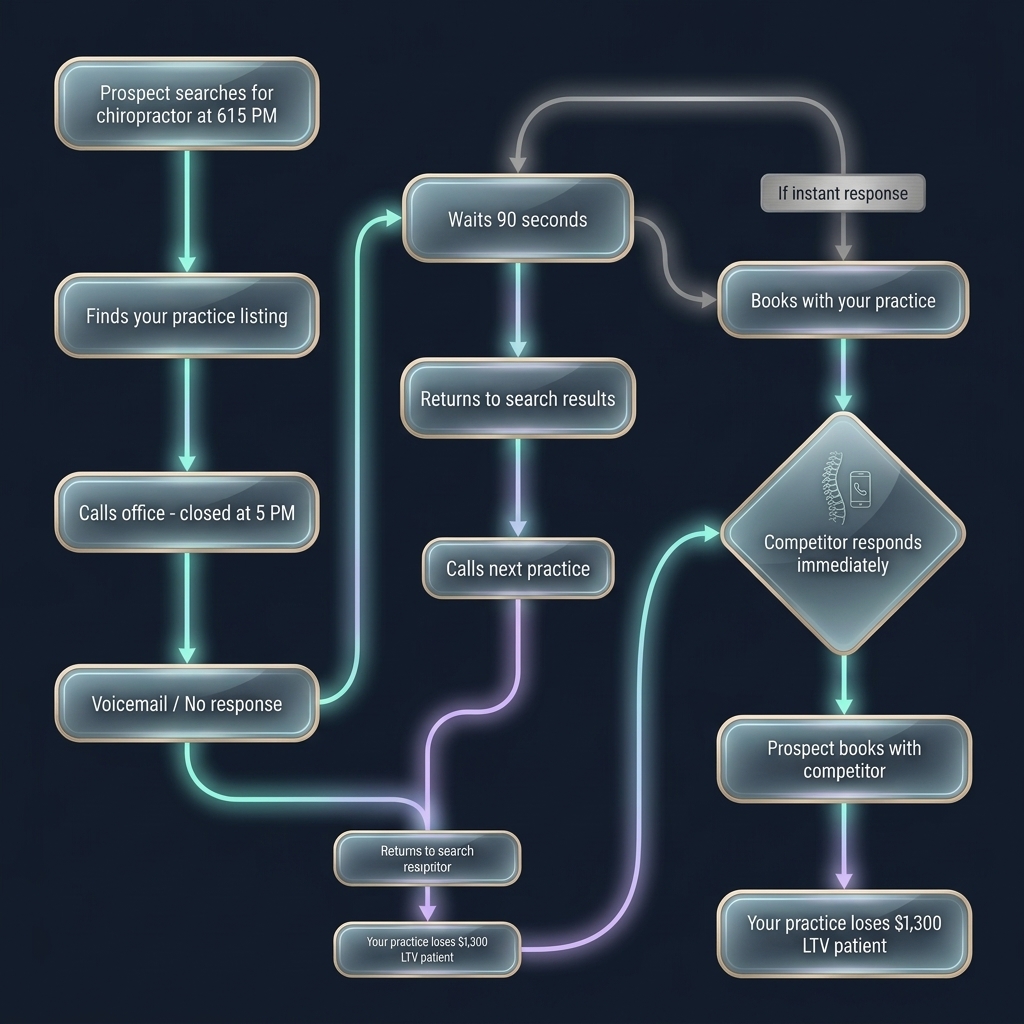
The Silent Leak in the Practice Funnel
The 6:15 PM Patient Search: a Study in Friction
A local prospect sits on their couch after a long workday. Lower back stiffness has progressed from annoying to debilitating. They search Google for a local chiropractor and find your practice.
It is 6:15 PM. Your office closed at 5:00 PM.
The call goes to voicemail. The form submission lands in an unmonitored inbox. Within ninety seconds of receiving no immediate response or confirmation, the prospect clicks back to search results and contacts the next listing.
This is the First-Responder Advantage. 78% of customers buy from the vendor that responds to their inquiry first, regardless of reviews or historical longevity. The patient does not owe you loyalty. They owe themselves relief.
The practice with the fastest response time captures the appointment.
The Cold Arithmetic of the Delayed Response
Medical practices miss an average of 42% of incoming calls during business hours. That number comes from an analysis of 7,000 calls across 22 practices in 18 states. Your practice is likely in that range.
Here is what that miss rate costs you.
The typical lifetime value of a chiropractic patient is $1,300. That estimate assumes an average visit revenue of $50–$90 and 12–30 lifetime visits per patient. Conservative, not aspirational.
Now count your missed leads. Include after-hours calls, lunch breaks, and the moments when your front desk is helping an in-office patient and cannot pick up the phone. A practice running modest digital marketing typically misses 15 inbound leads per month.
The math: 15 leads × $1,300 LTV = $19,500 in unrealized monthly revenue.
That is $234,000 per year walking out the door because no one answered the phone fast enough.
The problem compounds when you add paid advertising. Pouring money into Google Ads or Facebook campaigns without an instant response system is effectively subsidizing your competitors' growth. You pay to generate the lead. They answer first. They book the patient.
The Lead Decay Curve explains why. A 2012 study by MIT and InsideSales.com found a 100x decrease in lead contact rates and a 21x decrease in qualification rates when a lead is responded to in 30 minutes versus 5 minutes. The data is from 2012, but the behavior has only intensified. Patients now expect instant confirmation.
Every minute you wait, the probability of conversion drops.
Why the Obvious Fixes Break Under Pressure
The first instinct is to ask your existing front-desk team to "just answer faster." This is the Work Harder Fallacy.
Your front desk is already managing check-ins, insurance verification, scheduling, and in-person patient questions. 60% of patients are not willing to hold for more than one minute when calling a healthcare provider, and only 32% will call back if they hang up. Asking staff to juggle ringing phones while maintaining quality in-office service leads to burnout, compromised patient care, and administrative errors.
The second instinct is to hire more staff or contract a 24/7 answering service. This is expensive and incomplete. A dedicated after-hours team or phone service that lacks clinical context cannot book directly into your electronic health record. They take messages. The patient still waits. The competitor still answers first.
The third instinct is the passive auto-responder. "We received your message and will get back to you within 24-48 business hours." This email does not stop the prospect from continuing their search. It confirms that you are slow.
None of these fixes address the core mechanism: immediate confirmation reduces patient anxiety and builds instant clinical trust. A fast response signals operational competence before the patient ever steps into your adjustment room.
How Do You Build a Frictionless Patient Acquisition Ecosystem?
Build a frictionless patient acquisition ecosystem by implementing four interconnected pillars: establishing content presence through SEO-optimized materials, deploying instant response systems with sub-2-minute reply times, accelerating review velocity for social proof, and maintaining continuous patient communication. This flywheel approach compounds effectiveness, with rapid response times potentially boosting conversions by 391% without increasing advertising spend.
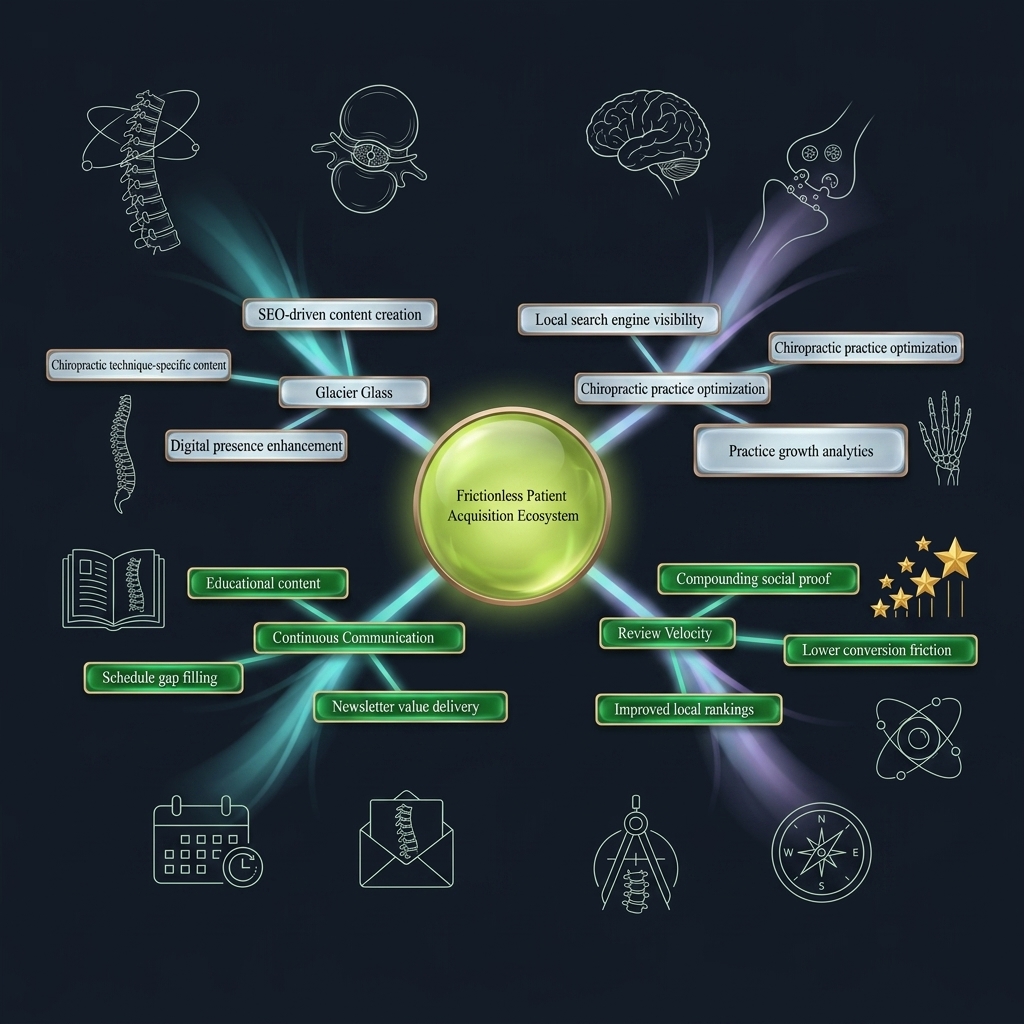
The Frictionless Patient Acquisition Ecosystem
The Unified Patient-Capture Engine
The solution is not a checklist of isolated marketing tasks. It is a unified, automated response system built on four pillars.
The Four Pillars of the Patient-Capture Flywheel:
- Content Presence: Establishing authority and trust before the first point of contact through consistent, SEO-optimized articles and social content.
- Instant Response Engine: Eliminating the gap between intent and booking with sub-2-minute response times across all channels.
- Review Velocity: Compounding social proof to lower conversion friction and improve local search rankings.
- Continuous Patient Communication: Keeping the schedule full through consistent, non-intrusive value delivery via newsletters and educational content.
Each pillar reinforces the others. Content presence brings the lead in. The instant response engine captures them. Review velocity makes the next lead easier to convert. Continuous communication fills gaps in the schedule and increases patient lifetime value.
This is not a funnel. It is a flywheel. Each rotation makes the next one faster.
The Compounding Power of the Velocity Advantage
Responding to an inbound lead within the first minute can boost lead conversions by up to 391%. That number comes from Velocify lead response research. The mechanism is simple: the patient is still in decision mode. Their phone is in their hand. Their calendar is open. They have not yet called the next practice.
This creates the Ad-Spend Multiplier. Shifting focus to lead response time yields a higher ROI than doubling your marketing budget. A practice spending $2,000 per month on Google Ads and converting 10% of leads generates roughly 6 new patients per month (assuming 60 clicks, 10% form submission rate, 10% conversion). That same practice, with the same ad spend and a sub-2-minute response time, can convert 30% to 40% of leads—18 to 24 new patients per month.
The math: 18 new patients × $1,300 LTV = $23,400 in new patient value, versus $7,800 with slow response times. Same ad spend. Triple the return.
Fast response does not just capture more leads. It sets the expectation for clinical excellence. A patient who receives an instant, professional response assumes the same efficiency will carry into their care. Trust compounds before the first adjustment.
What is the Execution Wall in Business Automation?
The execution wall in business automation refers to the practical barrier between knowing what system to implement and actually maintaining it consistently. It represents the point where manual processes become fragile and unsustainable, requiring 10-15 hours of specialized weekly work across multiple channels that most practices cannot reliably sustain long-term.
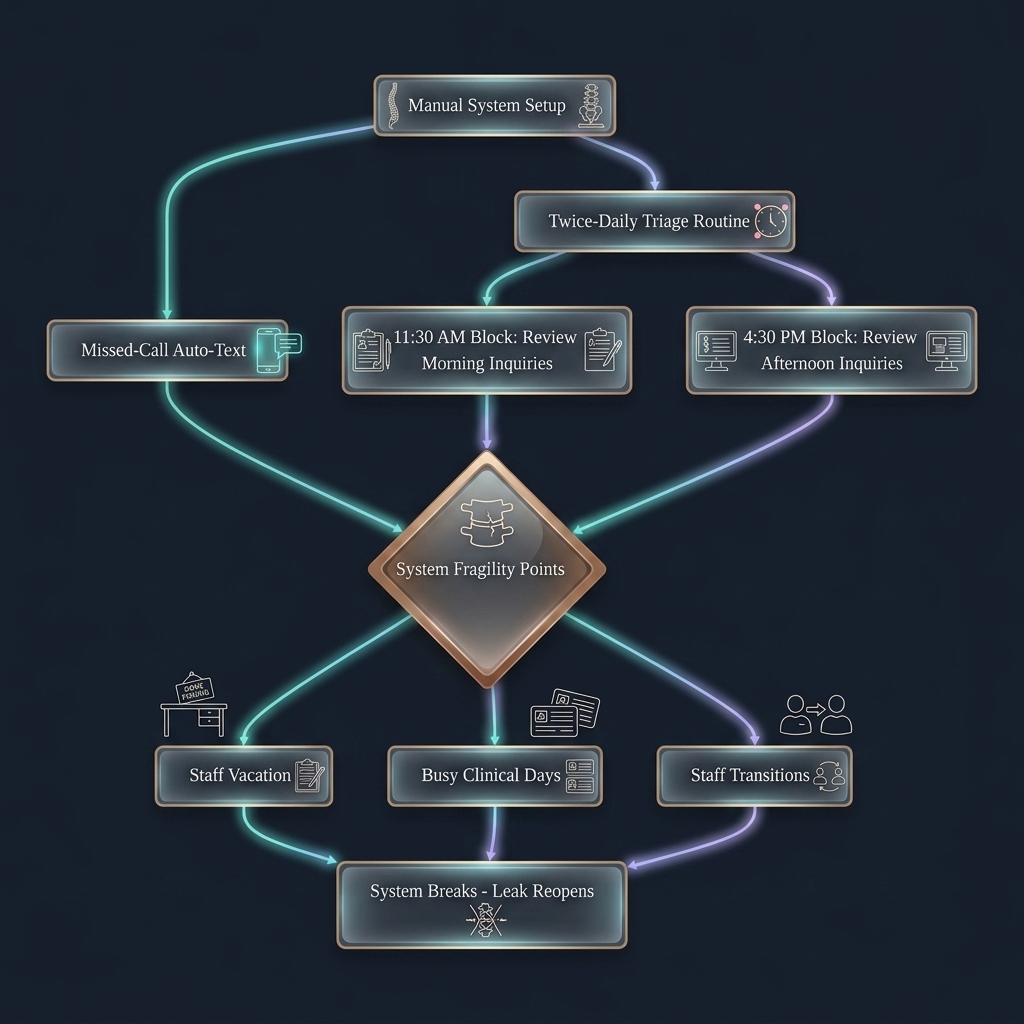
The Execution Wall
The Manual Protocol: What It Takes to Do This Yourself
You can build this system manually. Here is what it requires.
Start with a basic missed-call auto-text on your practice landline. The message: "Sorry we missed you! We are currently helping other patients. Click here to secure your appointment slot immediately: [Your Booking Link]."
Most phone providers offer this feature. Setup takes one to two hours of technical configuration.
Next, implement the Twice-Daily Triage Routine:
- Block 1 (11:30 AM - 11:45 AM): Review all morning missed calls, unreturned emails, and social media direct messages.
- Block 2 (4:30 PM - 4:45 PM): Review all afternoon inquiries before the end-of-day rush.
This routine requires 30 minutes of uninterrupted, highly focused administrative work every single day, without fail. During vacations, busy clinical days, or staff transitions, the system breaks. The leak reopens.
The manual protocol works. It is also fragile.
The Enterprise-Scale Reality of the Full System
The manual protocol handles missed calls. It does not handle the full patient-capture flywheel.
Primary care and specialty medical practices receive an average of 53 inbound calls per physician per day. Chiropractic practices run leaner, but the multi-channel demand is the same. Patients reach out via SMS, email, Google Business Profile, Facebook Messenger, and web chat. Each channel requires monitoring, response, and follow-up.
Despite the availability of online scheduling and web portals, 67% of patients still prefer calling over other contact methods when reaching out to their healthcare provider. A web-only chat widget misses the primary friction point.
Running a complete patient-capture, content-marketing, and review-generation engine manually demands 10 to 15 hours of highly specialized work per week. That work includes copywriting, technical integration, SEO optimization, customer relationship management, and database management.
Most practice owners do not have those skills. Hiring someone who does costs $25 to $50 per hour, or $1,300 to $3,250 per month for part-time execution.
The time deficit is real. The skill gap is real.
The Illusion of the Generic AI Shortcut
The next instinct is to bolt ChatGPT or a generic chatbot to your website. This is a high-risk strategy.
Generic AI models are unpredictable. They generate different answers to the same questions. This is called the Non-Deterministic Problem. A patient asks, "Do you take insurance?" on Monday and receives one answer. They ask again on Wednesday and receives a different answer. Inconsistent communication erodes trust.
Worse, unsupervised AI tools can inadvertently make unauthorized medical claims, promise specific clinical outcomes, or violate strict health-advertising regulations. A generic chatbot trained on the open internet does not know what a chiropractic practice is legally allowed to say. It will write claims you are not allowed to make.
Even if you configure the AI carefully, you still spend invisible hours writing prompts, auditing chat logs, correcting hallucinations, and manually publishing content. The time savings evaporate. You have traded one manual process for another.
Generic AI does not solve the execution problem. It shifts it.
The Path of the Sovereign Practice Owner
Building and maintaining a world-class patient-communication system is a full-time operational role. You can do it yourself, hire someone to do it, or accept the revenue leak.
The choice is simple: decide whether to be a software integrator and marketing administrator, or a clinician focusing on patient outcomes and clinical leadership.
Some practice owners enjoy the technical work. Most do not. Most want the system running silently in the background while they focus on adjustments, patient care, and practice growth.
Platforms that operate this whole loop end-to-end, content publishing, instant lead response, review automation, and patient communication, exist for this reason; tools like Omniply handle the full patient-capture flywheel so the practice owner never touches a prompt or audits a chatbot log.
The system is undeniable. It runs best when operated for you.
Frequently Asked Questions
How Fast Should You Respond to a New Lead?
Under five minutes. Research shows a 100x decrease in contact rates when response time stretches from 5 minutes to 30 minutes. The patient is still in decision mode during the first few minutes. After that, they have moved on to the next listing.
How Many Times Should You Follow up With Leads?
At least three times over three days if the initial contact attempt fails. Most leads require multiple touchpoints, but the first response must happen immediately. Subsequent follow-ups can be spaced, but the initial speed is non-negotiable.
Can I Use ChatGPT to Text New Leads?
Not without significant risk. Generic AI models are non-deterministic and can generate inconsistent responses or make unauthorized medical claims. If you use AI for patient communication, it must be configured specifically for healthcare compliance and supervised closely.
How Do I Automate Lead Follow up?
Start with a missed-call auto-text linked to your online booking system. Then implement a twice-daily triage routine to manually follow up on emails and social messages. Full automation requires integration between your phone system, website, electronic health record, and customer relationship management platform.
Is Texting Leads HIPAA Compliant?
Protected Health Information (PHI) under HIPAA includes any individually identifiable health information held or transmitted by a covered entity such as a chiropractic practice. If a prospective patient contacts your clinic and provides their name, phone number, and a health condition to schedule an appointment, that data is considered PHI and is protected by HIPAA from the moment your practice receives it. A formal doctor-patient relationship is not required for HIPAA privacy and security rules to apply. Use a secure, HIPAA-compliant platform for all patient communication and avoid sharing protected health information via unsecured channels. Consult your compliance advisor for practice-specific guidance.
Is Lead Automation Software Worth It?
If you are missing more than 10 leads per month, yes. The math is straightforward: 10 missed leads × $1,300 lifetime value = $13,000 in monthly revenue loss. Most automation platforms cost a fraction of that and eliminate the manual time burden.
Should I Hire an Agency for Lead Follow up?
Only if the agency can integrate directly with your scheduling system and respond in under five minutes. Most agencies take messages and forward them, which reintroduces the delay. Look for solutions that automate the response and booking in real time.