
Your front desk just booked three new-patient exams, but your active patient count didn't budge. Three existing patients quietly stopped booking. Chasing new files to replace them is a slow financial bleed.
It costs $250 in marketing to acquire a single new patient today. Reactivating an existing one costs almost nothing.
Yet, most clinics suffer from The Acquisition Trap. They overspend on Google ads while ignoring the back door. This mismatch quietly kills your patient lifetime value.
When you constantly hunt for new cases, your staff burns out and your profit margins shrink. You do not need more leads. You need a system that plugs the leaks in your schedule.
This guide breaks down the cold math of keeping patients, the hidden cost of front-desk friction, and the exact protocols to keep your tables full without spending another dollar on ads. Your bottom line depends on this shift.
Walk into any chiropractic clinic on a Friday afternoon and you'll see the paradox. The waiting room is full of first-time patients pulled in by a $29 new-patient special on Facebook. Your Google Ads dashboard shows fifty clicks this week. The front desk is drowning in intake forms.
Meanwhile, Mrs. Henderson hasn't booked in six weeks. The construction worker who came in twice for his shoulder? Gone. The marathon runner on your wellness plan? Last visit was two months ago, no appointment on the books.
High new-patient volume creates the illusion of practice growth. The schedule looks full. Revenue feels stable. But you're running on a treadmill at an incline you didn't choose.
The math is brutal: acquiring a new customer costs five to twenty-five times more than keeping an existing one, depending on your marketing channel. For chiropractic practices specifically, acquisition costs typically run $150 to $300 per new patient when you factor in ad spend, discounted exam offers, and the two hours your CA spends on follow-up calls before the patient even walks through the door. Some specialties in healthcare see costs climb higher, financial services, for comparison, averages $653 per lead in paid channels, but even at the lower end, the numbers are punishing.
Shifting capital and clinical focus from aggressive acquisition to systematic patient communication is the single most profitable decision a clinic owner can make. Not the most exciting. Not the easiest to show on social media. But the most profitable.
Here's why the math works, why most practices get it backwards, and what happens when you engineer the system correctly.
Key Takeaways
- Acquisition Cost Reality: Chiropractic practices spend $150–$300 per new patient through Google Ads, discounted exams, and front-desk labor, requiring 5.1+ visits post-exam to break even when most patients stop after three visits.
- Churn Rate Impact: Healthcare providers lose 48% of their patient base annually, forcing practices to spend $40,000 yearly in acquisition costs just to maintain current revenue levels without actual growth.
- Retention Profit Multiplier: A 5% improvement in patient retention increases practice profits by 25–95% according to Bain & Company research, because retained patients generate $1,794 in profit over 51 visits versus new patients who lose $148 over three visits.
- Manual System Cost: Running a complete retention system manually requires nine hours weekly for content creation, newsletters, social media, and review management—costing $93,600 annually in lost clinical revenue at $200/hour.
- Compliance Exposure Risk: Generic ChatGPT lacks HIPAA compliance (no Business Associate Agreement), produces non-deterministic output with potential unsubstantiated health claims, and exposes practices to Tier 1 HIPAA violations starting at $145 per incident.
Why is My Chiropractic Practice Losing Patients?
Chiropractic practices lose patients primarily due to poor retention economics rather than acquisition problems. Most new patients attend only three visits for acute pain relief, never reaching the 5+ visits needed to recover acquisition costs of $143-$326. This creates a "leaky bucket" where practices subsidize unprofitable short-term patients while failing to convert them into long-term, profitable accounts.
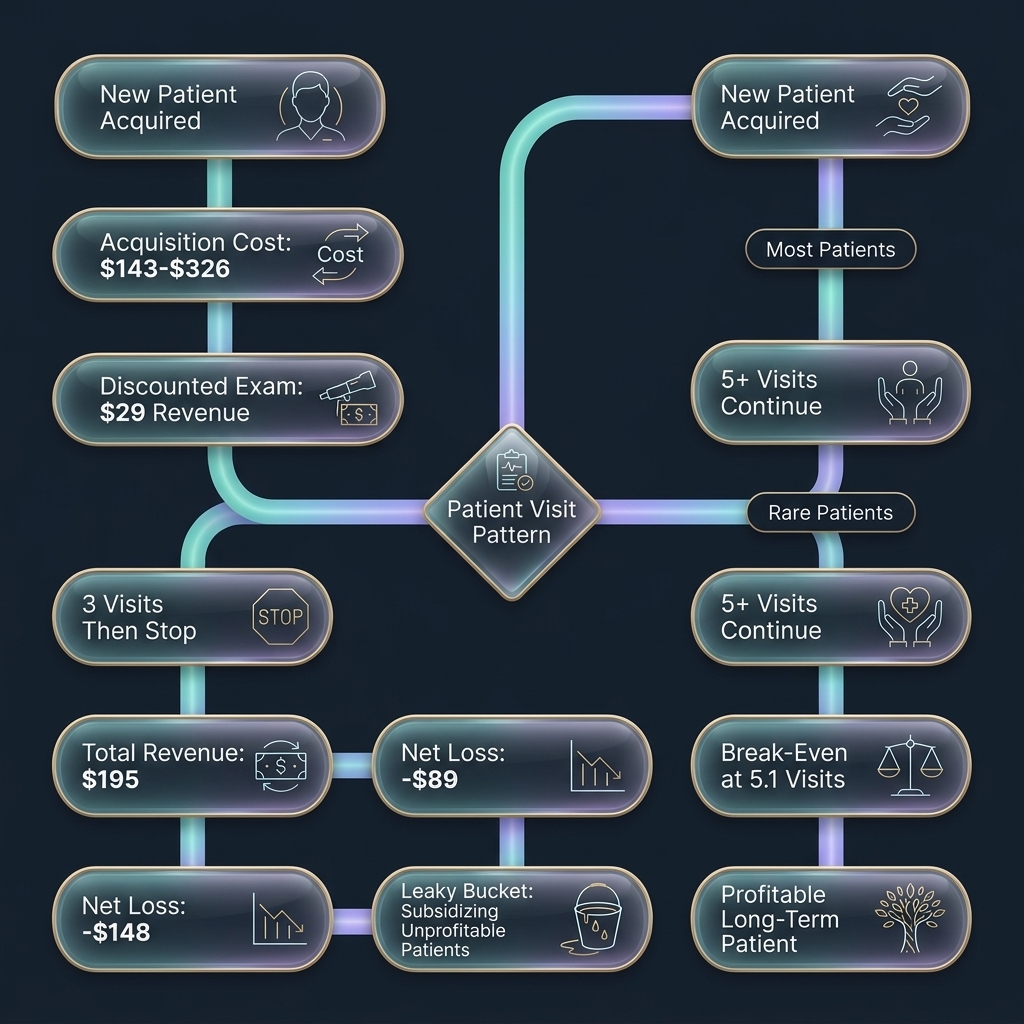
The Leaky Bucket of Chiropractic Practice Growth
The Invisible Math of Customer Acquisition Cost
Most practice owners know what they spend on Facebook ads. Few know their true cost per new patient.
Start with the ad spend. A competitive chiropractic market in a mid-sized metro runs $8 to $15 per click on Google Ads for terms like "chiropractor near me" or "back pain relief." Your landing page converts at 12% if it's good, 6% if it's average. That means you're paying $67 to $250 just to get a lead to fill out a form.
Then comes the offer. You're running a $29 new-patient exam because that's what converts in a crowded market. Your standard exam is $95. You just gave up $66 in margin to get them in the door.
Add the labor. Your front desk spends fifteen minutes on the initial call, another ten minutes on the reminder call, five minutes on intake paperwork. At $20/hour loaded cost, that's another $10 in hidden acquisition expense.
Total customer acquisition cost: $143 to $326 per new patient, depending on your market and conversion rates. And you collected $29.
You're $114 to $297 in the hole before you've delivered a single adjustment.
The break-even horizon tells you how long you're working for free. If your average visit is $65 and your margin is 60% after overhead, you're making $39 per visit in actual profit. To recover a $200 acquisition cost, you need that patient to come back 5.1 times. Not 5.1 visits total; it is 5.1 visits after the discounted exam.
Most new patients come three times and stop when the pain subsides.
You never broke even. You paid $200 to generate $87 in gross visits and $52 in profit. You lost $148.
This is the new-patient trap. It feels like growth because the schedule is full. It's actually a subsidy program for people who will never become profitable accounts.
The Economics of the Churn Rate
Now compare two patient trajectories.
Patient A: Comes in for acute lower back pain. Three visits over two weeks. Pain resolves. Total revenue: $195. Total profit after acquisition cost: -$5.
Patient B: Same initial presentation. Same three acute visits. But this patient transitions into a maintenance plan: twice a month for a year, then once a month for two more years. Total visits: 51. Total revenue: $3,315. Total profit after acquisition cost: $1,794.
Patient B is worth 359 times more profit than Patient A.
The average healthcare provider loses 48% of their active patient base every year. That's the industry churn rate. For practices that don't actively work to prevent it, the number is higher; it is closer to 60%.
Here's what that churn costs. Say you have 400 active patients and you lose 50% annually. You need to acquire 200 new patients just to stand still. At $200 per patient, that's $40,000 in acquisition cost to maintain your current revenue.
If you cut churn from 50% to 45%, just ten fewer patients leaving, you save $2,000 in acquisition cost and keep $7,800 in annual visit revenue from those ten patients (assuming 12 visits per year at $65). Total impact: $9,800.
A 5% improvement in retention increases profits by 25% to 95%, depending on your baseline margin. That's not a marketing claim. That's Bain & Company's research across industries, and healthcare sits on the high end of that range because acquisition costs are steep and visit frequency is high.
The hidden operational drag makes it worse. Constant patient turnover exhausts your front desk. Every new patient is a full intake: insurance verification, health history, X-ray consent, financial policy explanation. Your CA spends 40% of her week on new-patient admin and 15% on recall attempts for people who've gone quiet.
Meanwhile, retained patients check in with their name. They know the drill. They pre-pay. They refer.
The schedule built on retained patients is predictable. The schedule built on new acquisition is chaos.
Why the Obvious Fixes Fail
When the schedule thins out, the first instinct is to turn up ad spend. More budget, more clicks, more new patients.
This is Failed Fix #1: feeding a leaky bucket. You're not solving the problem; you're making it worse. Higher ad spend means higher acquisition cost. You're now paying $300 per patient instead of $200, and they're still leaving after three visits. The bleed accelerates.
You also burn out. Fifty new patients a month means fifty exams, fifty reports of findings, fifty conversations about care plans. Your clinical time goes to education and selling instead of adjusting. You're working harder and profiting less.
Failed Fix #2 is the high-pressure report of findings. The rigid script. The 40-visit prepayment plan presented on day two with the expectation of a credit card before they leave.
This worked in 1997. It does not work now.
Seventy-one percent of consumers expect personalized interactions from the businesses they use. A one-size-fits-all sales script feels like a time-share presentation. It destroys trust. The patient who might have come back twelve times over six months now ghosts after visit two because you tried to lock them into a $2,400 package before they were ready.
You win the battle and lose the war.
Failed Fix #3 is tasking your overwhelmed front desk with manual recall. You hand your CA a list of 80 inactive patients and ask her to call them between checking in patients, answering phones, and processing insurance.
She makes six calls in a week. Four go to voicemail. Two people answer and say they'll call back to schedule. Neither does.
The system dies from inconsistency. Your CA didn't fail; you gave her an impossible job. First-year turnover for healthcare employees is 29.5%. When she quits, you're starting over. The recall list gets abandoned. The leak continues.
You cannot manually operate a retention system at scale. The math doesn't work.
How Do I Build a System to Retain Patients?
Build a multi-channel communication engine operating on four pillars: consistent educational content to maintain top-of-mind awareness, frictionless booking and response systems, active review generation for social proof reinforcement, and steady non-invasive communication like bi-weekly newsletters and seasonal check-ins. This automated system runs independently of personality, ensuring patients remain engaged between visits.

Engineering the System That Keeps Patients
Retention as an Engineered System, Not a Personality Trait
Most practice owners believe retention comes down to clinical skill and bedside manner. Be a great adjuster. Be friendly. Patients will stay.
This is half true and fully incomplete.
Clinical excellence is the foundation. But it's not a retention system. Seventy-seven percent of chiropractic patients rate their care as "very effective." They're not leaving because they're unhappy with your adjustments. They're leaving because they forgot about you.
Life intervened. The pain stopped. Three months passed. Now it feels awkward to call and book because they think you'll judge them for the gap.
The charismatic chiropractor with the great personality still loses 40% of their patient base annually if they don't have a system running in the background.
A retention system is a multi-channel communication engine. It runs whether you're in the office or not. It doesn't depend on your front desk remembering to send an email. It doesn't require you to write a newsletter every week.
It operates on Four Pillars:
1. Consistent educational content presence. Your clinical philosophy stays top-of-mind through weekly articles, social posts, and patient-facing resources. The patient sees your name and your ideas even when they're not in pain.
2. Rapid, frictionless response mechanisms. Patients can text to book, email with a question, or click a link to schedule. You meet them where they are. No phone tag. No friction.
3. Review and reputation momentum. Active patients leave reviews. Those reviews reinforce the decision of existing patients to stay. Social proof works in both directions: it attracts new patients and validates current ones.
4. Steady, non-invasive communication. A bi-weekly newsletter. A birthday message. A seasonal check-in. Not a desperate discount. Not a guilt trip. Just consistent value.
This is not about being friendlier. It's about being present.
The Mechanism of the Retention Flywheel
The system works by shifting patient beliefs over time.
When a patient first walks in, their internal narrative is: "I visit the chiropractor when my lower back hurts."
That belief leads to a three-visit relationship. Pain appears. They book. Pain resolves. They stop.
The goal is to shift that narrative to: "I use chiropractic care to optimize my nervous system and maintain quality of life."
That belief leads to a fifty-visit relationship.
The shift doesn't happen in a single conversation. It happens through repeated exposure to the idea. A newsletter article about the connection between spinal alignment and sleep quality. A social post about maintenance care for athletes. A patient testimonial from someone who avoided surgery through consistent adjustments.
Each touchpoint is a small deposit. Over six months, the deposits compound. The patient's understanding of chiropractic care expands. They start thinking about prevention, not just pain relief.
This is The Compounding Effect of Top-of-Mind Awareness. Patients don't leave because they're dissatisfied. They leave because they're busy and you're not present in their mental landscape when the thought "I should probably get adjusted" crosses their mind.
The newsletter keeps you there. The social posts keep you there. The birthday text keeps you there.
When the thought arrives, they book. No recall call needed. No discount required.
This is The Reactivation Engine. Educational content triggers passive reactivations. A patient reads your article about posture and desk work. They realize their neck has been tight for two weeks. They text to book.
You didn't chase them. The system brought them back.
What is the Execution Wall in Patient Retention?
The execution wall in patient retention refers to the significant time burden and operational complexity of manually running a complete retention system. Healthcare practices face approximately nine hours of weekly work including content creation, newsletter management, social media posting, and review monitoring—revealing the gap between understanding retention problems and actually implementing solutions consistently.
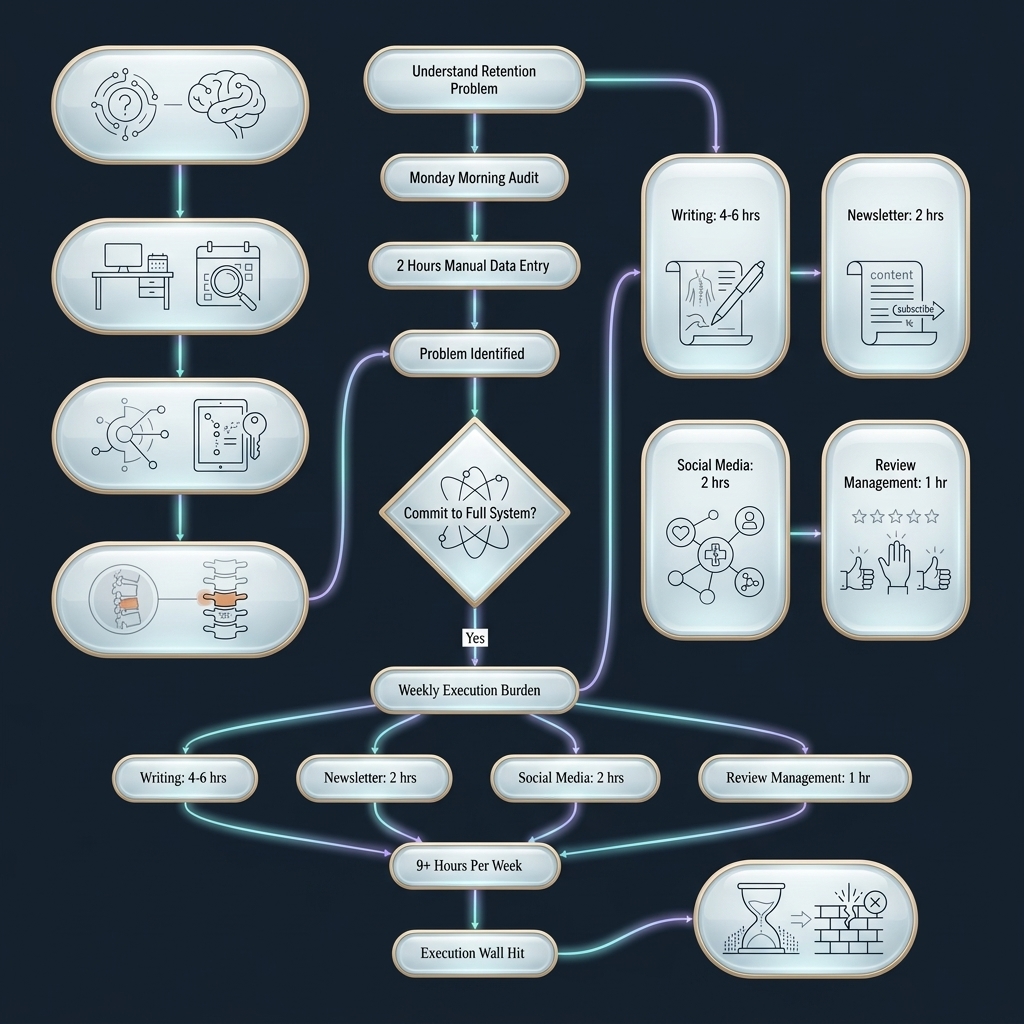
The Execution Wall
The Monday Morning Audit Protocol
Before you build the system, you need to see the leak.
Here's a simple audit you can run Monday morning. Open a spreadsheet. Four columns.
Column A: Total Active Patients. Count every patient who had an appointment in the last 30 days.
Column B: New Patients Added. Count first-time visits this month.
Column C: Reactivated Patients. Count returning patients who had gone 90+ days without a visit.
Column D: Churned Patients. Count patients who haven't visited in 60 days and have no future appointment booked.
Now calculate your Retention-to-Acquisition Ratio. Take Column C (reactivations) and divide by Column B (new patients). If the number is below 0.5, you're spending twice as much energy on acquisition as you are on keeping what you already have.
Run this audit monthly. Track the trend. A healthy practice sees reactivations equal or exceed new patients within six months of implementing a retention system.
The cost of this protocol: two hours of uninterrupted data entry and analysis every month. It's tedious. It's manual. It requires discipline.
And it only shows you the problem. It doesn't fix it.
The Reality of Running the Full System Manually
Say you commit to operating the full retention system in-house. Here's the weekly time breakdown.
Writing evidence-based clinical articles: Four hours. You need to research the topic, find credible sources, write 1,200 words, optimize for search, format for web, and publish. If you're not a trained writer, add two hours.
Designing and sending patient newsletters: Two hours. Draft the content, format in your email tool, write the subject line, segment your list, schedule the send, review for errors.
Creating social media content: Two hours. Write posts, source images, schedule across platforms, monitor comments.
Managing reviews and feedback: One hour. Respond to Google reviews, send review requests to recent patients, handle negative feedback.
Total: Nine hours per week.
Now do the math on opportunity cost. If you're the chiropractor, your clinical time is worth $200 per hour in collected revenue (assuming $65 per visit and three visits per hour). Nine hours of marketing work costs you $1,800 in lost clinical revenue every week.
That's $93,600 per year.
Even if you delegate this to a staff member at $25/hour, you're paying $11,700 annually for someone to manually run a system that needs to be perfect, consistent, and compliant every single week.
And you still have the quality problem.
The Trap of Generic AI Shortcuts
The obvious next move is to use AI. Open ChatGPT. Prompt it to write a newsletter about the benefits of chiropractic care for office workers. Copy, paste, send.
It takes ten minutes instead of two hours. Problem solved.
Except it's not.
Generic AI tools produce non-deterministic output. You ask for a patient newsletter and you get something that sounds plausible but lacks your clinical voice. It's dry. It's robotic. It doesn't reflect how you actually talk to patients.
You edit it. That takes twenty minutes. You're still saving time, but now you're a content editor on top of being a clinician and a business owner.
Worse, generic AI doesn't know healthcare compliance. It will confidently write: "Chiropractic care can cure migraines, digestive issues, and chronic fatigue." You publish that, and you've just made an unsubstantiated health claim that violates advertising regulations in most states.
The free version of ChatGPT is not HIPAA-compliant. OpenAI does not sign a Business Associate Agreement for consumer accounts. Any patient information you input, even anonymized case details, may be used to train future models. That's a HIPAA violation.
The penalty structure is not gentle. A Tier 1 violation (you didn't know you were breaking the rule) starts at $145 per incident. Willful neglect that you don't correct caps at $2,190,294 annually. The Department of Health and Human Services has processed 374,322 HIPAA complaints since 2003. Enforcement is real.
You remain 100% liable for every word the AI generates. If it hallucinates a clinical claim, if it makes a promise you can't keep, if it accidentally discloses patient information — that's on you.
Generic AI is a tool, not a system. It still requires your time, your expertise, and your legal exposure. It doesn't solve the execution problem. It just shifts it.
How Do I Sustainably Grow My Chiropractic Practice?
Sustainable chiropractic practice growth requires prioritizing patient retention over acquisition. Implementing consistent content delivery, fast response systems, review generation, and steady communication reduces churn rates significantly. Since acquiring new patients costs $150-$300 while retaining existing ones costs minimal effort, reducing patient loss by just 5% can increase profits by 25-95%, creating predictable long-term growth.
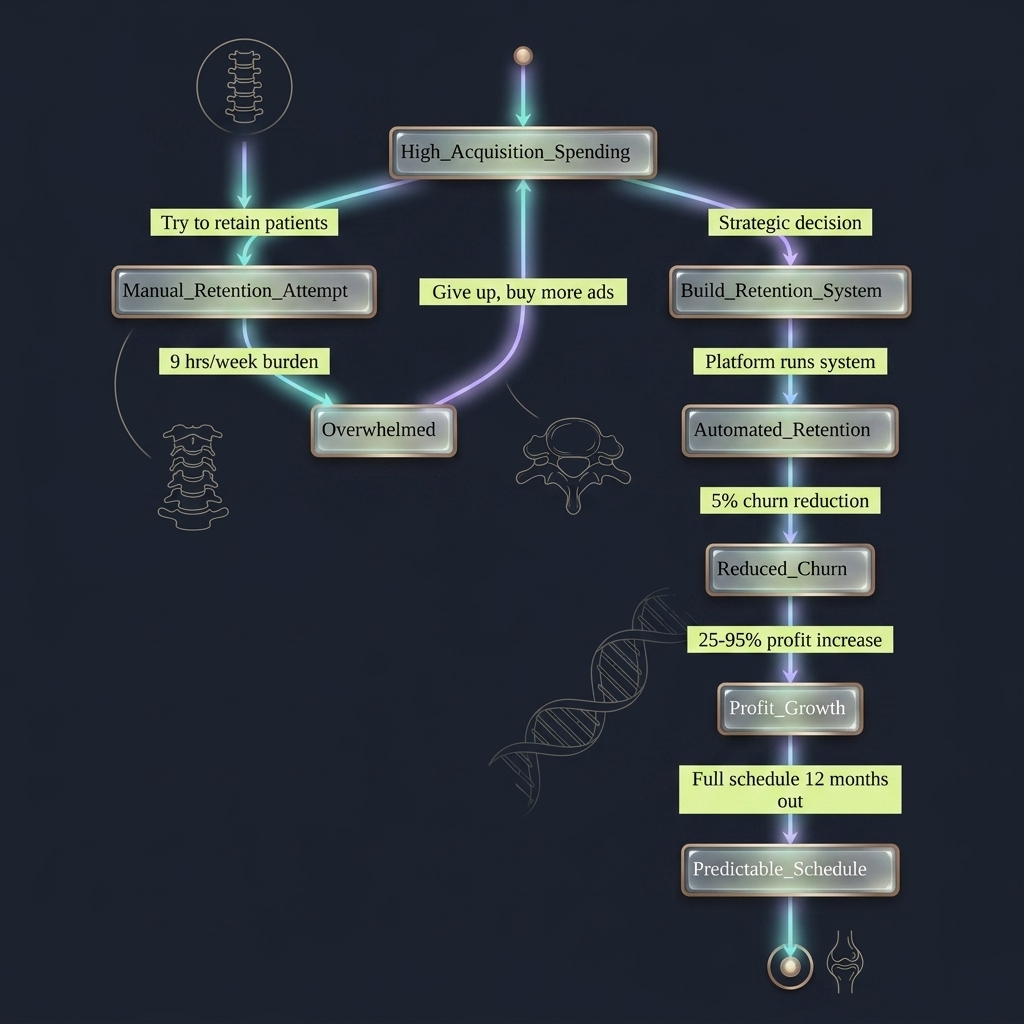
The Path to Sustainable Practice Growth
You now hold the math.
Acquiring a new patient costs $150 to $300 for most chiropractic practices, with some healthcare specialties seeing costs climb significantly higher. Keeping an existing patient costs the price of a text message and a weekly email.
A 5% reduction in your churn rate can increase practice profit by 25% to 95%. The average practice loses 48% of its patient base every year. Yours might be higher.
The system that prevents this is not a mystery. Consistent content. Fast response. Review momentum. Steady communication. It's the same four pillars every time.
But operating the system manually is a part-time job. Nine hours a week. $93,600 in opportunity cost if you're doing it yourself. And generic AI doesn't solve it; it just creates new risks.
The final decision is between continuing to fund an expensive, high-stress acquisition machine or building a quiet, predictable system that keeps the patients you already earned.
The math says plug the leak first.
The operational reality says you need the system running for you, not by you. Platforms that operate this whole loop end-to-end, content, communication, compliance, exist specifically for this reason; Omniply is one example, built to run the retention flywheel for chiropractic practices without consuming the owner's time or exposing them to regulatory risk.
But the decision isn't about a tool. It's about where you allocate capital and attention.
Most practices will keep spending on ads because it feels like action. A few will build the system that makes ads optional.
The difference shows up in the schedule twelve months from now.
Frequently Asked Questions
How Much Does It Cost to Acquire a New Patient?
For chiropractic practices specifically, expect $150 to $300 per new patient when you factor in ad spend, discounted exam offers, and front-desk follow-up time. Some healthcare specialties see costs climb higher, financial services, for comparison, averages $653 per lead in paid channels, but chiropractic typically sits in the lower to mid-range of healthcare acquisition costs.
What is the Average Patient Dropout Rate?
The average healthcare provider experiences a churn rate of 48% annually. Chiropractic practices without active retention systems often see higher rates, 50% to 60%, meaning you lose half your patient base every year and must replace them just to maintain current revenue.
Can ChatGPT Write Patient Reactivation Emails?
Generic ChatGPT can generate text, but it produces non-deterministic output that lacks your clinical voice and doesn't ensure compliance with health-advertising regulations. The free version is not HIPAA-compliant because OpenAI doesn't sign a Business Associate Agreement, and you remain legally liable for any claims or errors the AI generates.
Is Texting Inactive Patients HIPAA Compliant?
Texting can be HIPAA-compliant if you use a platform that encrypts messages, signs a Business Associate Agreement, and allows patients to opt in. Standard SMS through your personal phone or non-secure platforms creates compliance risk. The key is using a system built for healthcare communication.
How Do You Automate Patient Recall?
Automated recall systems use scheduled email and text sequences triggered by patient visit history. When a patient hasn't booked in 45 days, the system sends a friendly check-in. At 60 days, it sends educational content. At 90 days, it offers an easy way to re-book. The system runs without manual intervention from your front desk.
Is a Healthcare Marketing Agency Worth the Cost?
Traditional agencies charge $2,000 to $5,000 monthly and focus on new-patient acquisition through ads. They rarely build retention systems. The ROI depends on your current churn rate; if you're losing 50% of patients annually, spending more on acquisition without fixing retention is pouring water into a leaky bucket.
How Do I Get Old Patients to Come Back?
Reactivation works through consistent, non-invasive communication. Send a bi-weekly newsletter with clinical insights. Post educational content on social media. Text a seasonal check-in. The goal is to stay top-of-mind so when the patient thinks "I should get adjusted," you're the obvious choice. Avoid desperate discounts — they cheapen your value and attract price-shoppers, not loyal patients.