
Your front desk spends four hours a day chasing leads who clicked a "$29 adjustment" ad but will never walk through your door.
Discount promotions do not build a clinic. They attract bargain hunters who exit your practice the moment you suggest a multi-week care plan. This is the Discount Deficit. It drains your marketing budget and exhausts your clinical team.
The math proves a different strategy works. Real growth is driven by clinical trust, and that trust is built through systematic patient education. When you teach your community why their joints fail, they do not shop on price. They show up ready for care.
This article analyzes the hard data comparing educational content to promotional offers. We will examine the patient acquisition costs, the clinic drop-off rates, and the exact content structures that turn readers into active cases.
The evidence is clear. The decision to shift your strategy is yours.
Key Takeaways
- Discount Promotions Fail: Cheap new patient specials generate 33% no-show rates versus 6.81% industry median, attracting price-shoppers who refuse multi-week care plans and produce zero committed wellness patients despite $1,500 monthly ad spend.
- Patient Education Drives Trust: Nearly 8 in 10 U.S. adults search online for health symptom answers, with "why does my lower back hurt when I stand up" receiving 2,400 monthly searches versus 140 for "chiropractor near me $29," proving educational content captures high-intent patients.
- True Acquisition Costs Hidden: Healthcare practice patient acquisition cost reached $217 in 2024, but discount funnels add $300 staff labor, $200 software overhead, and $850 in blocked appointment opportunity costs monthly, creating undefined CAC when committed patient acquisition is zero.
- AI Content Creates Compliance Risk: ChatGPT fabricated 69% of medical Q&A references in a 2023 Mayo Clinic study, while Texas Board of Chiropractic Examiners imposes $1,000 daily penalties for false advertising, making generic AI tools legally hazardous for healthcare marketing.
- Review Momentum Compounds Growth: 84% of patients check online reviews before booking, with providers holding 50+ reviews receiving 10 times more appointments than those with fewer than 10, while Google's September 2025 update caused 15% search impression drops for low-quality medical content.
Do Cheap New Patient Specials Actually Hurt Chiropractic Practices?
Cheap new patient specials typically damage chiropractic practices by attracting price-shoppers rather than committed wellness patients. These promotions generate high no-show rates (33% versus 6.81% industry median), create positioning problems that prevent transitioning patients to comprehensive care plans, and train local markets to wait for discounts rather than value clinical expertise, ultimately resulting in zero long-term patient acquisition despite appearing busy.
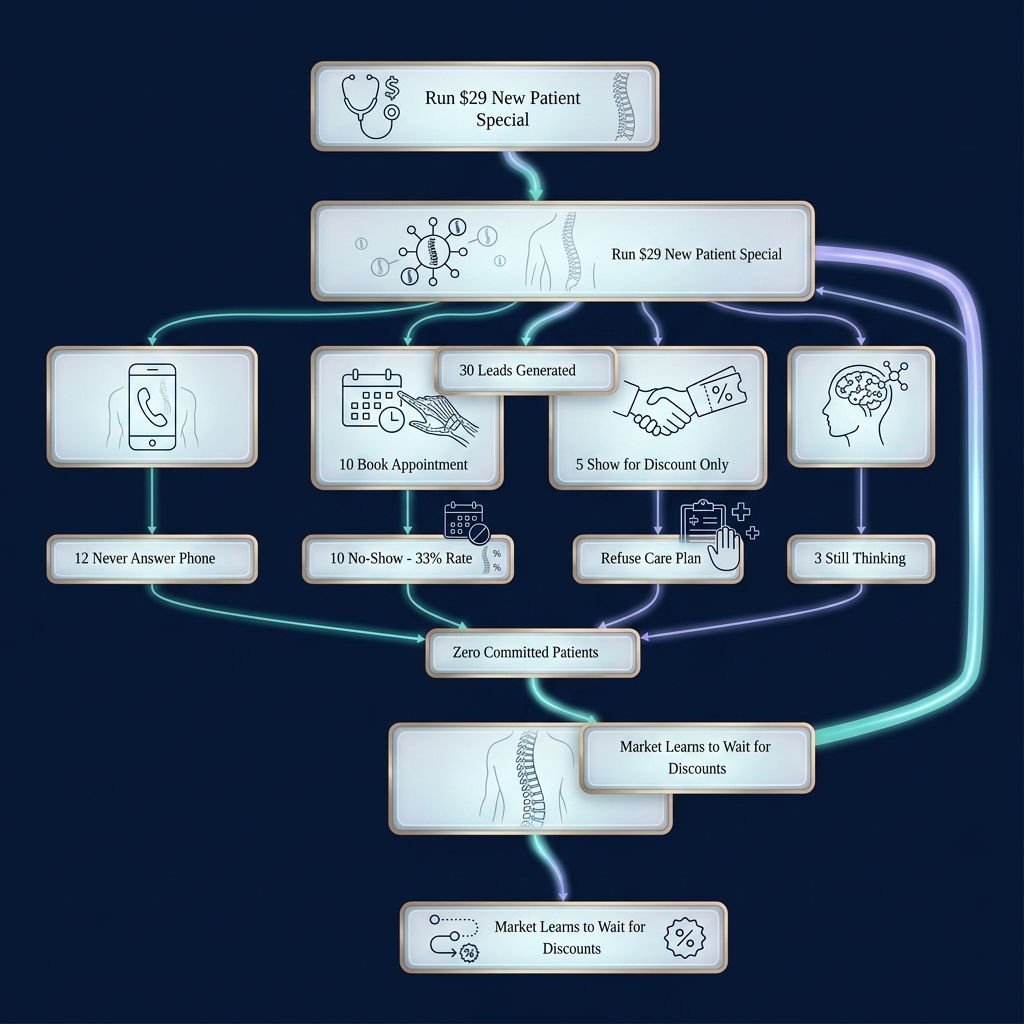
The High-Cost Illusion of the "New Patient" Discount
The Friday Afternoon Spreadsheet Reckoning
The last patient leaves at 4:47 PM. You sit at the clinic desk and open the monthly marketing dashboard.
The "$29 New Patient Special" Facebook ad campaign generated 30 leads. You spent $1,500. The math should be simple: $50 per lead.
Then you trace what actually happened. Twelve never answered the phone. Ten booked but failed to show. Five showed up only for the discounted adjustment and refused a care plan when you explained the underlying spinal dysfunction. Three are still thinking about it.
You acquired zero committed wellness patients. The waiting room felt busy. The bank account is stagnant.
The median no-show rate for single-specialty medical practices was 6.81% in 2023. Your discount-driven campaign is running at 33%. Missed appointments cost the U.S. healthcare system $150 billion annually. Each missed visit costs your practice $196 in direct financial loss: wasted staff time, blocked appointment slots, and sunk marketing dollars.
You are not treating patients. You are treating transactional price-shoppers.
The Mechanism of the Discount Addiction Cycle
Running constant promotions teaches your local market a specific lesson: wait for the coupon.
This is The Devaluation Signal. When you lead with price, you communicate that your clinical expertise is a commodity. A Doctor of Chiropractic with years of neuromuscular training gets lumped into the same mental category as a discount massage parlor.
The trust deficit compounds. Lead-generation funnels built on deep discounts attract patients with low clinical compliance and high cancellation rates. They are not searching for a healthcare provider. They are searching for a deal.
The positioning trap closes. You cannot pivot to wellness-based care plans when your entire acquisition funnel has trained patients to expect bargain pricing.
The Invisible Math of Promotional Churn
The customer acquisition cost calculation most practice owners run is incomplete. They divide ad spend by booked appointments and call it done.
The real math includes three cost layers.
Direct Ad Spend: $1,500 per month on Facebook and Google ads promoting the discount offer.
Staff Overhead: Your front desk spends 15 hours per month chasing uncontacted leads. At $20 per hour, that is $300 in labor cost. Add another $200 for the practice management system, scheduling software, and CRM tools required to track the funnel.
Opportunity Cost: High-value clinical time slots blocked by no-shows and single-visit shoppers. If your average established patient visit generates $85 in revenue and you lose 10 slots per month to discount-driven no-shows, you forfeit $850.
Total monthly cost: $2,850. Total committed patients acquired: zero. Your true customer acquisition cost is undefined because the denominator is zero.
Now run the retention math. The average healthcare practice patient acquisition cost reached $217 per new patient in 2024, a 34% increase from 2020. For specialty practices like chiropractic, the range runs $150 to $600 depending on local competition and paid channel reliance.
A patient who completes a 12-visit care plan at $65 per adjustment generates $780 in revenue. If your practice operates at a 40% margin after overhead, that patient contributes $312 in net profit. Acquiring that patient for $217 yields $95 in profit.
A 10% increase in retention, moving from 60% care plan completion to 66%, adds $31 in profit per patient. Across 50 new patients per month, that is $1,550 in additional monthly profit, or $18,600 annually.
A 50% increase in raw lead volume from discount promotions, with the same terrible conversion and retention rates, adds zero profit. You simply process more bargain hunters.
The bucket has a leak. Pouring more water into it does not fill it.
Why the Obvious Fixes Fail
Most practice owners recognize the problem and attempt three standard fixes.
The Agency Trap: Hiring a new "chiropractic lead-gen agency" that runs the exact same Facebook ad templates with a slightly different discount offer. The funnel structure does not change. The trust deficit does not change. You pay a new vendor to accelerate the race to the bottom.
Increasing the Ad Budget: Feeding more money into a broken, low-trust funnel burns cash faster without fixing the underlying authority deficit. Referral-based patient acquisition for specialty care dropped from 70% of new patients in 2020 to just 40% by late 2024. Paid ads now carry more weight, but only if the message builds trust instead of signaling desperation.
The "More Follow-Up" Delusion: Forcing your front desk to call cold discount leads six times a day destroys staff morale and alienates potential patients who feel pressured. A January 2025 Medical Group Management Association poll found that 42% of medical group leaders now utilize a no-show fee to combat missed appointments. Penalties do not build trust. They confirm that your practice attracts unreliable patients.
None of these fixes address the root cause. You are still leading with price instead of clinical authority.
What is the Trust-transfer Flywheel in Healthcare Marketing?
The trust-transfer flywheel in healthcare marketing is a system where providers build pre-qualified patient trust by consistently publishing educational content that answers health questions patients search for online. This approach prioritizes clinical authority and patient education over transactional promotions, converting passive searchers into active readers who trust the provider before scheduling appointments.
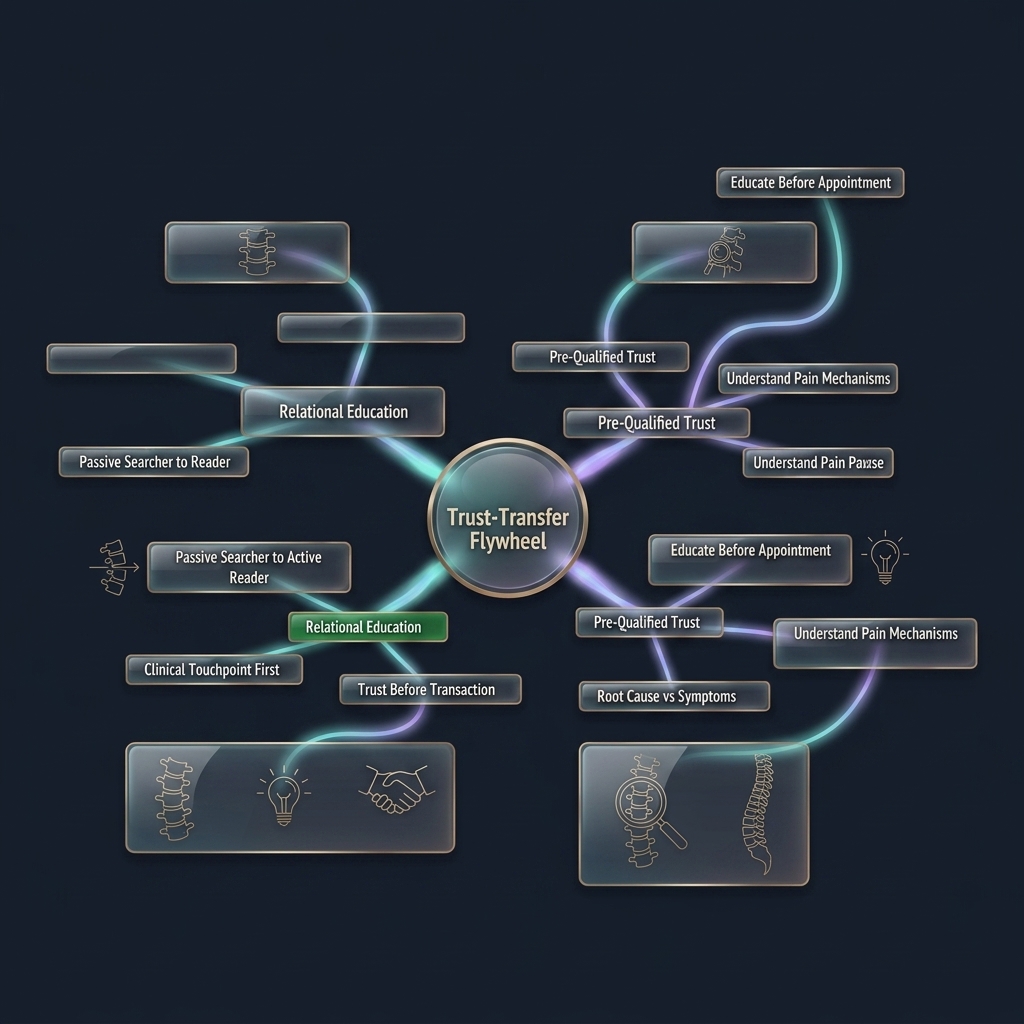
The Trust-Transfer Flywheel
The Paradigm Shift: From Transactional Friction to Relational Education
The modern health consumer does not start their journey by searching for a discount. They start by searching for answers.
"Why does my lower back hurt when I stand up?" gets 2,400 searches per month. "Chiropractor near me $29" gets 140.
In 2024, 65% of Medicare beneficiaries utilized the internet to look up health information. Nearly 8 in 10 U.S. adults reported they are likely to go online to answer a specific question about health symptoms or a health condition, according to a 2025 survey by the Annenberg Public Policy Center.
Patients searching for relief from chronic back pain, sciatica, or migraines prioritize clinical authority over a $10 discount. They want to understand the mechanism of their pain. They want to know if chiropractic care addresses the root cause or just masks symptoms.
When you educate patients on the why of their symptoms, you build pre-qualified trust before they ever step foot in your clinic. This is The Trust-Transfer Effect.
The Four Pillars of the Trust-Transfer Flywheel
The system operates through four interlocking mechanisms.
Pillar 1: Consistent Content Presence. Publishing high-intent, search-optimized articles answering the exact questions patients ask Google at 2:00 AM. A chiropractic blog that explains the neurological link between spinal misalignment and tension headaches moves a passive searcher into an active reader. Health content marketing is not a soft tactic. It is the first clinical touchpoint.
Pillar 2: Rapid Response and High-Intent Capture. Educational touchpoints must immediately route interested readers to low-friction scheduling options. Data aggregated from over 400 healthcare practices between 2024 and 2026 indicates that implementing automated, multi-touchpoint appointment reminders reduces practice no-show rates by 30% to 60%. Speed matters. The patient who reads your article on sciatica relief at midnight must be able to book an appointment without waiting for your front desk to open.
Pillar 3: Review Momentum. An overwhelming 84% of patients reported checking online reviews before booking healthcare appointments in late 2024. Online reviews directly shape 73% of patient healthcare decisions in 2026. Healthcare providers with 50 or more patient reviews receive 10 times more bookings than those with fewer than 10 reviews. Health literacy drives better clinical outcomes. Better outcomes fuel authentic, high-rating Google reviews. The flywheel compounds.
Pillar 4: Steady Patient Communication. Maintaining a continuous educational dialogue with existing and past patients via newsletters and updates transforms single-episode patients into lifelong wellness advocates. Word-of-mouth marketing accelerates when you equip your current patient base with the vocabulary to explain your value to friends and family.
The Compounding Mechanism of the Flywheel
The trust-transfer effect operates differently than paid advertising. Paid ads stop delivering leads the second you stop paying. Educational content acts as a digital asset that ranks higher and drives free organic traffic over time.
This is The SEO Compounding Loop. Google's Search Quality Rater Guidelines prioritize E-E-A-T, Experience, Expertise, Authoritativeness, and Trustworthiness, to determine the value and ranking of health-related content. A well-written article on posture correction for desk workers published in January will rank higher in March, drive more traffic in June, and continue generating leads in December.
The cost per lead declines over time while the quality increases. A patient who finds your practice through an educational article on the biomechanics of disc herniation arrives with a fundamentally different mindset than a patient who clicked a "$29 adjustment" ad.
They do not ask about price. They ask about care plans.
Despite the rise of digital search and online scheduling, 93% of non-mental health visits in 2025 still occurred in person rather than virtually. The demand for face-to-face care remains strong once trust is established. Educational content is the mechanism that establishes that trust at scale.
What is the Execution Wall and Compliance Trap?
The execution wall refers to the practical impossibility of healthcare practitioners maintaining consistent content marketing while managing 15-20 weekly hours of administrative tasks alongside patient care. The compliance trap emerges when practices attempt shortcuts using generic AI tools like ChatGPT, which produce content that lacks clinical authority, authenticity, and may violate healthcare marketing regulations, creating legal and professional risks.

The Execution Wall and the Compliance Trap
The Monday Protocol: the 4:1 Content Audit
Open your practice's social media feeds and website blog. Analyze the last 10 posts.
Categorize each as either Promotional/Announcement ("Call us today," "New year promo," "Holiday hours") or Educational/Value-First ("3 ergonomic tips for desk workers," "The link between posture and tension headaches").
Most practices run 8:2 or 9:1 in favor of promotional content. This is the inverse of what works.
The 4:1 Rule: For every one promotional post, you must have four highly valuable, educational posts that demand nothing from the reader but deliver genuine health insights.
The audit takes 15 minutes. Rebalancing the content calendar requires 4 to 6 hours of research, writing, formatting, and scheduling every single week.
This is The Discipline Tax. Writing authoritative medical content between patient appointments, staff meetings, and administrative duties is a part-time job.
The Reality of Running the Full System Manually
The average physician spends 15 to 20 hours per week on administrative tasks, much of it occurring on personal time outside of direct patient care. Freed's 2025 Clinician Survey found that 57% of clinicians lose more than 44 hours per month strictly to documentation and administrative tasks.
Adding a consistent content marketing system to that workload is not realistic. Writing deep, search-optimized articles, designing social graphics, drafting email newsletters, and managing distribution channels is a full content operation.
Most clinical content marketing efforts fail within 90 days. Patient care and practice operations inevitably take priority over writing schedules. This is The Consistency Chasm.
The AI Shortcut Mirage and the Compliance Hazard
The obvious solution is to delegate content creation to AI tools like ChatGPT. The reality is more complicated.
Prompting ChatGPT to "write a chiropractic blog post" produces generic, soulless, and often clinically inaccurate content. A 2023 study published in Mayo Clinic Proceedings: Digital Health evaluating AI chatbots for medical reference generation found severe hallucination rates, with ChatGPT fabricating 69% of medical Q&A references.
A 2025 study published in npj Digital Medicine evaluating AI-generated clinical notes found a hallucination rate of 1.47% per sentence. Notably, 44% of those fabricated sentences were classified as "major" errors that could directly affect patient diagnosis or management.
Generic AI tools do not understand compliance. Google classifies medical and health information under its strict "Your Money or Your Life" (YMYL) category. Content that could impact a person's health or safety is held to the highest algorithmic standard of accuracy. The September 2025 Google core update heavily targeted YMYL categories, causing significant ranking volatility for medical clinics and an average 15% drop in search impressions for practices relying on low-quality content.
The legal risk is more severe. The Federal Trade Commission's Health Products Compliance Guidance mandates that all marketing materials for health products and services, including chiropractic care, must be truthful, non-deceptive, and substantiated by scientific evidence. State chiropractic boards strictly enforce advertising regulations. The Texas Board of Chiropractic Examiners can penalize false or misleading advertisements with administrative penalties of up to $1,000 per violation per day, alongside potential license revocation or suspension.
Generic AI tools will happily write aggressive, unscientific medical claims that violate state chiropractic board regulations. The practice owner holds 100% of the legal and civil liability for any non-compliant claims or medical advice drafted by an automated tool.
You still have to prompt the tool, review the output, fact-check the claims, rewrite the sections that sound robotic, and verify compliance with state advertising laws. The time savings evaporate.
The Ultimate Realization: You Can Run a Clinic or a Media Company, but Not Both
Building a consistent, high-authority educational engine is a necessity for modern practice growth. Executing it manually is an inefficient use of a clinician's time.
The operational choice is clear. You need the system. You do not have the hours to operate it yourself. Generic AI tools do not solve the problem because they still consume your time and introduce compliance risk.
The leverage comes from platforms that operate this whole loop end-to-end: weekly SEO articles published to the practice website, social posts, newsletters, and lead-generation systems, all generated from the practice's own voice and reviewed by the practice, like Omniply does for chiropractic clinics.
The system works. The question is whether you will operate it yourself or delegate it to a managed platform built for your specialty.
Stop discounting your expertise. Start compounding your authority.
Frequently Asked Questions
Why is Educational Content Better Than Promotional?
Educational content builds clinical authority before the patient books an appointment. Promotional content signals price competition and attracts bargain hunters who do not complete care plans. The trust-transfer effect means patients who arrive through educational touchpoints show up ready for care, not shopping for discounts.
Do Medical Blogs Actually Bring in New Patients?
Yes, if the content answers high-intent search queries and ranks well. Nearly 8 in 10 U.S. adults go online to answer specific health questions. A well-optimized blog acts as a digital asset that drives free organic traffic over time, with compounding returns as search rankings improve.
Is Content Marketing Cheaper Than Google Ads?
Over time, yes. Paid ads stop delivering leads the moment you stop paying. Educational content continues to rank and drive traffic months after publication. The cost per lead declines as the content library grows and search authority compounds.
How Often Should a Medical Practice Blog?
Consistency matters more than frequency. One high-quality, search-optimized article per week builds authority faster than three low-quality posts. The 4:1 rule applies: for every promotional post, publish four educational pieces that deliver genuine health insights.
Can ChatGPT Write Medical Blog Posts?
Not safely. Generic AI tools fabricate medical references at alarming rates; one study found ChatGPT fabricated 69% of medical Q&A references. Google penalizes low-quality health content under its YMYL standards, and state chiropractic boards hold practice owners liable for any non-compliant claims. Generic AI still requires extensive review and rewriting.
How to Delegate Marketing to Front Desk Staff
Front desk staff are already losing 15 hours per month chasing cold leads. Adding content creation, social media management, and newsletter writing to their workload is not realistic. The average clinician loses 44 hours per month to administrative tasks. Delegation only works if the system is managed externally.
Can Doctors Share Patient Stories in Blogs?
Only with explicit written consent and proper de-identification. HIPAA regulations prohibit sharing protected health information without patient authorization. Even with consent, state advertising rules may restrict the types of outcome claims you can make. Always consult your state chiropractic board's advertising guidelines before publishing patient testimonials or case studies.