
Your front desk spent Tuesday afternoon staring at six empty slots on the schedule. That is $900 in lost revenue from patients who simply forgot you exist. Every year, the average clinic loses up to 30% of its active files to this silent drift.
You want to reach out, but you fear looking desperate. This hesitation creates the Silent Drop-Off.
Most practices handle patient outreach by feel. They blast text messages when the schedule is empty. They go silent when the waiting room is full. This erratic rhythm damages your brand and wastes your staff's time.
To build a steady patient flow, you must stop guessing. You need a systematic contact frequency based on operational math, not emotional instinct.
This guide establishes the exact calendar rules for your practice. We will break down the three-part contact framework that protects your schedule without draining your team's energy.
The math of recall is simpler than you think.
Key Takeaways
- Revenue Loss Math: The average clinic loses up to 30% of active patient files annually to cognitive drift, with just two forgotten patients monthly costing $67,200 in lifetime value plus $4,800 in replacement marketing costs.
- Lifecycle-Based Frequency: Active care patients require touchpoints every 3-5 days, transition-phase patients need contact every 7-10 days, and inactive patients respond to one message every 3-4 weeks without perceiving desperation.
- Healthcare Email Performance: Healthcare-related email campaigns achieve 41.23% average open rates when delivering educational value, with unsubscribe rates spiking above 0.5% only when practices shift from teaching to selling.
- Manual Execution Cost: The minimal viable cadence requires 6-8 hours monthly of focused work, while a fully optimized multi-channel system demands 15 hours weekly, representing $6,000-$9,000 in monthly opportunity cost for practice owners.
- AI Compliance Risk: Generic AI tools produce 64.1% hallucination rates on medical content without structured mitigation, exposing practices to HIPAA violations carrying minimum penalties of $73,011 per incident and maximum annual caps of $2,190,294.
Why Do Patients Stop Coming to Their Appointments?
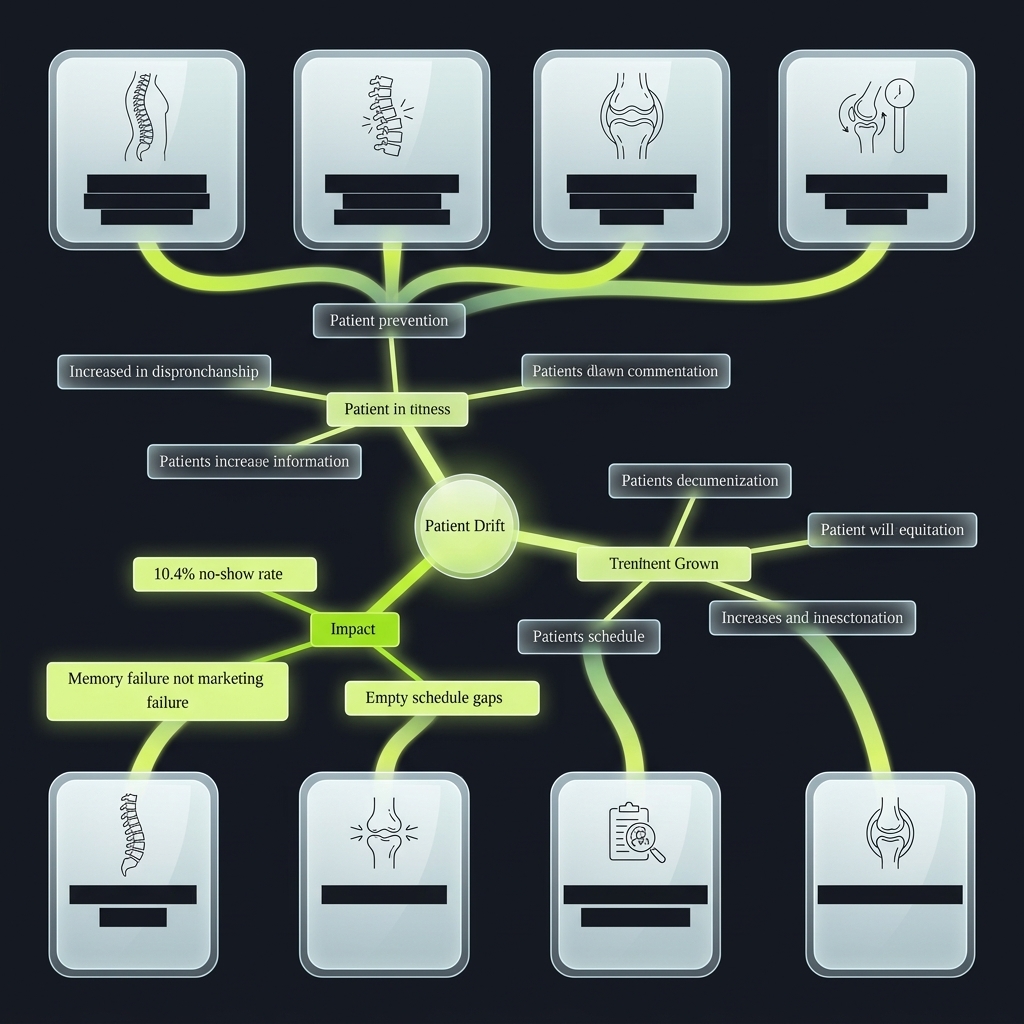
Patients primarily stop attending appointments due to cognitive drift rather than dissatisfaction. Research shows the leading cause of no-shows is simply forgetting, with U.S. outpatient clinics experiencing a 10.4% mean no-show rate. Without structured reminders and touchpoints, healthcare practices fade from patients' active awareness into background noise despite ongoing need for care.
The Anatomy of Patient Drift
The patient was a textbook case. Three visits in, showing measurable progress, posture improving, pain dropping from a seven to a three. She promised to call next week to schedule her follow-up.
That was six weeks ago.
She did not leave because she was angry. She did not switch to a competitor. She simply drifted into the white noise of daily life.
Research from the University of Nevada, Las Vegas shows that the mean no-show rate in U.S. outpatient clinics sits at 10.4%, and the single most common reason patients give for missing their appointment is that they forgot. Not dissatisfaction. Not cost. Forgetfulness.
This is the Cognitive Drift Mechanism. Without structured touchpoints, your practice fades from active intention to background noise. The patient still likes you. They still need care. But you are not top-of-mind the moment their lower back flares up again.
The Tuesday morning gap in your schedule is not a marketing failure. It is a memory failure.
What is the Bleeding Ledger in Chiropractic Business?
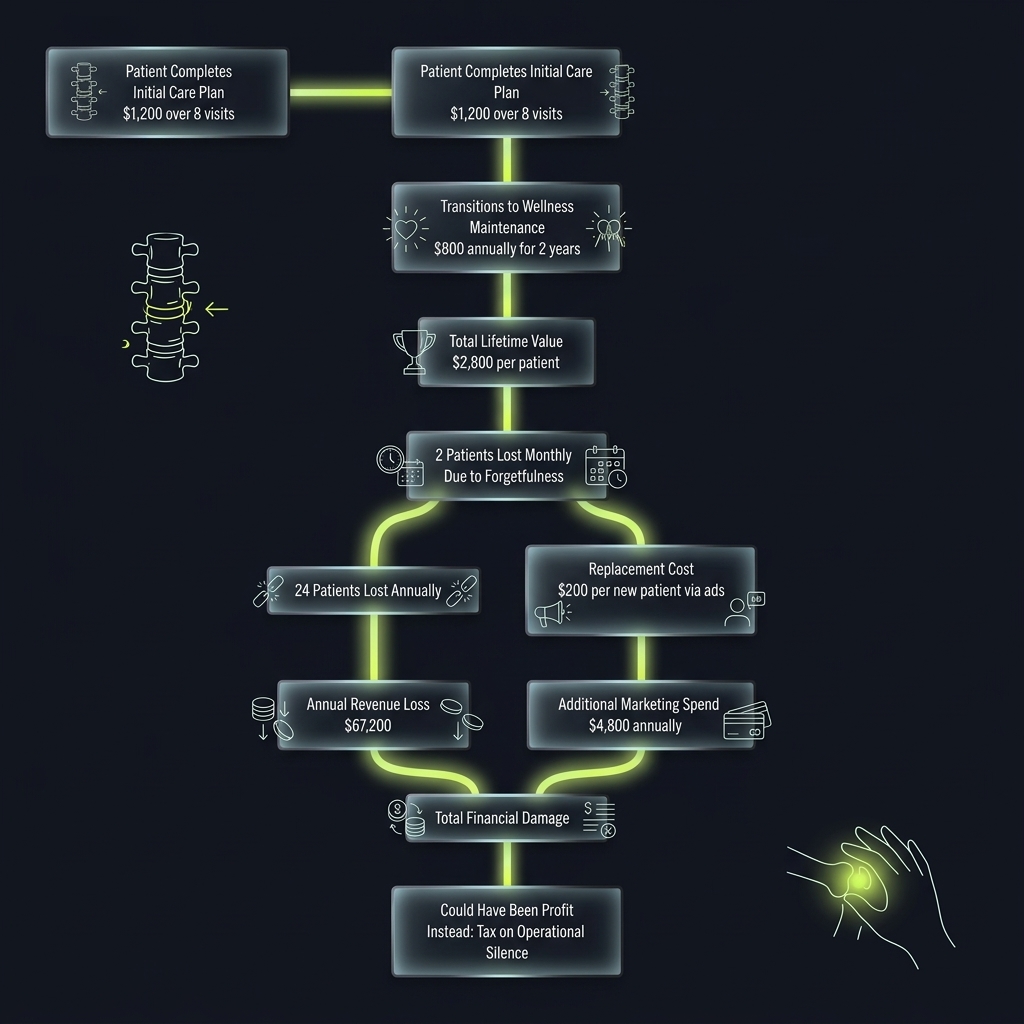
The bleeding ledger in chiropractic business refers to the invisible revenue loss from patient attrition due to forgetfulness and inconsistent follow-up. When patients forget to schedule appointments, practices lose substantial lifetime value, potentially $67,200 annually from just two patients monthly, plus additional marketing costs to replace them, creating compounding financial damage that could have been profit.
The Bleeding Ledger
Let's make the invisible decay visible through hard numbers.
Assume your average patient completes an initial care plan worth $1,200 over eight visits, then transitions into wellness maintenance worth another $800 annually for two years. Total lifetime value: $2,800.
Now assume you lose just two patients per month to forgetfulness. That is 24 patients per year.
Do the math: 24 patients × $2,800 = $67,200 in predictable, recurring revenue that evaporated because those patients simply forgot to call.
The compounding damage gets worse when you factor in replacement cost. Harvard Business Review research shows that acquiring a new customer costs anywhere from 5 to 25 times more than retaining an existing one. If you are spending $200 per new patient on Facebook ads and Google pay-per-click campaigns, you are burning $4,800 annually just to replace the two patients per month who drifted away.
That $4,800 could have been profit. Instead, it is a tax you pay for operational silence.
Industry data from Strive Labs shows that only 30% of patients who receive outpatient rehab services attend all the visits authorized by their insurance. That is a 70% drop-out rate. Most practices assume this churn is inevitable.
It is not. It is the direct result of inconsistent contact cadence.
Why Do Quick Marketing Fixes Always Seem to Fail?
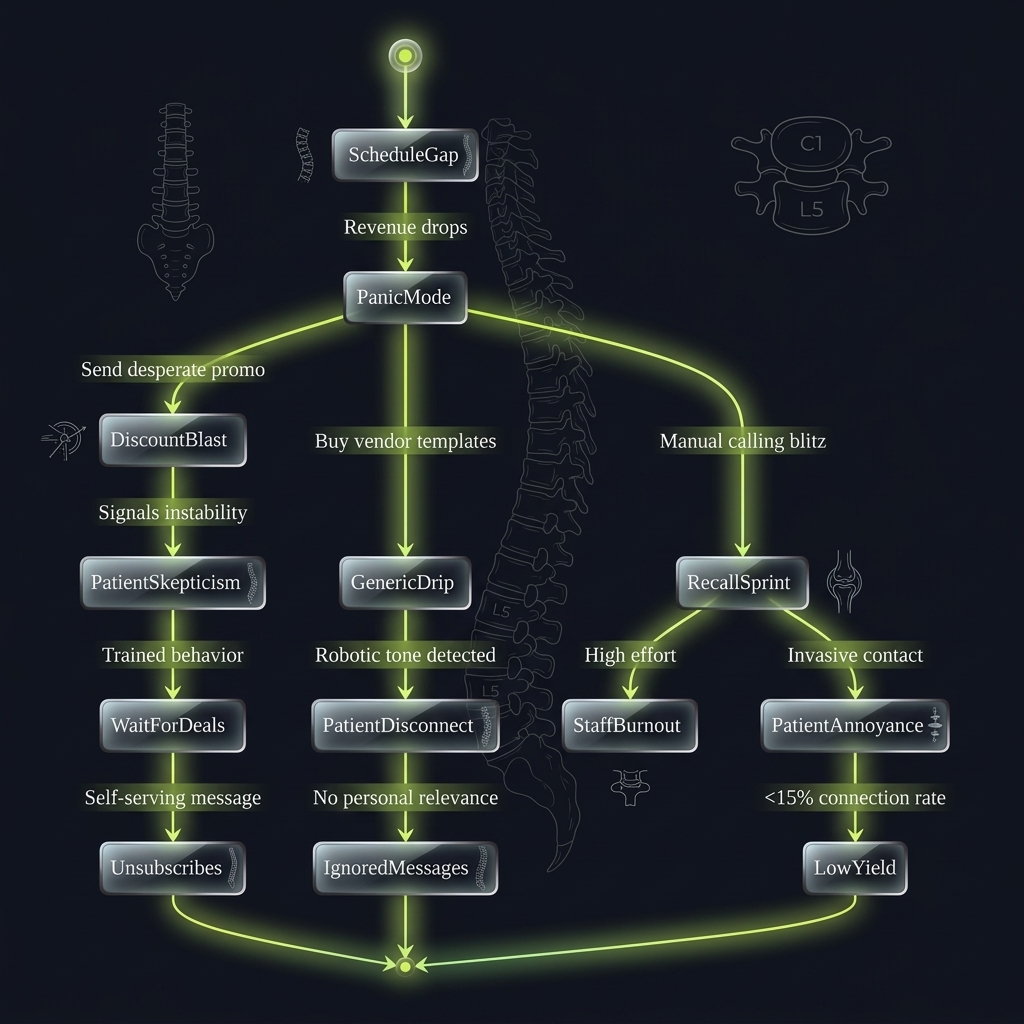
Quick marketing fixes fail because they signal desperation rather than building genuine relationships. Panic-driven discount blasts train patients to wait for deals and erode trust. Generic automated campaigns feel robotic and disconnected from actual patient needs. Last-minute recall sprints overwhelm staff while annoying patients with invasive, telemarketer-style outreach that yields minimal results.
Why the Obvious Fixes Fail
You have already tried the emergency solutions. They do not work, and here is why.
The "Blast When We're Quiet" Mistake
When the schedule empties out, panic sets in. You send a desperate promotional email: "20% Off Adjustments This Week Only!"
This strategy destroys trust for three reasons. First, it signals operational instability; patients can tell you are scrambling. Second, it trains them to wait for discounts rather than book at full price. Third, it spikes unsubscribe rates because the message is transparently self-serving.
You are not building a relationship. You are begging.
The Cold, Out-of-the-Box Drip Campaign
You buy a pre-written 12-month email sequence from a marketing vendor. It promises to "nurture leads and reactivate inactive files."
Patients can smell the generic copy from the subject line. The messages reference conditions you do not treat, use clinical language you would never say out loud, and arrive at arbitrary intervals that have nothing to do with where the patient is in their care journey.
Robotic automation is worse than silence. It signals that you do not care enough to speak in your own voice.
The Friday Afternoon Recall Sprint
You assign your front-desk staff to call 50 inactive patients before the weekend. They make the calls. Most go to voicemail. A few patients answer and sound confused or annoyed.
This approach burns out your team and yields connection rates below 15%. Worse, it feels invasive to the patient. They have not heard from you in six months, and now you are cold-calling them like a telemarketer.
Manual recall sprints are high-effort, low-yield theater. They create the illusion of action without solving the underlying problem.
How Often Should I Email Patients During Active Care?
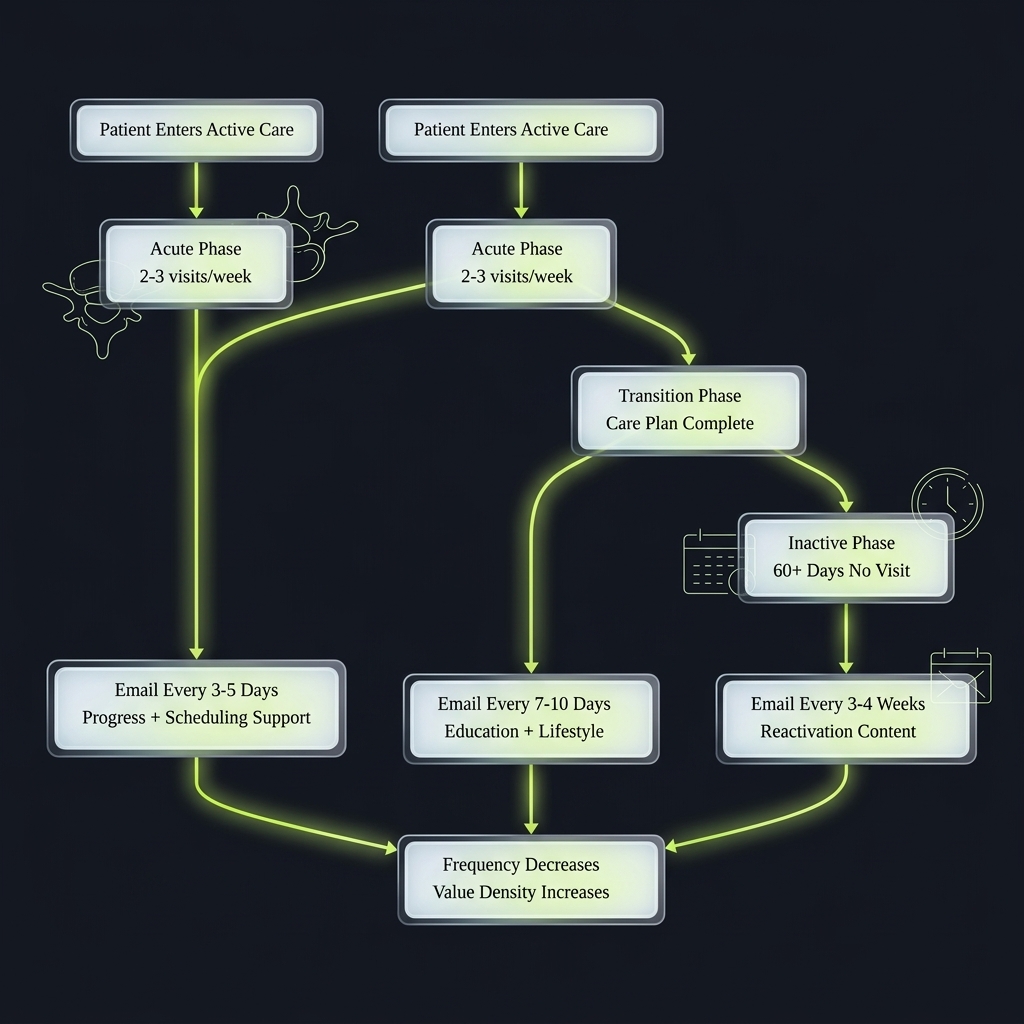
During active care, when patients visit two to three times per week, chiropractors should send one email touchpoint every 3-5 days. These high-frequency messages should reinforce treatment progress, proactively answer common questions, and reduce scheduling friction. This cadence matches the patient's acute phase psychological state and supports their active engagement in care.
The Paradigm Shift: Cadence as a Lifecycle Ecosystem
The question is not "How often should I email my list?" The question is "How does my outreach rhythm match the patient's current psychological state?"
This is the Lifecycle Segmentation Principle. Different patients need different frequencies at different stages.
The Acute Phase: High-touch, high-value, high-frequency support. The patient is in active care, coming in two or three times per week. Your messages should reinforce progress, answer common questions before they arise, and eliminate friction around scheduling. Frequency: one touchpoint every 3-5 days.
The Transition Phase: Educational, lifestyle-focused, moderate-frequency content. The patient has completed their initial care plan and is deciding whether to continue into wellness maintenance. Your messages should teach ergonomics, posture correction, and injury prevention. Frequency: one touchpoint every 7-10 days.
The Inactive Phase: Low-frequency, high-relevance reactivation touchpoints. The patient has not scheduled in 60+ days. Your messages should remind them you exist without sounding desperate, using educational content that positions you as the default choice when discomfort returns. Frequency: one touchpoint every 3-4 weeks.
Notice the pattern: frequency decreases as the patient moves away from active care, but value density increases. You are not sending more messages. You are sending smarter messages.
What is the Unified Flywheel in Patient Recall?
The unified flywheel in patient recall is a sustainable system combining four interlocking elements: consistent educational content that establishes authority, frictionless response infrastructure for easy re-engagement, ongoing review and reputation building for social proof, and value-first outreach through newsletters and tips. These components work together to build trust and ensure patients return when care is needed.
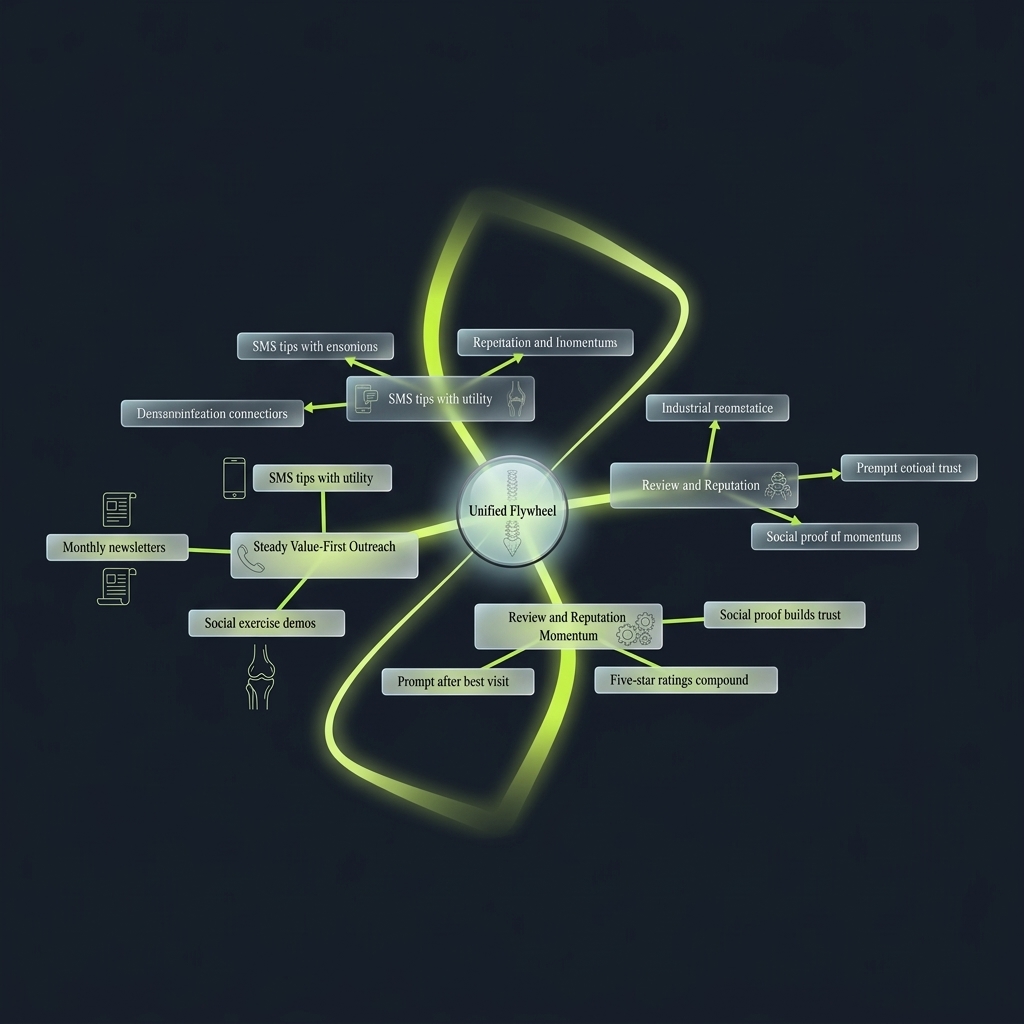
The Unified Flywheel
A sustainable recall system is not a single tactic. It is four interlocking elements running simultaneously.
Consistent Content Presence: Educational articles published weekly to your website, answering the exact questions patients type into Google at 11 PM when their neck seizes up. This content positions you as the local authority and captures search traffic while you sleep.
Rapid Response Infrastructure: When a patient decides to re-engage, friction must be zero. That means online booking links in every message, SMS confirmations, and someone answering the phone on the second ring.
Review and Reputation Momentum: Social proof working silently in the background. Every happy patient should be prompted to leave a review within 24 hours of their best visit. Five-star ratings compound over time, making your practice the obvious choice for new patients researching providers.
Steady, Value-First Outreach: Messages that teach, never sell. Monthly newsletters covering ergonomics, sleep posture, stretching protocols. Social posts demonstrating exercises. SMS tips that take 15 seconds to read and provide immediate utility.
The Flywheel Effect emerges when these elements run together. Each touchpoint builds authority. Authority builds trust. Trust eliminates hesitation. And when the patient's back goes out again, you are the only name in their head.
How Often Should I Email Patients Without Annoying Them?
Healthcare practices can email patients frequently without causing annoyance by prioritizing educational value over promotional content. When emails answer questions and provide genuine health information rather than selling services, patients view them as helpful resources rather than interruptions. The key is teaching consistently, which builds authority and keeps the practice top-of-mind when care is needed.
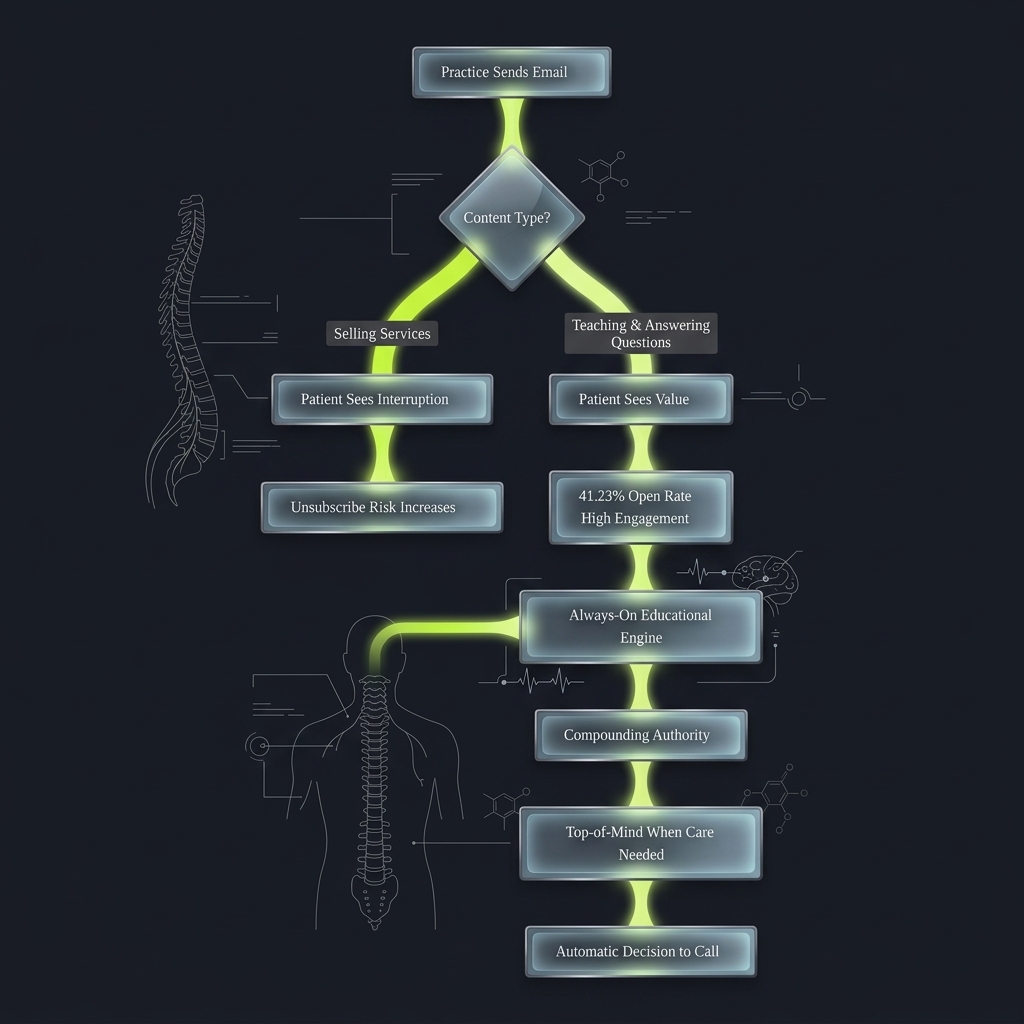
The Psychology of Value-First Frequency
Practice owners fear unsubscribes. They imagine every email driving patients away.
The data tells a different story. Paubox research shows that healthcare-related email campaigns achieve an average open rate of 41.23%, sitting in the mid-to-high range compared to cross-industry averages. Patients open and engage with healthcare messages when those messages deliver genuine value.
The unsubscribe fear is rooted in a false assumption: that patients view your messages as interruptions. They do not, as long as you are teaching instead of selling.
When you answer questions before patients ask them, the relationship shifts. You are no longer a transactional service they visit twice a year. You are an indispensable health resource they consult constantly.
This is the Always-On Educational Engine. It runs in the background, compounding authority with every article, every post, every newsletter. And when the patient needs care, the decision to call you is not a decision at all. It is automatic.
What is the Monday Morning Sustainable Floor Protocol?
The Monday Morning Sustainable Floor Protocol is a minimal content marketing system for chiropractic practices requiring three uninterrupted hours on the first Monday of each month. It produces one monthly educational newsletter and two weekly social media posts, totaling six to eight hours of focused work monthly. The protocol emphasizes consistent cadence, with broken schedules signaling operational neglect worse than no content at all.
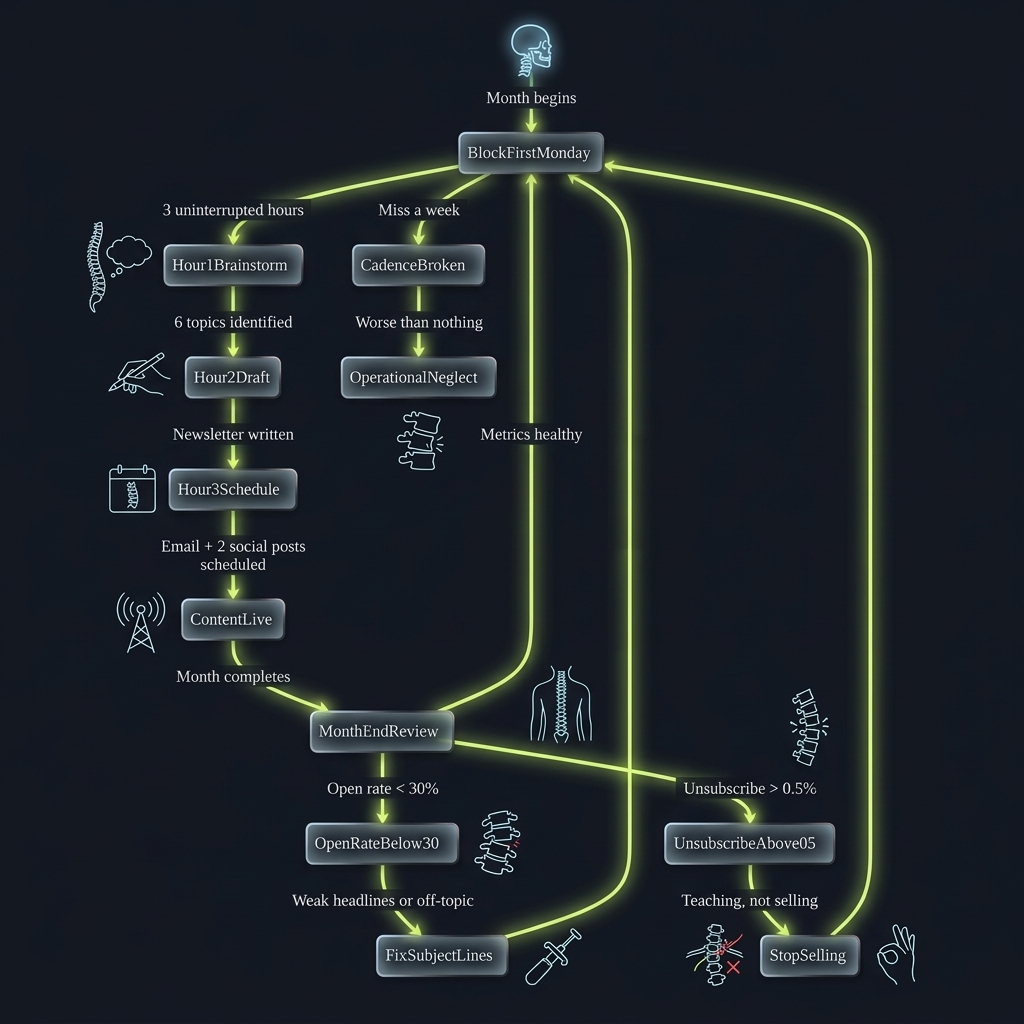
The Monday Morning Sustainable Floor Protocol
Here is the minimal viable cadence you can execute manually without outside help.
The Asset: One monthly educational email newsletter focused on lifestyle and ergonomics, plus two high-value social media posts per week.
The Execution Steps:
Block the first Monday morning of every month for three uninterrupted hours. Use the first hour to brainstorm six content topics: common patient questions, seasonal injury patterns, posture mistakes you see daily. Use the second hour to draft the newsletter in plain language, as if you are explaining it to a patient in the adjusting room. Use the third hour to design the email template in your patient relationship management software and schedule the two weekly social posts using a publishing tool.
Review unsubscribe rates and open rates at the end of each month. If open rates drop below 30%, your subject lines are weak or your content is drifting off-topic. If unsubscribe rates spike above 0.5%, you are selling instead of teaching.
The Honest Price Tag: Six to eight hours of uninterrupted, high-focus creative work per month.
The calendar does not care if the clinic is busy. It does not care if staff call out sick. It does not care if you are exhausted. If you miss a week, the cadence breaks.
A broken cadence signals operational neglect. It is worse than sending nothing at all.
What Does a Fully Optimized Healthcare Marketing System Look Like?
A fully optimized healthcare marketing system includes weekly SEO articles targeting local searches, daily social media distribution across three platforms, automated review acquisition workflows, immediate front-desk response protocols, and segmented email sequences triggered by patient behavior. This comprehensive ecosystem requires professional copywriting, SEO optimization, technical integration, and design expertise to function effectively.
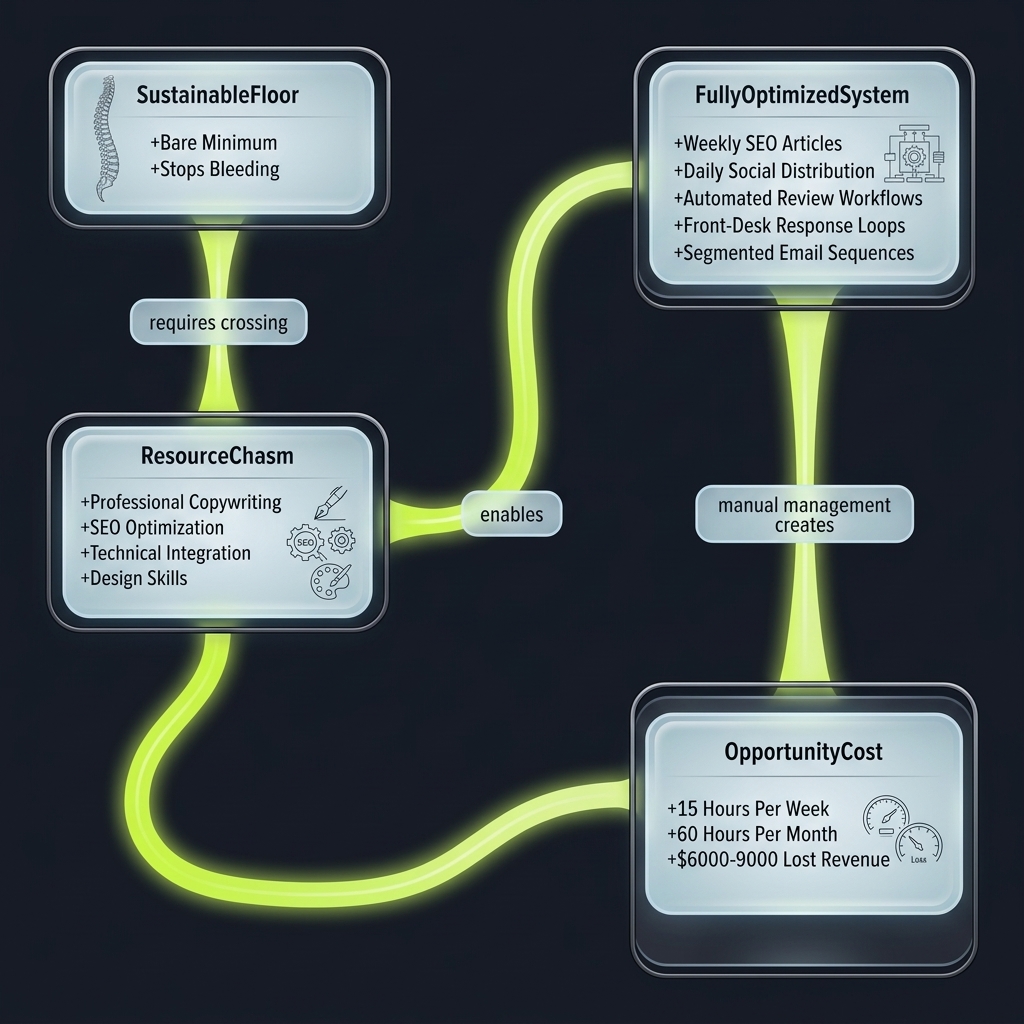
The Reality of the Full-Scale System
The sustainable floor is not the optimized system. It is the bare minimum required to stop the bleeding.
The fully optimized system looks different: weekly SEO articles targeting local search queries, daily social media distribution across three platforms, automated review acquisition workflows, immediate front-desk response loops, and segmented email sequences triggered by patient behavior.
This is the Resource Chasm. Moving from the floor to the full system requires professional copywriting, SEO optimization, technical platform integration, and design skills. Most clinical teams do not have these skills.
Constant Contact research shows that 56% of small business owners devote an hour or less per day to marketing activities, and 73% report lacking confidence that their current strategy actually contributes to their business goals. The time simply does not exist.
Managing the complete ecosystem manually scales into a 15-hour-per-week part-time job. That is 60 hours per month. At your effective hourly rate as a practice owner, that is $6,000 to $9,000 in opportunity cost, time you are not spending in the adjusting room generating revenue.
The math does not work.
Why is Generic AI Content Bad for My Practice?
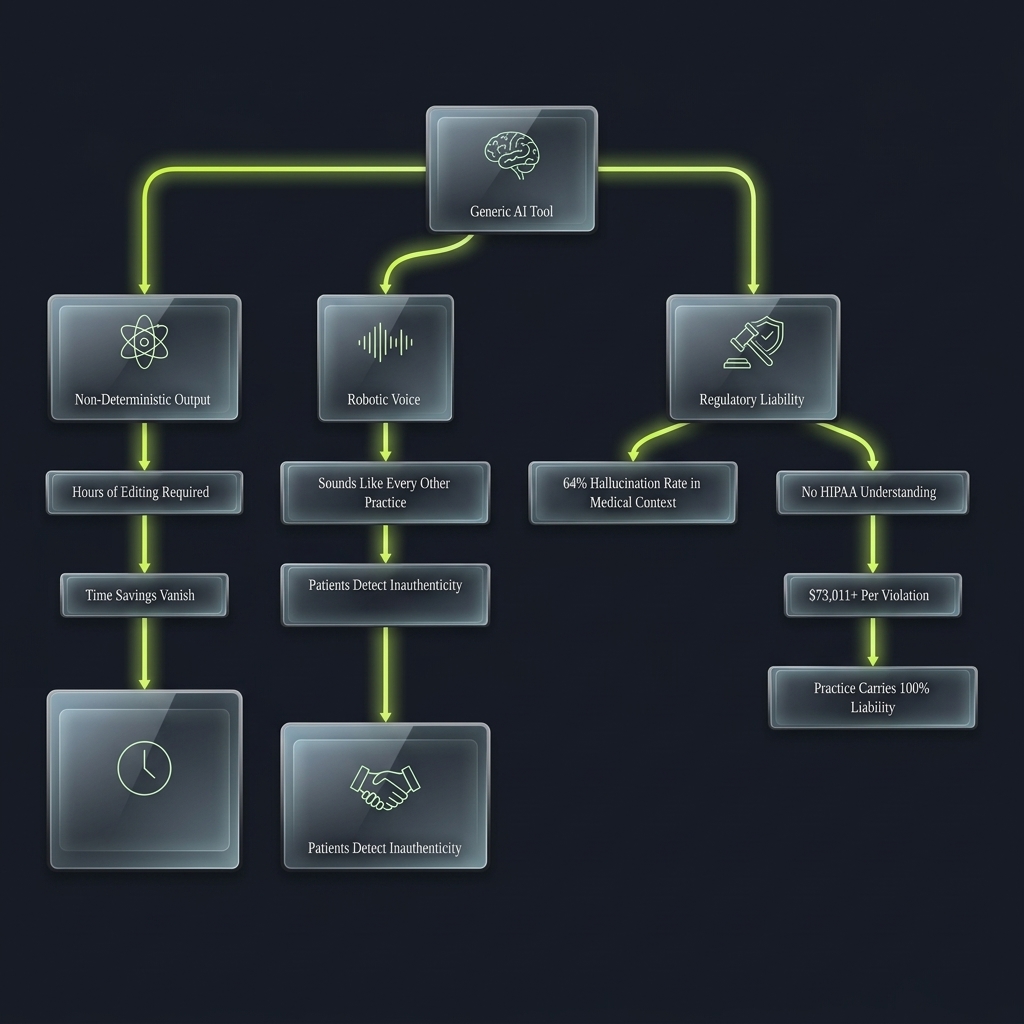
Generic AI content creates three critical risks for chiropractic practices: unpredictable output that eliminates time savings through constant editing, robotic voice that patients recognize as inauthentic, and severe regulatory liability since AI tools don't understand HIPAA rules or state licensing restrictions. AI hallucination rates reach 64% in medical contexts, while HIPAA violations carry penalties exceeding $73,000 per incident.
The Dangerous Shortcut: the Generic AI Trap
Tools like ChatGPT seem like a silver bullet. Type a prompt, get a newsletter, publish it, move on.
The illusion collapses under operational scrutiny.
First, the output is non-deterministic. You cannot predict what the tool will generate until you read it. That means you still spend hours prompting, rewriting, editing, and manually publishing. The time savings vanish.
Second, the voice is robotic. Generic large language models produce content that sounds like every other practice using the same tool. Patients can tell. The writing lacks your clinical perspective, your local references, your specific treatment philosophy.
Third, the regulatory and legal liability is catastrophic. Generic AI tools do not understand health-advertising regulations. They do not know HIPAA rules. They do not know what your state chiropractic licensing board prohibits you from claiming.
When an AI tool writes a patient-facing email that makes a clinical claim your practice is legally prohibited from making, you carry 100% of the liability. Under current inflation-adjusted civil monetary penalties, Tier 4 HIPAA violations, willful neglect that is not corrected, carry a minimum penalty of $73,011 per individual violation, with a maximum penalty and annual penalty cap of $2,190,294.
The shortcut is not a shortcut. It is a legal minefield.
How Often Should You Message Patients on Different Channels?
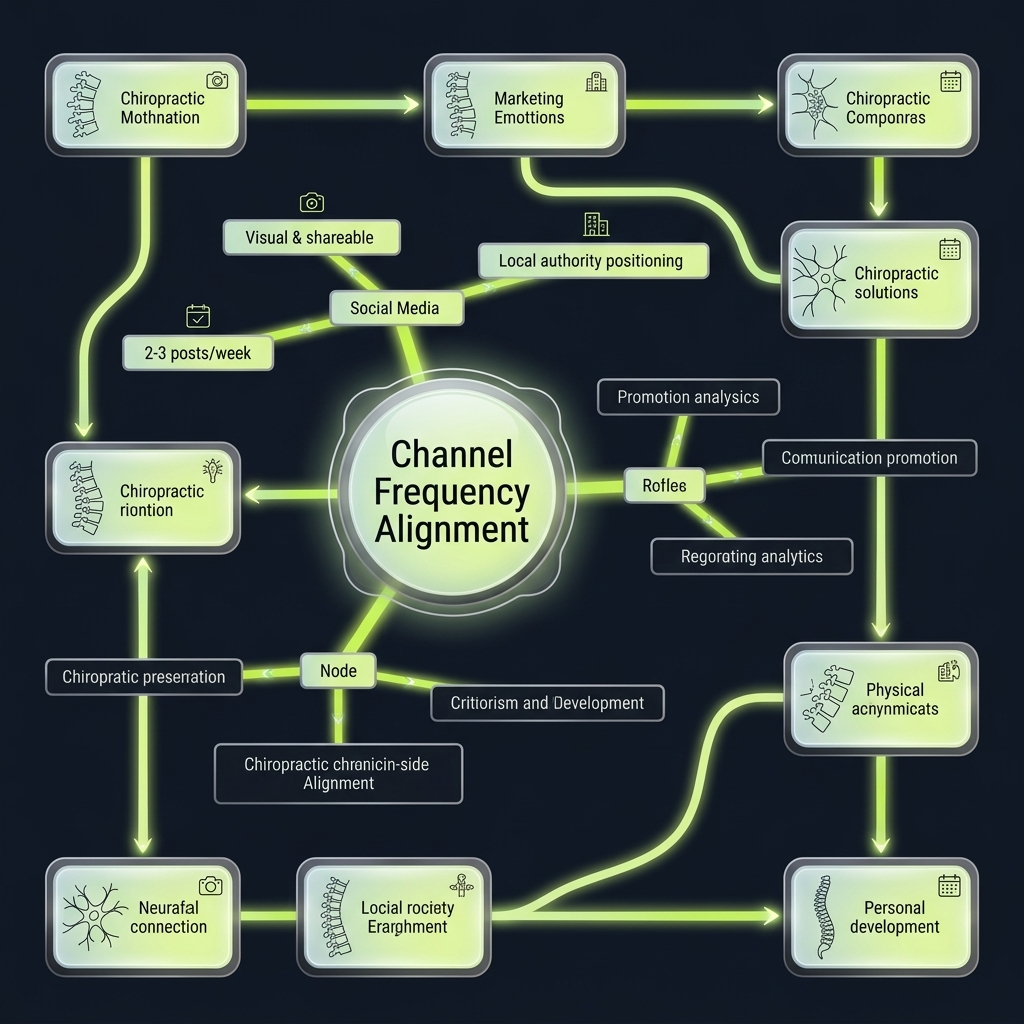
Healthcare providers should message patients at channel-appropriate frequencies: email once or twice monthly for inactive patients and every 7-10 days for active patients; SMS only for appointment reminders 24 hours before visits and quarterly reactivation messages; social media posts two to three times weekly. Each channel serves distinct purposes requiring different messaging cadences and content types.
The Channel-Frequency Alignment
Not all channels behave the same way. Email tolerates higher frequency than SMS. Social media tolerates higher frequency than email.
Bandwidth research shows that 28% of patients report they are likely to switch providers if their current provider does not offer text messaging as a communication option. But SMS is a high-urgency, high-friction channel. Patients expect texts to be short, relevant, and immediately actionable.
Send too many texts, and you trigger unsubscribes. Send texts that require more than 15 seconds to read, and you trigger annoyance.
The Channel-Frequency Alignment Rule looks like this:
Email: One to two messages per month for inactive patients. One message every 7-10 days for active patients. Educational, long-form, teaching-focused.
SMS: Appointment reminders only, sent 24 hours before the visit. Reactivation messages sent no more than once per quarter. Transactional, short, action-focused.
Social Media: Two to three posts per week. Educational, visual, shareable. Designed to position you as the local authority when prospective patients are researching providers.
Each channel has a job. Mixing the jobs creates friction.
How Do I Automate Patient Outreach to Improve Retention?
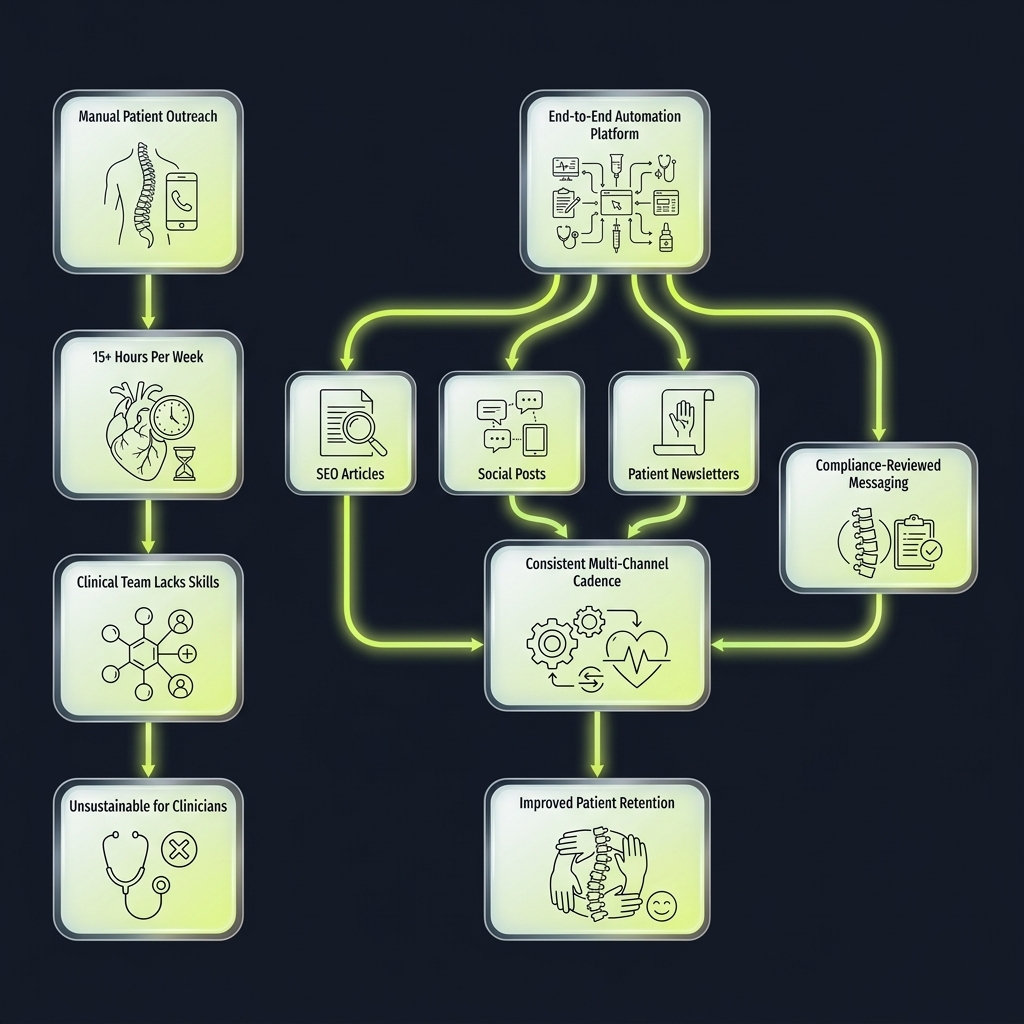
Healthcare practices can automate patient outreach using end-to-end platforms that generate multi-channel content including SEO articles, social posts, patient newsletters, and compliance-reviewed messaging. These specialized systems handle the entire retention loop automatically, eliminating the 15+ weekly hours required for manual execution while maintaining regulatory compliance and practice-specific voice consistency.
The Ultimate Conclusion
The math is clear. A consistent, multi-channel outreach cadence is vital for retention. But building and running that machine by hand is a second job you did not sign up for.
The sustainable floor takes six to eight hours per month and only covers the basics. The full-scale system takes 15 hours per week and requires skills your clinical team does not have. Generic AI tools do not solve the problem; they introduce new operational friction and expose you to regulatory liability.
Platforms that operate this whole loop end-to-end, like Omniply, which generates weekly SEO articles, social posts, patient newsletters, and compliance-reviewed messaging from your practice's own voice, exist specifically because the system is correct but the execution is unsustainable for a working clinician.
The system deserves to be operated by an engine built specifically for the task.
You belong in the adjusting room, not the marketing department.
Frequently Asked Questions
Can I Use ChatGPT to Write Patient Texts?
You can, but you carry the legal liability for every word it generates. Generic AI tools do not understand health-advertising regulations, HIPAA rules, or state licensing board restrictions. A 2025 study found that AI hallucination rates on medical content reached 64.1% without structured mitigation. If the tool fabricates a clinical claim your practice is prohibited from making, you are legally responsible.
How Much Time Does Managing Patient Texts Take?
If you are doing it manually, expect 30 to 60 minutes per week for appointment reminders alone. Add reactivation campaigns, and you are looking at another two to three hours per month. The time compounds quickly when you factor in segmentation, personalization, and compliance review.
Is Automated Outreach Worth the Cost?
Run the math. If you lose two patients per month to forgetfulness at $2,800 lifetime value each, that is $67,200 in annual revenue walking out the door. If a structured recall system retains even half of those patients, the return is $33,600 per year. Most automation tools cost a fraction of that.
Do You Need HIPAA Consent to Text Patients?
Yes. SMS is not a secure channel by default. You need explicit written consent before sending any text message that contains protected health information. Appointment reminders that reference specific conditions or treatments fall under HIPAA. Transactional reminders that only include date, time, and location are generally safe, but you should still obtain consent to cover all bases.
How Often Can You Text Patients Before They Unsubscribe?
Bandwidth research shows that 28% of patients will switch providers if texting is not available, but frequency tolerance is low. Limit SMS to appointment reminders and quarterly reactivation messages. Anything more frequent triggers annoyance. Patients expect texts to be short, urgent, and immediately actionable.
How Often Should a Clinic Email Its Patient List?
It depends on patient lifecycle stage. Inactive patients can handle one to two educational emails per month. Active patients in care can handle one message every 7-10 days if the content is valuable and teaching-focused. Paubox data shows healthcare emails achieve a 41.23% open rate, which means patients do engage when the content is relevant.
What is the Best Frequency for Patient Text Reminders?
One reminder per appointment, sent 24 hours before the scheduled visit. Do not send a second reminder unless the patient specifically requests it. Over-texting creates friction and increases no-show rates instead of reducing them.