
Last month, 132 million Americans visited physicians for musculoskeletal conditions, the broad medical category that includes back pain, neck pain, joint issues, and spine care. That is your addressable market. Every one of them is a prospective new patient file.
Most of them skipped your practice entirely.
They did not leave because your clinical care is poor. They left because your front desk operates on an outdated playbook.
Modern searchers do not leave voicemails. They do not wait two hours for a call back. When a prospective patient hits a barrier, they click the next local listing in three seconds.
This behavior shift has quietly redefined modern patient acquisition.
Your schedule has open slots not from a lack of local demand, but from Search Friction. Your practice is bleeding high-value care plans at the exact moment of initial intent. Traditional referral channels can no longer patch this hole.
This article outlines the three structural shifts driving this 132-million-visit migration. You will see why standard intake workflows fail, how your current setup loses revenue, and what your front desk must change this week to capture that intent.
The fix is purely operational.
Key Takeaways
- Search Friction Costs: 132 million annual musculoskeletal visits represent your addressable market, but practices lose up to 70% of referral leads at digital validation when lacking recent reviews and active online presence.
- Review Recency Dominates: 74% of consumers only trust reviews written within the last three months, making continuous review velocity more valuable than static five-star counts from years past.
- Care Plan Abandonment: Practices without automated multi-touch communication lose 40% of patients by week four, representing $46,080 in annual revenue per 20 monthly new patients at $60 per visit.
- Compliance Risk Reality: Generic AI tools like ChatGPT lack healthcare advertising guardrails and generate outcome promises that violate state board rules, creating regulatory exposure for practices.
- Patient Trust Threshold: 63.1% of U.S. adults prefer waiting 48 hours for clinician-reviewed content over instant AI responses, and 61% reject physicians with poor online feedback despite personal referrals.
How Do Patient Search Numbers Impact Provider Growth?
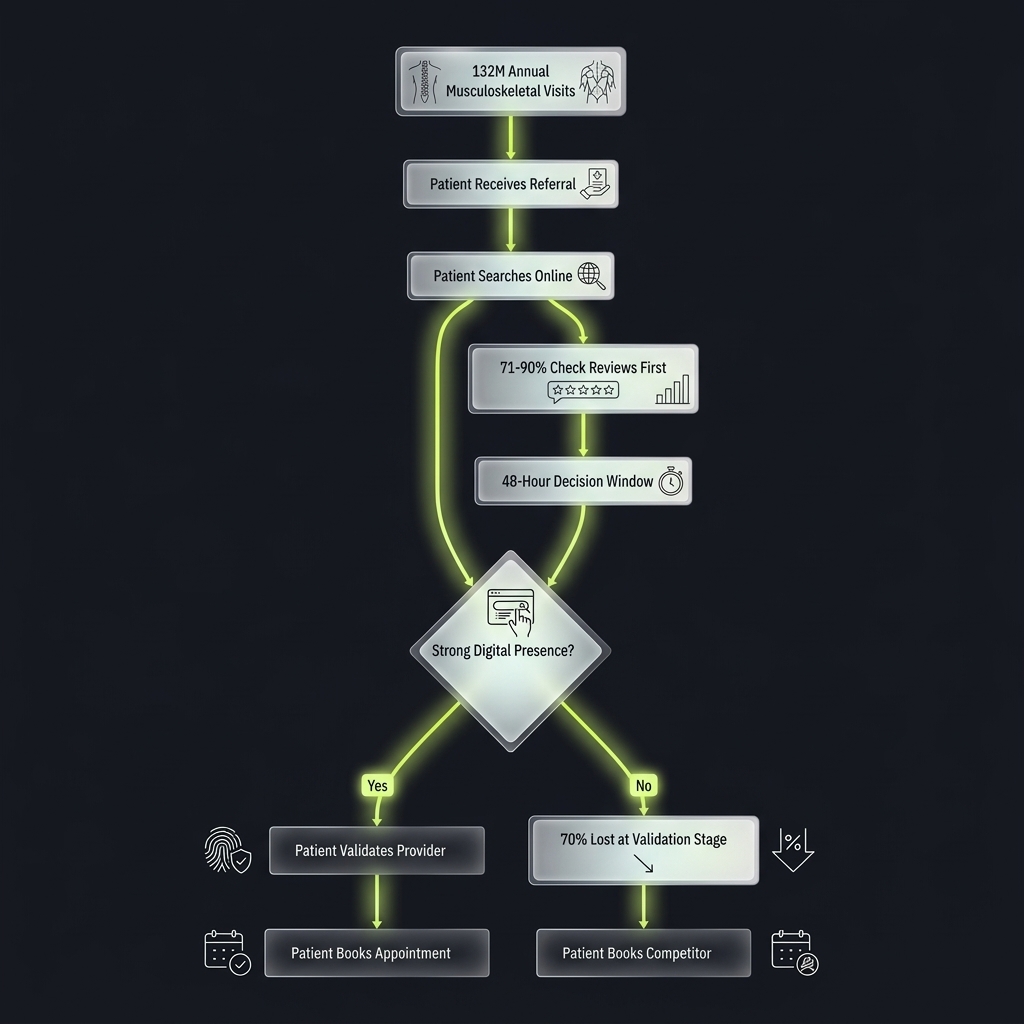
Patient search numbers directly impact provider growth by determining visibility during critical decision windows. With 132 million annual musculoskeletal visits and 71-90% of patients using online reviews as their first step, practices that lack strong digital presence lose up to 70% of referral leads at the validation stage, preventing conversion of high-intent searchers into booked appointments.
The Numbers That Changed Everything
Start with the baseline. According to CDC and national health data, 132 million physician visits occur annually in the United States for musculoskeletal conditions: back pain, neck pain, joint dysfunction. That volume represents your total addressable market.
Now look at how they find you.
The Online Validation Threshold
The data: 71% of patients use online reviews as the very first step in finding a new healthcare provider. Another study puts it higher: 90% of patients read online reviews to evaluate providers before they ever call.
What it means: A personal referral is no longer the final step in a patient's decision. It is a lookup trigger. Your best patient refers their coworker. That coworker opens Google. If your profile looks dormant, they book with the practice two listings down.
The operational reality: Clinics relying solely on traditional word-of-mouth are losing up to 70% of their warmest referral leads at the digital validation stage. The referral happened. You just never saw the patient.
The 48-Hour Decision Window
High-intent medical searches, especially those driven by acute pain, lead to rapid provider selection. Patients in pain search on their phone during a work break or late at night. They want an answer now. Decision-making happens in short, concentrated bursts.
If your practice does not appear in that search, or if your listing looks outdated, you do not exist in their consideration set. The window closes fast. After that, they have already booked elsewhere.
The Review Recency Rule
The data: 74% of consumers only pay attention to online reviews written within the last three months.
What it changes: Having 200 five-star reviews from two years ago carries less trust weight than having 15 five-star reviews published over the past three weeks. Patients interpret review recency as a proxy for practice health. A static review count signals an inactive or declining practice, even if your clinical outcomes are excellent.
The implication: You need continuous review momentum, not a one-time review push. The standard advice, ask every patient for a review, fails because it depends on manual execution. Front-desk teams get busy. The asking stops. The review velocity dies.
Educational Content as Authority Signal
Content marketing has become a primary conversion driver. Patients actively evaluate a clinic's educational presence to assess clinical expertise. A patient with sciatica looks for content about sciatica. A patient with postural issues looks for content about posture and ergonomics.
If your website is a static brochure with five pages written in 2019, you lose that patient. They conclude you are not current, not engaged, not the expert they need.
This is not a branding luxury. It is operational infrastructure.
The Retention Math
Here is what I have observed across 16 years running marketing for health professionals and local practices: practices that maintain structured, weekly communication with patients retain about 30% more active care plans over a 12-month period compared to clinics relying only on in-office reminders.
The math on a 12-visit care plan: If your average visit is $60 and you lose 30% of care plans early, you are leaving $216 per dropped patient on the table (12 visits × $60 × 30%). Multiply that across 20 new patients a month. That is $1,296 in monthly revenue walking out the door because communication stopped the moment the patient left your office.
The system inside Omniply, and the playbook elite practice coaches teach their clients to execute by hand, works every time it is actually executed. It fails every time life gets in the way of executing it.
That is the gap this article addresses.
Why Do Patients Find Chiropractors Differently Now?
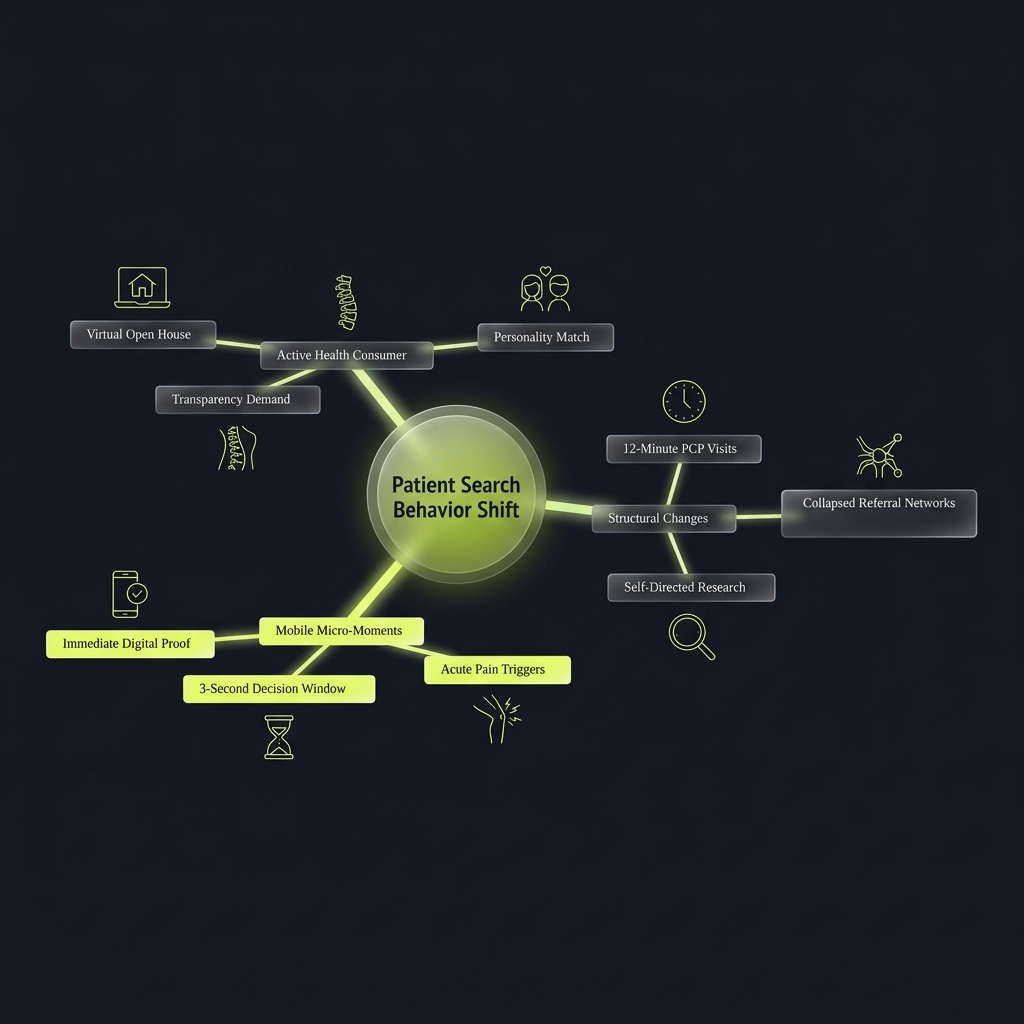
Patients now find chiropractors through self-directed online searches rather than primary care referrals. Shortened physician appointments and collapsed insurance referral networks have eliminated the traditional gatekeeper model. Patients conduct mobile searches during acute pain moments, comparing websites, reviews, and digital presence to make immediate booking decisions based on transparency and educational content.
Why the Numbers Look This Way
Three structural shifts created this new selection behavior. None of them are reversible.
The Breakdown of Primary Care Referral Networks
Twenty years ago, most patients found specialists through their primary care physician. Insurance structures and appointment logistics have collapsed that pathway. Primary care visits are now 12 minutes long. The physician has no time to research and recommend a specific chiropractor. They hand the patient a generic referral and tell them to find someone in-network.
The patient is now self-directed. They open Google. They read reviews. They compare websites. The old gatekeeper model is gone.
Mobile-First Micro-Moments
Nearly 8 in 10 adults in the U.S. report they are likely to go online to answer a specific question about health symptoms or a health condition. These searches happen on mobile devices during moments of acute need: late at night when back pain prevents sleep, during a work break when neck stiffness becomes unbearable, in the car after a minor accident.
The patient is not browsing. They are solving an urgent problem. Immediate digital proof wins the conversion. Site speed matters. Modern layout matters. Recent reviews matter. Educational answers matter. If any of those elements are missing, the patient moves to the next listing in three seconds.
The Shift From Passive Patient to Active Health Consumer
Patients now demand transparency before they book. They want to see the office environment. They want to understand your treatment philosophy. They want to know if your personality matches theirs. This is not entitlement. It is rational consumer behavior in a market with abundant choice and immediate information access.
Your website and digital presence serve as the modern virtual open house. If that open house looks closed, the patient books elsewhere.
Digital Noise and Shortened Trust Cycles
Prospective patients have developed skepticism toward generic advertising. Batch-and-blast marketing feels impersonal. Stock photos and templated copy signal a practice that does not care enough to show up authentically.
The benchmark for legitimacy is now consistent, authentic practice messaging across multiple channels: website, email, local SEO, social channels. Patients cross-reference these channels. If your messaging is inconsistent or absent, trust collapses.
That cross-referencing happens in minutes, not days.
Why is My Medical Practice Losing New Patients?
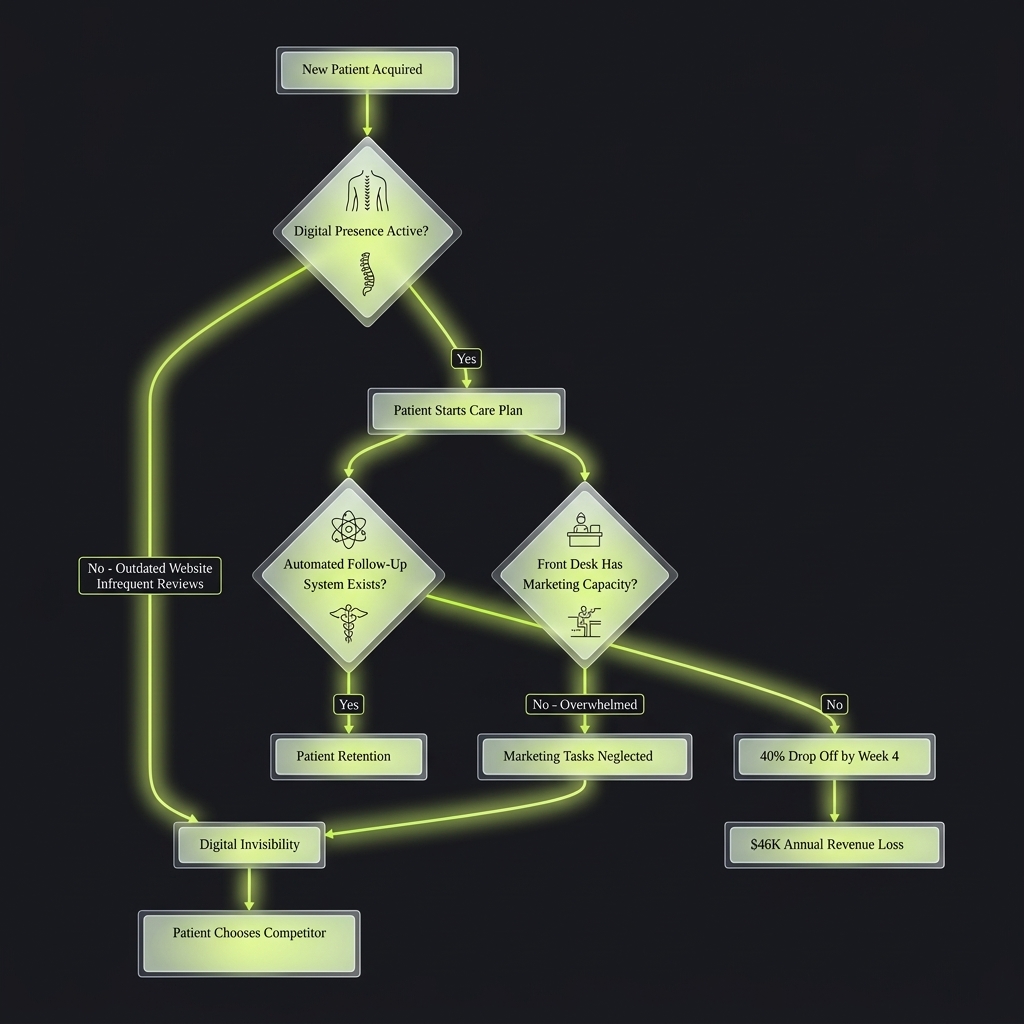
Medical practices lose new patients primarily due to digital invisibility, with outdated websites and infrequent reviews causing prospects to choose competitors with stronger online presence. Additionally, practices experience patient attrition when lacking automated follow-up systems, resulting in 40% care plan abandonment. Overwhelmed front-desk staff unable to manage marketing tasks compounds these retention challenges.
What This Means for Your Practice
The data translates into three operational scenarios. You are living in at least one of them right now.
Scenario One: the Invisible Expert
You are a veteran clinician. Twenty years of experience. Exceptional outcomes. State-of-the-art equipment. Your patients love you. But new patient numbers have plateaued.
The root cause: Your last digital content update was in 2021. Your Google Business Profile averages one new review every two months. Your website has six pages and no blog.
The reality: Prospective patients choose a less-experienced practitioner down the street because that competitor exhibits active digital presence, frequent content publishing, and recent review velocity. The market cannot see your expertise. You are clinically elite and digitally invisible.
Scenario Two: the Leaky Bucket
You successfully convert 20 new patients a month. But 40% drop off care plans by week four, well before achieving clinical correction. Your schedule has constant churn. You are working hard to fill the same slots every month.
The root cause: Communication ceases the moment the patient walks out the front door. No automated educational emails. No lifestyle newsletters. No ongoing touchpoints reinforcing the value of their care plan.
Do the math. If 40% of 20 new patients drop early, that is 8 patients per month. If each dropped patient represents 8 lost visits at $60 per visit, you are losing $3,840 in monthly revenue (8 patients × 8 visits × $60). Over a year, that is $46,080 walking away because you have no off-site engagement system.
Without continuous communication, daily life distorts patient priorities. They forget why they started care. Appointments get skipped. Plans get abandoned.
Scenario Three: the Overwhelmed Front Desk
You run a two-location practice. You know you need content marketing, review acquisition, and lead follow-up. You try to manage it manually using front-desk staff.
The root cause: Front-desk teams are overwhelmed by check-ins, phone calls, insurance verification, and patient scheduling. Marketing tasks are continually pushed to tomorrow.
The reality: Marketing becomes erratic. Executed in short panics when patient volume drops, then abandoned completely when the clinic gets busy. You never build momentum. You never see compounding returns.
This is not a personnel problem. It is a structural design flaw. You are asking a full-time role to absorb a second full-time role in spare minutes that do not exist.
What Do Local Search Trends Predict for Business Growth?
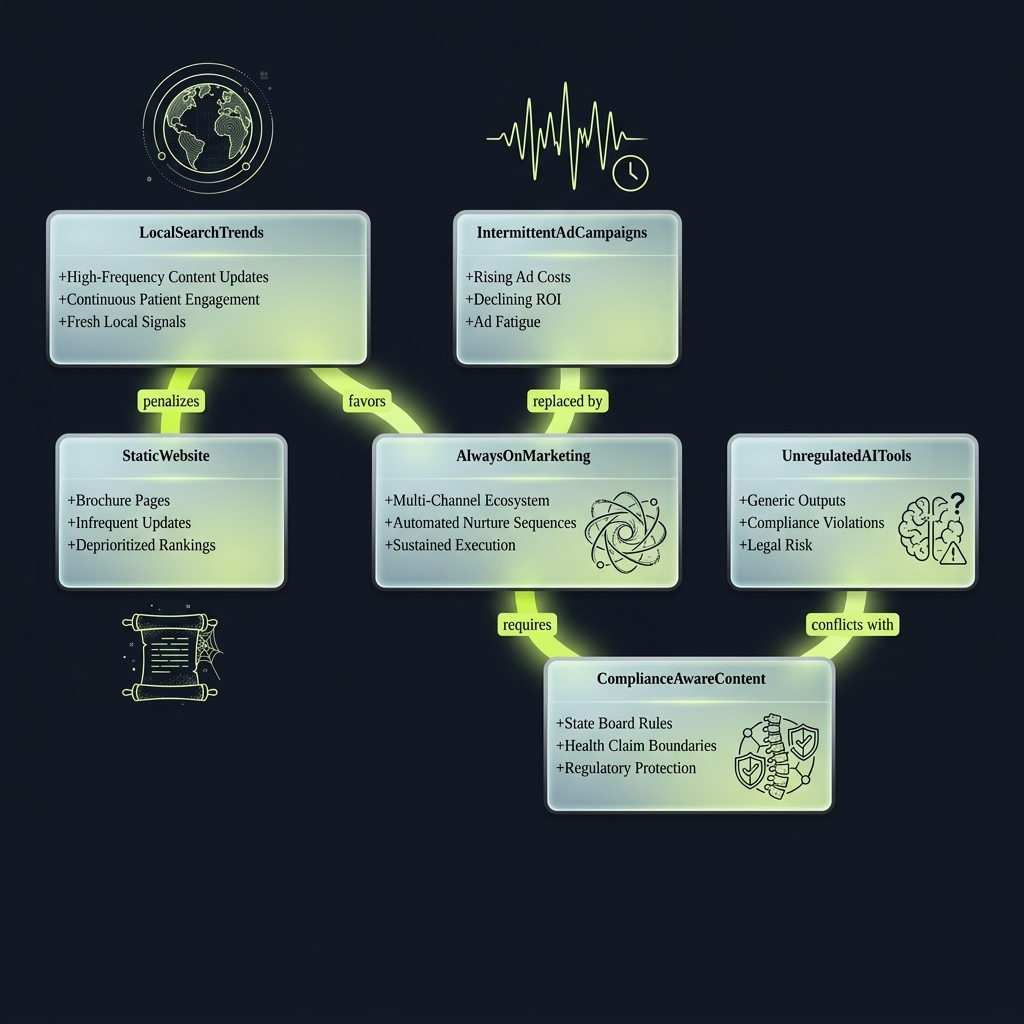
Local search trends predict that business growth will favor practices maintaining high-frequency content updates and continuous patient engagement over static websites. Sustained, always-on marketing ecosystems will outperform intermittent campaigns as ad costs rise and ROI declines. Meanwhile, compliance-aware content strategies will become essential as unregulated AI tools create regulatory risks for healthcare practices.
What the Data Predicts
Four trends are accelerating. Each one widens the gap between practices that adapt and practices that stagnate.
Trend One: Search Engines Reward High-Frequency Local Signals
Search algorithms increasingly favor local businesses that consistently update their web properties with original, localized content and continuous user engagement. Static brochure sites are being deprioritized in local search results.
The mechanism is straightforward. Search engines interpret fresh content as a signal of business health and relevance. A practice that publishes weekly articles about conditions it treats, written for its local market, will outrank a practice with a six-page static site, even if the static site is older and has more backlinks.
This trend is documented and irreversible.
Trend Two: the Fall of Intermittent Ad Campaigns
High-friction, one-off pay-per-click ad campaigns are yielding declining ROI. Ad costs are rising. Patients are developing ad fatigue. The practices I have worked with over 16 years that continue to grow are transitioning to integrated, multi-channel ecosystems: consistent content publishing, automated patient nurture sequences, continuous review acquisition.
These are always-on systems, not campaigns you turn on and off. The compounding returns come from sustained execution over months and years, not from short bursts of activity.
Trend Three: Regulatory Risk in Unregulated AI Marketing
As clinics turn to generic AI writing tools to generate marketing content, compliance violations are spiking. ChatGPT and similar platforms lack built-in boundaries for health claims, state board rules, and strict medical advertising regulations.
A generic AI tool does not know what claims a chiropractic practice in your state is allowed to make. It will write outcome promises you cannot legally publish. It will generate patient testimonials that violate advertising rules. It will create content that puts your license at risk.
Rules vary by jurisdiction. This reflects the United States as of October 2026. But the pattern is consistent: generic AI tools are not built for healthcare. They are built for general content. Using them in a regulated industry without compliance guardrails is operational negligence.
Trend Four: Patients Still Want the Doctor's Voice
Despite the rise of AI, patients demand verified clinical expertise. In a recent study published in JAMA Network Open, 63.1% of U.S. adults stated they would rather wait up to 48 hours for a clinician to review and edit an AI-generated medical answer than receive an instant, unreviewed AI response.
The implication: Patients want content that sounds like it came from the doctor, not from a generic content mill. Authenticity is the trust signal. Templated, generic content, whether written by a human or a machine, fails the authenticity test.
And here is the closing data point: 61% of patients state that poor online feedback would dissuade them from seeing a physician, even if that doctor was directly recommended by friends or family.
Referrals cannot override a poor digital footprint. The old playbook is dead.
What Does Data Show About Successful Practice Marketing?
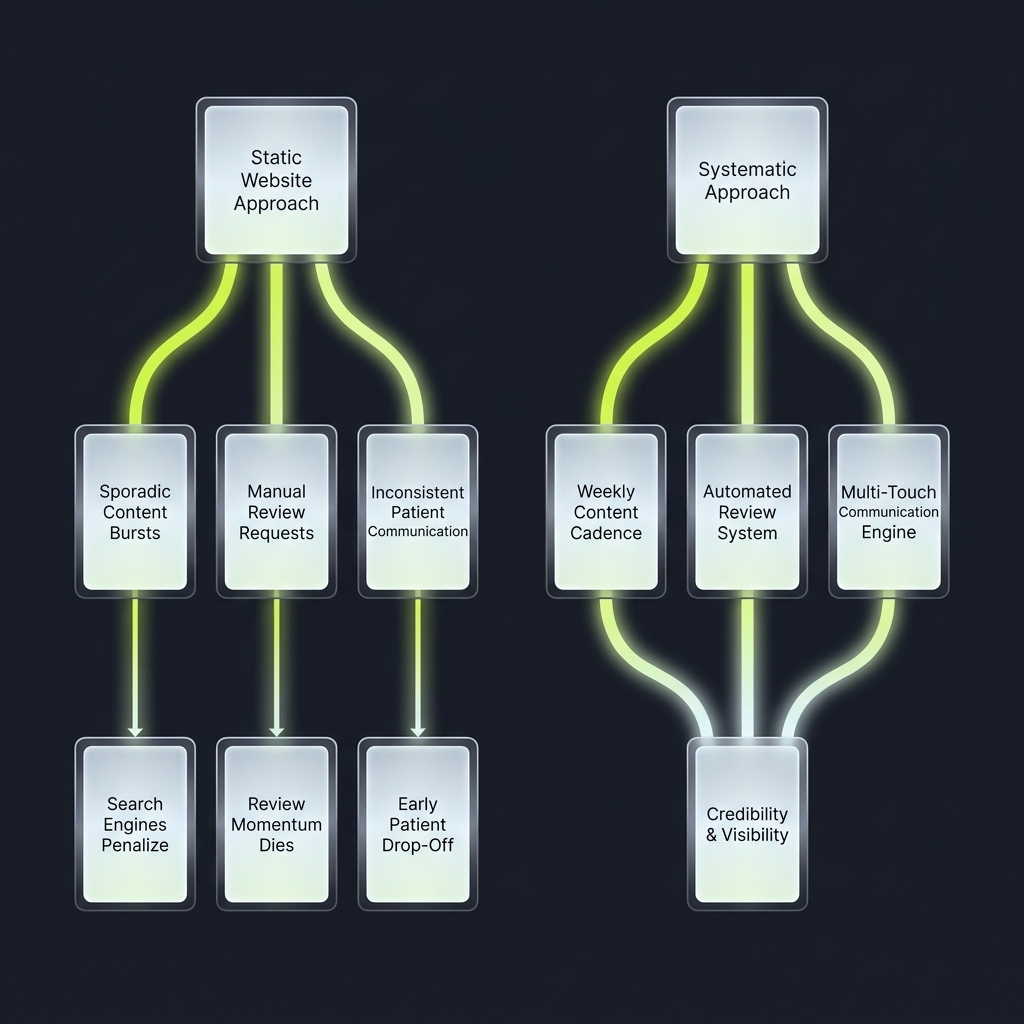
Data shows successful practice marketing requires three systematic approaches: maintaining consistent weekly content publication rather than sporadic bursts, automating review acquisition to generate fresh testimonials continuously, and deploying multi-touch patient communication that retains 30% more active care plans. Consistency and automation outperform manual, irregular efforts in building credibility and patient retention.
What the Data Demands
The solution is not working harder. The solution is installing a system that operates without consuming your time.
Action One: Establish a Non-Negotiable Content Cadence
Shift from treating your website as a static brochure to maintaining a published cadence of patient-focused, educational articles. These articles should be tailored to your local market and your clinical expertise.
The cadence matters more than the volume. One article per week, published consistently for a year, will outperform twelve articles published in a single month and then nothing for six months. Search engines reward consistency. Patients interpret consistency as credibility.
The content must answer the questions your prospective patients are typing into Google: What causes sciatica? How long does a disc bulge take to heal? What should I expect at my first chiropractic visit?
This is not creative writing. This is operational infrastructure.
Action Two: Automate Review Acquisition
Implement a system that prompts satisfied patients to share their experience online immediately following appointments. The prompt must be automatic, not dependent on a front-desk team member remembering to ask.
The goal is not to accumulate a lifetime total of reviews. The goal is to maintain fresh review velocity. You need new reviews every week, not 200 reviews from two years ago.
Manual execution fails here. Front-desk staff get busy. The asking stops. The review momentum dies. You need a system that cannot forget.
Action Three: Deploy Multi-Touch Communication Beyond Office Walls
Build an ongoing communication engine: weekly educational newsletters, condition-specific health guides, care-plan reinforcement emails. This communication must happen automatically, triggered by patient milestones and appointment schedules.
The math: If multi-touch communication retains 30% more active care plans, and each retained care plan is worth $720 in lifetime visit value, the system pays for itself with two retained patients per month.
Most practices lose eight patients per month to early drop-off. Retaining even half of those is a six-figure annual revenue recovery.
Action Four: Recognize Why Manual Execution and Generic AI Both Fail
The manual trap: Expecting a busy doctor or front-desk receptionist to regularly write SEO articles, draft newsletters, post to social channels, and follow up with leads manually is a recipe for failure. It fails every time life gets busy. It fails every time patient volume spikes. It fails every time someone goes on vacation.
The generic AI trap: Using tools like ChatGPT does not solve the problem. Generic AI is non-deterministic. Its output varies wildly. It consumes significant doctor time to write complex prompts and edit output. And critically, nothing in these tools ensures compliance with health-advertising regulations. They will write claims you are not allowed to make.
I learned to code and built the version that cannot get tired, cannot get busy, and cannot skip a week because I watched this pattern repeat for 16 years. The system works. Manual execution of the system does not.
Action Five: Transition to an Operated System
The solution is not adding more tasks to the front-desk checklist. The solution is installing an automated system built specifically for healthcare practices: one that extracts the authentic voice of the doctor, enforces strict advertising compliance, updates SEO content weekly, manages patient communication, and runs consistently without requiring clinical time.
Platforms that operate this whole loop end-to-end, content publishing, review acquisition, patient nurture, compliance guardrails, are the structural answer to the problem this article describes; Omniply is one such platform, built specifically for chiropractic practices, and it operates the entire system in your authentic voice after a single onboarding interview.
The elite practices that thrive over the next decade will not be those whose doctors spend ten hours a week writing marketing copy. They will be the practices that installed the right infrastructure and let it run.
Why is Digital Marketing Essential for Chiropractic Practices?
Digital marketing is essential for chiropractic practices because patient selection mechanisms have fundamentally shifted toward digital channels. With 132 million annual physician visits for musculoskeletal conditions, patients now choose chiropractors based on immediate digital visibility, recent online reviews, and authoritative content presence rather than traditional referral methods alone.

The Bottom Line
132 million physician visits for musculoskeletal conditions happen annually in the United States. Those patients have changed how they select a chiropractor. They evaluate practices based on immediate digital visibility, recent review momentum, and continuous authority-building content.
Your clinical skill has not changed. The selection mechanism has.
Stop relying on fragmented, manual marketing efforts that fall apart when your practice gets busy. Stop using generic AI tools that cannot ensure compliance and still consume your time.
The practices that capture this 132-million-visit market are not working harder. They installed the right system and let it operate.
That is the decision in front of you.
Frequently Asked Questions
How Do Patients Choose a Chiropractor Today?
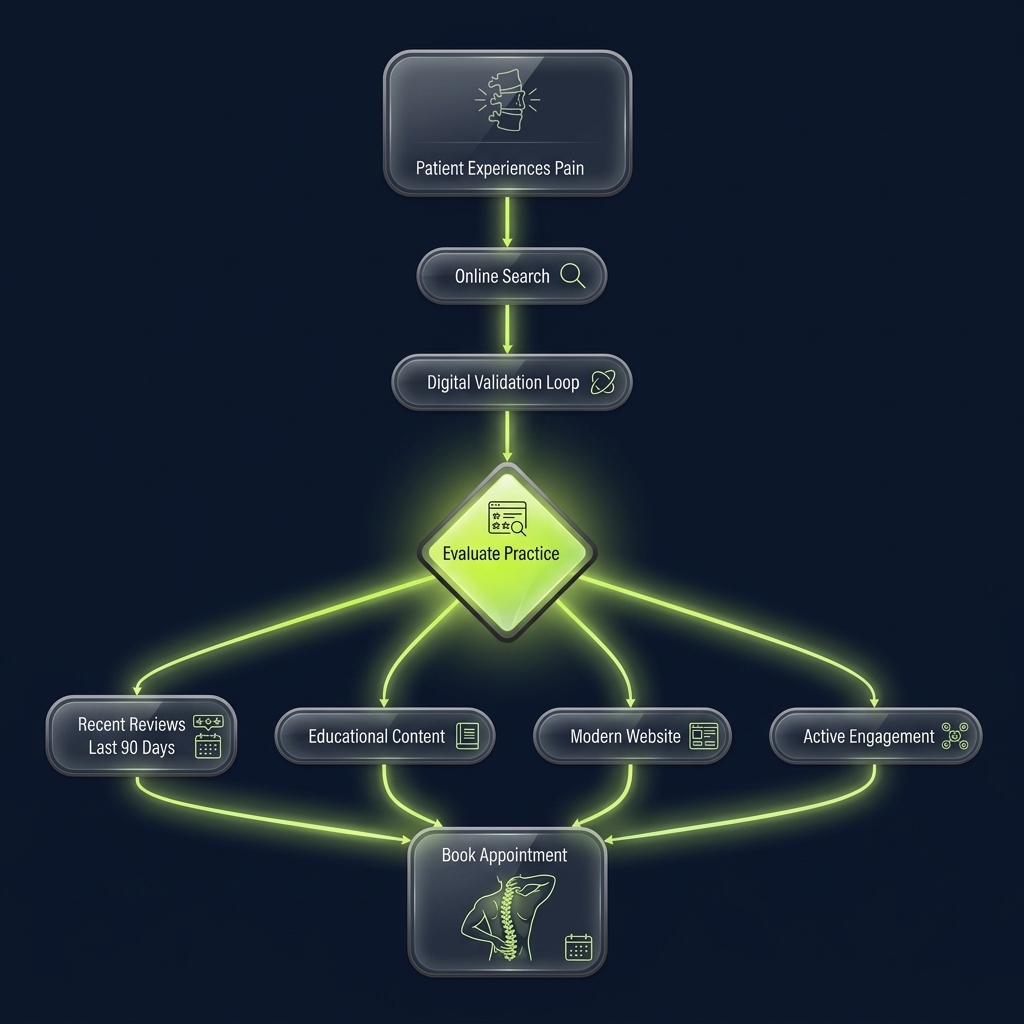
Patients use a three-step digital validation loop. First, they search online, often triggered by acute pain or a friend's referral. Second, they evaluate the practice's digital footprint: recent reviews, website quality, educational content. Third, they book with the practice that demonstrates the most credibility and responsiveness. The entire process happens quickly, usually on a mobile device.
What Do Patients Look for When Choosing a Chiropractor?
Recent reviews published within the last 90 days. Educational content that addresses their specific condition. A modern, fast-loading website. Evidence that the practice is active and engaged. Patients interpret these signals as proxies for clinical quality and practice health.
Can ChatGPT Write Blog Posts for a Chiropractic Practice?
Generic AI tools like ChatGPT can generate content, but they lack compliance guardrails for healthcare advertising. They will write outcome promises, patient testimonials, and clinical claims that violate state board rules. They also produce non-deterministic output that requires significant doctor time to prompt and edit. The time savings are illusory, and the regulatory risk is real.
Should a Practice Hire an Agency or Use Software?
Agencies require ongoing management, produce templated content that does not sound like your practice, and charge retainers that often exceed the value delivered. Software without operation is just another tool you do not have time to use. The right answer is an operated platform: software that runs the system for you, in your authentic voice, without requiring your time or management.
How Many Hours a Week Does Practice Promotion Take?
If executed manually, effective practice promotion consumes 10-15 hours per week: writing articles, managing social posts, drafting newsletters, following up with leads, requesting reviews. That is a part-time job. Most practices cannot sustain that workload, so execution becomes erratic and returns collapse. The solution is automation that operates the system without consuming clinical time.
What Compliance Rules Apply to Online Practice Promotion?
Rules vary by state and jurisdiction. Generally, healthcare advertising regulations prohibit outcome guarantees, unsubstantiated claims, patient testimonials that imply typical results, and any language that could mislead a prospective patient about the scope or efficacy of treatment. Generic AI tools do not understand these boundaries. Compliance-aware systems enforce them automatically.
How Much Should a Chiropractic Practice Spend on Promotion?
The right question is not cost, but return. If a system generates two additional retained care plans per month, and each care plan is worth $720 in lifetime visit value, the system must generate $1,440 in monthly value to break even. Most practices lose eight patients per month to early drop-off. Retaining even half of those is worth $5,760 per month. The cost of the system is irrelevant if the return is 3-5x.