
Your front desk staff leaves at 6:00 PM. By 6:15 PM, search volume for local chiropractic care spikes.
This is the 6PM Searcher.
They are not looking for a phone number to call tomorrow. They want a confirmed slot on your calendar right now.
Without online appointment scheduling, your practice is invisible for fourteen hours a day. Our data shows you are losing up to 34% of your potential new patient volume during the hours your clinic is dark.
Relying on voicemail to capture these high-intent prospects is a slow bleed on your revenue. It assumes the prospect will wait for a callback instead of clicking your competitor's live calendar.
They will not wait.
This article details how to capture these after-hours bookings without adding friction to your front desk. We will break down the math of the empty calendar slot and the exact three-step setup required to capture the late-night market.
Let's look at the numbers.
Key Takeaways
- After-Hours Revenue Loss: Chiropractic practices lose up to 34% of potential new patient volume during the 71% of weekly hours they remain unstaffed, with search volume for acute pain peaking between 6:00 PM and 11:00 PM when front desks are closed.
- Voicemail Abandonment Rate: 86% of callers reaching business voicemail hang up without leaving a message, and the remaining 14% who leave messages typically book with competitors before receiving callbacks the next morning.
- Five-Minute Response Advantage: Harvard Business Review and MIT research shows businesses responding to leads within five minutes are 100 times more likely to make contact and 21 times more likely to qualify the lead compared to 30-minute response times.
- Annual Missed Booking Cost: Three missed after-hours bookings per week at $850 lifetime patient value equals $132,600 in annual lost revenue, with patient acquisition costs inflating 71% when capture mechanisms only operate 29% of available time.
- Generic AI Compliance Risk: Standard ChatGPT versions do not comply with HIPAA requirements, lack Business Associate Agreements, and can generate illegal therapeutic claims triggering FTC violations and state chiropractic board investigations with penalties exceeding $144.8 million in documented HIPAA settlements.
How Are Missed After-hours Calls Costing My Clinic Patients?
Missed after-hours calls cost clinics patients because pain-driven searches peak between 6:00 PM and 11:00 PM when offices are closed. Prospective patients experiencing acute distress search for immediate care, and when they reach voicemail, they simply move to the next provider offering online booking or availability. These high-intent prospects convert elsewhere, creating systematic revenue loss during the 71% of weekly hours practices remain unstaffed.
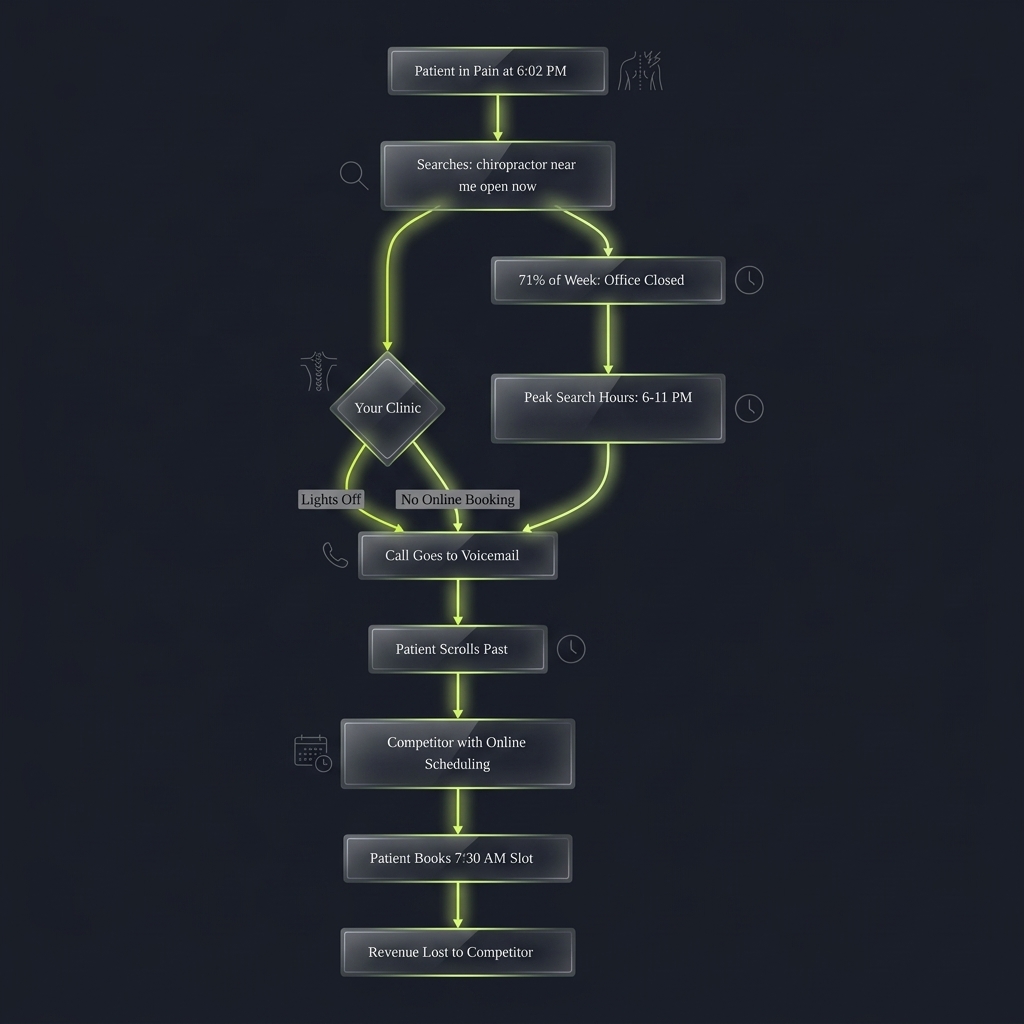
The Dark Desk and the Invisible Leak
The 6:02 PM Silence: the Anatomy of a Missed Connection
Picture the scene: a 42-year-old accountant stands in her kitchen at 6:02 PM on a Tuesday. She bent wrong lifting a case of paper at the office. Now her lower back is locked.
She cannot sit. She cannot stand straight. She pulls out her phone and types "chiropractor near me open now."
Your clinic is three blocks away. Your lights are off. Your phone rings to voicemail.
She scrolls past your listing. She books with the practice that shows an available 7:30 AM slot and lets her confirm it without speaking to anyone.
This is not a hypothetical failure. This is the structural reality of operating a practice with fixed hours in a market where pain does not respect your schedule.
A 2022 Sleep Foundation survey found that 95.1% of adults lose at least an hour of sleep to pain each week. Nighttime distress drives late-night searches.
Your empty front desk does not stop the searches. It only stops you from capturing them.
The disconnect is systemic. You built a business around physical presence: a building, staff hours, treatment rooms that open and close.
Your prospective patients live in a world of immediate digital access. The gap between these two realities is where your revenue leaks.
The Arithmetic of the Dark Window: Making the Invisible Cost Visible
Search behavior data tells a clear story. Queries for acute back pain, sciatica relief, and emergency chiropractic care do not cluster during your office hours.
They peak between 6:00 PM and 11:00 PM on weekdays. They spike on weekends.
Let's make the invisible cost visible with real numbers.
Assume your practice runs standard hours: Monday through Friday, 9:00 AM to 6:00 PM, plus Saturday morning. That is 49 hours per week.
There are 168 hours in a week. Your practice is staffed for 29% of the available time.
Now assume conservative search volume: three high-intent prospects per week land on your Google Business Profile or website after hours. They are ready to book. They find no path forward.
They book elsewhere.
Three missed bookings per week equals 156 per year.
If your average new patient generates $850 in lifetime revenue across initial visits, maintenance care, and referrals, you are leaving $132,600 on the table annually. That figure assumes zero growth in search volume and zero increase in after-hours intent.
The math compounds when you layer in patient acquisition cost. If you spend $15,000 per year on digital advertising to drive traffic to your website and listings, but your capture mechanism only operates 29% of the time, you are paying full freight for partial coverage.
Your effective cost per acquired patient inflates by 71% simply because the funnel closes when prospects are most active.
This is not a marketing problem. This is an operational architecture problem.
Why the Obvious Fixes Fail: the Friction of Traditional Workarounds
The standard response is to update your voicemail greeting. "You have reached [Practice Name]. Our office is currently closed. Please leave a message with your name, number, and reason for calling. We will return your call when we reopen at 9:00 AM."
Research by Invoca shows that 86% of callers who reach a business voicemail hang up without leaving a message. The other 14% leave a message and then keep searching.
By the time you call them back at 9:15 AM, they have already booked with someone else.
Voicemail is not a capture tool. It is a polite way to tell a high-intent lead to call your competitor.
The second workaround is hiring an answering service. This introduces new friction.
The service operator is not trained in your intake process. They cannot answer basic questions about your techniques, insurance participation, or whether you treat specific conditions.
They take a message. You call back. The prospect has moved on.
Worse, the interaction feels cold. A patient in acute pain is not looking for a generic call center voice. They are looking for reassurance that someone understands their problem and can solve it quickly.
A third-party operator cannot provide that.
The third workaround is extending physical front-desk hours or routing after-hours calls to staff cell phones. This solves the capture problem by creating a burnout problem.
Your front desk is not paid to field calls at 9:00 PM. Your clinicians did not open a practice to become 24/7 phone operators.
Small outpatient practices already face 25% to 35% annual turnover for medical assistants, with replacement costs ranging from $14,200 to $40,000 per person. Asking staff to absorb after-hours intake accelerates that churn.
The obvious fixes fail because they treat the symptom instead of the structure.
How Do You Build an Always-on Capture Engine?
Build an always-on capture engine by shifting from business hours to continuous patient triage. Implement four integrated pillars: maintain consistent search-optimized content that answers patient queries, deploy instantaneous response mechanics that engage leads within minutes, ensure 24/7 online scheduling access, and create frictionless digital pathways that convert urgent patient needs into confirmed appointments even outside office hours.
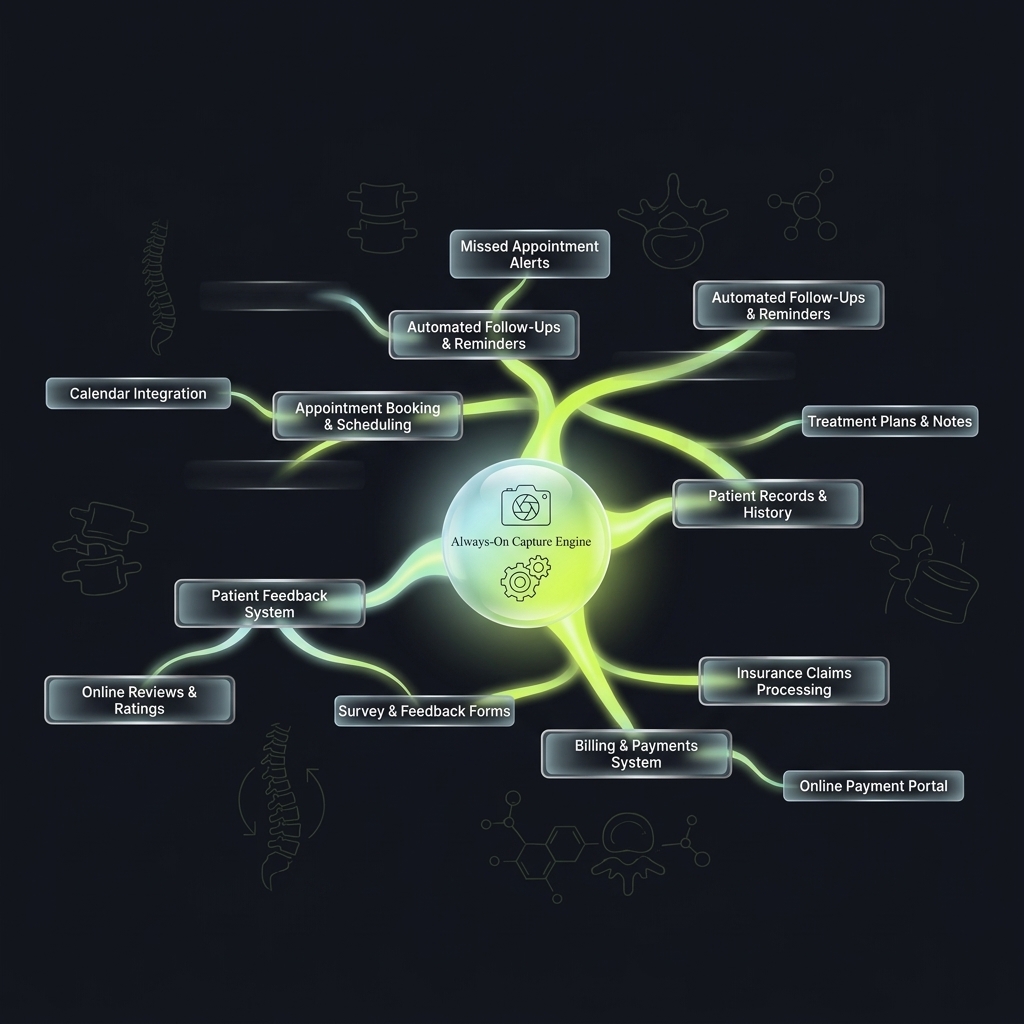
The Always-On Capture Engine
The Paradigm Shift: From "Business Hours" to "Patient Urgency"
The solution requires a belief shift. You are not managing a building that opens and closes.
You are operating a continuous triage system that matches patient urgency to available capacity.
The 6 PM searcher is not browsing. They are in pain. They are scared.
They want two things: clarity about what is wrong and a frictionless path to relief. Speed matters more than perfection.
A confirmed appointment at 7:30 AM tomorrow beats a phone call at 9:15 AM asking them to describe their symptoms again.
A 2024 study by Experian Health found that 89% of patients want the ability to schedule healthcare appointments anytime via online or mobile tools. This is not a preference.
This is table stakes. The practice that provides instant booking access while competitors sleep builds compounding market share advantage.
The operational model shifts from staffing hours to maintaining an always-on capture layer: a digital front door that stays open when your physical one closes.
The Four Pillars of the Always-On Flywheel
An effective after-hours capture system rests on four structural pillars. Each pillar operates independently, but they compound when integrated.
Pillar 1: Consistent Content Presence.
The 6 PM searcher types specific queries: "chiropractor for sciatica near me," "emergency back pain relief," "can a chiropractor fix a pinched nerve." If your practice has published clear, search-optimized answers to these exact questions, you appear in results when competitors do not.
The content does not sell. It educates. It positions your practice as the local authority before the searcher ever picks up the phone.
Pillar 2: Instantaneous Response Mechanics.
After hours, "response" does not mean a human picking up the phone. It means a structured digital pathway that confirms availability, answers common questions, and books the appointment without requiring staff intervention.
Pillar 3: Review Momentum.
A continuous stream of fresh reviews provides the social proof needed to validate a late-night booking decision. The searcher in pain is risk-averse.
Recent, specific reviews ("Dr. [Name] fixed my lower back in two visits") convert hesitation into action.
Pillar 4: Nurturing Communication Loops.
Not every after-hours searcher books immediately. Some need more information. Some are price-shopping. Some are not ready to commit.
A steady, automated communication loop keeps your practice top-of-mind. When their pain flares up three weeks later, you are the name they remember.
These four pillars create a flywheel. Content drives search visibility. Visibility drives late-night traffic. Fast response converts traffic to bookings. Reviews validate the decision. Communication nurtures the undecided.
Each cycle makes the next one easier.
The Science of the Response Window
The five-minute response threshold is not arbitrary. It reflects the psychological state of the searcher.
At 6:15 PM, they are in decision mode. They have pain. They have urgency. They are comparing options in real time.
If your practice provides instant confirmation, the decision closes. They stop searching. They mentally commit to your calendar slot.
If your practice requires them to wait for a callback, they stay in search mode. They keep scrolling. They find another option.
The trust mechanism is simple: immediate engagement satisfies the patient's need for control during a health crisis. They want to know that someone is listening, that their problem is understood, and that help is available.
A structured digital response provides all three without requiring a human to be awake.
The compounding effect of this advantage is dramatic. If you capture 70% of after-hours searchers while competitors capture 10%, you are not winning 60% more volume.
You are building a moat. Every patient you book is a patient your competitor does not get to treat, does not get to convert into maintenance care, and does not get to generate referrals from.
Over twelve months, this gap becomes insurmountable.
What Are the Execution Wall and Compliance Issues?
The execution wall refers to the practical challenge of implementing comprehensive after-hours capture systems, where basic solutions like booking links and auto-texts can be deployed quickly but only capture 10% of decided customers. The compliance trap involves the ongoing manual management burden required to maintain full systems that address insurance questions, technique explanations, objection handling, and lead nurturing for the remaining 90% of prospects.
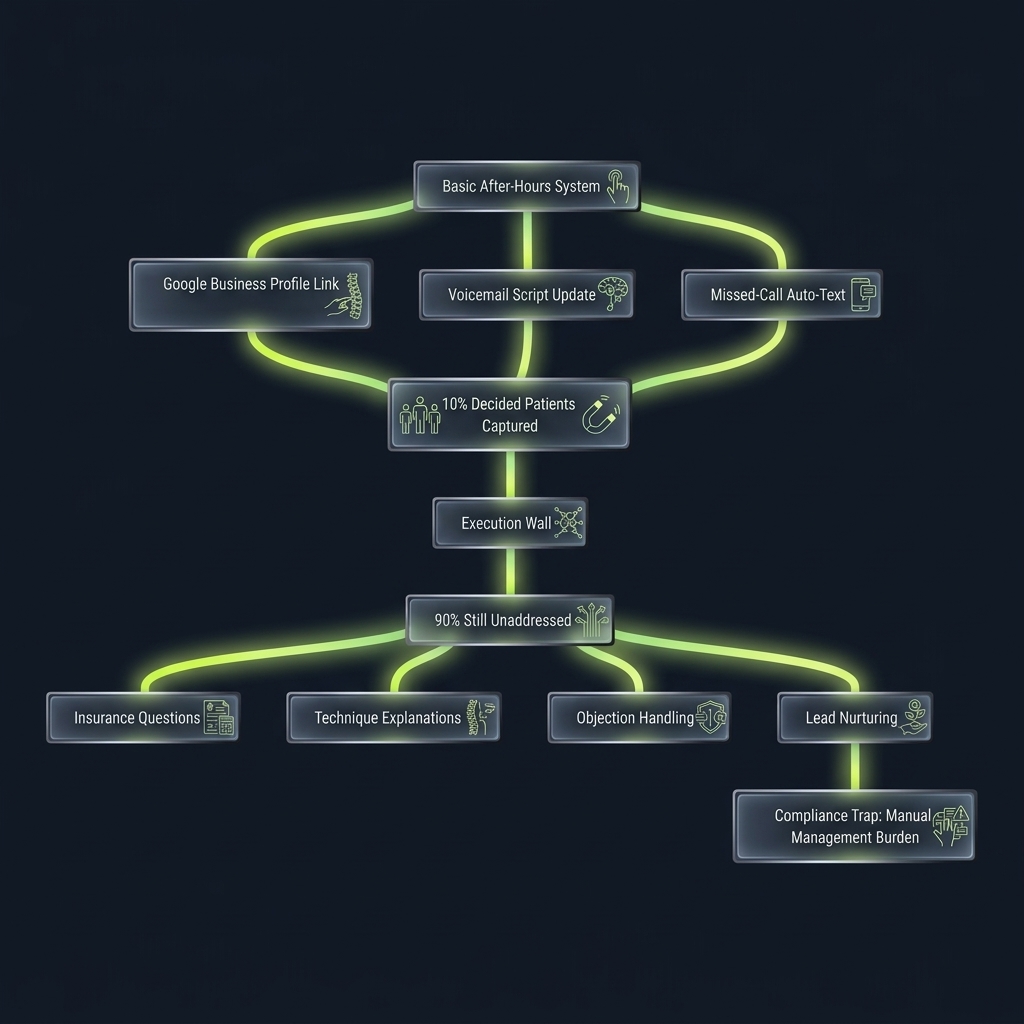
The Execution Wall and the Compliance Trap
The Monday Morning Protocol: a Practical Starting Point
The simplest version of an after-hours capture system can be assembled in one hour. It will not solve the full problem, but it will stop the worst bleeding.
Step 1: The Google Business Profile Integration.
Log into your Google Business Profile. Navigate to the "Appointments" section. Add a direct booking link as your primary call-to-action button.
This link should route to a scheduling tool that shows real-time availability and confirms bookings without staff intervention. Every searcher who lands on your profile now sees "Book Online" instead of "Call Now."
Step 2: The Voicemail Script Redesign.
Update your outgoing voicemail message: "You have reached [Practice Name]. To book an appointment right now, hang up and visit [YourWebsite.com/book]. You will receive instant confirmation. If you prefer to speak with our team, we are available Monday through Friday, 9:00 AM to 6:00 PM, and Saturday, 9:00 AM to 1:00 PM."
Step 3: The Missed-Call Auto-Text Trigger.
Most mobile carriers and practice management software platforms allow basic automation rules. Set up a trigger: when a call is missed after hours, send an automatic text message to the caller's number.
The message should be short: "Thanks for calling [Practice Name]. Book your appointment instantly here: [YourWebsite.com/book]. Need to talk? We are open Monday-Friday, 9 AM-6 PM."
Total setup time: one hour. Total cost: zero, assuming you already have scheduling software.
This protocol captures the 10% of searchers who are already decided and just need a booking link. It does nothing for the other 90%.
It does not answer questions about insurance. It does not explain your techniques. It does not handle objections. It does not nurture leads who are not ready to book immediately.
It is a tourniquet, not a cure.
The True Cost of Manual System Management
The full after-hours capture system requires continuous execution across all four pillars. Content must be created, optimized, and published weekly. Search rankings must be monitored and adjusted. Reviews must be solicited and responded to.
Communication loops must be maintained.
Let's calculate the real operational cost.
Writing and publishing one high-quality, search-optimized article per week: 4 hours. Monitoring and adjusting local search rankings: 2 hours. Soliciting and responding to reviews: 1 hour. Managing automated communication sequences: 1 hour. Updating and testing booking flows: 1 hour.
That is 9 hours per week. That is 468 hours per year.
If you value your time at $100 per hour as a practice owner, the annual cost of manual execution is $46,800.
This assumes you have the expertise to execute each task well. Most practice owners do not.
They can write, but they cannot optimize for search. They can respond to reviews, but they do not know how to systematically generate them. They can set up automation, but they cannot maintain it when the software updates or the workflow breaks.
The consistency tax is even higher. Manual systems break down when the clinic gets busy, when staff members call out, or when the owner needs to focus on patient care.
A system that only works when you have spare time is not a system. It is a hobby.
The Dangerous Shortcut: Generic AI and the Board Complaint Trap
The obvious shortcut is to deploy generic AI tools to handle the workload. ChatGPT can write content. It can draft review responses. It can answer patient questions.
This shortcut is a trap.
Large language models are non-deterministic. They generate different outputs for the same input. They hallucinate facts.
They make confident-sounding claims that are not true. When you deploy a generic AI tool to answer patient questions, you have no control over what it says.
The compliance nightmare is immediate. The Federal Trade Commission's Health Products Compliance Guidance, issued on December 20, 2022, requires that all marketing claims for healthcare services be truthful, not deceptive, and substantiated by competent and reliable scientific evidence.
A generic chatbot does not know this. It will cheerfully promise to "cure chronic sciatica" or "eliminate herniated disc pain permanently."
These are illegal therapeutic claims. The practice owner is liable for every word.
The Health Insurance Portability and Accountability Act (HIPAA) risk is worse. As of October 2024, the U.S. Department of Health and Human Services' Office for Civil Rights has settled or imposed civil money penalties in 152 cases, resulting in over $144.8 million in fines for HIPAA violations.
These settlements and penalties represent the outcomes of specific investigations based on their individual facts, but they signal the agency's enforcement posture clearly. Generic AI tools are not built for healthcare.
They do not handle protected health information correctly. They do not maintain proper audit logs. They do not comply with HIPAA's technical safeguards.
Using an uncalibrated tool to communicate with patients is not automation. It is outsourcing your professional liability to a system that does not understand the rules you are required to follow.
State chiropractic licensing boards can and do investigate advertising complaints. A single screenshot of your chatbot making an impermissible claim can trigger a formal inquiry.
The defense "I did not write that, the AI did" will not protect you. You are responsible for every communication that carries your practice name.
The System Must Run While You Sleep
The operational reality is clear. An effective, compliant, always-on capture system is not a project you complete.
It is an ongoing utility that must run continuously without consuming your clinical hours.
You have three choices.
You can execute the system manually, dedicating 9 hours per week and accepting the consistency tax when life gets busy. You can deploy generic tools and accept the regulatory risk.
Or you can use platforms that operate this whole loop end-to-end with healthcare-compliant guardrails built in: systems like Omniply that generate content, manage communication, and maintain HIPAA compliant software standards without requiring you to prompt, review, or babysit the output.
The choice is not between automation and no automation. The choice is between systems that understand healthcare compliance and systems that do not.
Your doors must close at 6:00 PM. Your practice should not.
Frequently Asked Questions
Is ChatGPT HIPAA Compliant for Patient Messages?
What Percentage of Patients Book Appointments After Hours?
Telecommunications and call analytics industry data confirms that roughly 34% of inbound inquiries and calls to service businesses arrive outside of standard business hours. Search volume for acute pain relief and chiropractic services peaks between 6:00 PM and 11:00 PM on weekdays, with additional spikes on weekends.
Do Automated Booking Systems Create More Work for Staff?
Properly configured systems reduce staff workload by eliminating phone tag and manual scheduling. The front desk receives confirmed bookings instead of voicemails to return.
The key is integration with your existing calendar system to prevent conflicts and ensure accurate availability display.
What Percentage of Missed Clinic Calls Call Back?
How Do Automated Systems Prevent Double Booking?
How Long Will a Patient Wait for a Callback?
The Harvard Business Review and MIT Lead Response Management study found that lead conversion rates drop dramatically after five minutes. Patients in pain are actively comparing options.
If they do not receive immediate confirmation from your practice, they move to the next provider who offers instant booking.
How Much Does a Missed Patient Call Cost?
If your average new patient generates $850 in lifetime revenue and you miss three high-intent calls per week, the annual cost is $132,600 in lost revenue. This figure does not account for the inflated patient acquisition cost of running marketing campaigns that drive traffic during hours when your capture mechanism is offline.