
Your front desk is empty at 12:15 PM.
The phone rings three times and goes to voicemail. That silent ring costs your practice exactly $150.
Most chiropractic owners look at their clinical schedule to find revenue leaks. They should look at their phone logs instead. There is a specific sixty-minute window every day where new patients slip away. We call this the Leaky Hour.
It happens during lunch breaks, morning rushes, or shift changes. Your staff cannot be in two places at once. Yet, letting a new inquiry go to voicemail is a quiet drain on your cash flow. Modern patients do not leave messages; they simply call the next clinic on Google.
This is why a system that catches every missed call is an operational necessity, not an administrative luxury.
This article audits the real cost of your Leaky Hour and outlines the exact steps to capture every single prospect who dials your number.
Key Takeaways
- Revenue Loss Quantified: Chiropractic practices missing four calls weekly lose approximately $150,000 annually, calculated from a $1,500 patient lifetime value and 50% conversion rate on answered calls.
- Leaky Hour Defined: The 12:00 PM to 1:00 PM lunch window and 5:01 PM to 6:30 PM after-hours period represent predictable call volume peaks when 62% of incoming calls go unanswered and 85% of voicemail recipients hang up without leaving messages.
- Response Speed Advantage: Practices responding to leads within five minutes are 21 times more likely to convert compared to 30-minute delays, and 78% of patients book with the first business that responds to their inquiry.
- Staffing Cost Reality: Adding a full-time front desk employee costs $67,000 annually including benefits (31.4% of compensation) but only covers 24% of the 168-hour week, leaving systematic coverage gaps unresolved.
- AI Compliance Risk: Generic AI models like GPT-4 fabricate medical citations 18% of the time and lack HIPAA-compliant infrastructure, exposing practices to civil penalties ranging from $145 to $2,190,294 annually for Protected Health Information violations.
How Do Busy Clinics Handle Missed Patient Phone Calls?
Busy clinics often miss patient calls during peak periods when front desk staff are simultaneously managing check-ins, check-outs, and insurance verifications. Most missed calls occur during lunch hours when staff are unavailable but patient intent is highest, and after-hours when practices are closed. These calls typically go to voicemail, with 85% of callers hanging up without leaving messages and calling competitors instead.
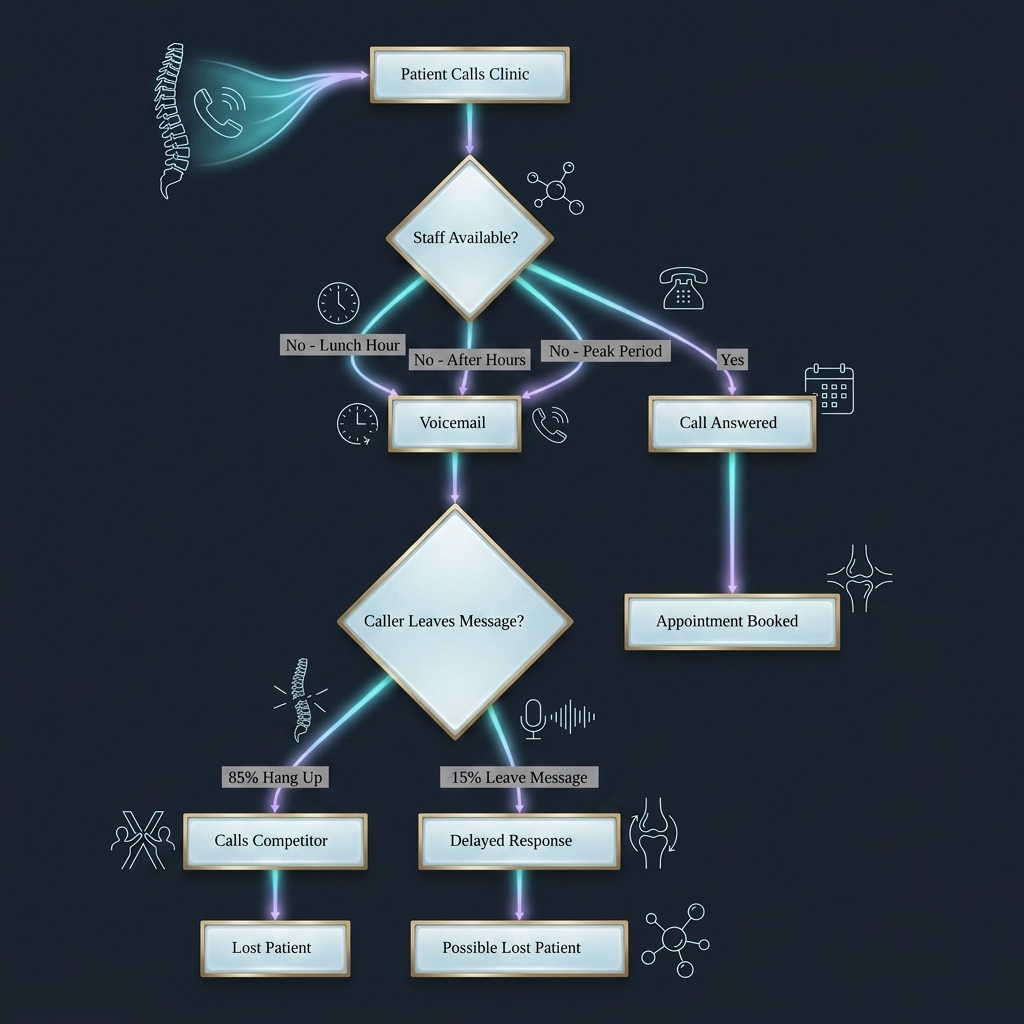
The Monday Morning Mirage: a Scene From the Front Lines
Picture your clinic at 11:45 AM on a Monday.
A patient is checking out at the front desk, credit card in hand. Another is waiting in the adjustment room. Your coordinator is pulling up the billing screen while simultaneously trying to answer a question about insurance coverage. The phone rings.
She glances at it. The second ring. She's mid-sentence with the checkout patient. Third ring. Voicemail picks up.
On the other end of that call is a 34-year-old office worker with acute lower back pain, sitting in her car during lunch break. She's already Googled "chiropractor near me," opened three tabs, and this is her second call. The first clinic didn't answer either.
She hears the voicemail greeting. She hangs up. She clicks back to her search results and dials the next number.
The data on this behavior is unambiguous: 85% of callers who reach a business voicemail hang up without leaving a message. Your competitor down the street just answered on the second ring. She books an appointment for tomorrow at 3:00 PM.
You never knew she existed.
Defining the Mechanism: the Leaky Hour
The Leaky Hour is any sixty-minute window where your call volume and your staff availability are misaligned.
The most dangerous window is 12:00 PM to 1:00 PM. Your team is at lunch. Your prospective patients are also at lunch, which means they finally have time to make healthcare calls. This is when intent is highest and your phone goes directly to voicemail.
The second leak occurs between 5:01 PM and 6:30 PM. Your practice is closed. Your prospect just finished work and is sitting in traffic, scrolling their phone, ready to book. You are unavailable.
A third, less visible leak happens during your mid-morning patient surge. When your clinical schedule is packed and your front desk is managing check-ins, check-outs, and insurance verifications simultaneously, incoming calls become background noise. Research shows that 62% of incoming calls to small businesses go unanswered altogether.
These are not random gaps. They are predictable, recurring patterns.
The Brutal Math of the Missed Call
Let's calculate what you are actually losing.
Start with the lifetime value of a single chiropractic patient. A conservative estimate includes an initial care plan (12 visits at $65 per adjustment), plus six months of maintenance care (twice monthly), plus one family referral within the first year. That totals between $1,500 and $2,500 per patient over two years, with higher-value cases (sports injuries, chronic pain management) averaging $3,200.
Now count your missed calls. Pull your Voice over IP system's call logs for last week. Cross-reference every incoming call against your patient check-in sheet and your manual intake forms. Most practices discover they miss between three and five calls per week during lunch and after-hours windows alone.
Use four missed calls per week as the baseline. Apply a 50% conversion rate for new patient inquiries (the industry standard for practices that actually answer the phone). You are losing two new patients every week.
Two patients at $1,500 each: $3,000 per week. Multiply by 50 working weeks: $150,000 per year.
That is the revenue walking out the door because your front desk cannot be in two places at once.
But the damage compounds. Every missed call also burns your marketing spend. If you are paying $200 per new patient in Google Ads or direct mail, and half of those leads hit voicemail and immediately call a competitor, your actual customer acquisition cost doubles to $400. You are funding your competitor's growth.
Why the Obvious Fixes Fail
The instinct is to hire another front desk person.
The math does not support it. According to the Bureau of Labor Statistics, the median annual wage for medical secretaries and administrative assistants, the correct classification for a chiropractic front desk role, is $45,930. Add employer taxes, health benefits, and paid time off, which together account for 31.4% of total compensation, and the true cost reaches approximately $67,000 per year.
A single full-time employee covers 40 hours of your 168-hour week. That is 24% coverage. Your Leaky Hour still exists every single day. You have added $67,000 in fixed costs to capture a fraction of the problem.
The second instinct is to deploy an automated phone menu. Press 1 for appointments. Press 2 for billing. Press 3 to speak with a team member.
This destroys trust. A patient in pain does not want to navigate a corporate phone tree. They want a human voice. Interactive Voice Response systems increase call abandonment rates because they add friction at the exact moment when the patient is deciding whether your practice feels accessible.
The third instinct is to rely on voicemail and promise a callback within 24 hours.
This is a death sentence. The patient who called you at 12:15 PM has already booked with someone else by 12:30 PM. The data is definitive: 78% of customers buy from the first business that responds to their inquiry. If you are not first, you are not in the conversation.
How Do You Recover Patients When You Miss Calls?
Patient recovery when calls are missed requires a three-rung system: first, an automated SMS acknowledgment within 45 seconds stops patients from continuing their search; second, a conversational messaging bridge collects appointment details and offers available time slots; third, the system converts the interaction into a confirmed booking without requiring staff intervention during the initial contact.
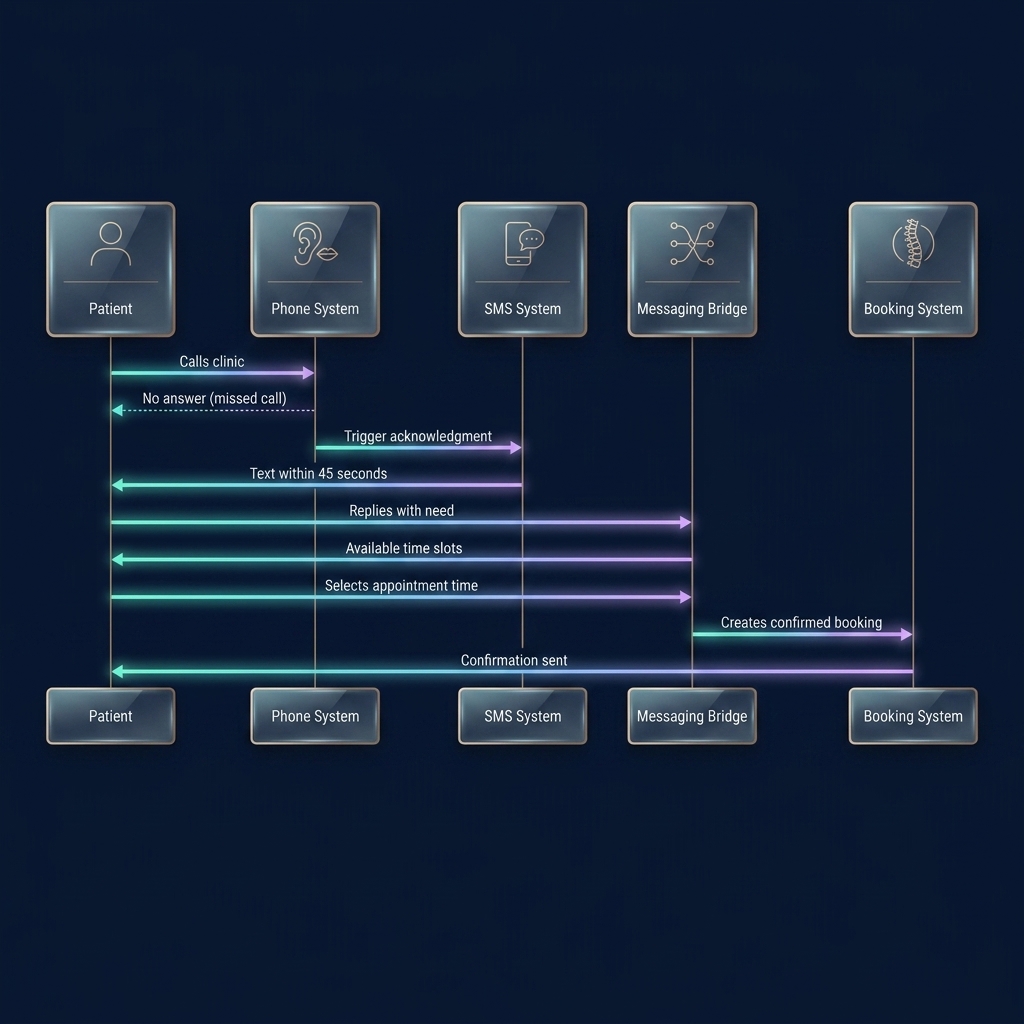
The Architecture of Patient Recovery
The solution is not about answering more calls. It is about building a system that recovers the patient even when you miss the call.
This requires a shift in how you think about front desk operations. You are not trying to staff for every possible call. You are building a safety net that captures the patient's intent the moment they reach out, holds that intent, and converts it into a booked appointment.
The First-to-Answer Advantage
Modern patients operate on an on-demand expectation. They do not plan their healthcare shopping three days in advance. They feel pain, they search, they call, they book—all within a fifteen-minute window.
Speed is not a convenience factor. It is the primary decision variable. Practices that respond to a lead within five minutes are 21 times more likely to qualify that lead compared to those who wait 30 minutes. By the time you call back tomorrow morning, the patient has already attended their first appointment somewhere else.
This is why the system must operate in real time, not on your team's schedule.
The Three-Rung Recovery System
The mechanism that solves this has three parts.
Rung 1: The Instant Text Acknowledgment. Within 45 seconds of a missed call, the patient receives a Short Message Service text: "Hi, this is [Your Practice Name]. We just missed your call. How can we help you today?" This single message halts the patient's search. They are no longer scrolling through Google results. They are in a conversation with you. SMS messages have a 98% open rate, with 90% opened within three minutes. Email, by comparison, sits at 20%.
Rung 2: The Conversational Bridge. The patient texts back: "I need to book an appointment for lower back pain." A HIPAA compliant messaging system responds with your next available slots, answers basic scheduling questions, and collects the information your front desk needs to prepare the chart. This is not a cold, impersonal booking link. It is a structured conversation that feels like texting with your front desk, even when your office is closed.
Rung 3: The High-Context Callback. When your team arrives Monday morning, they do not face a voicemail inbox full of blind callbacks. They have a queue of warm leads, each with context: the patient's chief complaint, their preferred appointment times, and their responses to pre-qualification questions. The callback is no longer a cold prospecting call. It is a confirmation conversation.
This system does not replace your front desk. It extends their capacity across the hours they cannot physically cover.
The Compounding Effects of Consistent Response
A fast response system does more than capture individual patients. It creates a flywheel.
First, it changes how patients perceive your practice. The speed of your initial response sets expectations for the entire care experience. A practice that answers instantly signals operational competence. A practice that calls back two days later signals disorganization.
Second, it increases your review volume. More patients booked smoothly means more opportunities for five-star reviews. This is not a soft benefit. 84% of patients check online reviews before booking care, and 75% will refuse to book with a provider rated below 4.0 stars. Each additional review compounds your local search visibility, which drives more organic calls, which feeds the system.
Third, it reduces front desk burden. When your team is not chasing down voicemails and playing phone tag, they have bandwidth to focus on the patients standing in front of them. This improves in-office experience, which reduces patient churn, which increases lifetime value.
The system pays for itself in captured revenue, then continues to pay in operational efficiency.
Why Do Most Practices Fail to Implement New Systems?
Most practices fail to implement new systems because they lack the dedicated time required for full execution. The complete patient recovery system demands 10 to 15 hours weekly for content creation, review workflows, and text response management. Practice owners and front desk staff typically operate at full capacity, creating an execution gap that prevents successful implementation.
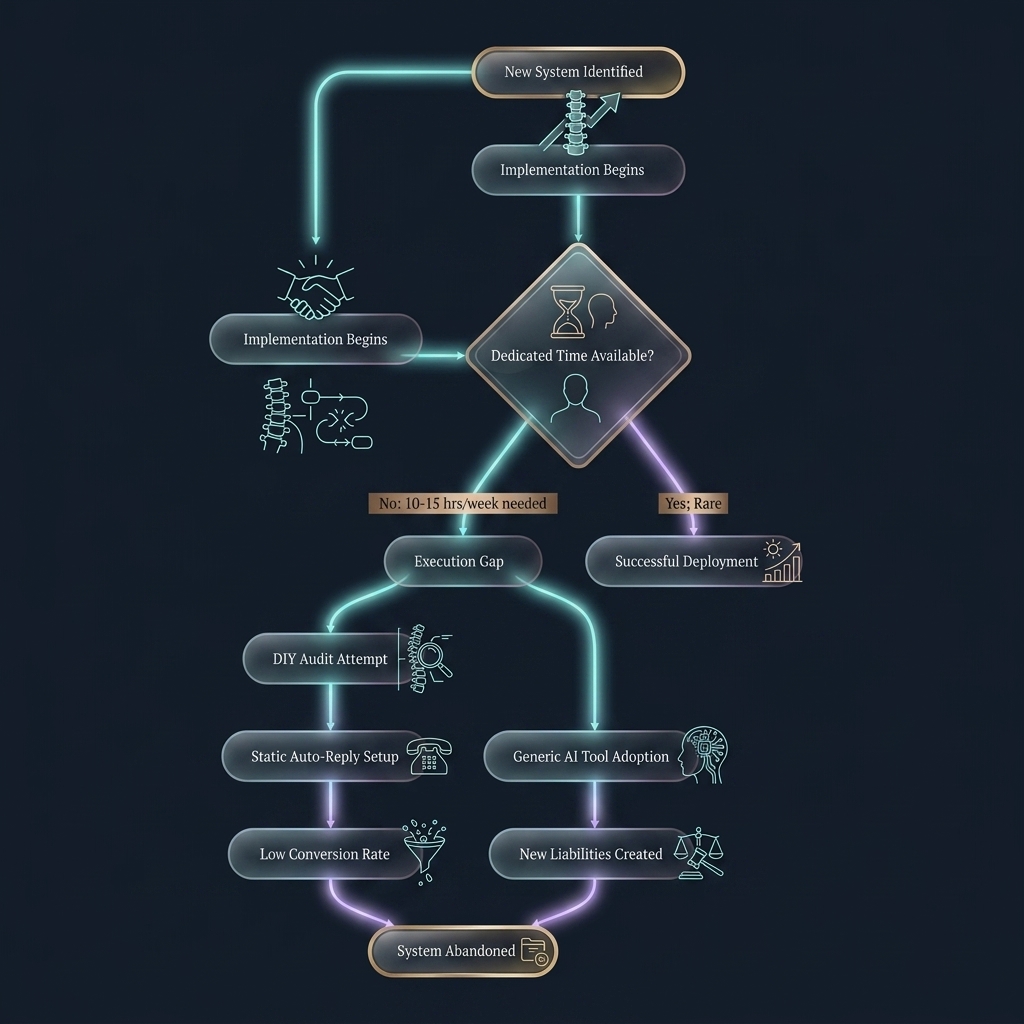
The Execution Wall
You now understand the system. The next question is how to deploy it.
This is where most practices hit the wall.
The DIY Audit
Start with a one-week baseline audit. Export your phone system's call logs for five business days. Cross-reference every incoming call against your patient check-in records. Document every missed call: the time, the duration it rang, and whether your team called back.
Next, measure your callback speed. For every missed call your team did return, calculate the delay between the missed call and the actual callback. Most practices discover their average callback time is between four and eight hours.
Finally, enable a basic auto-reply text in your existing phone system. Most Voice over IP providers offer this feature. Set a static message: "Thanks for calling [Practice Name]. We will call you back shortly. You can also book online at [link]."
This entire setup takes about 45 minutes of technical work, plus 30 minutes per day of manual tracking.
The problem is that a static text and a booking link do not convert at the rate you need. The patient who texts back with a question gets no response. The patient who needs to ask about insurance coverage before booking hits a dead end. You have acknowledged the call, but you have not captured the patient.
The Full System Requires Full-Time Execution
To run the complete patient recovery system, instant text response, conversational follow-up, callback preparation, plus the content engine that feeds your inbound call volume in the first place, you need between 10 and 15 hours per week of dedicated labor.
That labor breaks down into content creation (weekly blog posts optimized for local search, social media updates, monthly patient newsletters), review generation workflows, and the ongoing management of the text-back system itself.
Most practice owners do not have 10 extra hours per week. Most front desk coordinators are already working at capacity.
This is the gap where practices turn to generic AI tools.
Why Generic AI Creates New Liabilities
The promise of tools like ChatGPT is appealing: automate the text responses, generate the content, handle the patient communication without adding headcount.
The reality is that generic AI is non-deterministic. It does not follow rules; it predicts the next most likely word based on patterns in its training data. This means its output is inconsistent and occasionally bizarre. Recent studies on medical hallucinations in foundation models like GPT-4 found that they fabricate or hallucinate medical citations roughly 18% of the time. A global survey of clinicians found that 91.8% had encountered AI hallucinations, and 84.7% believed these specific errors could directly cause patient harm.
You cannot hand a non-deterministic system access to patient communication and walk away. You must review every message it sends, which reintroduces the time burden you were trying to eliminate.
Worse, generic AI has no concept of healthcare advertising regulations. It will confidently write claims you are not allowed to make: "Our adjustments cure sciatica instantly." "We guarantee pain relief in one visit." These statements violate state chiropractic board rules and expose you to disciplinary action.
The compliance risk extends to Protected Health Information. Under current Health Insurance Portability and Accountability Act regulations, civil monetary penalties for HIPAA violations range from $145 to $73,011 per violation, with annual caps reaching $2,190,294 for willful neglect. Generic AI platforms are not built to handle Protected Health Information securely. Using them for patient communication creates legal exposure most practices cannot afford.
The system is right. The execution requires specialized infrastructure.
The Operated Solution
The practices that solve this successfully do not build the system themselves. They deploy platforms that operate the entire loop end-to-end: weekly content published to their website, social posts, patient newsletters, and a compliant AI assistant that handles missed calls and after-hours inquiries, all generated from the practice's own voice and reviewed before it goes live. Omniply is one example of this category, built specifically for chiropractic practices.
The value is not in the software. The value is in the operation. The system runs without adding tasks to your team's plate.
Should We Manage Our Front Desk or Outsource It?
The decision depends on whether a practice wants to operate call management systems internally or deploy an automated platform. Since missed calls represent lost patients and wasted marketing spend, the core issue is systematic call coverage rather than staffing. Practices should evaluate their capacity to maintain consistent phone availability against outsourced solutions that eliminate coverage gaps.
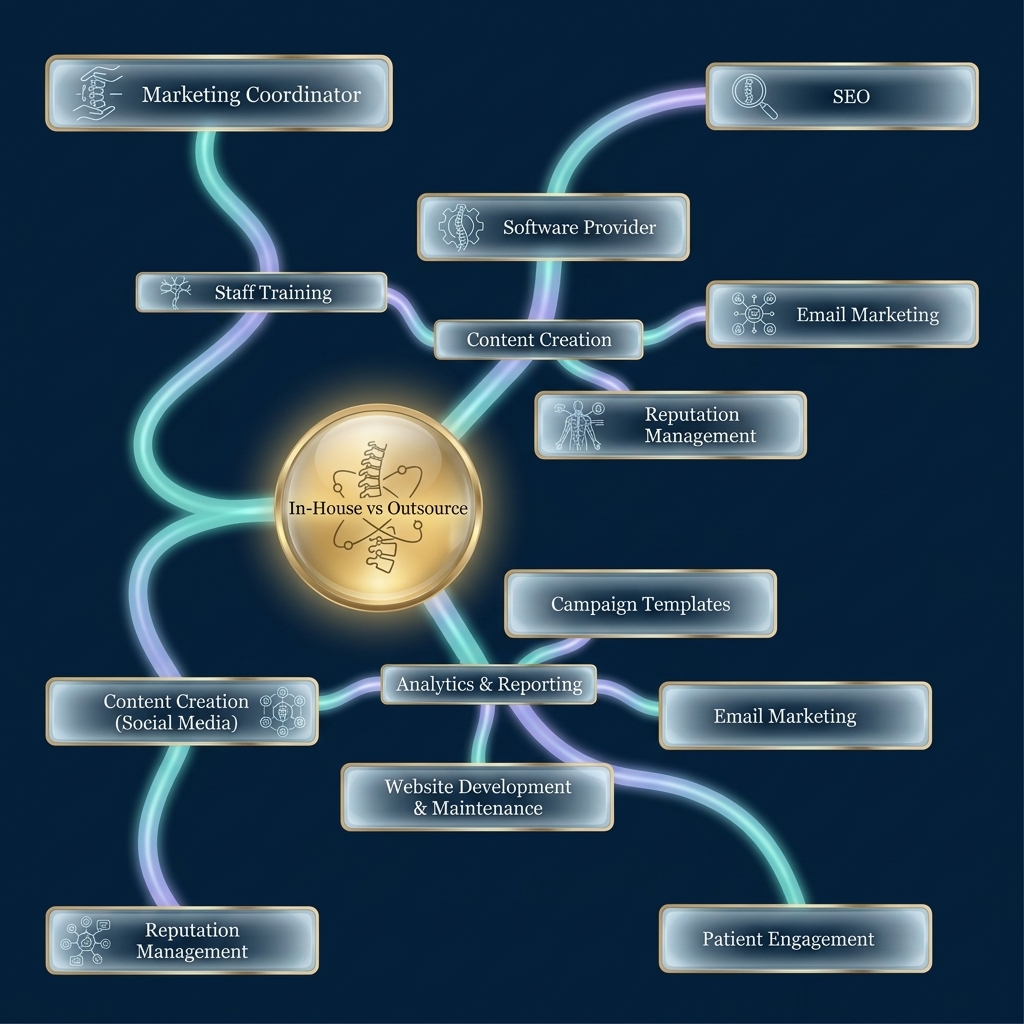
The Decision in Front of You
Your front desk cannot be in two places at once.
Every ring you miss is a patient your competitor is currently welcoming through their doors. Every voicemail you leave unanswered is marketing spend you are burning.
The Leaky Hour is not a staffing problem. It is a system problem. You can audit it, measure it, and calculate exactly what it costs you. The solution exists. The question is whether you want to operate it yourself or deploy a platform that does it for you.
Stop paying for marketing that rings an unanswered phone.
Frequently Asked Questions
What is a Normal Missed Call Rate for Clinics?
Most small practices miss between 30% and 40% of incoming calls during peak hours and after-hours windows. Research shows that 62% of calls to small businesses go unanswered altogether. The rate varies by practice size and front desk staffing, but any missed call represents lost revenue.
How Much Revenue Do Clinics Lose From Missed Calls?
A practice missing four calls per week, with a 50% conversion rate and an average patient lifetime value of $1,500, loses approximately $150,000 annually. Higher-volume practices or those in competitive markets lose significantly more. The calculation depends on your specific patient lifetime value and call volume.
Is Automated Text Back HIPAA Compliant for Clinics?
Only if the platform is specifically built for healthcare communication and uses encrypted messaging channels. Generic SMS systems and standard business texting apps do not meet Health Insurance Portability and Accountability Act requirements for handling Protected Health Information. Verify that any system you deploy includes a Business Associate Agreement and encrypted data storage.
Can ChatGPT Write Text Replies for Missed Clinic Calls?
Not safely. Generic AI models like ChatGPT are non-deterministic, meaning their output is unpredictable. They frequently fabricate information and will write clinical claims that violate healthcare advertising regulations. They also lack HIPAA-compliant infrastructure for handling patient data. Using them for patient communication creates both operational and legal risk.
Should I Hire a Call Center for My Clinic?
Traditional call centers add cost without solving the core problem. Most charge per call or per minute, which compounds quickly. They also lack the clinical context to handle chiropractic-specific questions and often create a disconnected patient experience. A specialized automated system provides faster response, lower cost, and better conversion rates.
How Long Does Front Desk Phone Training Take?
Initial training for a new front desk coordinator typically requires 20 to 30 hours of shadowing and practice. Ongoing coaching to maintain high conversion rates on new patient calls requires monthly review and feedback. The time investment is significant, which is why turnover at the front desk position is so costly.
How Do I Audit My Front Desk Phone Calls?
Export your phone system's call logs for one week. Cross-reference every incoming call against your patient check-in records and intake forms. Document each missed call and measure the time delay between the missed call and your team's callback. This baseline audit takes about 30 minutes per day and reveals your exact leakage rate.