
A prospective patient fills out an inquiry form at 7:15 PM on Tuesday. By Wednesday at 9:00 AM, that person has already booked with the practice down the street.
You paid $65 to generate that inquiry. Your ad worked. Your website worked.
Your front desk did nothing wrong. They were simply off the clock.
This is The Response Gap. Most practice owners blame campaign strategy when ad dollars burn. The math says otherwise.
Your inquiry response time dictates whether your budget yields new consults or donates cash to your local competitors. Wait an hour, and the prospect is gone.
Traffic is not your problem. Speed is.
This article breaks down the precise financial math behind fast inquiry response, why standard front-desk workflows fail after hours, and the exact operational shifts required to secure every inquiry before they call someone else.
Key Takeaways
- Response Velocity Math: Responding within five minutes makes practices 21 times more likely to qualify inquiries and 100 times more likely to make contact compared to waiting thirty minutes, according to Dr. James Oldroyd's research published in Harvard Business Review.
- Cost Per Patient Impact: Practices with two-hour average response times pay $567 per acquired patient at $85 per inquiry, while five-minute response times reduce cost to $189 per patient - three times more patients at one-third the unit cost from identical ad spend.
- Structural Front-Desk Failure: Medical practices experience 40 percent annual turnover in front-office roles per MGMA's 2023 report, making manual inquiry follow-up structurally impossible when staff must prioritize patients physically present over digital form submissions during clinical hours.
- After-Hours Conversion Loss: PatientPop research shows 34 percent of new patients encountering busy signals or voicemail will not leave messages and simply call the next provider, with inquiries submitted at 7:15 PM typically booking with competitors by 9:00 AM the next day.
- Trust Signal Economics: Fast response speed functions as the primary operational competence signal for prospective patients who cannot evaluate clinical quality pre-visit, directly influencing appointment no-show rates and conversion from "evaluating options" to "preparing for my visit" before attention shifts elsewhere.
Why is Increasing My Ad Spend Not Bringing Results?
Increasing ad spend fails to deliver results because most practices suffer from a conversion problem, not a traffic problem. While they pay $85 to $145 per inquiry, over half of inbound leads go uncontacted during clinical hours due to delayed response times and overwhelmed front desk staff, creating a leaky bucket that wastes acquisition investment.
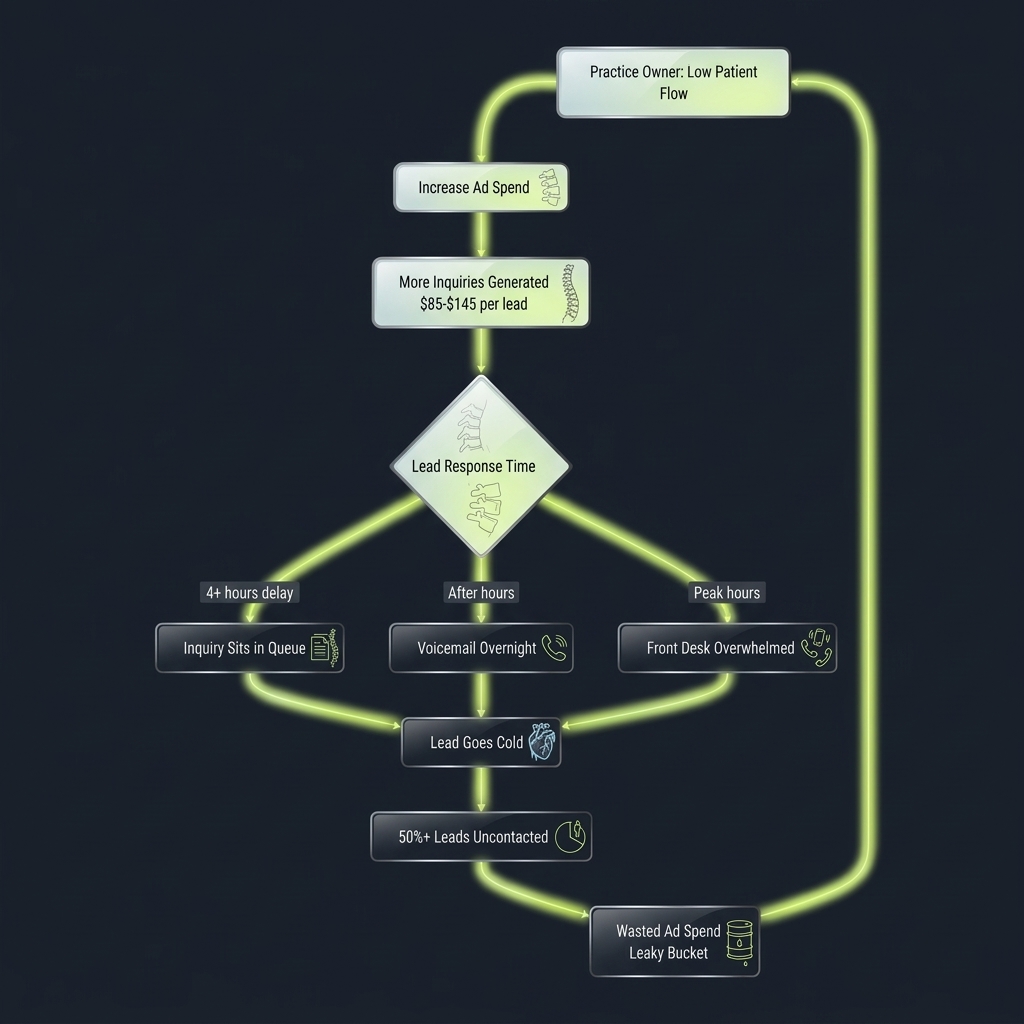
The "More Ad Spend" Trap
Most practice owners default to the same solution when new patient flow slows: increase the ad budget.
The logic feels airtight. More visibility means more traffic. More traffic means more inquiries. More inquiries mean more booked appointments. Marketing agencies reinforce this view because their revenue depends on it. They promise fifty new inquiries per month through Meta or Google campaigns, and the numbers look compelling on the proposal.
The problem surfaces downstream.
You pay $85 to $145 per inquiry in paid channels. The average blended cost across healthcare is $163 per inquiry. Those numbers come from LanderLab's 2026 benchmarks across thousands of practices. You are spending real money to generate real interest from real people in your market.
Then those inquiries sit in a webform queue for four hours. Or they land in voicemail at 6:45 PM and get returned at 9:30 AM the next day. Or they arrive during a lunch rush when your front desk is managing three check-ins, two phone calls, and a payment dispute.
This is the Leaky Bucket reality. You are pouring expensive fuel into a conversion engine with a cracked block.
Over sixteen years working with local practices and health professionals, the pattern repeats: practices spend thousands per month on acquisition while more than half of inbound inquiries go uncontacted during clinical hours because the team is rightly focused on the patients standing in front of them.
Volume does not solve a velocity problem.
How Fast Does Lead Response Time Decay?
Lead response time decay is measured in minutes, not hours. Research by Dr. James Oldroyd shows that responding within five minutes makes businesses 21 times more likely to qualify an inquiry and 100 times more likely to make contact compared to waiting thirty minutes. Intent peaks immediately upon form submission and deteriorates rapidly thereafter.
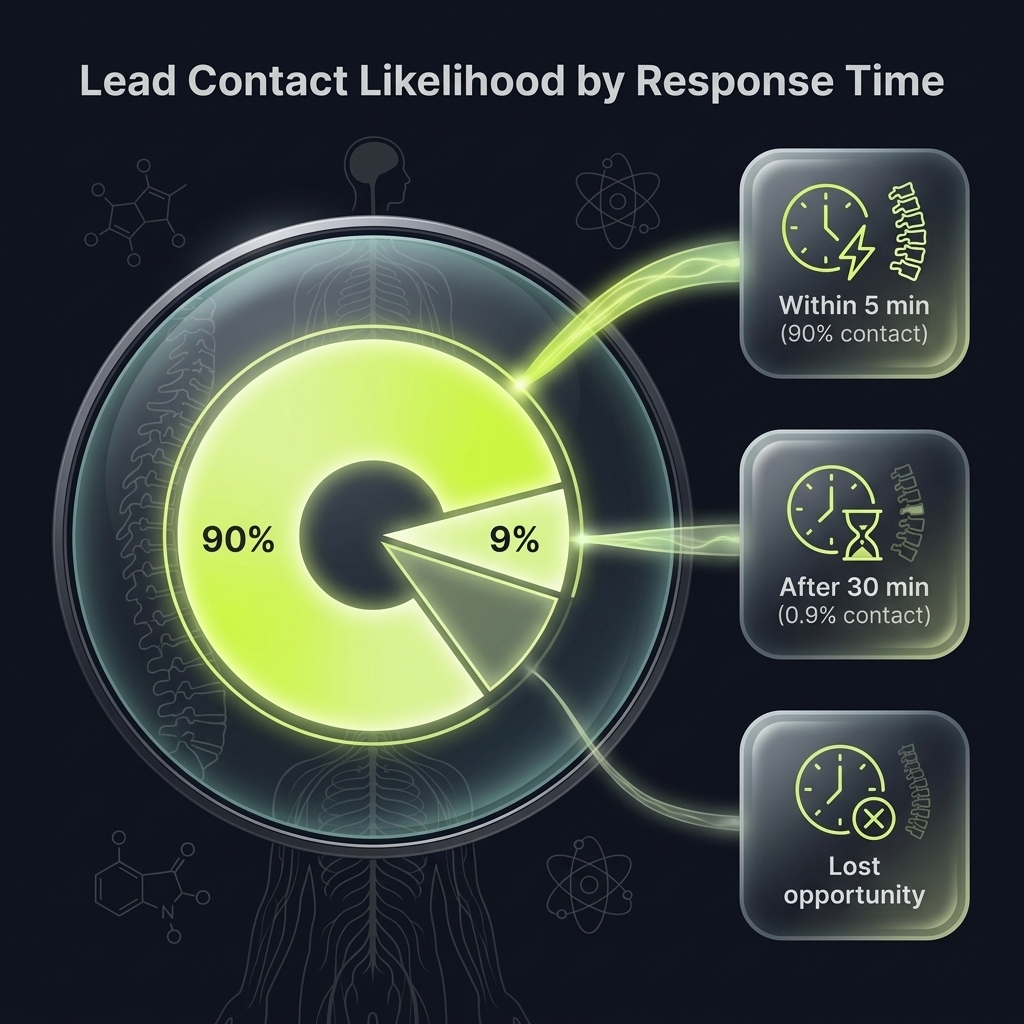
Intent Decays in Minutes, Not Hours
The person who fills out your inquiry form is not casually browsing. They are in discomfort, frustrated with their current state, or seeking immediate relief. Their intent is at maximum the second they hit submit.
That intent has a half-life measured in minutes.
Twenty-one times. Not 21 percent; 21 times.
The mechanism is straightforward. A person seeking chiropractic care submits forms to two or three local practices simultaneously. They are comparison shopping, but not passively. The first practice to deliver a clear, responsive touchpoint wins the appointment. The others get ignored or receive a "no longer needed" reply.
Here is the math on a typical practice:
You generate twenty inquiries per month at $85 each. Total spend: $1,700. If your average response time is two hours, your contact rate drops to roughly 30 percent based on the Oldroyd data. You successfully reach six people. If half of those book, you acquire three new patients.
Cost per acquired patient: $567.
Now run the same scenario with a five-minute response window. Your contact rate jumps to 90 percent. You reach eighteen people. Half book. Nine new patients.
Cost per acquired patient: $189.
Same ad spend. Same inquiry volume. Three times the patient acquisition at one-third the unit cost.
The difference is not your campaign creative or your landing page copy. The difference is the sixteen minutes between your response and your competitor's.
Why is My Medical Front Desk Failing to Follow up?
Medical front desks fail at follow-up due to structural role conflict, not lack of effort. Staff must prioritize patients physically present over digital inquiries, making timely responses impossible during high-volume periods. Combined with 40 percent annual turnover and unpredictable daily demands like sick calls and rush periods, manual follow-up systems collapse under real operational pressure.
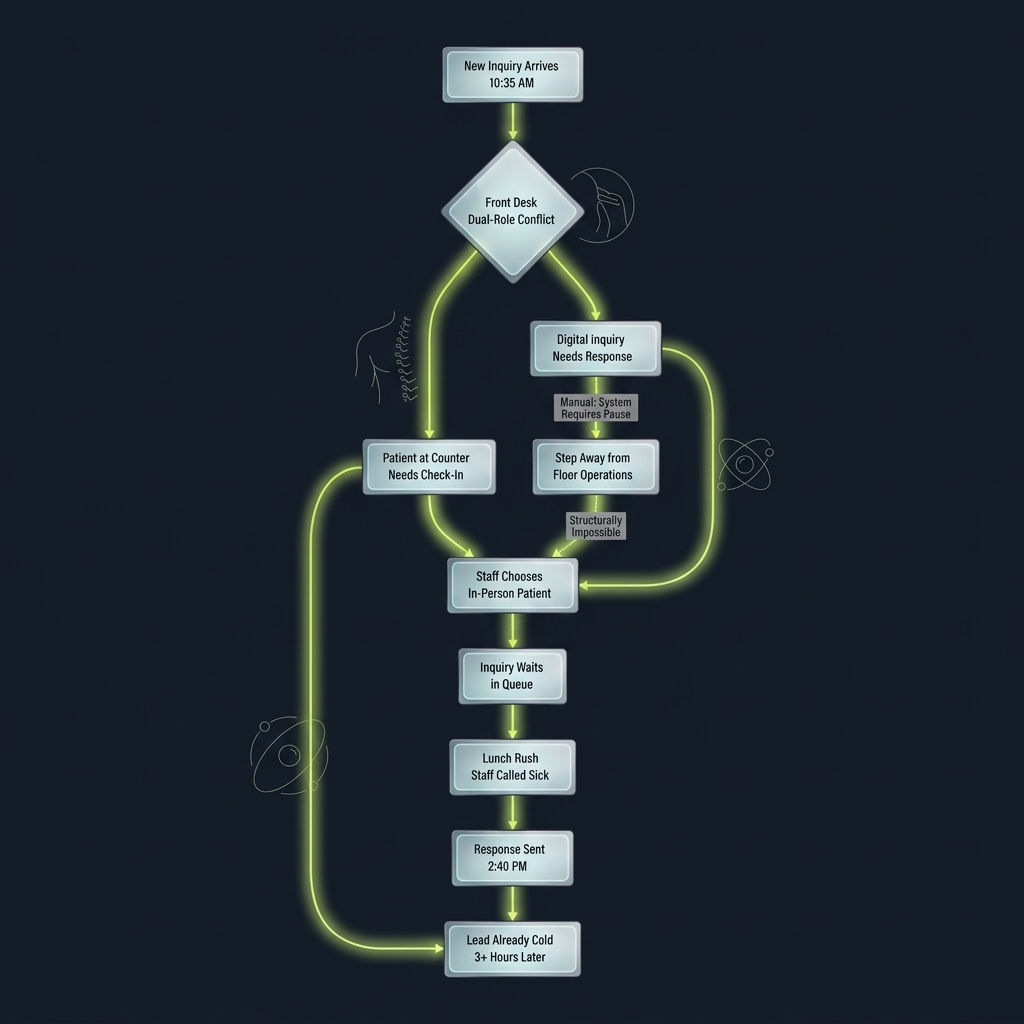
The Front-Desk Bottleneck Nobody Names
The obvious solution is to tell your front desk to respond faster. Elite practice coaches provide detailed playbooks: call immediately, text twice a day, follow up for seven days straight.
The playbook is correct. The execution is structurally impossible.
Your front desk operates in a dual-role conflict. They are simultaneously running floor operations for patients physically present and acting as the first point of contact for prospective patients who exist only as form submissions and voicemail messages.
The in-person work is non-negotiable. Checking in arrivals, processing payments, answering the ringing phone, managing room flow, handling insurance verifications, and coordinating with the clinical team. These tasks cannot be paused.
When a webform inquiry arrives at 10:35 AM during a packed morning, your front desk faces an impossible choice: step away from the patient standing at the counter to manually text a stranger, or prioritize the person in front of them and respond to the inquiry later.
They choose the patient in front of them. This is the correct clinical and operational decision.
The inquiry goes cold.
Manual follow-up systems work perfectly on paper and fail the moment real clinical volume hits. Staff call in sick. Lunch rushes happen. Afternoons get slammed. The inquiry that arrived at 11:50 AM gets addressed at 2:40 PM, which might as well be next week in conversion terms.
Medical practices experience 40 percent annual turnover in front-office support roles, according to the Medical Group Management Association's 2023 operations report. High attrition driven by demanding workloads means you cannot build a reliable inquiry response system on top of already-stretched human capacity.
The bottleneck is not effort. The bottleneck is structure.
Why Does Response Speed Build Trust With New Patients?
Response speed builds trust because prospective patients cannot evaluate clinical quality before their first visit, so they judge a practice's operational competence through communication responsiveness. Fast replies signal organized systems, on-time appointments, and reliable follow-through. Delayed responses create doubt about whether care will be managed smoothly, causing patients to choose competitors instead.
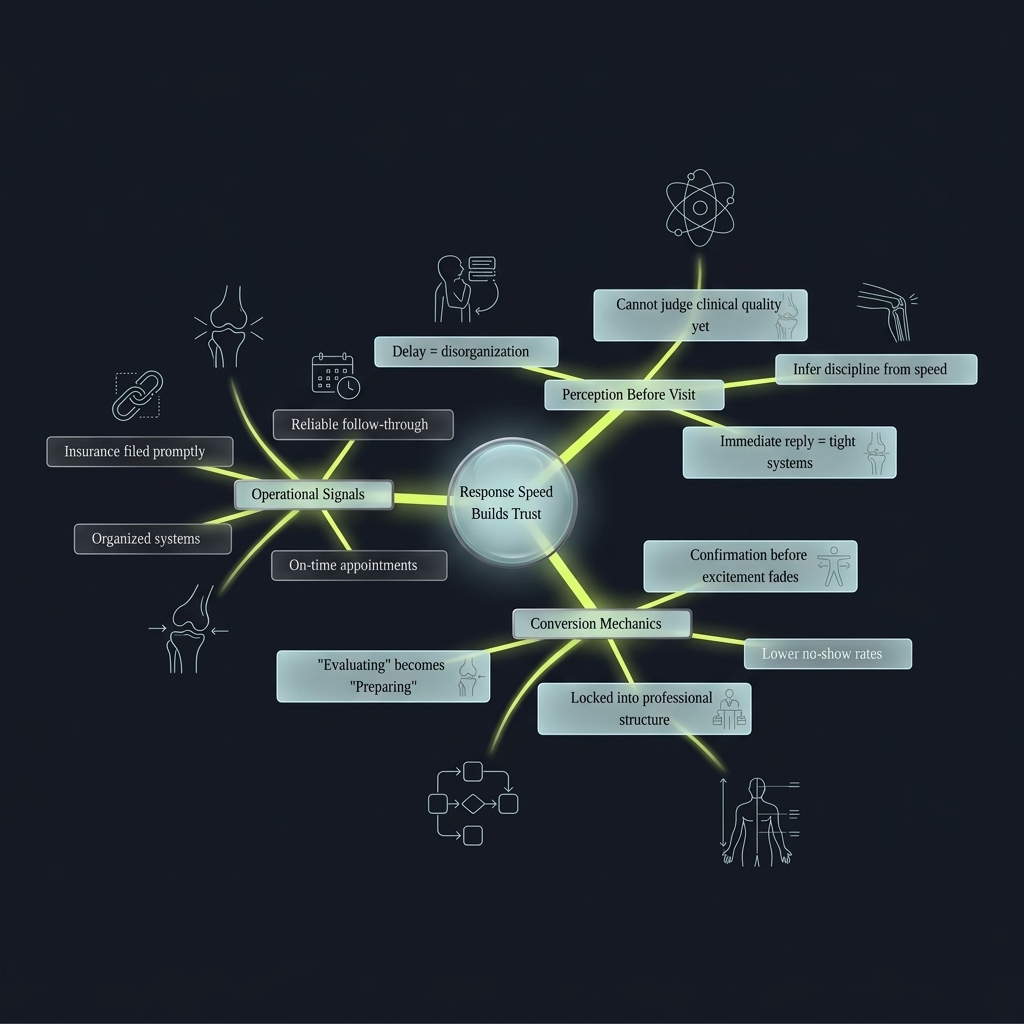
Speed Signals Trust Before the First Visit
Fast response is not just a sales tactic. It is the prospective patient's first impression of how your practice operates.
A person evaluating chiropractic care is making two simultaneous decisions: whether the clinical approach fits their needs, and whether the practice itself is organized enough to deliver consistent care. They cannot evaluate clinical quality before the first visit. They can only evaluate operational signals.
Responsiveness is the loudest signal.
An immediate, professional reply communicates that your practice runs tight systems. It suggests that appointments start on time, that treatment plans get followed up, that insurance claims get filed promptly. The prospective patient has no direct evidence of these things, but they infer operational discipline from communication speed.
The inverse is equally true. A delayed response, or worse, no response, communicates disorganization. The prospective patient begins to doubt whether their actual care will be managed smoothly. Friction enters the decision before they ever walk through your door.
This perception gap has measurable consequences. PatientPop research shows that 34 percent of new patients who encounter a busy signal or voicemail will not leave a message. They simply call the next provider on their search list.
You never even know they existed.
Practices with automated, fast-response intake systems experience lower initial appointment no-show rates. The mechanism is straightforward: the patient feels instantly locked into a professional structure. They have received confirmation, appointment details, and pre-visit instructions before the initial excitement wears off. The commitment is real.
Conversion is not just about capturing interest. It is about converting "evaluating options" into "preparing for my visit" before the prospective patient's attention moves elsewhere.
What Are the Main Objections to Fast Response Times?
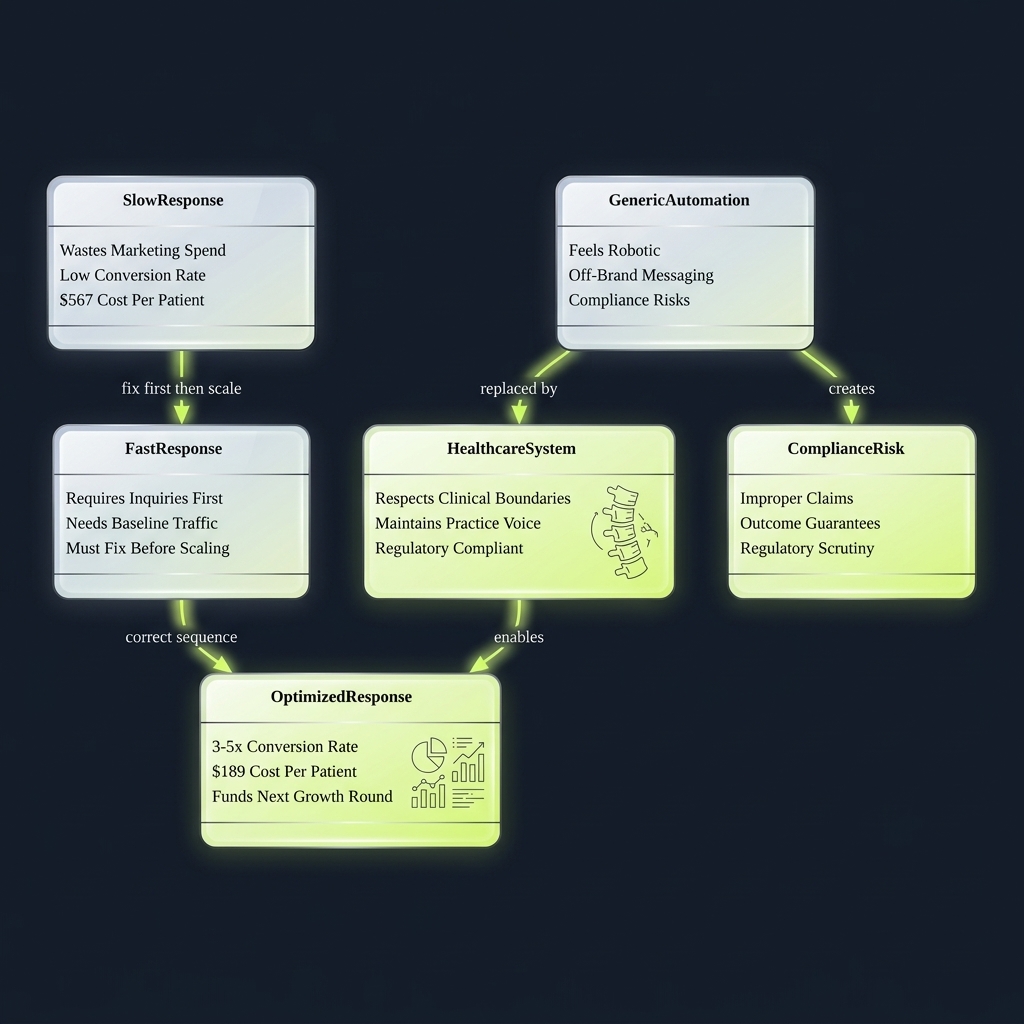
The main objections are that fast response times still require generating inquiries first, and that automation may feel impersonal or create compliance risks in healthcare. However, these concerns are addressed by fixing response velocity before scaling marketing spend, and using structured systems built specifically for healthcare that maintain brand voice while respecting clinical boundaries and regulatory requirements.
The Obvious Objections
Objection: You Still Need Inquiries in the First Place
True. Zero traffic yields zero bookings regardless of response speed. Baseline market visibility is required.
But scaling marketing spend before establishing fast inquiry response is financial waste. You are paying to generate demand you cannot capture. The correct sequence is: fix response velocity first, then increase inquiry volume. Every additional inquiry you generate after fixing response velocity converts at three to five times the rate of inquiries handled slowly.
The return on investment math flips. Instead of spending $567 to acquire a patient, you spend $189. That margin funds the next round of growth without requiring outside capital or unsustainable ad budgets.
Objection: Automation Feels Impersonal or Risks Compliance Issues
This concern is half-right. Generic auto-responders and unvetted AI tools can feel robotic, off-brand, or make clinical claims that violate health advertising regulations. A ChatGPT-generated response might promise outcomes you are not allowed to guarantee or use phrasing that triggers regulatory scrutiny.
Speed does not require sacrificing voice or compliance.
The solution is not raw AI or off-the-shelf chatbots. It is structured systems built specifically for practice communication: systems that respect clinical boundaries, maintain your practice's voice, and deliver immediate engagement without making improper claims.
The distinction matters. A system built for healthcare practices understands what you can and cannot say. A general-purpose AI tool does not.
How Do I Improve My Business Response Time?
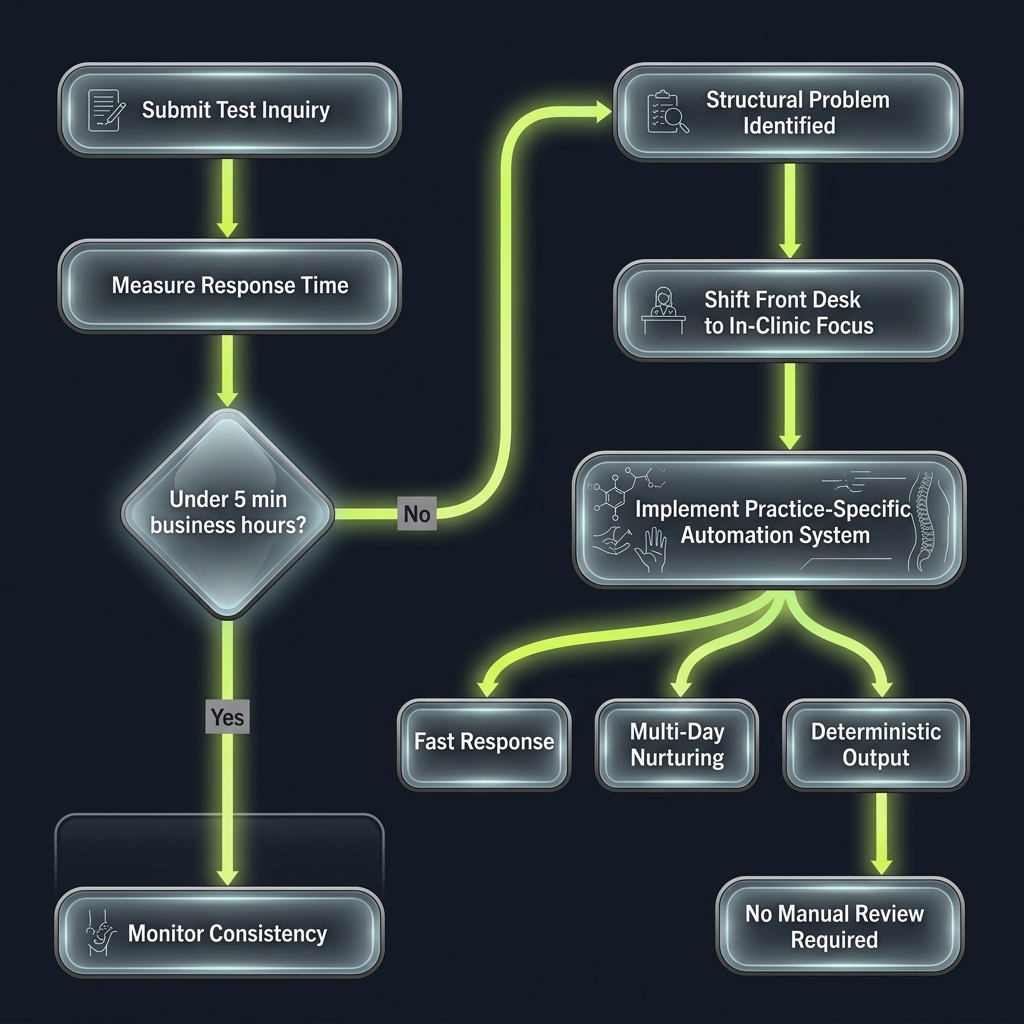
Businesses should first audit their actual response times by testing inquiries at different hours, aiming for under five minutes during business hours. They should then implement practice-specific automation systems that handle rapid responses, multi-day nurturing, and consistent communication without manual intervention. The ideal solution maintains brand voice, ensures compliance, and produces deterministic outputs that don't require human review.
What to Do About It
Start by measuring what you currently do.
Audit your true response time. Submit a test inquiry through your website during peak morning hours, during lunch, and after 5 PM. Calculate the exact minute delta between submission and first personalized response. Not an auto-confirmation email; it is an actual human or human-quality reply.
If that number is above five minutes during business hours or above sixty minutes after hours, you have a structural problem.
Shift front-desk responsibilities from chasing to welcoming. Your front desk should not be responsible for immediate inquiry outreach. They should be responsible for delivering an elite in-clinic experience for arriving patients. Remove the manual burden of inquiry response so your team can focus on the work that directly impacts patient satisfaction and retention.
This requires infrastructure.
Evaluate systems built for practice-specific automation. You need something that handles fast response, nurtures inquiries over multiple days, and maintains consistent communication without requiring daily manual prompting. Platforms that operate this whole loop end-to-end, like the systematic framework inside Omniply, are built to handle inquiry velocity, maintain your practice voice, and stay compliant with health advertising regulations without consuming your time or your team's attention.
The key is deterministic output. A system that generates the same quality response every time, not a tool that requires you to craft prompts and review variable output for compliance issues.
Generic AI tools cannot deliver this. They are non-deterministic by design, which means every output is slightly different and requires human review. They also have no built-in knowledge of what a chiropractic practice is allowed to claim in marketing communication. You are still doing the compliance work manually.
The right infrastructure removes you from the loop entirely while maintaining voice and regulatory safety.
Why is Fast Lead Response Time so Critical?
Fast lead response time is critical because conversion rates drop dramatically with delays; a five-minute response converts 21 times better than a thirty-minute response. Most practices lose potential patients not from insufficient traffic but from slow inquiry handling, which allows competitors to capture high-intent leads first. Speed directly determines which practice converts the inquiry into a patient.
The Bottom Line
Outspending your competitors will never compensate for lost intent caused by slow response times. The math is unforgiving: a five-minute response window converts at 21 times the rate of a thirty-minute window.
Most practices do not have a traffic problem. They have a conversion problem caused by structural bottlenecks in inquiry handling.
Your front desk cannot solve this manually. They are already operating at capacity managing in-person patient flow. Asking them to also act as instant responders to digital inquiries guarantees inconsistent results and staff burnout.
The solution is not more ad spend. The solution is infrastructure that captures the inquiries you already generate.
Run the audit. Measure your true response time. Calculate what you are losing to The Response Gap. Then decide whether the operational shift required to fix it is worth the three-to-five-times improvement in cost per acquired patient.
The inquiries are already there. The question is whether you will be the practice that answers first.
Frequently Asked Questions
Can ChatGPT Answer Website Inquiries for a Practice?
ChatGPT can generate responses, but it is non-deterministic and has no built-in knowledge of health advertising regulations. Every output requires manual review to ensure you are not making improper clinical claims. It also requires you to write prompts, paste inquiry text, and manage the workflow manually. You are still doing the work; you have just added a tool that requires oversight.
How Quickly Do Website Inquiries Drop Off If Not Answered?
Intent decays rapidly. Research shows that waiting thirty minutes instead of five minutes makes you 21 times less likely to qualify the inquiry and 100 times less likely to make contact. After two hours, most prospective patients have already moved on to another provider or lost the initial urgency that prompted the inquiry.
How Fast Should a Local Practice Reply to Inquiries?
Five minutes or less during business hours. After hours, the first response should arrive within an hour. The goal is to be the first practice the prospective patient hears from, which dramatically increases the odds they book with you instead of continuing to shop.
How Fast Should Front Desk Answer Website Forms?
Ideally within five minutes, but this is structurally difficult when front desk is managing in-person patient flow. The better question is: should front desk be manually responsible for this task at all? The answer is no. Automated systems handle this faster and more consistently without pulling staff away from in-clinic responsibilities.
How to Handle After Hours Website Inquiries?
After-hours inquiries require automated infrastructure. A prospective patient submitting a form at 7 PM will not wait until 9 AM the next day for a response. They will book with the practice that replies immediately, even if that reply is automated. The key is ensuring the automated response is professional, compliant, and maintains your practice voice.
Is Automated Texting to New Inquiries HIPAA Compliant?
HIPAA protects individually identifiable health information held by a covered entity, regardless of whether a formal doctor-patient relationship has been established. A basic inquiry containing only a name, phone number, and a general question about services (such as "What are your hours?") does not contain health information and is not considered Protected Health Information (PHI). However, if a prospective patient includes health information in their initial webform or voicemail, such as "I am having severe lower back pain and need an adjustment", that inquiry immediately becomes PHI and is protected under HIPAA. The determining factor is the nature of the data collected, not the official status of the individual submitting it. Use systems built for healthcare that understand this distinction and handle the transition correctly once someone becomes a patient.
Should a Clinic Hire Staff Dedicated to Follow up?
Only if inquiry volume justifies a full-time salary and you can afford the 40 percent annual turnover rate typical in front-office roles. For most 1-3 location practices, hiring dedicated staff for inquiry follow-up is more expensive and less reliable than implementing automated systems that handle the work consistently without attrition risk.