
A prospect sits in your parking lot, comparing your clinic to the competitor down the street. They look at your Google profile. You have fifty five-star reviews. You also have zero replies. That silence costs you money.
To a searching patient, your silence looks like neglect. It suggests your table-side manner ends the moment the copay clears. This is The Silent Character Witness at work.
When you ignore feedback, prospects assume you are too busy, or too indifferent, to care. Knowing how to respond to Google reviews is not a matter of polite manners. It is a clinical defense of your reputation.
This guide outlines the three-step framework your front desk needs to handle every review in under sixty seconds. We will analyze why silence drains your local authority. You will learn how to neutralize a one-star complaint. Finally, we will show you how to turn your public profile into a high-converting referral engine.
Your quietest reviews are speaking the loudest.
Key Takeaways
- Revenue Impact: Chiropractic clinics can lose up to $135,000 annually when unanswered Google reviews cause 15% of 50 monthly profile viewers to abandon their search, with each lost patient representing $1,500 in lifetime value.
- Ranking Algorithm Weight: Google Business Profile signals including review responses account for 32% of Local Pack ranking factors, meaning consistent reply cadence directly increases map-pack visibility and patient acquisition.
- Consumer Expectation Gap: 88% of consumers expect businesses to respond to reviews and 56% change their perspective based on response quality, making silence a critical trust barrier that prospects interpret as clinical neglect.
- HIPAA Compliance Risk: The U.S. Department of Health and Human Services fined practices $30,000 and $23,000 in 2023 and 2022 for disclosing protected health information in Google review responses, requiring strict privacy-compliant scripts.
- Manual Execution Cost: Running a complete practice marketing system demands 8 hours weekly of non-clinical work across articles, social media, newsletters, and review management - equivalent to losing an entire patient-care workday.
How Does Ignoring Online Reviews Damage Patient Trust?
Ignoring online reviews signals indifference to patients, who interpret silence as lack of attentiveness in clinical care. When prospects see unanswered reviews, they project worst-case assumptions about the practice's responsiveness and professionalism. Research shows 88% of consumers expect businesses to respond to reviews, and 56% change their perspective based on how businesses engage with feedback, making silence a critical trust barrier.
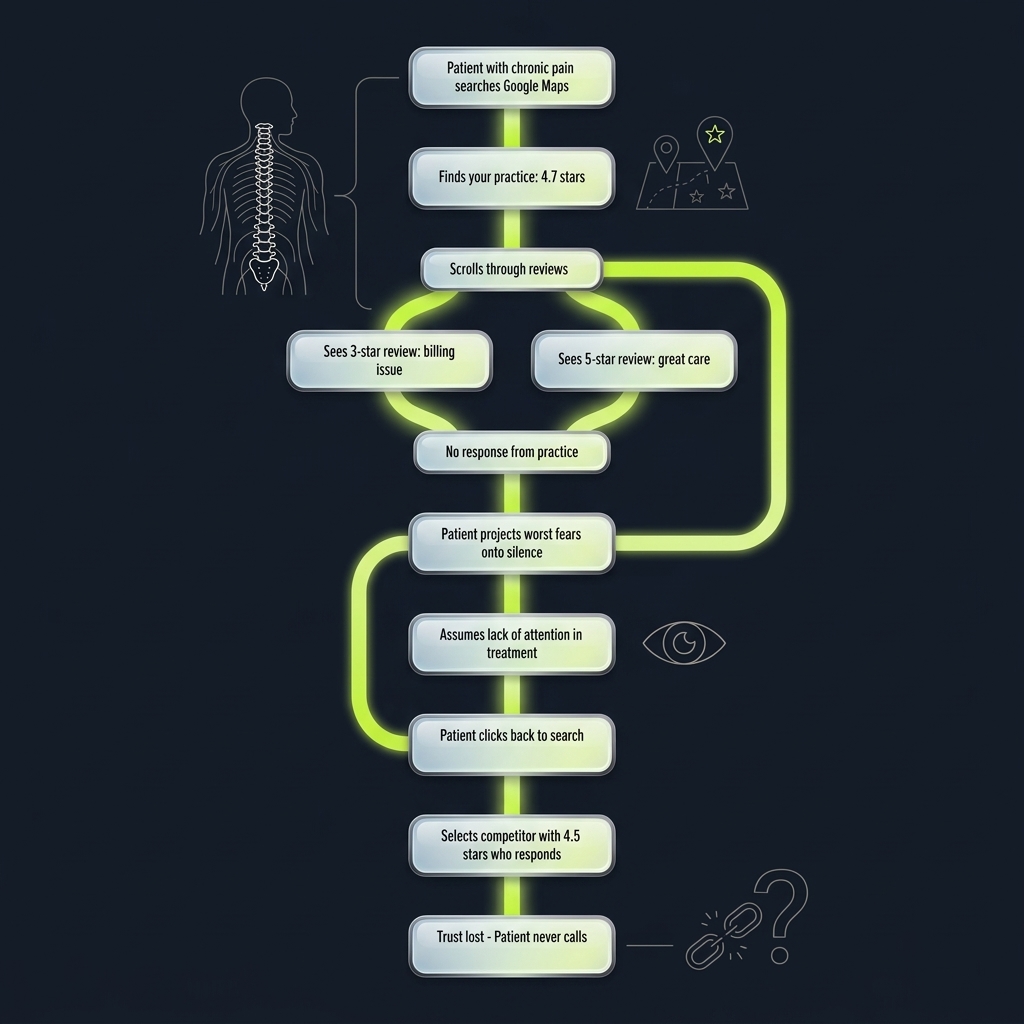
The Friday Afternoon Leak: a Micro-Moment of Lost Trust
Picture the decision point. A prospect sits on their couch, suffering from chronic, radiating lower back pain that has begun to affect their sleep and work performance. They open Google Maps to find a local chiropractor.
They find your practice. You have a respectable 4.7-star rating. But as they scroll down, they see a 3-star review from six months ago detailing a billing misunderstanding, and a 5-star review from three months ago praising your clinical care.
Neither review has a response from you.
The prospect doesn't call. They click back to the search results and select a competitor with a 4.5-star rating who actively responds to every review.
This is the mechanism at work: The Silent Character Witness. In the absence of your voice, the prospect projects their worst fears onto your silence. They assume that your lack of response in public matches your lack of attention in the treatment room.
According to BrightLocal's 2026 Local Consumer Review Survey, 97% of consumers read reviews for local businesses, and 88% expect businesses to respond to their reviews. Separate research from Podium's State of Reviews data found that 56% of consumers change their perspective on a business based on how the business responds to reviews. In healthcare specifically, Software Advice's 2020 survey data indicates that 90% of surveyed patients use online reviews to evaluate physicians, and 71% use online reviews as their very first step when finding a new doctor.
The numbers tell you what the prospect will never say: they are reading your silence as a character statement.
How Much Revenue Do Clinics Lose From Neglected Profiles?
Chiropractic clinics lose approximately $11,250 monthly when neglected Google Business Profiles cause 15% of prospects to abandon their search, totaling $135,000 annually. This calculation assumes 50 monthly profile views and a conservative $1,500 patient lifetime value. The revenue loss compounds as declining engagement signals reduce Google Local Pack visibility, directing more patients to competitors.
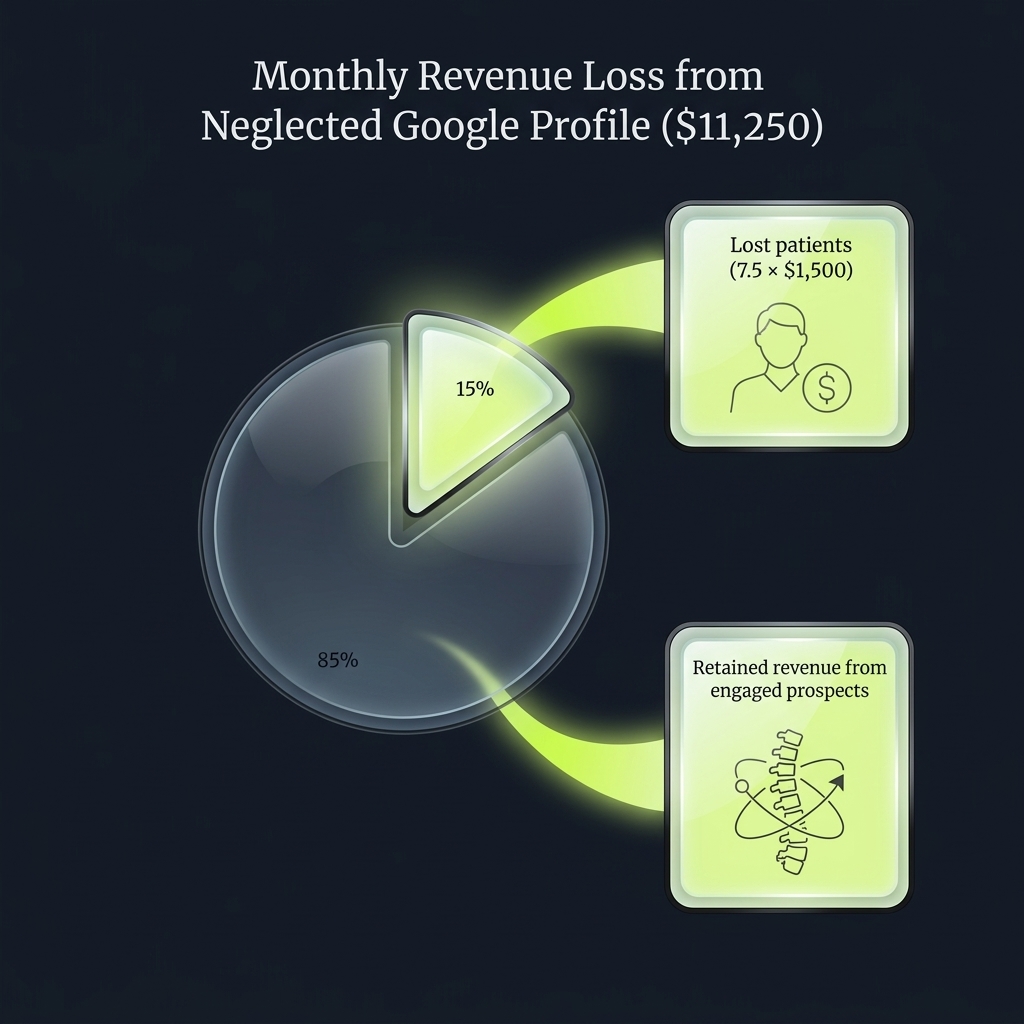
The Cold Arithmetic of Abandonment: Making the Invisible Damage Visible
Let's establish a realistic baseline. According to 2026 industry data from ChiroBasix and GYCP, the average patient lifetime value for a standard chiropractic patient ranges from $1,300 to $3,500. We will use a conservative $1,500 for this calculation, factoring in initial care plans, maintenance visits, and family referrals.
Now the math. If 50 prospects view your Google Business Profile monthly, and 15% walk away due to perceived neglect, unanswered reviews, stale information, a profile that looks abandoned, you lose 7.5 patients per month.
7.5 patients × $1,500 lifetime value = $11,250 in lost revenue every single month.
Annualized cost of silence: $135,000.
This is not a one-time loss. It is a compounding drain on your local search engine optimization authority and market share to faster-moving competitors. Google's algorithms detect engagement signals on your profile: review count, review recency, and owner response rates. According to Whitespark's 2026 Local Search Ranking Factors Report and BrightLocal's local algorithm analysis, Google Business Profile signals account for 32% of the ranking factors that determine placement in Google's Local Pack.
When you stop responding, your visibility drops. When your visibility drops, fewer prospects see your profile. When fewer prospects see your profile, your competitors capture the patients who would have been yours.
The leak becomes a flood.
Why Do Standard Review Management Strategies Always Fail?
Standard review management strategies fail because they treat responses as isolated administrative tasks rather than core patient-acquisition assets. Delegating to overwhelmed front-desk staff produces rushed, forgotten replies. Generic templates signal corporate apathy. Ignoring negative reviews backfires as prospects actively seek unanswered criticism to evaluate how practices handle problems, not successes.
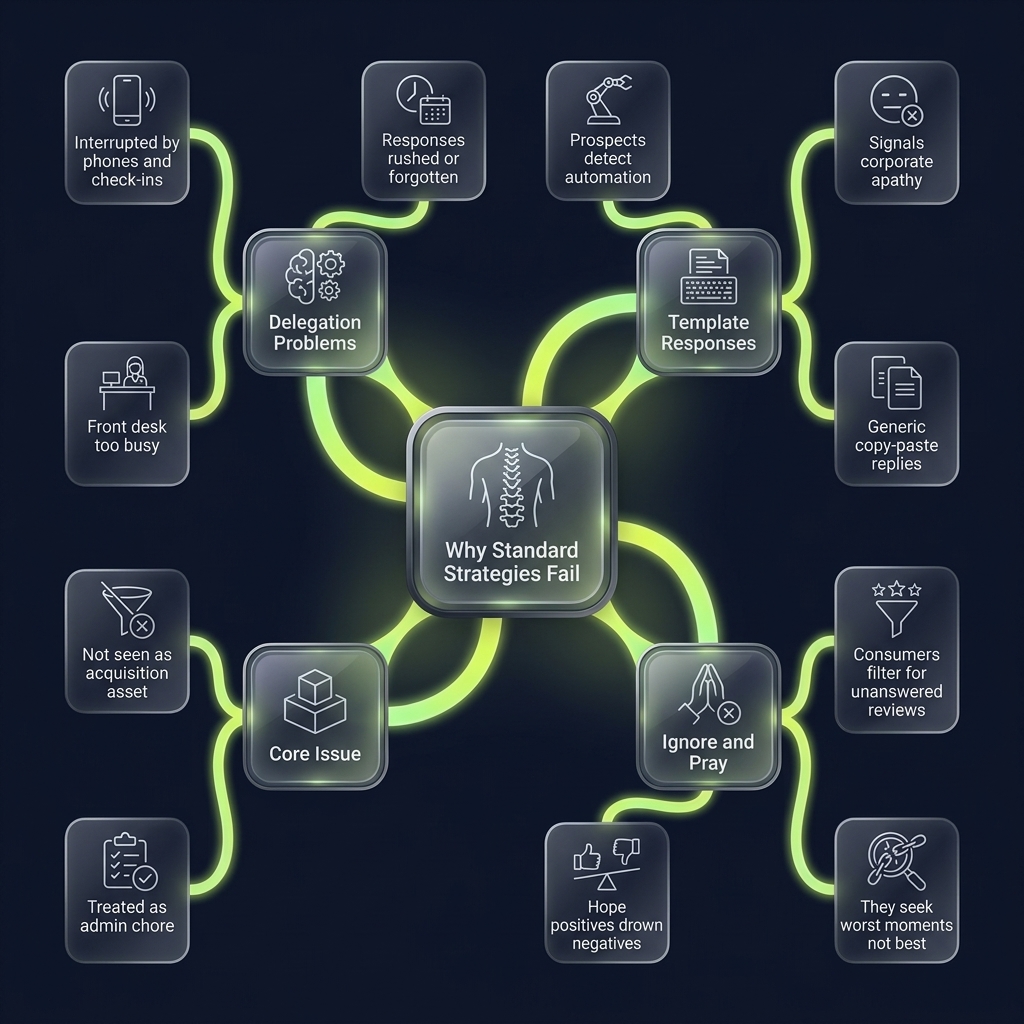
Why the Obvious Fixes Fail (and Why You've Already Abandoned Them)
You have tried to solve this before. You assigned review responses to a busy front-desk chiropractic assistant. They are interrupted by ringing phones, check-ins, and copays. The responses become rushed, low-quality, or forgotten entirely. This is The Front-Desk Delegation Trap.
Or you used a template. You copied and pasted the same robotic "Thank you for your feedback, please call our office" response for every review. It looked worse than leaving them blank. It signaled corporate apathy and lazy automation. Prospects can smell a script from a mile away.
Or you adopted the "Ignore and Pray" strategy. You hoped positive reviews would naturally drown out unanswered negative or mixed reviews. But modern consumers filter specifically for low or unanswered reviews to see how a business handles friction. They are looking for your worst moment, not your best.
The obvious fixes fail because they treat review responses as an isolated administrative chore rather than a core pillar of a unified patient-acquisition system.
How Do Online Reviews Help Convert New Patients?
Online reviews convert new patients by demonstrating practice character and clinical authority through authentic responses, which build trust with prospects researching providers. When integrated with educational content and consistent engagement, reviews trigger Google's local ranking algorithms, increasing visibility in map-pack results and driving qualified traffic that converts at higher rates due to established credibility.

The Systematic Shift: From Reputation Defense to Active Conversion
Responding to reviews is not about damage control. It is about building The Trust Flywheel.
Here is how the system works. Educational content on your website establishes clinical authority. High-quality communication with existing patients primes them to leave detailed reviews. Authentic, compliant, and prompt responses to those reviews validate the patients and show prospects your character. Google recognizes the high engagement and rewards the practice with higher local map-pack rankings, driving more traffic back to your website.
Each element reinforces the others. The system compounds.
But the system only works if it runs consistently. According to Yelp data cited in 2026, 70% of consumers who read reviews are more inclined to write a review themselves when they see that the business manager takes the time to respond to customer feedback. Consistency breeds momentum.
Break the cadence, and the flywheel stops.
How Do Prospective Patients Judge Doctors by Their Review Replies?
Prospective patients evaluate doctors' review replies as a "Proxy Experience" that previews bedside manner and character under pressure. They assess whether responses demonstrate compassion and professionalism or reveal defensive, ego-driven behavior. Patients aren't judging clinical expertise through replies, but rather determining if the physician will listen to concerns and provide patient-centric care.
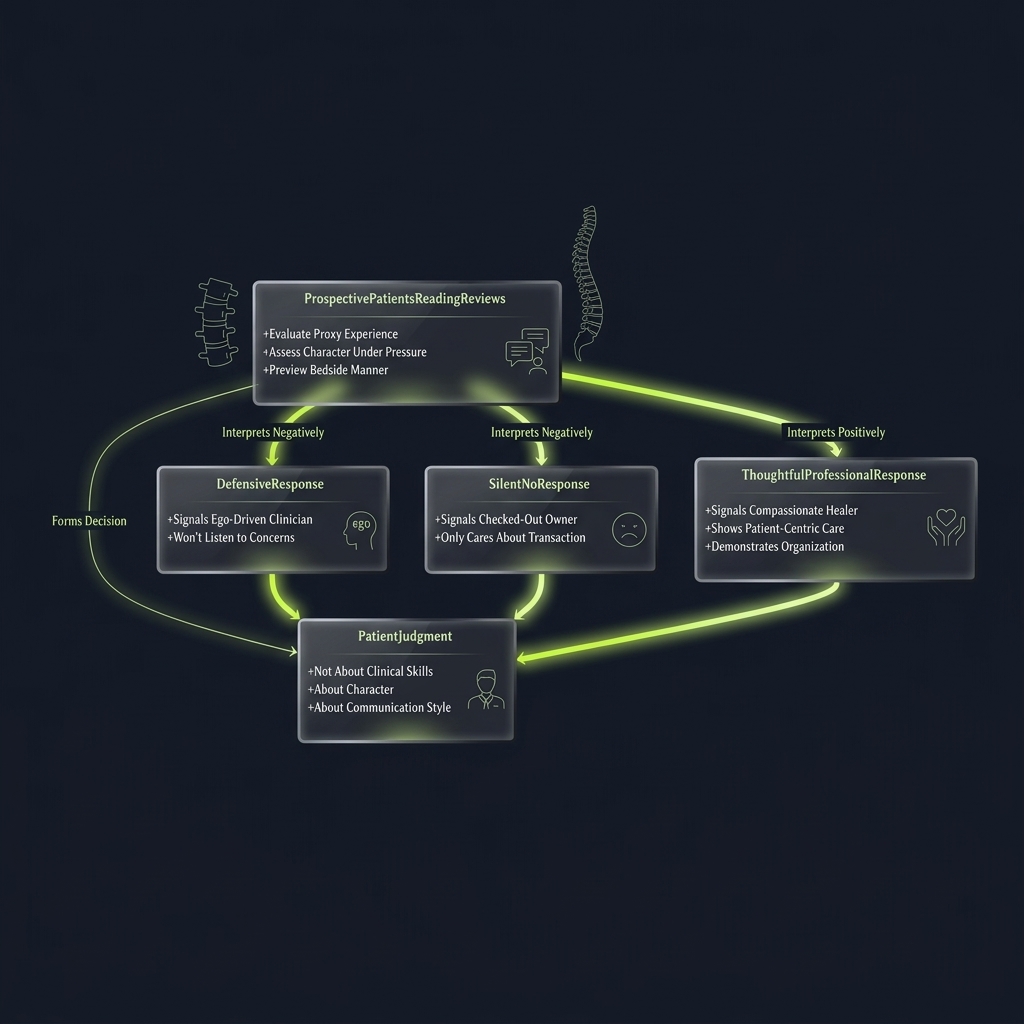
The Psychology of the Review Reader: Deciphering the Prospect's Mindset
Prospective patients do not read your replies to see if you are right. They read them to see how you behave when things are not perfect.
This is The Proxy Experience. Your public communication style serves as a direct preview of your bedside manner.
A defensive response signals an ego-driven clinician who won't listen to patient concerns. Silence signals a checked-out business owner who only cares about the transaction. A thoughtful, professional response signals a compassionate, organized, and patient-centric healer.
The prospect is not evaluating your clinical skills. They are evaluating your character under pressure.
How Do You Write High-converting Google Review Replies?
High-converting Google review replies follow four core principles: express radical gratitude by acknowledging specific details in positive reviews, take non-defensive ownership of shortcomings in mixed reviews, maintain strict HIPAA compliance by never confirming patient relationships or clinical details, and preserve clinical dignity through professional, emotionally neutral language regardless of reviewer tone.
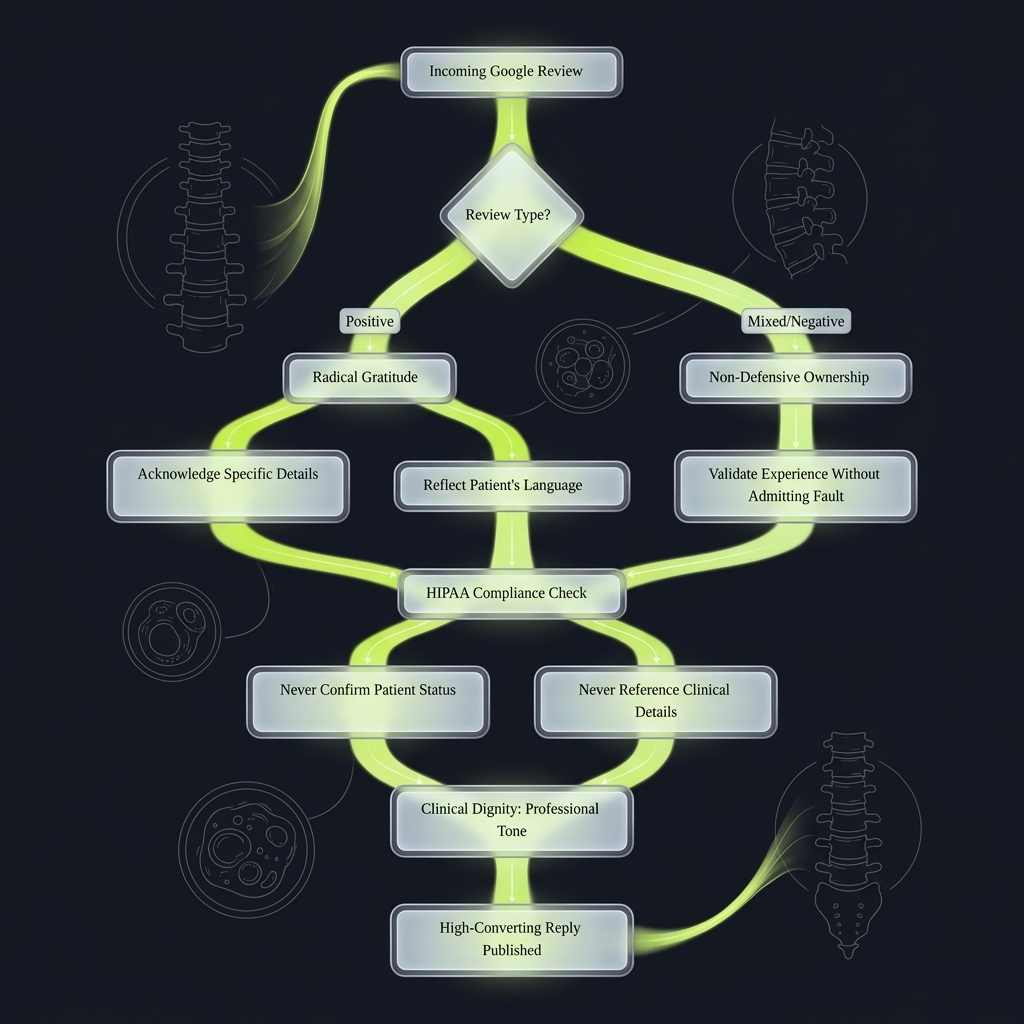
The Core Principles of High-Converting Google Review Replies
Principle 1: Radical Gratitude (For Positive Reviews). Acknowledge the specific, non-clinical human element of the review to make the patient feel seen and valued. If they mention your front-desk staff by name, mention that person. If they describe feeling heard, reflect that language back.
Principle 2: Non-Defensive Ownership (For Mixed Reviews). Validate the patient's experience without validating false narratives or violating privacy regulations. You are not admitting fault. You are acknowledging that their experience fell short of your standard.
Principle 3: Uncompromising Compliance (The Health Insurance Portability and Accountability Act Boundary). You cannot confirm or deny that the reviewer is a patient of your practice. You cannot reference specific treatments, diagnoses, or clinical details. Any response must be written as if you are addressing a stranger who might not even be a patient.
In June 2023, the U.S. Department of Health and Human Services Office for Civil Rights fined a medical practice $30,000 for impermissibly disclosing protected health information in responses to negative Google reviews, following a similar $23,000 fine against a dental practice in December 2022. The regulatory enforcement is real.
Principle 4: Clinical Dignity. Keep the tone elevated, professional, and entirely free of emotional reactivity, regardless of the reviewer's tone. You are a clinician. You do not argue with patients in public.
How Do I Run the Monday Morning Protocol?
Block exactly 15 minutes every Monday at 8:00 AM before patient adjustments begin. Respond to glowing reviews with warm thanks, address mixed reviews by validating concerns and offering offline contact, and handle negative reviews with a privacy-compliant script directing patients to the practice manager. Maintain absolute weekly discipline to prevent consistency decay.
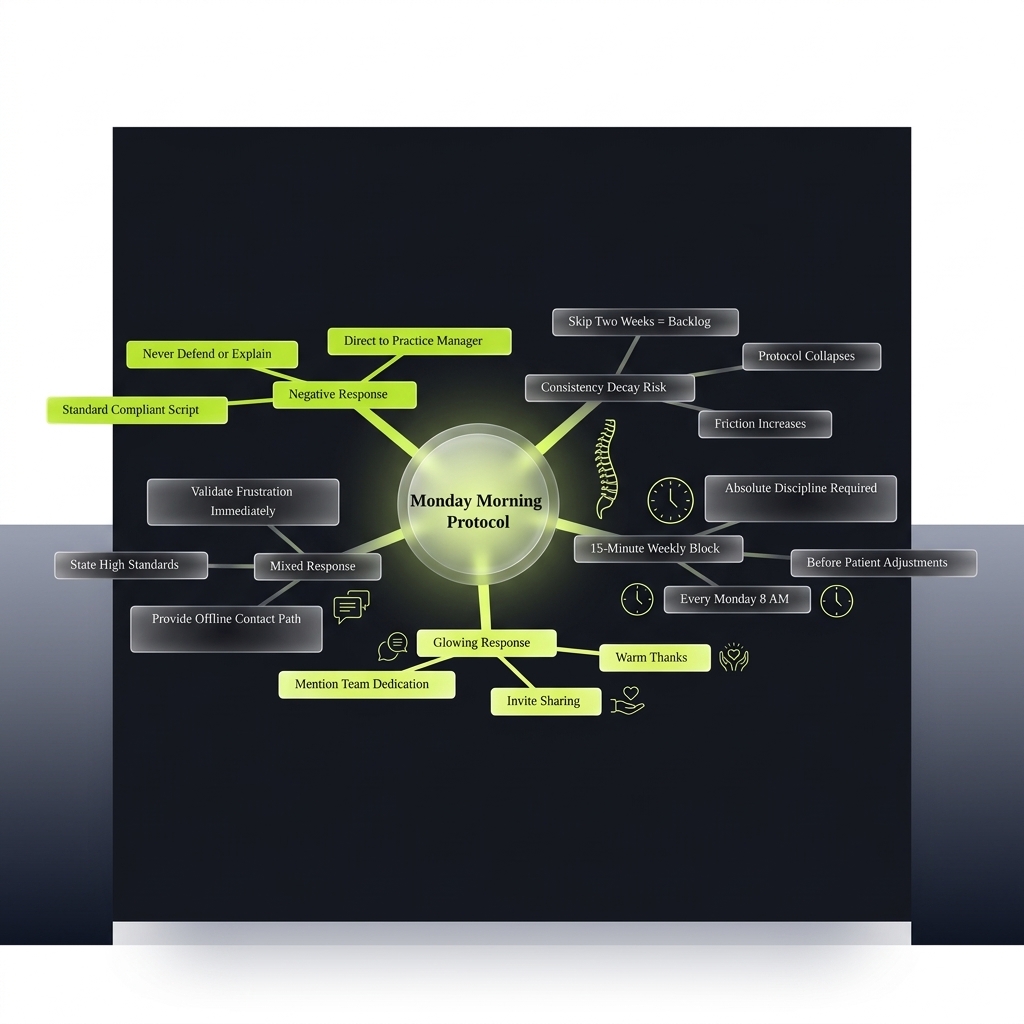
The Monday Morning Protocol: Your 15-Minute Weekly Reply Block
Here is the manual framework. Block exactly 15 minutes every Monday at 8:00 AM before patient adjustments begin.
The Glowing Response: Thank the reviewer warmly, mention your team's dedication to patient experience, and invite them to share their wellness journey with others. Example: "Thank you for taking the time to share this. Our team works hard to create a welcoming environment, and it means a lot to hear that came through in your visit. We're honored to be part of your care."
The Mixed Response: Validate the feeling of frustration immediately, state your practice's high standards for patient satisfaction, and provide a direct offline contact path. Example: "We're sorry to hear your experience didn't meet the standard we set for ourselves. Our goal is always to provide clear communication and compassionate care. Please reach out to our practice manager directly at [Phone] so we can make this right."
The Unfair or Negative Response: Never defend, never explain. Acknowledge the feedback with a standard, compliant script: "We take all feedback seriously, but due to patient privacy laws, we cannot discuss individual care details online. Please contact our practice manager directly at [Phone] so we can resolve this."
The true price of this protocol: absolute, unbroken weekly discipline. If you skip just two weeks, the backlog builds, the friction of starting again increases, and The Consistency Decay begins.
How Does Inconsistent Review Responding Affect Customer Trust?
Inconsistent review responding signals operational problems to potential customers, suggesting the business is struggling, understaffed, or treating customer service as temporary marketing rather than genuine commitment. This broken cadence undermines trust more powerfully than positive reviews can build it. Additionally, Google's algorithms detect activity drop-offs and penalize rankings, as the system rewards consistency and punishes profile abandonment.
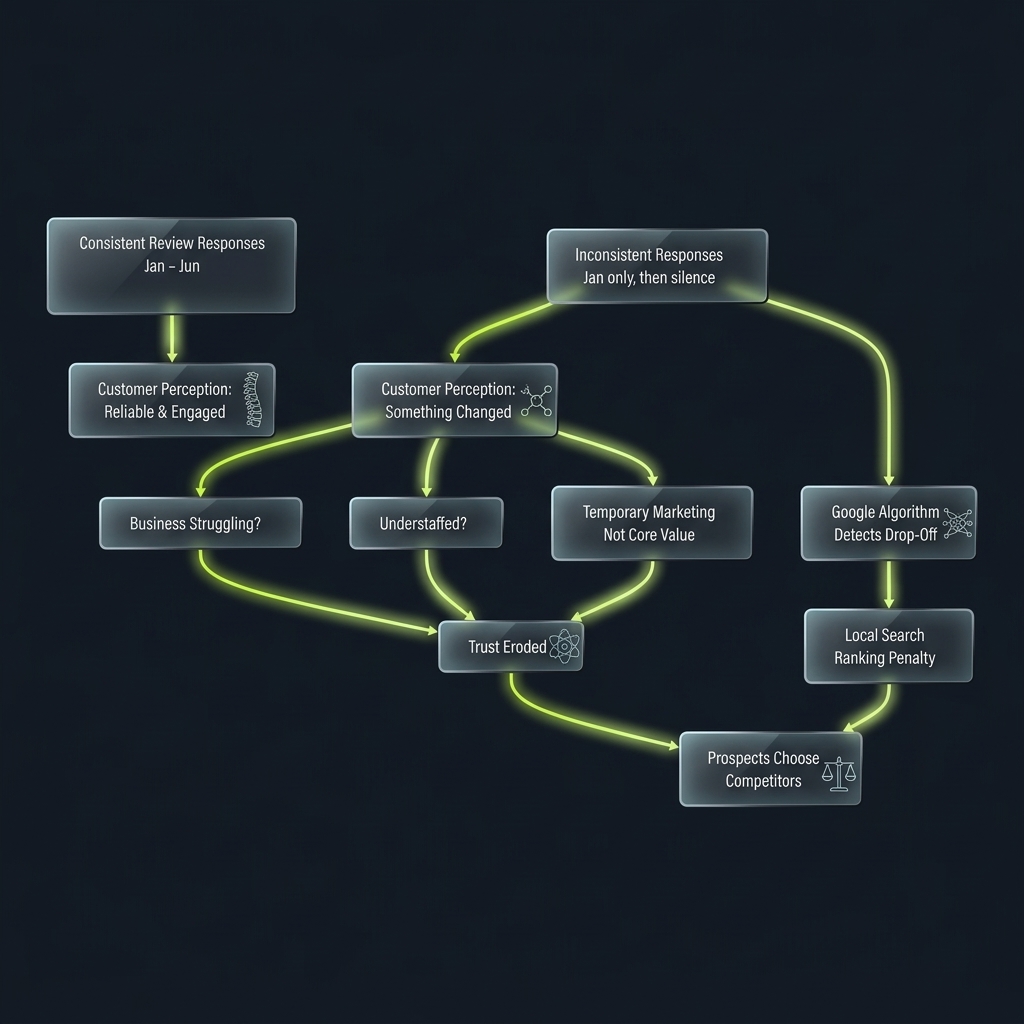
The Consistency Decay: Why a Broken Cadence Destroys Trust
When a prospect visits your profile and sees that you responded to reviews diligently in January, but left everything blank from February through June, they draw one conclusion: something changed.
The practice is either struggling, understaffed, or your customer service was just a temporary marketing push rather than a core value. The negative signal is louder than the positive reviews themselves.
Google's algorithms detect the drop-off too. A sudden halt in profile activity leads to a slow slide down the local search rankings. The system rewards consistency, and it punishes abandonment.
What Does Running a Full Practice Marketing System Take?
Running a full practice marketing system requires managing weekly SEO-optimized articles, consistent social media updates, regular newsletters for patient retention, lead-generation resources, review responses, and local listing updates. This totals approximately 8 hours per week of non-clinical work, which is equivalent to an entire workday that chiropractors could otherwise spend delivering patient care.
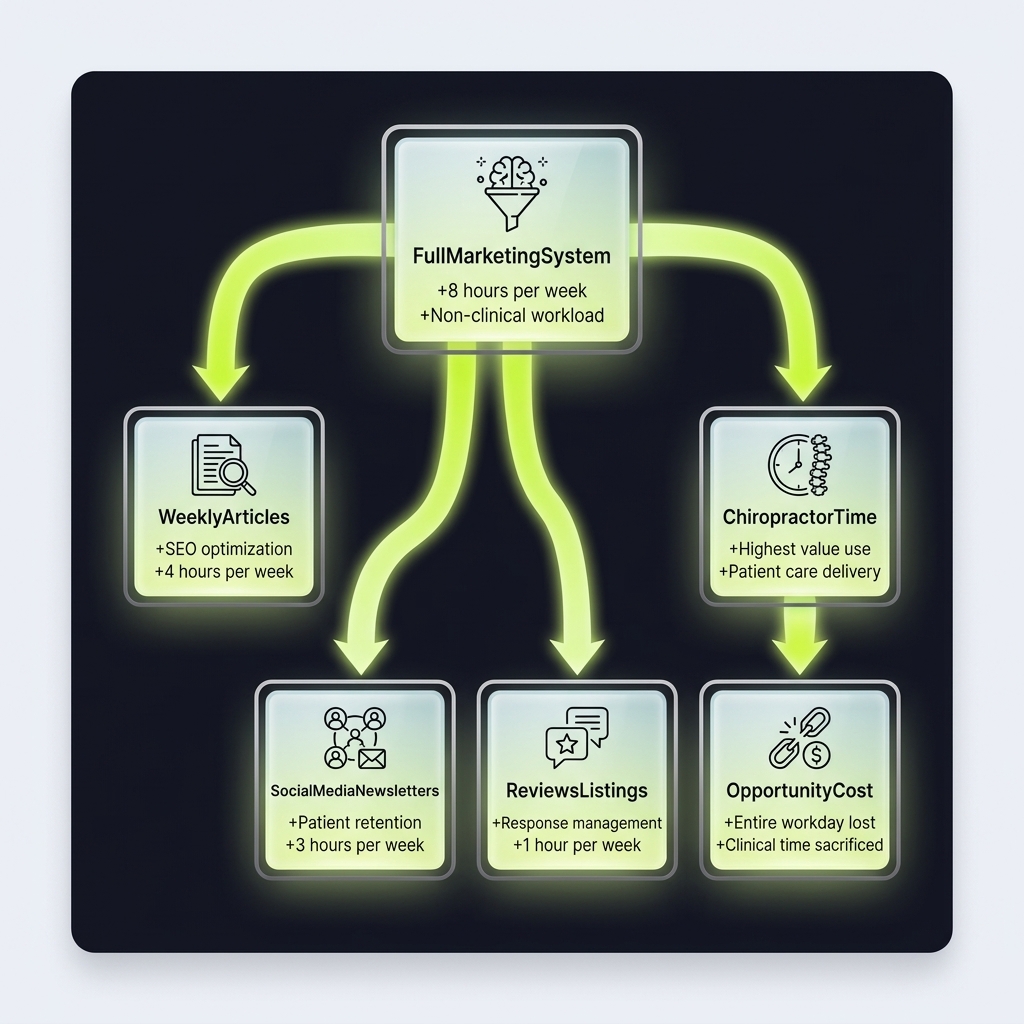
Widen the Lens: What Running the Full System Actually Takes
Review responses are just one gear. To truly dominate your local market, you must also manage:
Weekly articles published to your practice website, optimized for the search terms your prospects are typing into Google. Consistent social media updates that reflect your clinical philosophy. Regular newsletters to drive retention and reactivations. Lead-generation resources to capture prospective patients searching for pain relief.
Let's do the math on manual execution.
Writing, editing, and publishing weekly articles: 4 hours per week. Managing social media and newsletters: 3 hours per week. Responding to reviews and updating local listings: 1 hour per week.
Total time cost: 8 hours per week of non-clinical work. That is the equivalent of an entire workday lost for a busy chiropractor.
Your highest and best use is in the adjusting room, delivering life-changing care to your patients. Not drafting blog posts at 10 PM on a Sunday.
Why is Using Generic AI for Healthcare Marketing Risky?
Generic AI platforms pose significant compliance risks for healthcare marketing, with hallucination rates reaching 27% on simple tasks and 10-20% on medical content. These tools frequently generate responses that violate healthcare regulations by making impermissible medical claims, confirming diagnoses, or exposing protected health information, potentially triggering board complaints and HIPAA violations.

The Illusion of the Generic AI Shortcut
The temptation is obvious. Use ChatGPT or another generic AI platform to quickly draft your Google review replies and website content. It feels like the solution.
It is not.
Generic AI is highly unpredictable. According to 2025 and 2026 data on AI hallucination rates in healthcare, AI chatbots can hallucinate up to 27% of the time on simple tasks, and medical-specific evaluations regularly report hallucination and fabrication rates between 10% and 20%. These tools do not understand the strict legal boundaries of healthcare marketing.
AI tools will happily draft responses that confirm clinical diagnoses, mention specific treatments, or make impermissible medical claims, promising that chiropractic care "cures" sciatica or migraines, exposing your practice to severe board complaints and violations. Data entered into consumer AI platforms may be retained or incorporated into public training pipelines, which constitutes a data breach under the HIPAA Privacy Rule.
And even if the output were compliant, you still have to spend valuable time writing prompts, reviewing outputs for accuracy, correcting clinical errors, and manually copy-pasting the text into Google. It remains a manual job.
The shortcut does not save time. It shifts the work.
How Do I Automate Marketing for My Chiropractic Practice?
Chiropractors can automate marketing by implementing end-to-end platforms that handle weekly articles, social posts, newsletters, lead-generation guides, and review management automatically. These systems generate compliant content using the practice's voice while eliminating manual execution. Purpose-built platforms like Omniply specifically address chiropractic regulatory requirements, allowing practitioners to maintain consistent marketing without weekend work or compliance risks.
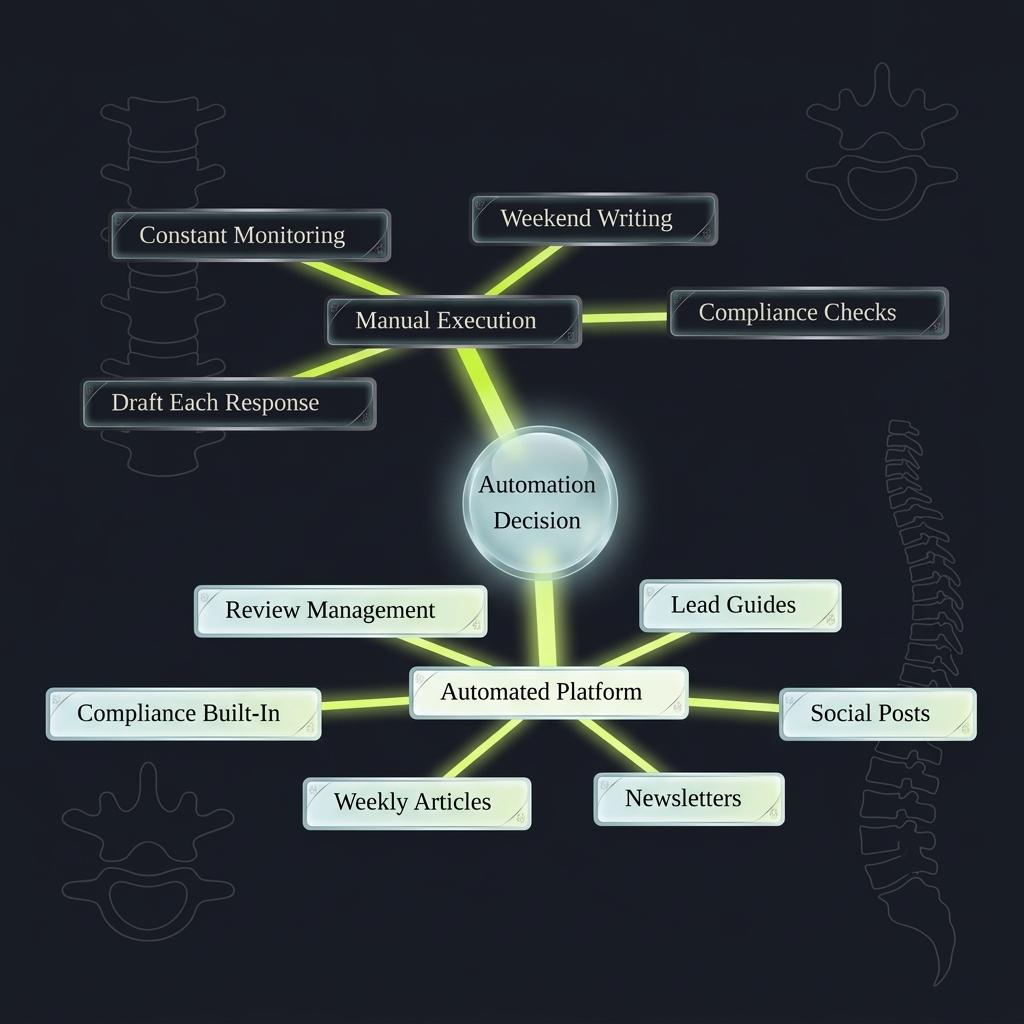
The Logical Conclusion: the Engine Must Run on Autopilot
You have two choices. You can spend your weekends writing articles and drafting review responses, or you can delegate it to a system designed specifically for the unique regulatory and clinical demands of a chiropractic practice.
The system must run, but you should not be the one turning the crank.
Platforms that operate this whole loop end-to-end, weekly articles, social posts, newsletters, lead-generation guides, and review management, all generated from the practice's own voice and reviewed for compliance, solve the execution problem without creating a new compliance risk. Omniply is one such platform, built specifically for chiropractic practices.
The decision is not whether to run the system. The decision is whether you will run it manually or let it run itself.
A quiet, high-performing engine is always built to run itself.
Frequently Asked Questions
Do Google Review Replies Affect Local Ranking?
Yes. Google Business Profile signals, including review count, review recency, and owner response rates, account for 32% of the ranking factors that determine placement in Google's Local Pack. Responding to reviews consistently signals active profile management, which Google rewards with higher visibility.
What Happens If You Don't Reply to Google Reviews?
Prospects interpret silence as neglect. They assume your lack of public response reflects your level of care in the treatment room. Additionally, Google's algorithms detect low engagement on your profile and gradually lower your local search rankings, reducing your visibility to new patients.
Is Replying to Google Reviews Worth the Time?
If 50 prospects view your profile monthly and 15% walk away due to unanswered reviews, you lose 7.5 patients per month. At a conservative $1,500 lifetime value per patient, that is $11,250 in lost revenue monthly, or $135,000 annually. The time investment is minimal compared to the financial leak.
Can ChatGPT Write Replies to Google Reviews?
Generic AI tools like ChatGPT are not designed for healthcare compliance. They can hallucinate clinical claims, confirm protected health information, or draft impermissible medical promises, exposing your practice to regulatory penalties. You still have to review and edit every output, which does not save meaningful time.
What Are Common Violations in Google Review Replies?
Confirming or denying that a reviewer is a patient, referencing specific treatments or diagnoses, and disclosing any protected health information all violate privacy regulations. The U.S. Department of Health and Human Services has fined practices tens of thousands of dollars for these errors in public review responses.
Should You Reply to Negative Google Reviews?
Yes, but never defensively. Acknowledge the feedback with a compliant script that validates the concern without confirming clinical details. Provide a direct offline contact path to resolve the issue privately. Prospects are watching to see how you handle friction, not whether you win the argument.
Is There an Easy Way to Manage Google Reviews?
The manual method requires blocking 15 minutes every Monday to respond to new reviews using a three-step framework: gratitude for positive reviews, non-defensive ownership for mixed reviews, and compliant scripts for negative reviews. Consistency is the challenge. Platforms that automate compliant review management eliminate the execution burden without creating regulatory risk.