
Your practice has 42 Google reviews. The competitor two miles away opened last year and already has 189.
That gap is not a marketing failure. It is a compounding deficit.
In local search, Google reviews act like compound interest. Most chiropractors treat them like a one-time tax. You run a quick campaign, collect twenty reviews, and then your front desk stops asking. This is Review Atrophy.
When you stop depositing, your search visibility flatlines. New patient phone calls drop.
Figuring out how to get Google reviews is not a software problem. It is an operational habit. You do not need expensive agency retainers or complex content marketing. You need a system your front desk can run in four seconds per patient.
This article lays out the math behind local search algorithms, why automated emails fail, and the three-step script your team can use today.
The math is simple.
Key Takeaways
- Review Velocity Dominance: Google Business Profile signals account for 32% of local pack ranking factors, with review recency and velocity outweighing total volume—a practice with 50 reviews from the last 90 days ranks above one with 200 reviews from 2022.
- Map Pack Revenue Impact: Dropping from position #2 to #6 in local search reduces monthly clicks from 200 to 20, translating to 18 fewer new patients and $259,200 in lost annual revenue at $1,200 average patient lifetime value.
- Compliance Penalties: Review gating violates the FTC's Consumer Review Rule (16 CFR Part 465) with civil penalties up to $53,088 per violation, while HIPAA breaches in review responses cost one New Jersey practice $30,000 in June 2023.
- Manual System Collapse: Front-desk review protocols require 208 hours annually but fail within 14–21 days during high-volume periods, compounded by 40% front-office turnover rates costing $25,000–$30,000 per replacement in 2023.
- AI Hallucination Risk: Generic AI tools produce non-compliant outputs with 23% hallucination rates in medical applications, creating legal liability when generating review responses or content without healthcare-specific compliance guardrails.
Why is My Business Losing Local Market Share?
Local businesses lose market share primarily due to declining review velocity rather than total review volume. Google's algorithm prioritizes businesses receiving fresh, recent reviews within 30-to-90-day windows, interpreting review silence as dormancy or decline. Competitors generating consistent new reviews gain visibility even with fewer total reviews, causing established businesses to drop in local search rankings despite strong historical ratings.
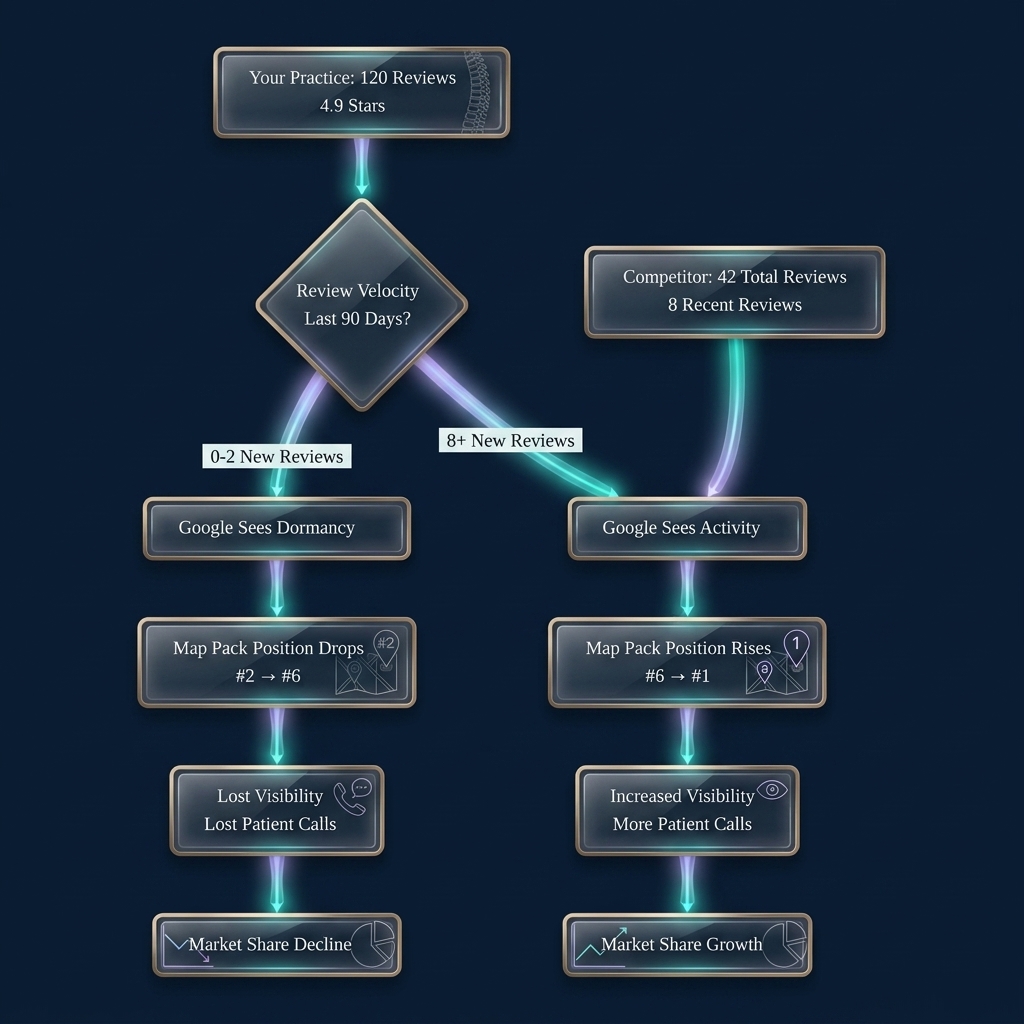
The Silent Decay of Local Market Share
The "Ghost Town" Map Pack: a Quiet Monday Morning in Your Practice
Picture this: it's 11:00 AM on a Monday. Your clinic is spotless. Three adjustment bays sit empty. Your next patient isn't scheduled until 1:30 PM.
You have 120 Google reviews and a 4.9-star rating. Your online reputation feels "handled."
You search "chiropractor near me" on your phone. Your practice has slipped from position #2 in the Google Map Pack to position #6. A competitor with only 42 total reviews now occupies the top spot. You scroll through their profile. Eight of those reviews were left in the last three weeks.
Google does not treat reviews as a static trophy room. It treats them as a real-time pulse.
The Algorithmic Reality: Review Velocity Vs. Review Volume
Total review count is a vanity metric. It blinds you to the actual mechanism driving local search rankings.
The mechanism is review velocity: the rate at which your Google Business Profile receives new, high-quality reviews over a rolling 30-to-90-day window.
Google's primary goal is to serve active, relevant, thriving businesses to searchers. A practice with 200 reviews from 2022 looks dormant compared to a practice with 15 reviews from this month. The algorithm interprets silence as closure or decline.
When the deposit of fresh user-generated content stops, your Google Business Profile enters a decay curve. Google Business Profile signals, driven by review volume, recency, and velocity, account for 32% of local pack ranking factors. Stop depositing, and you stop compounding. Your competitors keep depositing, and they pass you.
This is not theory. This is how the algorithm allocates visibility.
The Invisible Math of Map Pack Depreciation
The numbers clarify the stakes.
In a mid-sized market, the average monthly search volume for "chiropractor near me" and related local terms is approximately 1,500 searches. 42% of those searches result in a click within the Google Map Pack. That's 630 clicks distributed among the visible practices.
The top three positions in the Map Pack capture the majority of those clicks. Position #1 captures a 17.6% click-through rate. Position #2 captures 15.4%. Position #3 captures 15.1%. Combined, the top three positions capture roughly 600 of the 630 available clicks.
Positions 4 through 6 capture approximately 4% combined, which is about 60 clicks distributed among three practices.
Do the math on what happens when you drop two positions. You go from receiving 200 clicks per month to receiving 20. That's 180 fewer website visits or direct phone calls every month.
Now multiply that by conversion rate. If 10% of those clicks convert to booked appointments, you've lost 18 new patients per month. If the average new patient generates $1,200 in total revenue over their treatment plan, that's $21,600 in monthly recurring value you no longer capture.
Annually, that's $259,200.
Review velocity is not a marketing metric. It is a revenue mechanism.
Why the Obvious "Reputation Fixes" Consistently Fail
Most practices try three approaches. All three fail for structural reasons.
The Review Blast Campaign: You send a mass email or SMS to your entire patient database once a year. You get a spike of 15 to 20 reviews in one week. Then nothing for months. Google's spam-detection algorithms flag the suspicious burst. The sudden silence afterward signals that the activity was artificial, not organic. Your profile gets quietly deprioritized.
The Staff Incentive Program: You offer front-desk bonuses for every review collected. For two weeks, your team asks aggressively. Patients feel the pressure. The awkwardness builds. The team burns out. Within a month, asking stops entirely, and you're back to baseline behavior.
The Static Automated Email Trigger: You set up an automated email from your EHR that goes out 24 hours after every adjustment. Patients ignore it. The message is generic, uncontextualized, and robotic. Open rates hover around 8%. Click-through rates are 1%. You get one review per 100 emails sent.
None of these approaches build a system. They are campaigns with start and end dates. Compounding requires consistency.
What is the Multi-engine Flywheel in Healthcare Marketing?
The multi-engine flywheel in healthcare marketing is a self-reinforcing system where patient reviews, consistent website content, rapid review responses within 24 hours, and patient education touchpoints work together synergistically. Each new review triggers increased local visibility, higher click-through rates, and algorithmic validation from Google, creating a compounding cycle that accelerates practice growth and local authority.
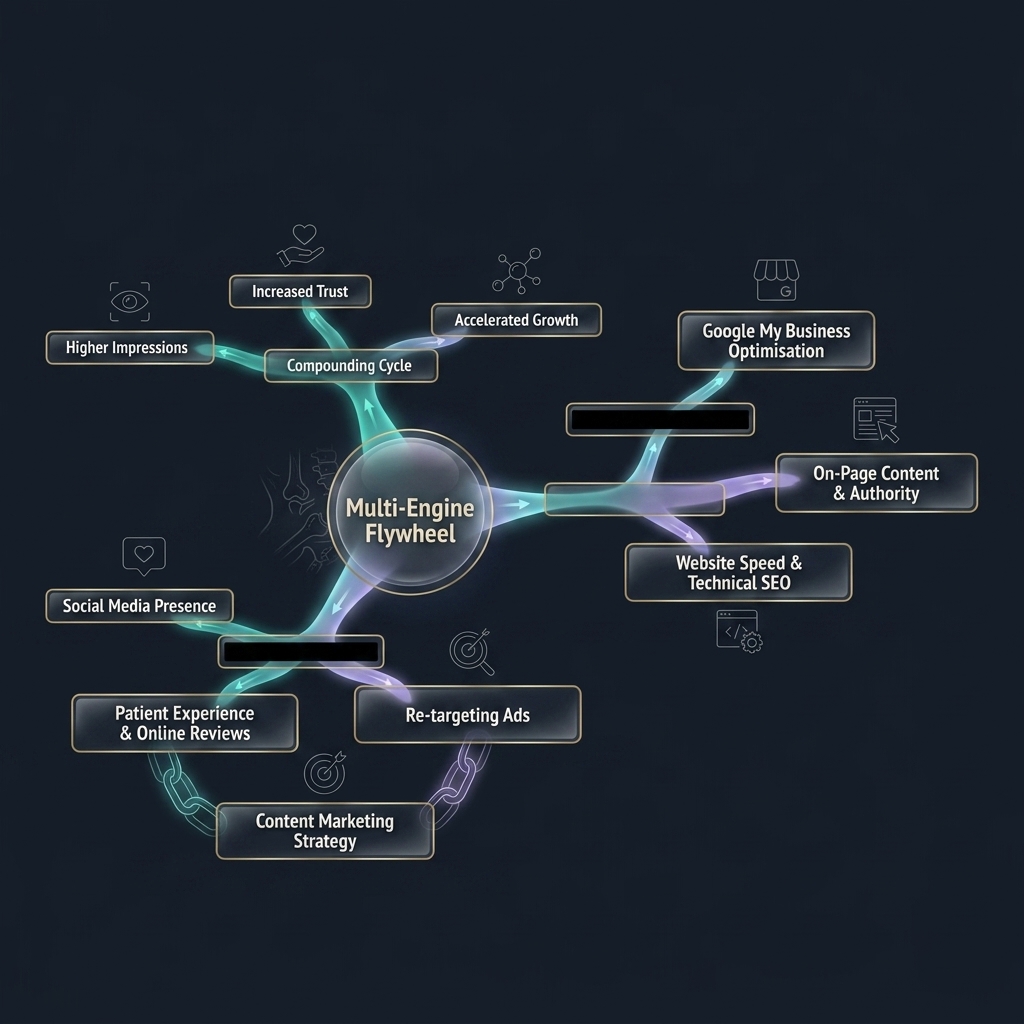
The Multi-Engine Flywheel
The Paradigm Shift: From "Review Collection" to "Reputation Infrastructure"
Reviews are not a marketing project. They are a financial asset requiring consistent, micro-deposits.
This is the compound interest philosophy. You do not run a campaign. You build infrastructure.
Google reviews do not exist in isolation. They are deeply tied to three other signals: consistent content presence on your website, rapid response loops to every review within 24 hours, and patient communication touchpoints that educate patients on why their feedback matters throughout their entire clinical journey.
When these systems operate together, they create a flywheel.
How the Review Engine Flywheel Compounds Local Authority
The flywheel operates through a five-step feedback loop.
Step 1: Fresh Review Deposited. A patient leaves a review mentioning "sciatica relief" and "low back pain treatment." Google's crawl bots detect new semantic keywords in user-generated content.
Step 2: Map Pack Lift. Your practice's local visibility increases for specific, long-tail search terms like "chiropractor for sciatica near me."
Step 3: Increased Impressions. More local searchers see your practice in the Map Pack.
Step 4: Higher Click-Through Rate. Fresh reviews build immediate trust. 84% of patients check online reviews before selecting a new healthcare provider. More searchers click through to your profile or call your office directly.
Step 5: Algorithmic Validation. Google observes high click-through rates and rewards your practice with even higher, more stable rankings.
The loop accelerates. Each new review feeds the next. This is the semantic value of patient language. Natural, unprompted patient descriptions of their recovery rank your practice faster than any technical keyword stuffing ever could.
The Strict Boundaries of Algorithmic Compliance
Speed matters. But compliance matters more.
Review gating is illegal. Review gating is the practice of surveying patients privately and only sending Google review links to those who report a positive experience. Under the Federal Trade Commission's Consumer Review Rule (16 CFR Part 465), which took full effect in October 2024, such deceptive practices can incur civil penalties of up to $53,088 per violation.
Do not pre-screen patients. Do not ask "Are you happy?" before sending them a review link. Send the link to everyone, or send it to no one.
Incentivization is equally dangerous. Offering free adjustments, gift cards, or discounts in exchange for reviews risks permanent de-indexing from Google Maps. Google's Terms of Service explicitly prohibit compensation for reviews.
The safe path is simple: build an authentic, high-velocity engine that embraces honest feedback. When you collect reviews consistently, occasional negative reviews get buried naturally by volume and recency.
One more compliance boundary: HIPAA. In June 2023, the U.S. Department of Health and Human Services Office for Civil Rights fined a psychiatric practice $30,000 for impermissibly disclosing protected health information in their public responses to negative online reviews. When you respond to a review, do not confirm the patient's identity. Do not reference their treatment details. Thank them generically, invite them to contact the office privately, and move on.
Compliance is not optional. It is the foundation of any system that compounds over time.
What is the Execution Wall in Business?
The Execution Wall refers to the breakdown point where manual business systems, particularly customer feedback protocols, collapse under operational pressure. Initially maintained for 14 to 21 days, these systems fail when staff face high-volume periods, absences, or competing priorities, causing disciplined processes to be abandoned despite requiring minimal financial investment but demanding consistent behavioral execution.

The Execution Wall
The Giveaway Protocol: the Three-Second Checkout Ask
The simplest system costs nothing. It requires only discipline.
Place a high-quality, weighted acrylic stand on your front desk. The stand contains a custom QR code that links directly to your practice's Google review write-up page. Not your website. Not a landing page. Directly to the review form.
When a patient says, "I feel so much better today," your front-desk team uses this exact script:
"We are so glad to hear that, [Name]! Our mission is to help more people in [City Name] experience that same relief. If you have three seconds while your receipt prints, would you mind scanning this card and leaving us a quick, one-sentence review about your experience with Dr. [Name] today? It helps people who are struggling with [Condition] find us."
The financial cost is zero. The operational cost is 100% emotional and behavioral discipline.
Your front-desk team must ask 15 to 20 times a day, every day, without fail. The moment the clinic gets busy, the phone rings, or a patient is in a rush, this protocol is the very first thing to be abandoned.
The Reality of Manual System Maintenance
Manual systems require weekly labor.
You must audit your EHR to identify which active patients have not yet left reviews. That takes two hours per week. You must respond to every review left in the last seven days with unique, non-generic, HIPAA-compliant copy. That takes one hour per week. You must update physical desk signs, check QR code redirects, and train staff on how to handle objections. That takes one hour per week.
Four hours per week. Fifty-two weeks per year. That's 208 hours of operational overhead.
Manual systems thrive for 14 to 21 days. Then they collapse. The clinic has a high-volume week. A staff member calls in sick. The phone rings off the hook. The protocol gets skipped once, then twice, then indefinitely.
This is the human consistency problem. The turnover rate for front office support staff in medical practices reached 40% in 2023. When a front-desk team member burns out and leaves, replacing them actually costs your practice between $25,000 and $30,000 when you factor in recruiting, onboarding, training, and lost productivity during the transition. Manual systems do not survive turnover.
The AI Shortcut Trap: Speed Vs. Regulatory Compliance
The obvious solution is automation. Use AI to respond to reviews, write follow-up newsletters, and generate blog posts to keep your local presence fresh.
Generic AI tools like ChatGPT are fast. They are also dangerous.
Generic large language models produce non-deterministic outputs. The same prompt produces different results every time. The output is often repetitive, robotic, and instantly recognizable as machine-generated. Real patients can tell. Search engines can tell.
More importantly, generic AI tools do not understand healthcare compliance. Boards of Chiropractic Examiners and national health-advertising regulations have strict rules regarding medical claims, patient testimonials, and guarantees of cure. A generic AI tool will happily draft a review response or blog post that makes illegal diagnostic claims or promises outcomes. You are legally liable for everything it publishes under your practice's name.
Industry data shows that even the lowest reported AI hallucination rates in medical applications sit at approximately 23%. Nearly one in four outputs contains fabricated or non-compliant information.
You still spend hours prompting, editing, reviewing, and publishing to ensure the AI does not violate HIPAA or local regulatory guidelines. The time savings evaporate. The liability risk remains.
The Ultimate Operational Choice
Maintaining a high-velocity Google review engine and a consistent local content presence is mandatory. 61% of patients now prioritize online reviews over personal referrals from friends and family. If you are not visible, you do not exist.
This is not a software problem. It is not a strategy problem. It is an execution problem.
Your time is highly leveraged when you are adjusting patients, managing clinical staff, and scaling operations. It is not leveraged when you are managing review campaigns, writing SEO-optimized articles, or policing front-desk scripts.
The system must run. The engine must compound. But it runs best when it is operated for you by infrastructure built specifically for the unique regulatory and operational needs of a modern chiropractic practice. Platforms that operate this whole loop end-to-end, like Omniply, which publishes weekly SEO articles, manages patient newsletters, and ensures every piece of content is reviewed for compliance, exist because the alternative is a part-time job you do not have time to do.
You cannot deposit consistency when you are too busy running a practice.
Frequently Asked Questions
Do Old Google Reviews Still Help SEO?
Old reviews still count toward your total review volume, but they carry significantly less algorithmic weight than recent reviews. Google prioritizes recency and velocity. A practice with 200 reviews from 2022 will rank below a practice with 50 reviews from the last 90 days, all else being equal. Total volume matters, but fresh deposits matter more.
How Many Google Reviews Should a Clinic Get Monthly?
The answer depends on your market and your competitors. In most mid-sized markets, collecting 8 to 12 new reviews per month is enough to maintain or improve Map Pack positioning. In highly competitive markets, you may need 15 to 20 per month. The key is consistency. A steady flow of 10 reviews per month compounds faster than a burst of 30 followed by months of silence.
Can I Use ChatGPT to Reply to Google Reviews?
You can, but you should not rely on it without heavy editing. Generic AI tools produce non-deterministic outputs that often sound robotic and repetitive. More critically, they do not understand HIPAA or chiropractic scope-of-practice regulations. A generic AI response may inadvertently confirm a patient's identity or reference treatment details, both of which violate HIPAA. Every response must be reviewed and edited for compliance before publishing.
Can You Offer Incentives for Google Reviews?
No. Offering free adjustments, gift cards, discounts, or any other form of compensation in exchange for reviews violates Google's Terms of Service and risks permanent de-indexing from Google Maps. It may also violate Federal Trade Commission guidelines. Build a system that collects reviews through genuine patient satisfaction, not transactional incentives.
Is Google Review Software Worth the Money?
It depends on what the software does. If it simply automates email requests, the return on investment is low. Patients ignore generic automated emails. If the software operates a full reputation infrastructure, automating the ask, ensuring compliance, responding to reviews, and integrating with your content presence, then the ROI is high. The real question is whether the software saves you more time than it costs, and whether it ensures regulatory compliance.
How to Manage Google Reviews Without Wasting Time
The only way to manage reviews without wasting time is to build a system that runs without your daily involvement. This means training your front-desk team to ask at checkout, automating compliant follow-up messages, and either outsourcing review responses or using a platform that drafts compliant responses for your approval. Manual management consumes four to six hours per week. That time does not scale.
Why Do Google Reviews Stop Showing up?
Google filters reviews that it suspects are fake, solicited improperly, or violate its content policies. Common reasons reviews get filtered include: the reviewer has no prior Google activity, multiple reviews were left from the same IP address in a short time window, or the review contains prohibited content. Review gating and incentivization also trigger filtering. Build a clean, compliant system, and your reviews will stick.