
A prospective patient sits in your waiting room. They read three five-star reviews on their phone before booking. That was the old buying journey.
Today, an algorithm reads those same reviews first.
Modern search visibility is no longer just about convincing human eyes. Search engines and AI assistants parse every word your patients write to decide if your practice solves specific complaints in your zip code. A vague review like "great place" gives the machine zero operational context. You lose visibility to the clinic down the street whose patients explicitly mention sciatica, spinal adjustments, or herniated discs.
We call this shift Double-Audience Indexing.
Your review volume used to build local trust. Now, its specific vocabulary drives your discovery.
This article outlines how AI evaluates your public feedback, why high star counts fail without clinical phrasing, and how your front desk can systematically guide patient wording without added work.
Your star rating is no longer the primary signal. The words inside it are.
Key Takeaways
- AI Overview Dominance: Google AI Overviews now appear in 48% of all tracked searches (up 58% year-over-year), and their presence correlates with a 58% lower click-through rate for the #1 organic result.
- Review Signal Growth: Review signals increased from 16% to 20% of total local pack ranking influence between 2023 and 2026, representing a 25% weighting increase in just three years.
- Semantic Analysis Requirement: AI search engines use Natural Language Processing to extract clinical terms like "herniated disc," "sciatica," and "spinal decompression" from review text, making condition-specific vocabulary more valuable than generic five-star praise.
- FTC Compliance Risk: The Federal Trade Commission finalized rules in October 2024 authorizing civil penalties up to $51,744 per violation for fake reviews, AI-generated testimonials, or incentivized reviews with mandated sentiment.
- Revenue Impact Math: A chiropractic practice losing 50% of organic search visibility (12 patients monthly at $1,200 lifetime value) faces $172,800 in annual revenue loss, yet most attribute the decline to seasonality rather than algorithmic shifts.
How Has Local Search Changed for Medical Practices?
Local search for medical practices has fundamentally shifted from ranking by review volume and star ratings to AI-powered semantic analysis. Google AI Overviews now appear in 48% of searches, using Natural Language Processing to extract clinical terms from review text. Practices must now be cited within AI-generated summaries by having entity-rich reviews containing specific treatment terms, not just generic praise.
What Changed: the Mechanics of Local Health Search
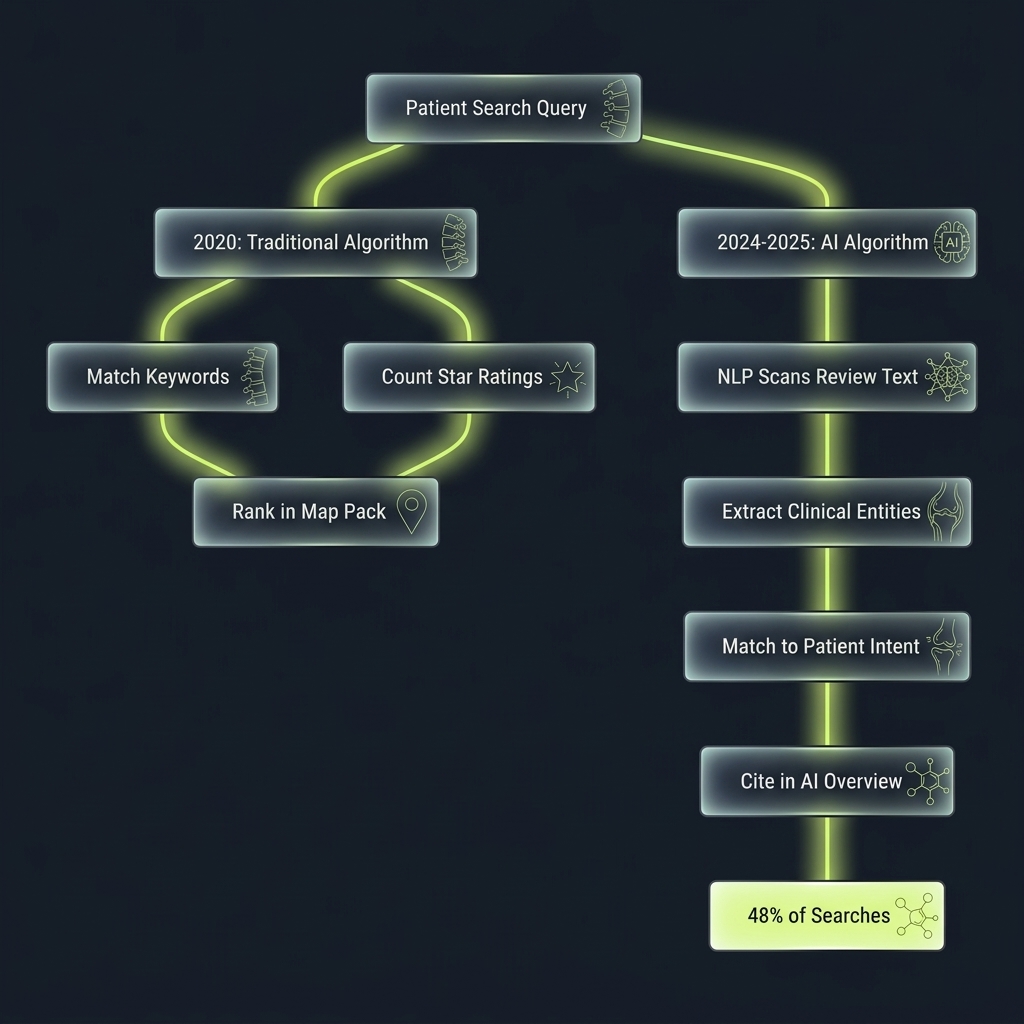
The infrastructure underneath patient discovery shifted in 2024 and accelerated through 2025. Google AI Overviews now trigger on 48% of all tracked search queries, up 58% year-over-year. That means nearly half of all searches now present an AI-synthesized summary before displaying traditional business listings.
Your practice doesn't just compete for position in a map pack anymore. You compete to be cited inside the summary itself.
The difference is mechanical. Traditional search algorithms ranked practices by matching keywords on your website and counting total review stars. The new systems use Natural Language Processing to read the full text of every review, extract clinical terms, and map them to patient intent.
When someone searches "chiropractor for pregnancy sciatica near me," the AI doesn't just look at your star rating. It scans your review corpus for mentions of pregnancy, sciatica, prenatal care, and specific adjustment techniques. If those terms don't appear in your reviews, you're invisible to the query, even if you treat pregnant patients every week.
The algorithm performs Entity Extraction: it tags clinical phrases like "herniated disc," "neck pain," "sports injury," or "pediatric adjustment" inside patient commentary and links them directly to your practice profile. Practices with entity-rich reviews get recommended. Practices with generic praise get filtered out.
What Practice Owners Expected Vs. What Actually Happened
Most multi-location chiropractic practices built their review strategy between 2015 and 2020. The playbook was simple: accumulate volume, maintain a 4.7+ average, respond politely to negatives. A practice with 300 five-star reviews felt secure.
That security was rational under the old ranking model. Review count and average rating were the two dominant signals.
Here's what happened instead. Practices with 500+ generic reviews ("Dr. Jones is amazing!" or "Best chiropractor ever!") started losing visibility to newer clinics with 120 reviews containing condition-specific narratives. A review that reads "Dr. Smith used spinal decompression and corrective exercises to resolve my L5-S1 disc bulge after six weeks" delivers more algorithmic value than ten reviews saying "Great experience."
Between 2023 and 2026, review signals grew from 16% to 20% of total local pack ranking influence. That's a 25% increase in weighting in three years. The clinics that adapted early saw patient volume rise. The clinics that assumed their legacy review banks would protect them saw new-patient counts stagnate or decline.
The threshold for patient trust escalated in parallel. In 2026, 68% of consumers report they will only use a local business with a rating of four stars or higher, up from 55% the year prior. And 41% of consumers now "always" read reviews when browsing for a business. You're being evaluated by both the machine and the human, and both have higher standards than they did 24 months ago.
What Technology is Driving Dual Indexing in Search?
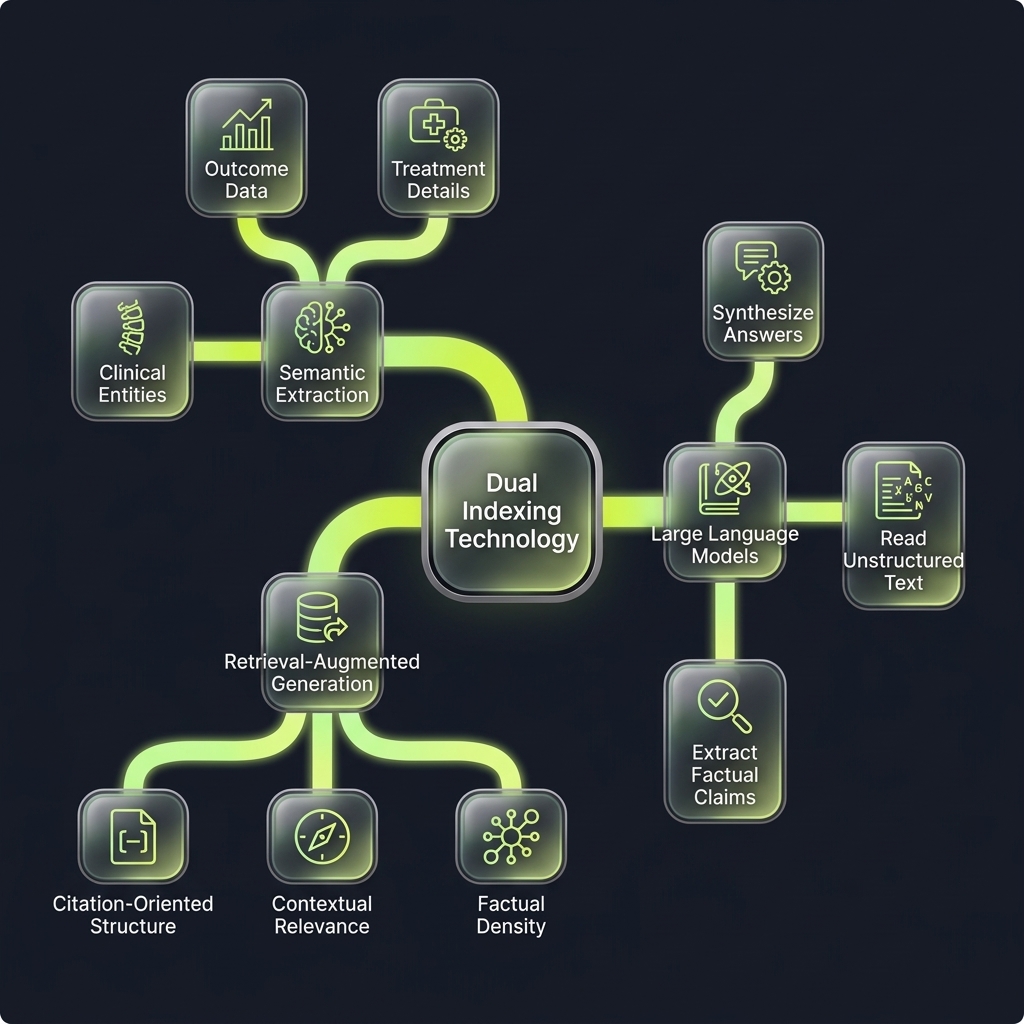
Large Language Models and Retrieval-Augmented Generation are driving dual indexing in search. These systems synthesize answers rather than simply matching keywords, reading unstructured content like reviews and website copy to extract factual claims and generate conversational summaries. The technology prioritizes contextual relevance, factual density, and citation-oriented structure over traditional ranking signals like star ratings alone.
Why This is Happening: the Technology Driving Dual Indexing
The shift isn't arbitrary. It's the result of Large Language Models becoming the default interface for information retrieval.
Search engines used to match keywords. Now they synthesize answers. The underlying architecture is called Retrieval-Augmented Generation. The model reads unstructured text, your patient reviews, your website copy, your directory listings, extracts factual claims, and generates a conversational summary.
A foundational study from Princeton and the Association for Computing Machinery demonstrated that generative search engines prioritize content with high contextual relevance, factual density, and citation-oriented structure. The model doesn't just count stars. It evaluates whether your reviews contain enough semantic detail to support a confident recommendation.
This is why vague reviews fail. "Great chiropractor" offers no retrievable facts. "Dr. Lee treated my chronic migraines with cervical adjustments and soft tissue work, and I've been headache-free for three months" gives the model six extractable entities: migraines, cervical adjustments, soft tissue therapy, chronic condition, treatment duration, and outcome.
The AI doesn't care that both reviews gave you five stars. Only one of them proves you treat migraines.
The Three Phases of Review Signal Evolution
Phase 1 (2012–2018): Volume and star rating dominated. Practices competed to accumulate the most reviews at the highest average. The algorithm treated reviews as a trust proxy, not a data source.
Phase 2 (2019–2023): Velocity and response rates became secondary factors. Practices that generated fresh reviews weekly and responded to feedback within 48 hours gained modest ranking advantages. The algorithm started measuring engagement, not just sentiment.
Phase 3 (2024–Present): Semantic richness and condition-specific terminology now dictate inclusion in AI-synthesized results. The algorithm reads reviews as structured data, extracting clinical entities and matching them to search intent.
We're three years into Phase 3. Most practices are still operating Phase 1 strategies.
Why Search Engines Need This Level of Precision
Search platforms are accountable for the quality of healthcare recommendations. When an AI Overview tells a user to visit a specific chiropractor for a herniated disc, that recommendation carries implied endorsement.
The platform mitigates risk by requiring third-party validation. Patient reviews serve as that validation layer. If 20 different patients mention successful treatment for disc issues, the algorithm gains confidence. If your reviews never mention discs, the algorithm has no evidence you treat them, even if it's 40% of your caseload.
The model defaults to competitors whose reviews explicitly document outcomes and conditions. This isn't a ranking penalty. It's an evidence threshold.
How Do Online Reviews Impact My Practice's Revenue?
Online reviews directly impact patient acquisition and revenue by influencing search visibility and booking decisions. Healthcare consumers read an average of five reviews before choosing a provider, relying on digital sources 3.1 times more than traditional referrals. Practices with systematic review collection see 20-30% increases in new-patient volume from organic search year-over-year.
What This Means for Your Practice: Visibility, Volume, and Revenue
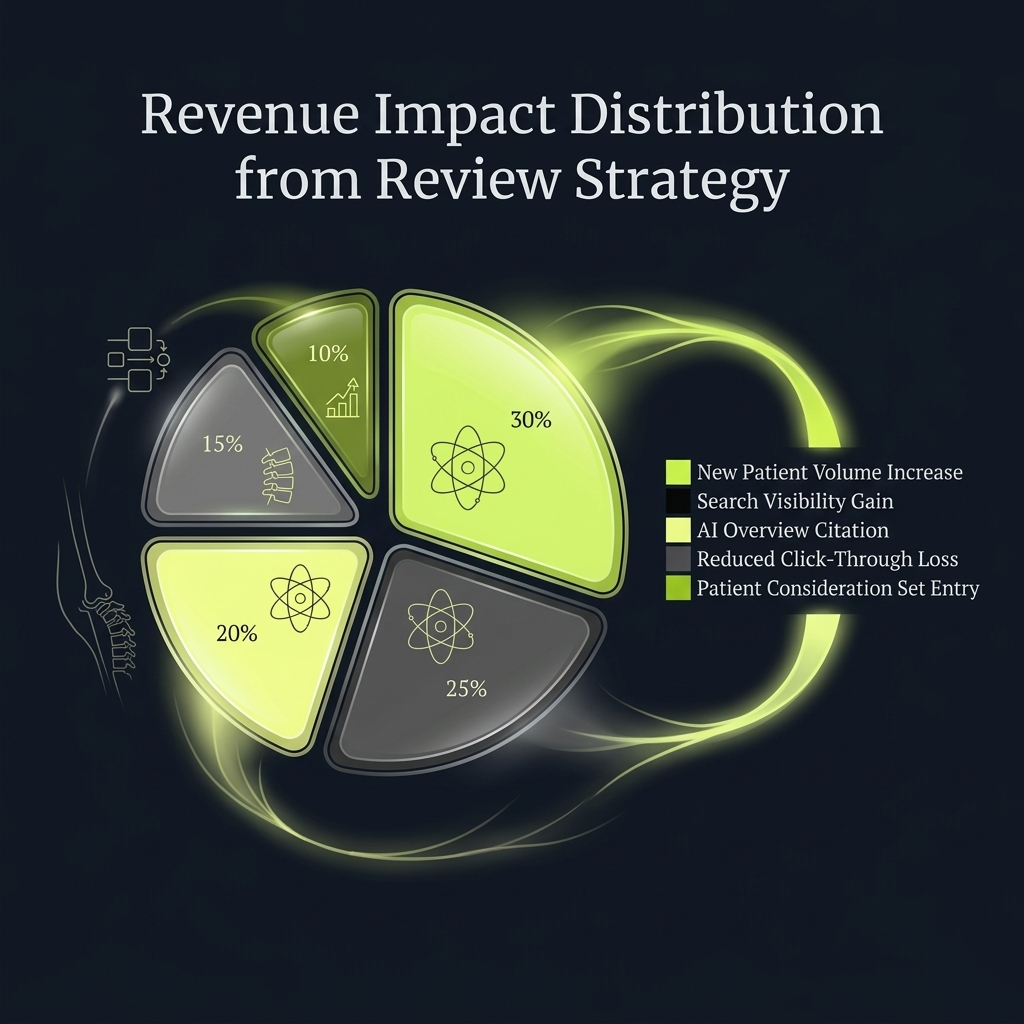
The immediate impact is patient flow. Healthcare consumers rely on digital sources 3.1 times more than traditional provider referrals when looking for a new primary care provider. And they read an average of five reviews before choosing.
If your reviews lack clinical specificity, you're losing patients before they ever call. The AI summary recommends your competitor. The prospective patient reads your competitor's reviews. You never appear in the consideration set.
The Zero-Click Search Problem
Read that again: being the top-ranked website now delivers 58% fewer clicks than it did before AI Overviews launched.
The user gets their answer at the top of the page. They don't scroll. They don't click through to your site. They either book with the practice mentioned in the summary or refine their search.
Your goal is no longer to rank first in the organic listings. Your goal is to be cited inside the AI-generated answer. That citation comes from your review text, not your website.
Scenario Analysis: Three Practice Trajectories
Best Case: A practice runs a systematic review collection process. Every discharged patient receives a timed request. The request includes a brief prompt: "If you're comfortable sharing, mention the specific condition we addressed and how you're feeling now." The practice generates 12–15 detailed reviews per month. Search visibility rises. New-patient volume from organic search increases 20–30% year-over-year.
Most Likely Case: A practice relies on front-desk staff to manually request reviews during checkout. Execution is inconsistent. Some weeks generate four reviews; other weeks generate none. The review feed stagnates. Competitors with automated systems pull ahead. New-patient counts from search decline 10–15% annually, offset partially by referrals and retention.
Worst Case: A practice ignores review velocity entirely, assuming legacy volume will sustain rankings. Reviews slow to one or two per month. Negative reviews go unaddressed. Search visibility drops sharply within 90 days. New-patient volume from organic discovery falls 40–50%. The practice increases ad spend to compensate, compressing margins.
The math on the worst case is brutal. Assume a practice averages 60 new patients per month, with 40% coming from organic search (24 patients). Average lifetime value per patient is $1,200 across six visits. Losing 50% of organic new patients costs the practice 12 patients per month, or $14,400 in monthly revenue. Annualized, that's $172,800.
Most practices don't see the drop as a single event. It's a slow erosion. Three fewer new patients this month. Five fewer next month. The owner attributes it to seasonality or competition, not to a structural shift in how patients discover care.
Strategic Impact by Practice Stage
Early-Stage Practices (1–2 years in operation): You have an advantage. You're not defending a legacy review bank. You can build a high-velocity, entity-rich review system from day one and outrank established competitors within six months. Your smaller total review count doesn't matter if your recent reviews are semantically superior.
Established Practices (10+ years, 500+ reviews): Your legacy reviews are losing algorithmic weight. A review from 2018 carries minimal ranking value in 2025. The AI prioritizes recency because it signals operational status. A practice with 500 old reviews and no new activity looks dormant. You need a review refresh strategy that generates 10+ detailed reviews per month to reactivate your profile.
How Will AI Change Local Healthcare Searches?
AI will shift local healthcare searches toward voice assistants and conversational AI, with over 40% of searches expected through these channels within 18 months. Instead of listing multiple options, AI will synthesize review data to recommend one or two practices based on specific conditions mentioned in recent patient feedback, fundamentally changing discovery patterns.
What Happens Next: the Forecast for Local Health Discovery
Gartner projected in February 2024 that traditional search engine volume will drop 25% by 2026 as search loses market share to AI chatbots and virtual agents. We're now in 2025, and the trend is accelerating faster than the forecast.
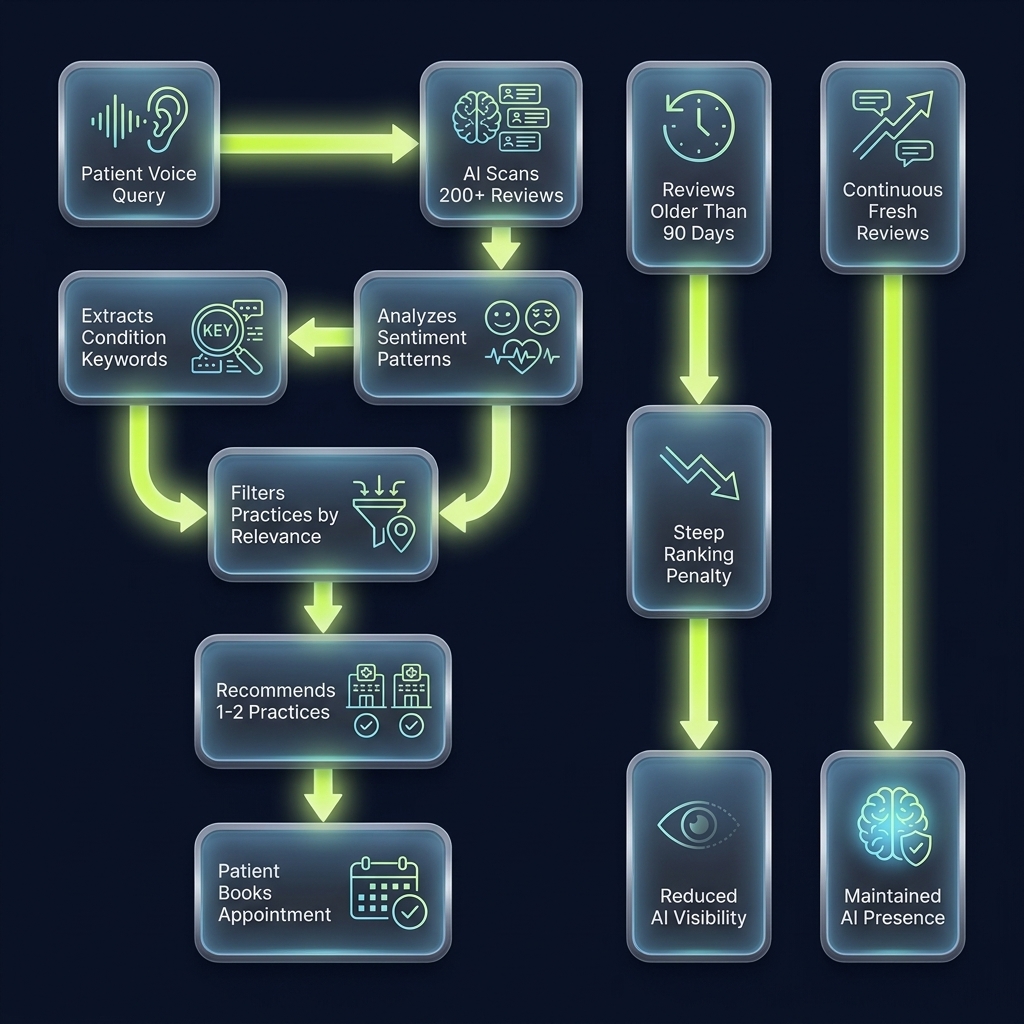
Within 12 to 18 months, I expect over 40% of local health searches will occur via voice assistants or conversational AI tools. These interfaces don't present a list of ten options. They recommend one or two practices based on synthesized review data.
The patient asks their phone, "Who should I see for lower back pain near me?" The AI reads 200 reviews across 15 practices, extracts condition mentions and sentiment, and replies with a single recommendation. If your reviews don't explicitly mention lower back pain, you're not in the pool.
Prediction 2: Recency Decay Will Accelerate
Reviews older than 90 days will suffer steeper ranking penalties. The AI model interprets review recency as a proxy for operational health. A practice generating fresh reviews weekly signals active patient flow and current service delivery. A practice with no reviews in three months signals stagnation or decline.
This creates a Review Treadmill. You can't build a review bank and coast. You need continuous generation to maintain visibility.
Prediction 3: Platform Scrutiny on Review Authenticity Will Intensify
As AI models rely more heavily on reviews for healthcare recommendations, search platforms will deploy stricter fraud detection. The Federal Trade Commission finalized a rule in October 2024 authorizing civil penalties of up to $51,744 per violation for businesses that purchase fake reviews, use AI-generated testimonials, or incentivize reviews with mandated sentiment.
Practices using review-gating software (systems that filter out dissatisfied patients before sending review requests) or scripted review templates will face profile suspension. The platforms can detect unnatural language patterns and sentiment clustering.
Authenticity is now a compliance requirement, not just an ethical standard.
How Do I Fix a Weak Review Strategy?
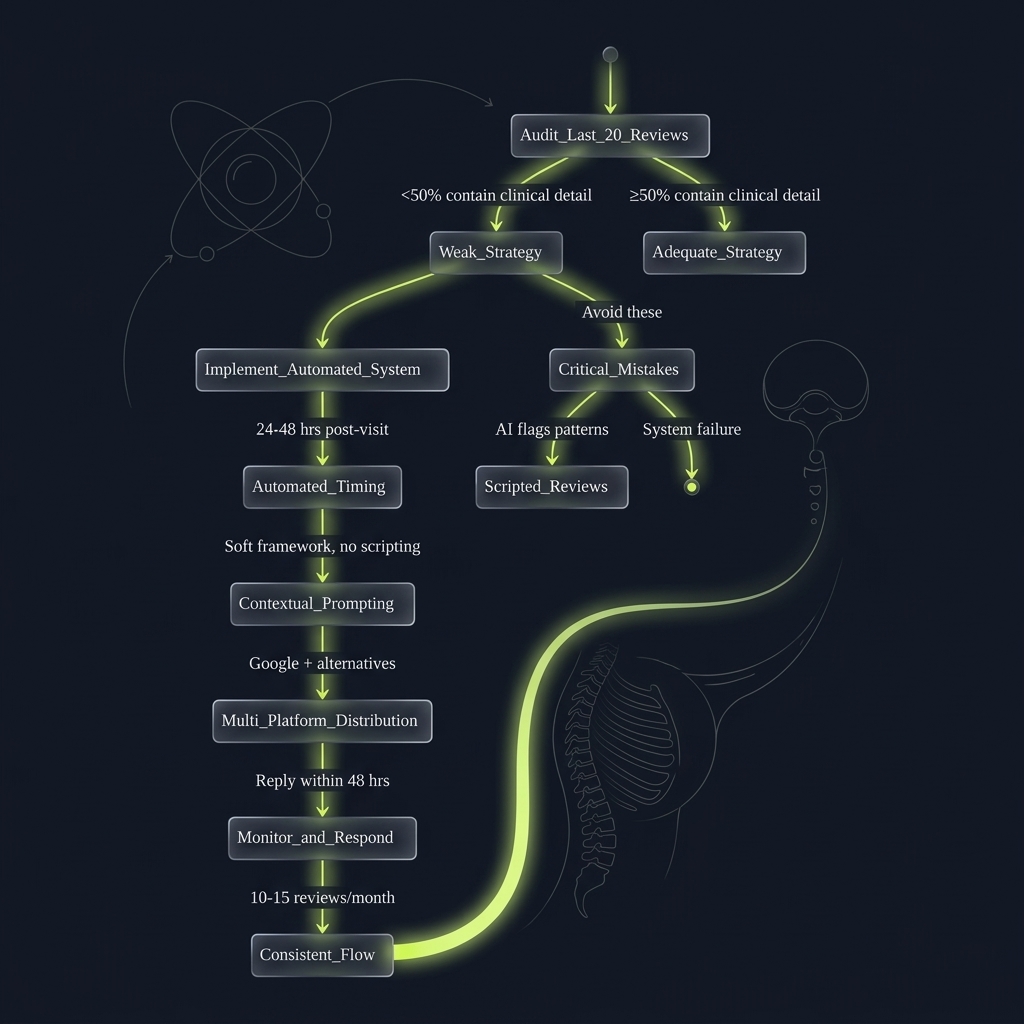
To fix a weak review strategy, healthcare practices should first audit their last 20 reviews for clinical detail. If fewer than half contain specific conditions or outcomes, implement an automated system with proper timing (24-48 hours post-visit), contextual prompting that encourages detail, multi-platform distribution, and consistent response protocols within 48 hours.
What to Do Right Now: the Operational Roadmap
Start with an audit. Pull your last 20 reviews. Count how many mention specific conditions, treatments, or outcomes. If fewer than half contain clinical detail, your review strategy is optimized for 2018, not 2025.
The fix isn't writing better reviews yourself. It's designing a patient communication system that prompts detailed responses without scripting them.
The Systematic Approach
Effective review generation operates as a background process, not a front-desk task. Your staff is already managing intake, scheduling, billing, and patient questions. Adding manual review requests guarantees inconsistent execution.
The system requires four components:
1. Automated Timing: The review request goes out 24–48 hours after the patient's visit, when the experience is recent but the outcome is evident. Too early, and the patient hasn't felt improvement. Too late, and they've forgotten the details.
2. Contextual Prompting: The request includes a soft prompt: "If you're comfortable, mention what brought you in and how you're feeling now." This isn't scripting. It's giving the patient a framework for detail without dictating content.
3. Multi-Platform Distribution: The request directs patients to your Google Business Profile first, but also offers options for Yelp, Healthgrades, or Facebook. Different patients prefer different platforms. Concentrating all reviews on one site creates vulnerability.
4. Monitoring and Response: Every review, positive, neutral, or negative, receives a response within 48 hours. The response is specific, never templated. It thanks the patient by name, references their condition (without violating privacy), and reinforces your clinical approach.
This system generates 10–15 reviews per month for a practice seeing 120 patient visits per week. That's an 8–10% conversion rate from visit to review, which is realistic for automated systems with good prompting.
What Not to Do: the Three Critical Mistakes
Mistake 1: Scripting Patient Reviews. Do not give patients template language or suggested phrasing. AI detection algorithms recognize manufactured patterns. Google's spam filters flag reviews with identical sentence structures across multiple accounts. Your profile gets penalized, and the reviews get removed.
Mistake 2: Using Generic AI Tools for Review Responses. ChatGPT and similar platforms are non-deterministic. You can't predict what they'll write. They lack healthcare compliance guardrails. They will draft responses that make clinical claims you're not allowed to make, promise outcomes you can't guarantee, or inadvertently disclose protected health information. Every response requires full human review, which consumes the time you were trying to save.
Mistake 3: Delegating Review Collection to Front-Desk Staff. Your front desk is already the operational bottleneck in your practice. They manage phones, check-in, insurance verification, and checkout. Asking them to also track review requests and follow up manually adds a task that will be deprioritized the moment the waiting room fills up. Manual systems fail under operational pressure.
The Execution Problem
You now understand the system: automated timing, contextual prompts, multi-platform distribution, fast response. The question is who operates it.
Running this system manually is a part-time job. Someone has to export patient lists daily, send requests, monitor five platforms for new reviews, draft custom responses, and ensure compliance with privacy regulations. That's 8–12 hours per week of administrative work.
Generic AI tools don't solve this. They still require your time to prompt, review, and edit. And they introduce compliance risk every time they generate text.
Platforms that operate this whole loop end-to-end, automated requests, compliance-checked responses, multi-platform monitoring, exist specifically to remove this work from your staff. Omniply is one example; there are others. The commonality is that they run the system as infrastructure, not as a task list.
How Do AI Search Engines Analyze My Practice Reviews?
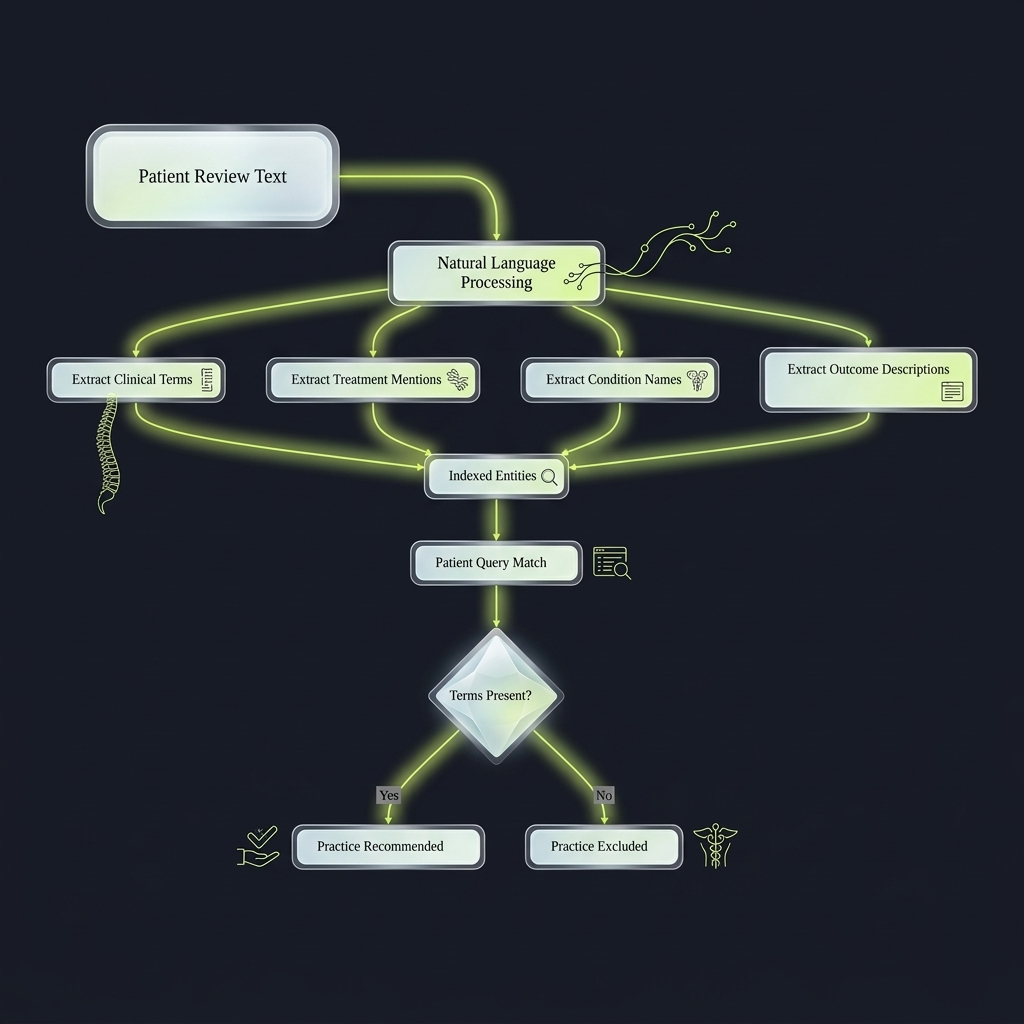
AI search engines use Natural Language Processing to parse review text and extract clinical terms, treatment mentions, condition names, and outcome descriptions. These extracted entities are indexed and matched to patient search queries. When patients search for practitioners treating specific conditions, AI scans review content for relevant mentions to determine recommendations.
How AI Reads Your Reviews: the Questions Practice Owners Ask
How Do AI Search Engines Use Online Reviews?
AI search engines parse the full text of your reviews using Natural Language Processing. They extract clinical terms, treatment mentions, condition names, and outcome descriptions. Those extracted entities get indexed and matched to patient search queries. When someone searches for a chiropractor who treats a specific condition, the AI scans your review corpus for mentions of that condition. If the terms don't appear, you're not recommended.
Are Online Review Responses Subject to HIPAA Compliance?
Yes. Under HIPAA's Privacy Rule, a healthcare provider cannot confirm or deny that a reviewer is a patient in a public forum. Responding to a review in any way that acknowledges patient status, including thanking someone by name on a medical review platform, constitutes an unauthorized disclosure of Protected Health Information. The Office for Civil Rights has established that a patient disclosing their own PHI online does not waive the provider's HIPAA obligations. You cannot repeat, confirm, or acknowledge the patient's medical condition in a response, even if the patient explicitly made it public first. The safest approach is to post a generic, non-specific response that thanks the feedback without confirming the reviewer's identity or patient relationship.
Is ChatGPT Safe for Writing Online Review Responses?
No. ChatGPT is non-deterministic, meaning it generates different outputs from the same prompt. It has no built-in healthcare compliance logic. It will write responses that make clinical claims, promise outcomes, or inadvertently reference patient details in ways that violate advertising regulations or privacy laws. Every response it generates requires full human review, which eliminates the time savings. And if you miss a compliance violation, you own the liability.
Does Replying to Online Reviews Affect Search Visibility?
Yes. Response rate is a secondary ranking signal. Practices that respond to reviews within 48 hours signal active management and patient engagement. The AI interprets this as operational health. Additionally, your responses add more text to your review profile, giving the algorithm more content to parse for entity extraction. A well-written response that naturally mentions clinical terms can reinforce the semantic richness of the original review.
How Do AI Search Tools Handle Negative Reviews?
AI models evaluate sentiment, but they also evaluate response quality. A negative review that receives a thoughtful, professional response often strengthens your profile more than a generic five-star review with no detail. The algorithm recognizes that negative feedback happens and weights your response as evidence of accountability. The worst scenario is an unaddressed negative review, which signals either inattention or poor service recovery.
How Much Time Should Staff Spend Managing Reviews?
Zero hours on manual collection. Your front desk should never be responsible for remembering to ask patients for reviews or tracking who has and hasn't responded. That task should be automated. Staff time should be reserved for responding to reviews that require clinical judgment or personalized language—roughly 2–3 hours per week for a practice generating 12–15 reviews monthly.
Do Automated Review Responses Harm Reputation?
Only if they're generic. Patients can detect templated responses immediately. An automated system that generates personalized, contextually relevant responses based on the review content is indistinguishable from a human-written reply. The harm comes from visible automation: responses that repeat the same phrases, ignore the patient's specific feedback, or sound robotic. A good system avoids this by varying structure and referencing review details.
How Do Patient Reviews Impact Local Search Results?
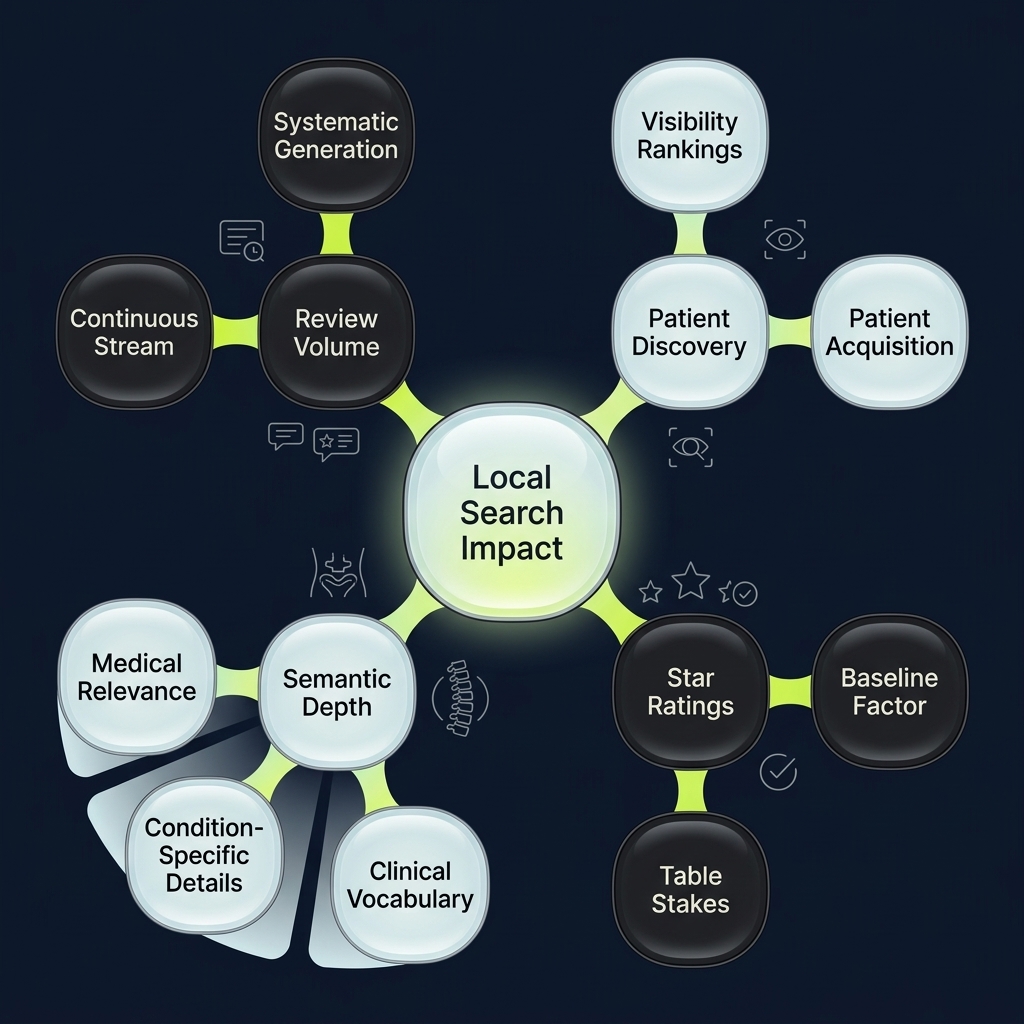
Patient reviews significantly impact local search results through AI algorithms that analyze semantic depth, clinical vocabulary, and condition-specific details within review content. While star ratings remain important baseline factors, search engines now prioritize practices generating continuous streams of detailed, medically-relevant reviews that demonstrate clinical expertise and patient outcomes, directly influencing visibility and patient acquisition.
The Bottom Line
AI algorithms now evaluate the semantic depth and clinical vocabulary inside your patient reviews to determine who gets recommended in local search. Star ratings still matter, but they're table stakes. The practices winning patient volume in 2025 are the ones generating a continuous stream of detailed, condition-specific reviews.
This isn't a temporary algorithm shift. It's the new infrastructure of patient discovery.
The solution is systematic: automated timing, contextual prompting, fast response, and compliance-checked language. The problem is execution. Running that system manually consumes 8–12 hours per week. Generic AI tools don't solve it; they introduce compliance risk and still require your time.
You need the system operating in the background, generating reviews and responses without adding work to your clinical team. Whether you build it, buy it, or hire it out, the system is non-negotiable.
Your reviews are being read twice now. Make sure both audiences get the information they need.