
Your front desk sees forty patients a day, but your Google Business Profile gained exactly two reviews last month.
That is not a visibility issue. It is an operational leak.
Ninety percent of your relieved patients leave your clinic fully intending to rate your care. Then life happens in the parking lot. Manual requests fail because they rely on memory, precise timing, and awkward front-desk conversations. If your goal is to get more google reviews, asking at checkout or sending delayed email blasts only drains staff energy and cheapens your authority.
You need a workflow as precise as a spinal adjustment.
In this guide, we break down the Ethical Extraction Method: a quiet, three-part system that turns daily foot traffic into a steady stream of five-star feedback without staff fatigue or policy violations. You will see the exact math behind ten-fold review growth, why standard follow-ups fail, and how to fix your intake-to-review pipeline permanently.
The diagnostic starts with your exit flow.
Key Takeaways
- Conversion Rate Failure: Standard review requests (checkout ask + delayed email) achieve only 1% conversion despite 84% of patients checking online reviews before selecting healthcare providers.
- Three-Part Extraction System: Peak Sentiment Timing (visits three through six), Verbal Micro-Commitment at checkout, and Immediate Digital Delivery (60–120 minutes post-visit) increase conversion rates from 1.25% to 20–25%.
- SMS Outperforms Email: Text messages deliver 98% open rates versus 28% for email, with direct Google review links (https://g.page/r/.../review) reducing friction and boosting completion rates.
- Review Gating Penalties: Google prohibits sentiment-based filtering before directing patients to public profiles; FTC fines reach $52,000 per violation under the October 2024 consumer review rule.
- HIPAA Response Compliance: Public review responses must never confirm patient identity or disclose clinical details; violations trigger civil penalties ranging from $145 to $2,190,294 per incident as of January 2026.
Why Are Patients Ignoring Our Google Review Requests?
Patients ignore review requests due to poor timing and ineffective channels. The typical approach, asking at checkout then sending delayed emails, fails because patients forget within 90 seconds of leaving and automated emails land in promotional folders with only 4% click-through rates. This creates a 1% conversion rate despite genuine patient willingness to help.
Why Your Current Review Requests Evaporate
According to 2025 healthcare consumer data, 84% of patients check online reviews before selecting a new healthcare provider, and 61% of patients prioritize online reviews over personal referrals from friends and family members. Your practice lives or dies on your Google Business Profile rating.
Yet most practices operate with what I call The Parking Lot Failure Pattern. The sequence looks like this:
Patient checks out at the front desk. Staff member says, "If you have time, we'd love a Google review." Patient nods and says "Sure, absolutely." Patient walks to their car, checks their phone, sees seventeen texts, remembers they need to pick up groceries, and your practice evaporates from working memory within ninety seconds.
Three days later, your practice management software sends an automated email with the subject line "We'd Love Your Feedback!" The email lands in a promotional folder the patient checks twice a month. Open rate: 28%. Click rate on the review link inside: 4%.
The math is brutal. If you see two hundred patients monthly and ask every single one for a review using this method, you generate roughly two completed reviews. That is roughly a 1% conversion rate on a population that genuinely wants to help you.
The failure is not your patients. The failure is your extraction timing and your communication channel.
What is the Three-part Extraction System?
The three-part extraction system consists of Peak Sentiment Timing, which identifies the optimal clinical moment (typically visits three through six) when patients experience functional breakthroughs; Verbal Micro-Commitment, using a front-desk script to secure agreement before sending requests; and Immediate Digital Delivery, which sends the review link while emotional momentum remains high.
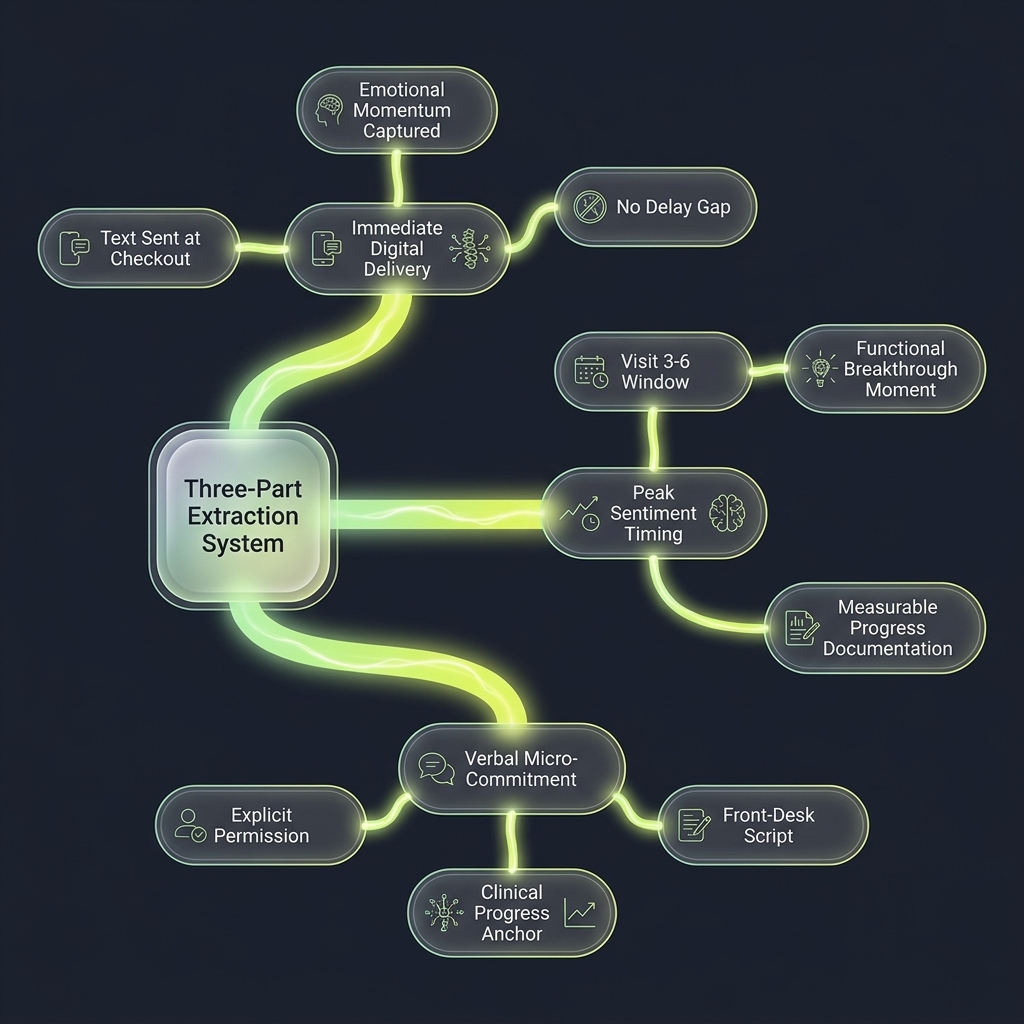
The Three-Part Extraction System
To achieve ten-fold review growth, you need three components operating in sequence: Peak Sentiment Timing, Verbal Micro-Commitment, and Immediate Digital Delivery. Each component solves a specific failure mode in the standard approach.
Component One: Peak Sentiment Timing
Most practices ask for reviews at the wrong clinical moment. They request feedback during the initial consultation when the patient is still in acute pain and has not yet experienced meaningful functional improvement. Or they wait until discharge, weeks after the emotional peak has passed.
The correct moment is Visit Three through Visit Six for most adjustment-based protocols, or immediately following a re-evaluation where you document measurable progress. This is the window where the patient has moved from pain relief to functional restoration. They can now pick up their toddler without wincing. They slept through the night for the first time in months. The clinical outcome is fresh and concrete.
Asking at this moment yields higher star ratings and longer, more detailed review text. The patient has a story to tell, not just a vague positive feeling.
Map your clinical pathway and mark the exact visit number where patients typically report functional breakthroughs. That visit becomes your review request trigger point.
Component Two: Verbal Micro-Commitment
Digital requests sent without prior verbal agreement feel like spam. The patient did not ask for the message, did not expect it, and deletes it reflexively.
The fix is a two-sentence front-desk script delivered at checkout:
"Dr. [Name] was thrilled with your mobility progress today. We're on a mission to help more people in [City Name] get out of pain; is it okay if we send you a quick text with a link to share your experience on Google?"
This script does three things. First, it anchors the request to the clinical progress the patient just experienced, making the ask feel earned rather than transactional. Second, it frames the review as community service rather than a favor to you. Third, it secures explicit verbal permission before the digital message arrives.
When a patient says "Yes, absolutely" at the front desk, they have made a micro-commitment. That commitment increases their likelihood of following through when the text arrives, based on observed click-through rates in practices that implement this verbal handoff versus those that skip it.
The front desk must execute this script every single time. It cannot be optional or dependent on how busy the checkout flow feels. Build it into your standard operating procedure and track daily completion in your morning huddle.
Component Three: Immediate Digital Delivery
Email is the wrong channel for review requests. In 2026, SMS text messages boast an estimated open rate of up to 98%, compared to an average email open rate of just 28%. Text messages arrive on the lock screen. They demand attention. They get read within minutes of receipt.
But timing matters as much as channel. If you wait twenty-four hours to send the text, the patient's emotional connection to their clinical progress has already faded. The ideal window is sixty to one hundred twenty minutes post-checkout.
The message itself should be short, personal, and contain only the review link:
"Hi [First Name], thanks for visiting [Practice Name] today! As promised, here is the quick link to leave your review on Google: [Short Link]"
The phrase "as promised" references the verbal conversation at checkout and eliminates the feeling of an unsolicited marketing message. The patient remembers agreeing to this. They expect it.
Before you deploy any text messaging system, verify that you have active SMS consent flags in your patient management software. The Telephone Consumer Protection Act (TCPA) requires prior express written consent before sending automated promotional text messages. TCPA class-action litigation surged dramatically in 2025, between 60% and 95% depending on the specific tracking month, with total settlements across the industry exceeding $150 million. Secure consent at intake or during the checkout conversation, document it in the patient record, and never send automated texts to patients who have not explicitly opted in.
How Do I Create a Direct Google Review Link?
To create a direct Google review link, log into Google Business Profile manager, select the primary location, and click "Ask for reviews." Google generates a short URL (https://g.page/r/.../review) that opens directly to the five-star rating modal, bypassing the map listing and removing friction that reduces completion rates by over 40%.
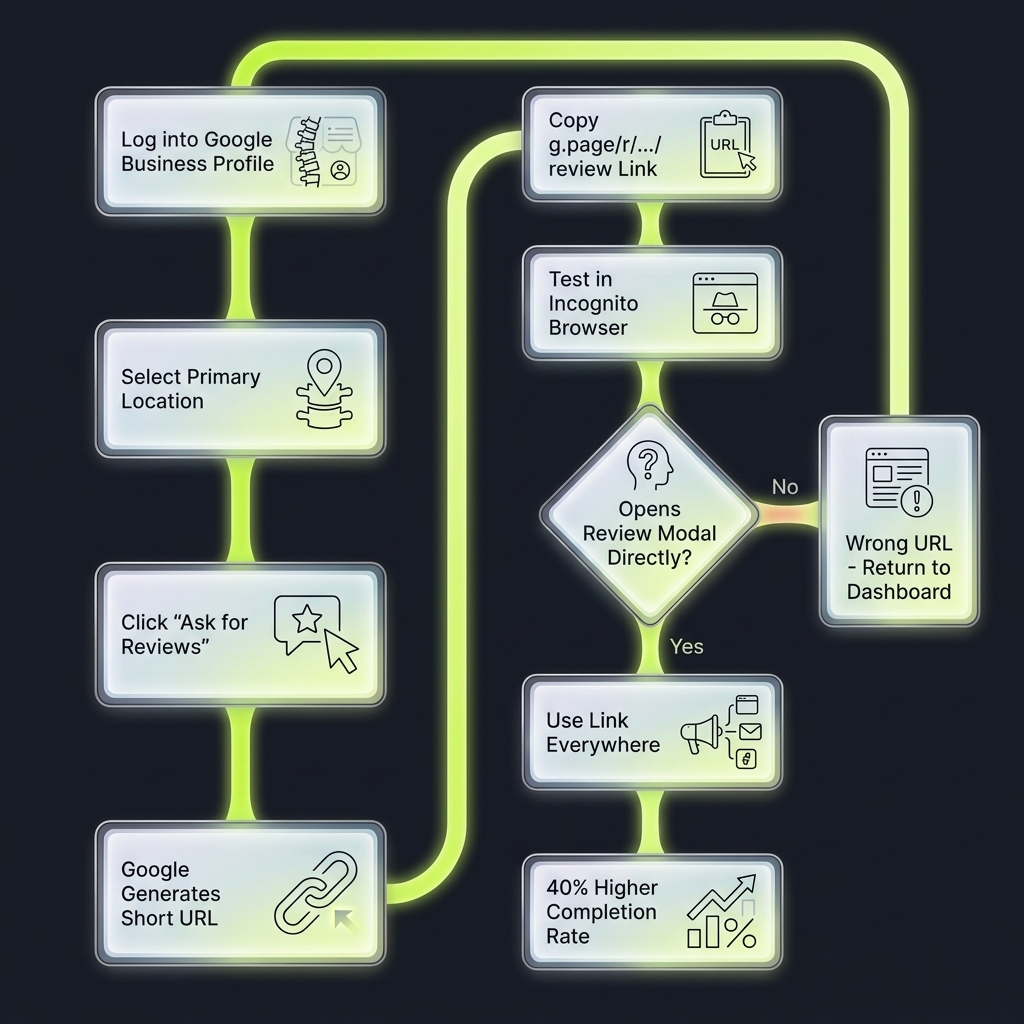
The Direct Review Link That Removes Friction
Most practices send patients to their Google Maps listing and expect them to find the review button. That adds two unnecessary steps: scrolling to locate the review section and clicking through to open the input form.
Every additional click reduces completion rates. The fix is your google review link: a direct URL that opens the five-star rating modal immediately.
To generate this link, log into your Google Business Profile manager, select your primary location, and click "Ask for reviews." Google generates a short URL that looks like https://g.page/r/.../review. Copy this link and test it in an incognito browser window on both desktop and mobile. The link should bypass your map listing entirely and open directly to the review input screen with the star selector visible.
If the link lands on your map listing instead of opening the review prompt, you copied the wrong URL. Return to the Google Business Profile dashboard and specifically copy from the "Ask for reviews" dialog.
Removing two clicks from the patient journey increases review completion rates. Use this direct link in every text message, email, and printed handout.
What Compliance Mistakes Can Destroy a Medical Practice?
Three critical compliance mistakes can destroy medical practices: review gating that filters patients by sentiment before directing them to public platforms, exposing practices to Google profile removal and FTC fines up to $52,000 per violation; HIPAA violations when responding publicly to patient reviews; and FTC penalties for manipulating feedback, all risking severe regulatory consequences and reputational damage.
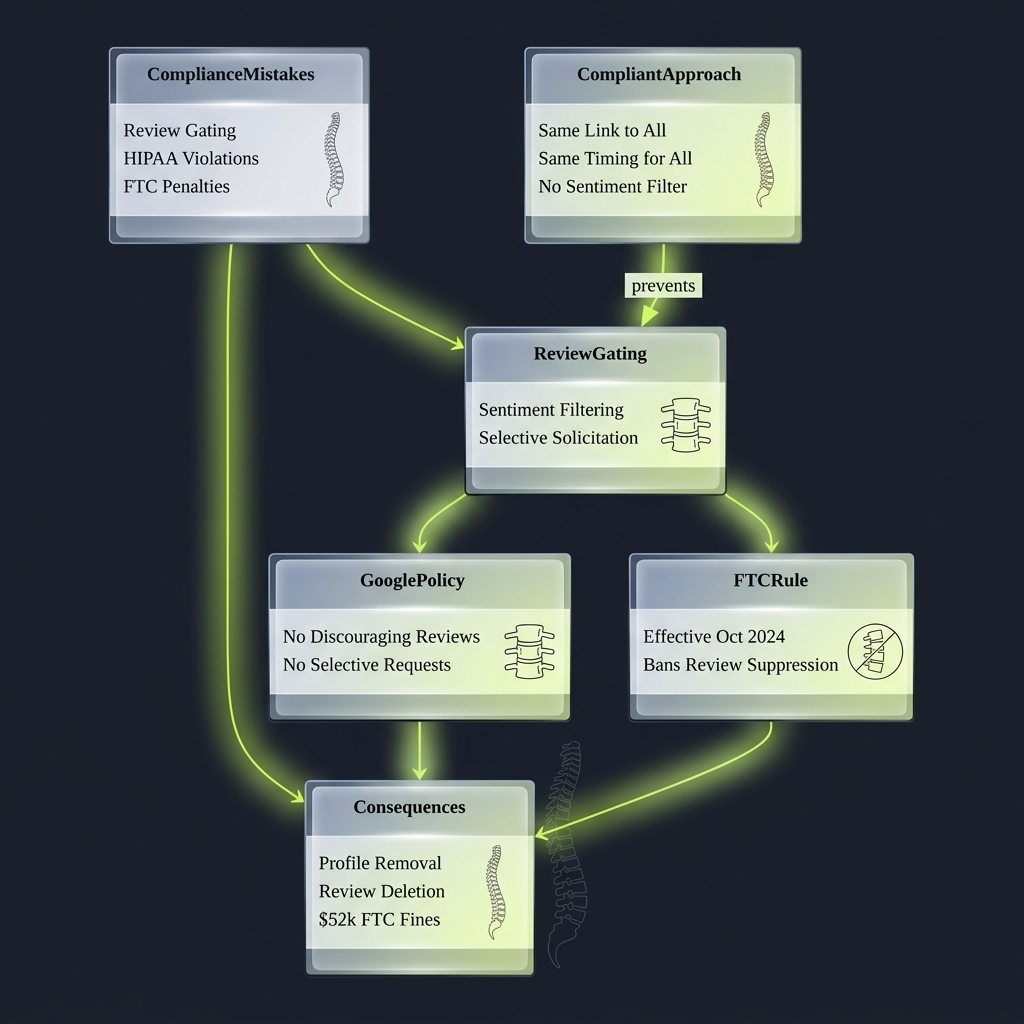
The Compliance Traps That Destroy Practices
Scaling review volume exposes you to three regulatory risks: google review gating, Health Insurance Portability and Accountability Act violations in public responses, and Federal Trade Commission penalties for manipulating feedback. Each risk carries severe consequences.
Review Gating: the Platform Removal Risk
Review gating is the practice of filtering patients based on sentiment before directing them to your public review profile. The most common implementation: software that asks, "Did you have a good experience? [Yes / No]" and sends happy patients to Google while routing unhappy patients to a private contact form.
This violates Google's explicit content policy. The platform prohibits businesses from discouraging or selectively soliciting reviews. While Google can and does suspend or remove profiles for severe or repeated violations, the most common immediate penalty is the mass deletion of illegitimate reviews themselves or temporary profile restrictions. But escalated enforcement can result in complete profile removal, erasing years of accumulated reviews and destroying your local search visibility.
The compliant approach: send every patient the same review link at the same moment in their clinical journey, regardless of whether you predict their feedback will be positive or negative. You can control timing and you can control who receives the request, but you cannot filter based on sentiment.
If you currently use software that screens patients before directing them to Google, dismantle it immediately. The risk is not theoretical.
Protected Health Information in Public Responses
When a patient leaves a review, your response becomes a public, permanent record. Most practice owners instinctively want to acknowledge the patient's specific clinical outcome and thank them by name. This creates a severe Health Insurance Portability and Accountability Act violation.
Example of a non-compliant response: "Thanks John, glad your lower back pain and sciatica feel better after your adjustment!"
This response explicitly confirms that John is a patient, reveals his diagnoses (lower back pain, sciatica), and discloses that he received treatment (adjustment). All three elements constitute Protected Health Information disclosure without written authorization.
The U.S. Department of Health and Human Services Office for Civil Rights actively penalizes healthcare practices for revealing Protected Health Information in review responses. Adjusted for inflation as of January 2026, civil monetary penalties for Health Insurance Portability and Accountability Act violations range from $145 per violation at the lowest tier up to $2,190,294 per violation for uncorrected willful neglect.
The compliant response template is neutral and privacy-preserving:
"Thank you for the feedback! We strive to provide high-quality care to all our local community members."
This response acknowledges the review without confirming the reviewer is a patient, without referencing any clinical information, and without using the reviewer's name. It signals account activity to Google's algorithm while protecting your practice from regulatory liability.
Respond to every review within forty-eight hours using this template structure. Consistent response activity is a ranking signal. Silence looks like abandonment.
How Do Negative Reviews Affect a Practice's Reputation?
Negative reviews significantly impact healthcare practices, with 40% of patients canceling or avoiding appointments based on unfavorable online feedback. A single one-star review dramatically affects practices with limited total reviews, visibly lowering average ratings. However, practices with higher review volumes experience minimal impact, as negative feedback becomes statistically insignificant when diluted by numerous positive reviews.
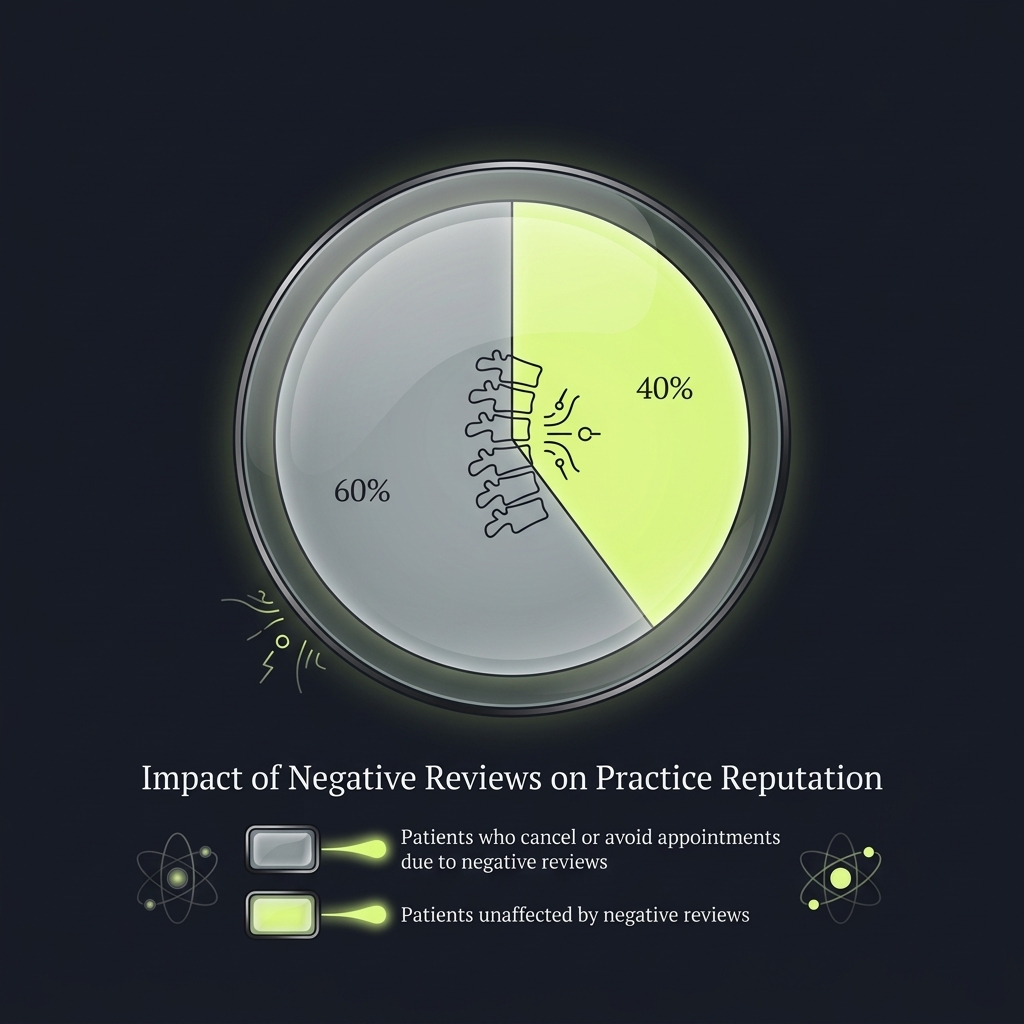
What Happens When Negative Reviews Arrive
Scaling review volume means you will receive negative feedback. This is not a system failure. It is operational variance.
According to healthcare consumer research, 40% of patients have changed their care plans, either canceling an appointment or choosing not to book with a particular provider, based on negative online feedback. A single one-star review on a profile with twelve total reviews moves your average rating visibly. But a single one-star review on a profile with one hundred twenty reviews barely registers.
The correct response to negative feedback is dilution through volume. You cannot remove legitimate negative reviews. You can only generate enough positive reviews that the negative entries become statistical noise.
When a one-star or two-star review appears, respond within twenty-four hours using a non-defensive, Health Insurance Portability and Accountability Act-compliant template:
"Thank you for reaching out. We take all feedback seriously. Please contact our office management directly at [Phone] so we can discuss your concerns privately."
This response demonstrates accountability without admitting fault, invites private resolution without revealing clinical details, and shows prospective patients that you handle problems professionally. Then continue your ethical review system. Fresh positive reviews will bury the negative entry within weeks.
How Can Practice Review Volume Grow Ten-fold?
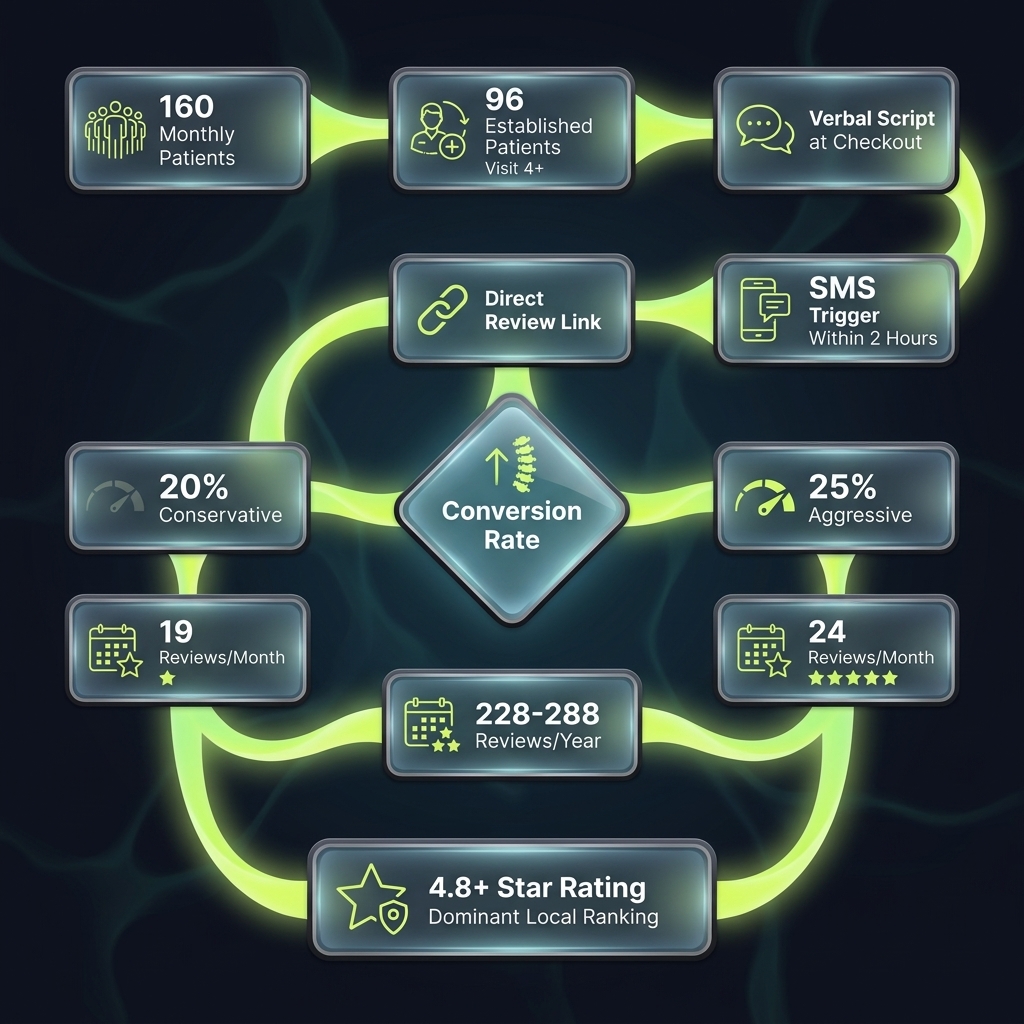
Practice review volume grows ten-fold by implementing a three-part extraction system: front desk staff deliver verbal scripts at checkout to established patients, automated SMS triggers fire within two hours, and direct review links remove friction. This approach increases conversion rates from 1.25% to 20-25%, generating 19-24 monthly reviews compared to the baseline of two reviews.
The Math of Ten-Fold Growth
Let's work through the numbers with a mid-sized practice.
Baseline state: You see one hundred sixty patients monthly across four providers. You gained two Google reviews last month. That is a 1.25% conversion rate.
You implement the three-part extraction system. Front desk delivers the verbal script at checkout to patients at Visit Four or later (roughly 60% of your monthly volume, or ninety-six patients). SMS triggers fire within two hours. Your direct review link removes friction.
Conservative conversion rate with this system: 20%. That means nineteen completed reviews monthly, up from two. That is a 9.5x increase.
Aggressive execution with strong front-desk adherence: 25% conversion. That yields twenty-four reviews monthly, a 12x increase.
The compounding effect appears in local search rankings. Google's algorithm weighs review velocity more heavily than total review count. A practice gaining twenty reviews monthly outranks a competitor with three hundred static reviews that gained zero new feedback in the past ninety days.
Over twelve months, this system generates between two hundred twenty-eight and two hundred eighty-eight new five-star reviews. Your average rating stabilizes above 4.8 stars. Your Google Business Profile becomes the dominant local result for your target keywords.
The operational cost: forty-five minutes of initial setup, three minutes daily to monitor the automated workflow, and ten minutes weekly to respond to new reviews. No advertising spend. No third-party lead generation fees.
Why Do Manual Processes Fail After a Few Weeks?
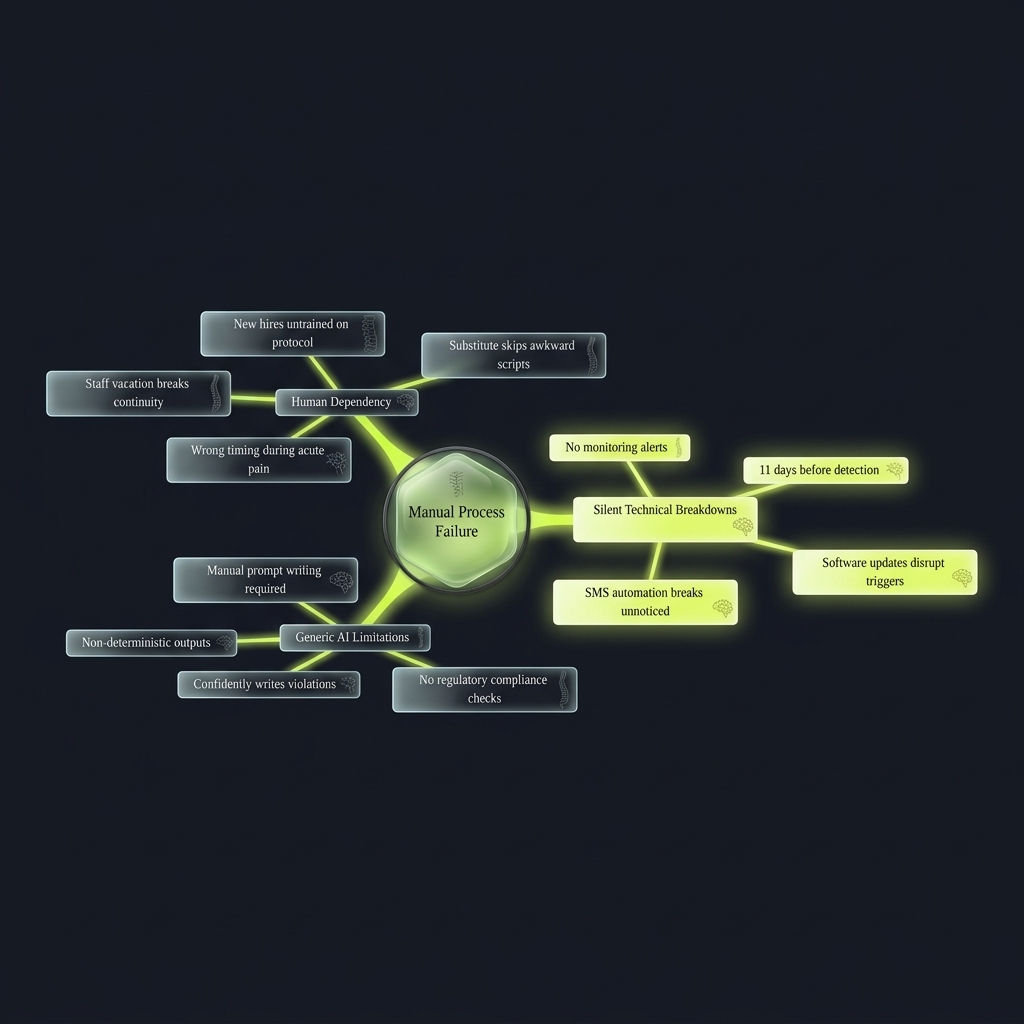
Manual processes fail within weeks because they depend on perfect human adherence under clinical pressure. Staff turnover, vacations, inadequate training, and unnoticed technical failures cause silent breakdowns. When key personnel leave temporarily or new staff aren't properly trained, critical steps like review requests get skipped, inconsistently executed, or performed at inappropriate clinical moments, causing immediate performance drops.
Why Manual Execution Fails Within Weeks
The system works. The math is proven. But sustained execution is where most practices collapse.
Here is what happens in month two. Your lead front-desk coordinator who championed the verbal script takes a week of vacation. The substitute staff member skips the checkout conversation because it feels awkward and they are not confident in the wording. Review volume drops by 60% that week.
Your patient management software updates and breaks the SMS automation trigger. No one notices for eleven days because everyone assumes the system is still running. You lose two weeks of review requests.
A new staff member joins and no one trains them on the review protocol. They start asking for reviews during initial consultations when patients are still in acute pain. Your average star rating drops because you are requesting feedback at the wrong clinical moment.
Manual systems depend on perfect adherence by imperfect humans operating under clinical pressure. They break silently. They require constant monitoring. They consume administrative attention that should focus on patient care.
Generic AI tools like ChatGPT do not solve this problem. They still require you to write prompts, review outputs, and manually trigger each message. Their responses are non-deterministic: the same prompt produces different outputs each time, and nothing in the tool ensures compliance with health advertising regulations. They will confidently write clinical claims your practice is not allowed to make, and you will not catch the violation until after it is public.
How Can We Automate Patient Review Requests?
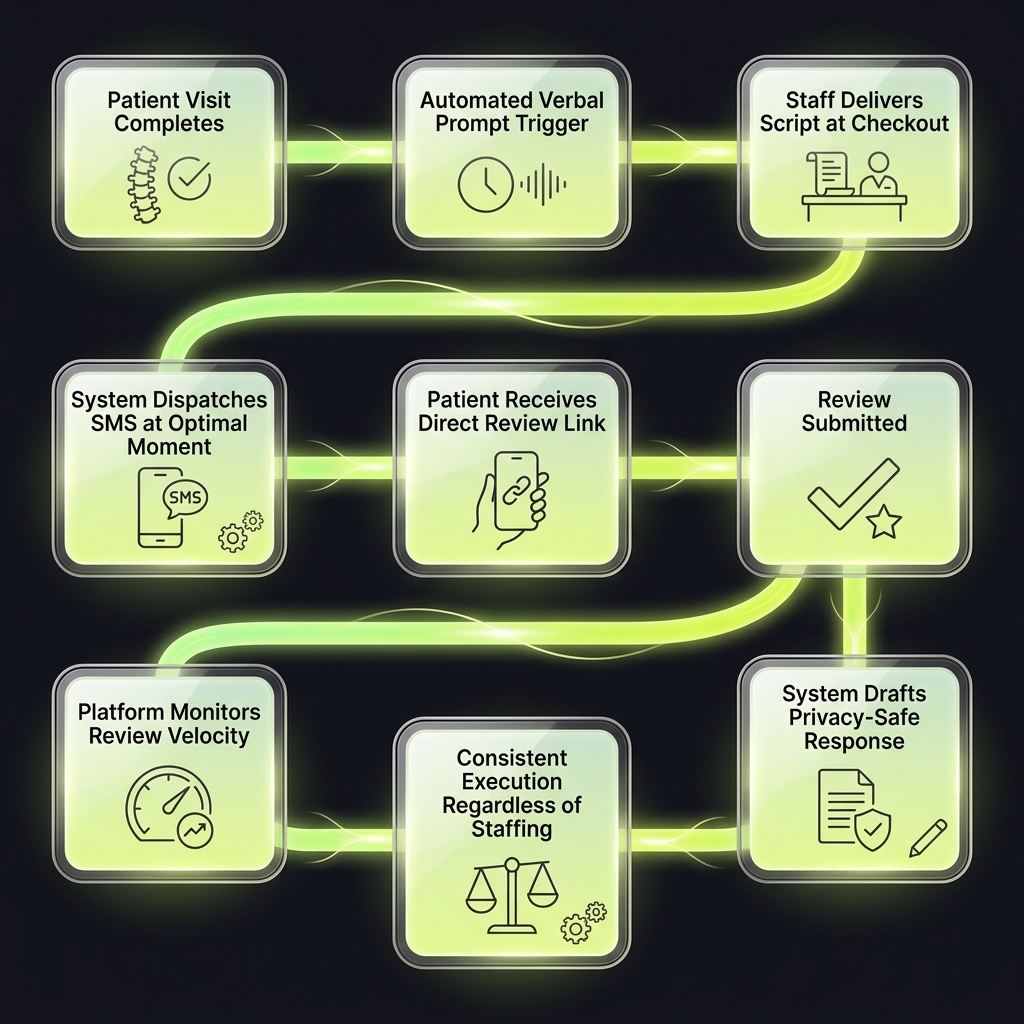
Healthcare practices can automate patient review requests through end-to-end platforms that trigger verbal prompts, dispatch compliant text messages at optimal clinical moments, monitor review velocity, and draft privacy-safe responses. These automated workflows maintain high conversion rates while eliminating manual execution burdens, ensuring consistent operation regardless of staffing levels or front desk availability.
The System That Cannot Get Tired
The solution is not better manual discipline. The solution is removing manual execution entirely.
Platforms that operate this whole loop end-to-end, triggering verbal prompts, dispatching compliant text messages at the correct clinical moment, monitoring review velocity, and drafting privacy-safe responses, eliminate the operational burden while maintaining the conversion rates that manual execution achieves when it actually runs. Tools like Omniply encode the entire extraction system into automated workflows that execute whether your front desk is fully staffed or running short that week.
The decision is not whether the system works. The decision is whether you want to operate it by hand or let software handle execution while you focus on adjustments.
Frequently Asked Questions
Can I Use ChatGPT to Ask Patients for Reviews?
You can use ChatGPT to draft message templates, but you cannot rely on it for automated execution. ChatGPT produces non-deterministic outputs, requires manual prompting for each message, and has no built-in compliance safeguards for healthcare advertising rules or Health Insurance Portability and Accountability Act requirements. It will generate clinical claims you are not allowed to make unless you review and edit every output.
Is Asking Patients for Google Reviews HIPAA Compliant?
Yes, if you follow two rules. First, secure prior consent for SMS or email communication during intake. Second, never include clinical information or patient names in your public review responses. The act of requesting a review does not violate Health Insurance Portability and Accountability Act. The violation occurs when you publicly confirm someone is a patient or disclose their treatment details.
Is Review Gating Allowed on Google?
No. Google's content policy explicitly prohibits review gating. You cannot screen patients based on sentiment before directing them to your public review profile. While Google can and does suspend or remove profiles for severe or repeated violations, the most common immediate penalty is mass deletion of illegitimate reviews or temporary profile restrictions, though escalated enforcement can result in complete removal of your Google Business Profile. The Federal Trade Commission also bans review gating, with civil penalties up to nearly $52,000 per violation.
Is Text or Email Better for Review Requests?
Text messaging delivers significantly higher open rates. In 2026, SMS text messages boast an estimated open rate of up to 98%, compared to an average email open rate of just 28%. Text messages appear on the lock screen and get read within minutes. Emails land in promotional folders and get checked sporadically.
Can a Clinic Offer Incentives for Google Reviews?
No. Google's policy prohibits offering compensation, discounts, or gifts in exchange for reviews. The Federal Trade Commission considers incentivized reviews deceptive. Violations can result in platform removal and regulatory penalties. The ethical approach is to make leaving a review easy and timely, not to pay for it.
How Many Google Reviews Should a Local Clinic Have?
The number matters less than the velocity. A practice with eighty reviews that gained twenty in the past month outranks a competitor with three hundred reviews that gained zero new feedback recently. Aim for consistent monthly growth rather than a static total count.
Can Front Desk Staff Automate Review Requests?
Yes, but automation must be built into your patient management software with proper consent flags and compliance controls. Manual execution by front desk staff fails within weeks due to turnover, vacation coverage, and competing clinical priorities. Automation removes the dependency on perfect human adherence.
Can Patients Leave Google Reviews Without a Gmail Account?
No. Patients need a Google account to leave a review on your Google Business Profile. Most patients already have one through Android devices or prior Gmail use. If a patient does not have a Google account, they must create one to complete the review. This friction is unavoidable but minimal.
How Should I Manage Our Review Generation Process?
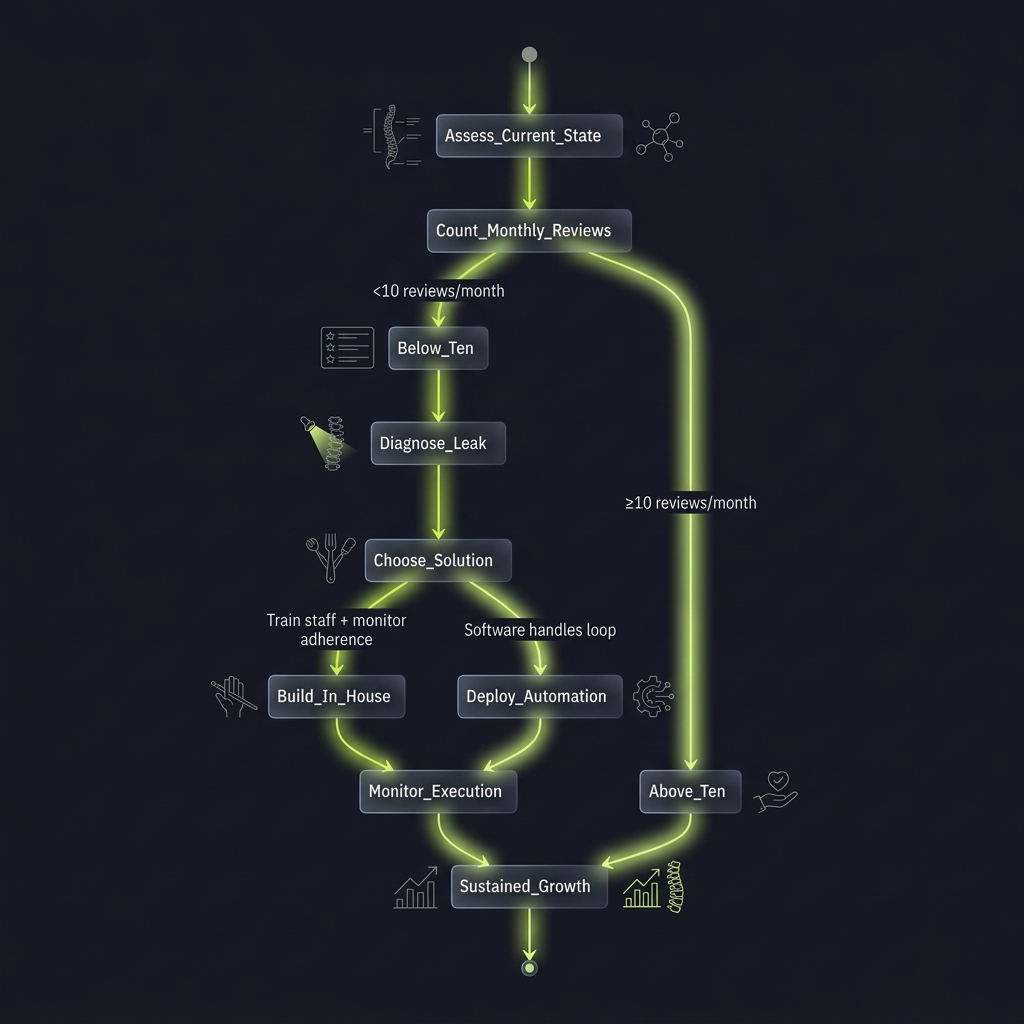
Businesses should choose between building an in-house workflow with trained staff or implementing automated software to manage the review generation loop. The decision depends on capacity to maintain consistent execution without compliance violations. A diagnostic benchmark is gaining at least ten reviews monthly; fewer indicates a broken process requiring either systematic repair or automation to capture willing reviewers.
The Operational Choice
You now understand the exact mechanism that turns daily foot traffic into sustained review growth. You have seen the math, the compliance boundaries, and the failure modes of manual execution.
The system works when executed. The question is who executes it.
You can build this workflow in-house, train your staff, monitor adherence, and repair breakdowns when they occur. Or you can route the entire operation through software designed to run this loop without consuming staff time or risking compliance violations.
The diagnostic is simple: open your Google Business Profile and count the reviews you gained in the past thirty days. If that number is below ten, your current approach is leaking patients who wanted to help you.
Fix the leak or accept the visibility cost.