
Your front-desk CA is staring at a blank screen. It is 2:15 PM. The phone is ringing, and three patients are waiting to check out.
Your CA is trying to write marketing copy. You pay them to manage your clinic flow, not to act as an agency. Every hour they spend struggling with design software is an hour they are not booking appointments.
That is a $25-an-hour leak on your P&L. Most agencies promise done for you marketing. But their version still requires your constant approval, edits, and supervision.
It is not actually done. It is just outsourced homework. This is a chronic symptom of bad delegation.
This article outlines the shift from passive delegation to true leverage. We will analyze the exact math of the Fifteen-Minute Review. This operational standard takes you out of the creative seat while keeping your tables full.
The hidden leak in your overhead starts right here.
Key Takeaways
- Opportunity Cost Math: Practice owners spending 5 hours weekly on DIY marketing lose $78,000 annually in clinical revenue at $300/hour, making "free" marketing the most expensive option available.
- Execution Wall Reality: Running a complete marketing system manually requires 21 hours monthly across copywriting, SEO, design, and compliance—skills most clinicians don't possess and can't sustain when patient volume increases.
- AI Hallucination Risk: Generic AI tools like ChatGPT produce hallucination rates between 3.1% and 19.1% on factual tasks and lack HIPAA compliance awareness, creating liability exposure for unverified medical claims.
- Fifteen-Minute Review Standard: True done-for-you marketing reduces practice owner involvement from 5 hours weekly to 15 minutes for approval only, eliminating the $6,300 monthly opportunity cost while maintaining consistent content output.
- Patient Discovery Dominance: 77% of patients begin healthcare searches on Google and 84% check online reviews before booking, making systematic SEO content and review generation essential infrastructure for new patient acquisition.
What is the Clinician-as-copywriter Trap?
The clinician-as-copywriter trap occurs when highly trained healthcare professionals spend valuable clinical time performing low-level marketing tasks like writing social media posts, designing graphics, and managing newsletters. This forces doctors to work outside their expertise, creating rushed, low-quality content while contributing to burnout and diverting attention from patient care and clinical leadership where their skills are most valuable.
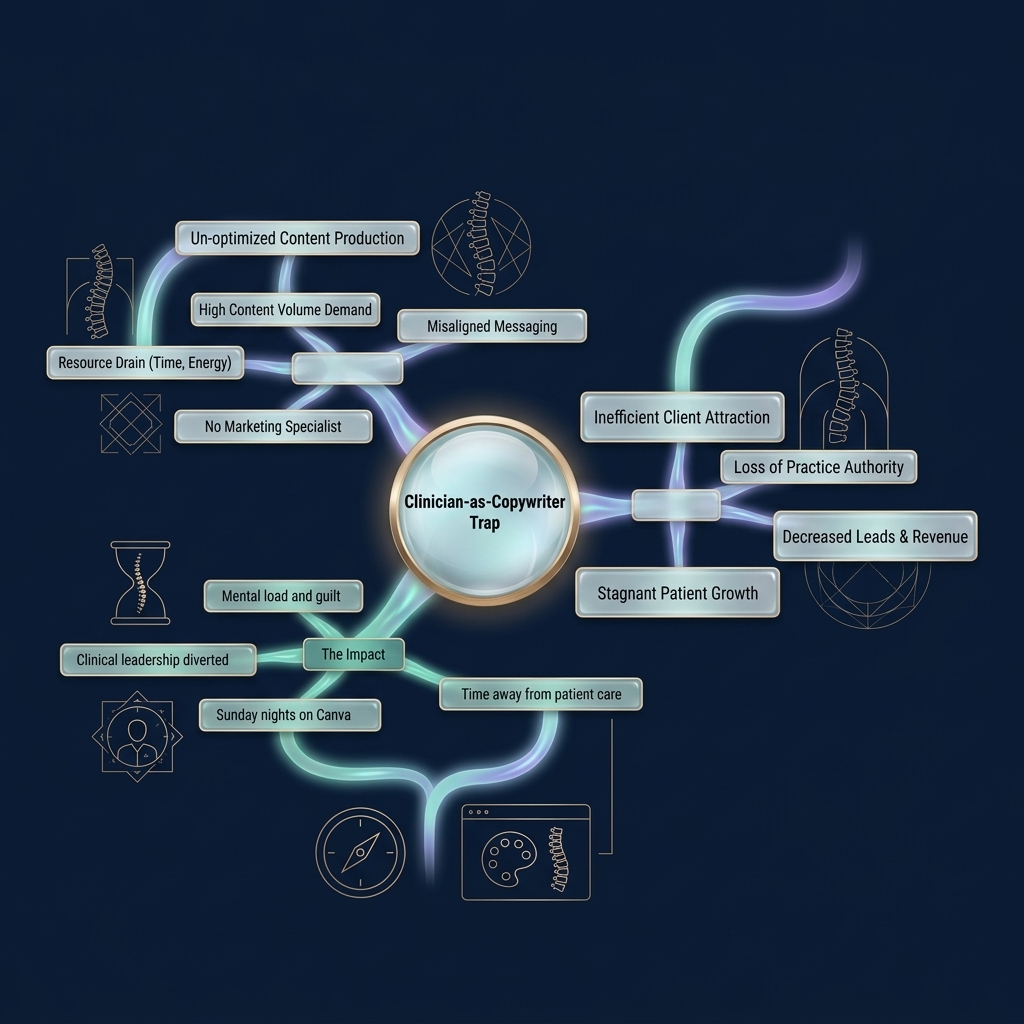
The Clinician-as-Copywriter Trap
It is 8:30 PM on a Sunday. The clinic is closed. The kids are asleep. But your laptop is open.
You are not reviewing patient files. You are not preparing clinically for Monday morning's adjustments. You are staring at a blank Canva template, trying to write a social media post about spinal hygiene, or struggling to format a patient newsletter.
This is the Clinician-as-Copywriter Trap. A highly trained medical professional forced to act as a low-level digital marketing agency.
The mechanism is invisible but brutal. You know marketing needs to get done. So you do it out of guilt rather than strategy. The content is rushed. The quality is low. The mental load is constant.
According to the 2024 Medscape Physician Burnout and Depression Report, 62% of physicians cite bureaucratic tasks, charting, paperwork, and administrative duties, as the leading contributor to their burnout. Marketing is just another line item on that list.
You are bleeding time at the exact moment your practice needs your clinical leadership most.
The Real Math of "Free" DIY Marketing
Let's run the numbers on what this Sunday night habit actually costs.
The U.S. Bureau of Labor Statistics reports the mean hourly wage for a chiropractor at $43.15. But that is not the right number. That is salary data. The real question is clinical revenue.
Industry acquisition data shows the average revenue per visit ranges from $60 to $90 for insurance-based practices, and $120 to over $200 for cash-pay practices. Let's use a conservative blended average of $100 per patient visit.
If you see 4 patients per hour during clinical time, that is $400 in gross revenue per hour. Even accounting for overhead, your effective clinical rate is somewhere between $250 and $350 per hour.
Now count the hours. Most practice owners spend at least 5 hours per week on marketing tasks: writing blogs, designing posts, managing newsletters, checking review sites, tweaking website copy.
Five hours per week at $300 per hour equals $1,500 per week in lost clinical capacity. That is $6,000 per month. That is $78,000 per year.
That is the opportunity cost of DIY marketing. Not the time you spend. The revenue you do not capture because you are spending that time.
Five hours spent wrestling with software is five hours not spent on patient care, clinical education, or community doctor-to-doctor referrals. It is five hours of empty adjustment slots that could have been filled if you were focused on high-value clinical leadership rather than fighting with email builders.
The math does not lie. "Free" marketing is the most expensive marketing you can do.
Why the Obvious Fixes Fail
So you try to delegate. Here is why the standard options collapse.
The Cheap Generalist Agency: You pay $500 per month to a local agency that promises social media management and blog writing. They do not understand clinical paradigms. They post generic stock photos of people drinking water or doing yoga. The copy is embarrassing. It dilutes your clinical authority and alienates modern patients who can smell templated content from a mile away.
The agency does not know the difference between a subluxation and a herniated disc. They cannot write with your voice. They cannot speak to your patients. So you end up rewriting everything anyway.
The Overwhelmed Front-Desk Delegation: You hand marketing to your front-desk CA. They are already managing phones, copays, insurance verifications, and patient intake. Marketing becomes the first thing dropped when the clinic gets busy.
According to a May 2026 Medical Group Management Association poll, 28% of medical group leaders reported higher staff turnover compared to the previous year, with medical assistants and front-desk administrative roles explicitly named as the most common turnover hotspots. Every time you lose a CA, you lose the marketing momentum. The campaigns become sporadic and inconsistent.
Your CA is not a copywriter. They are not a designer. They are not an SEO specialist. Asking them to be all three while also running the front desk is a structural failure.
The Template & Checklist Trap: You buy a "social media bundle" or a "marketing checklist" from an online course. The checklist is not a solution. It is just another to-do list assigned to a practice owner who is already at maximum capacity.
The Spring 2024 Small Business Now Report by Constant Contact found that 73% of small businesses are not confident their current marketing strategy is working, with limited time and budget constraints cited as primary barriers to effective execution. A checklist does not solve a capacity problem. It just documents it.
The pattern is clear. The obvious fixes fail because they do not remove you from the execution loop. They just rearrange the chairs.
What is the Integrated Practice Growth Engine?
The Integrated Practice Growth Engine is a unified marketing system for healthcare practices built on four interconnected pillars: consistent SEO-optimized clinical content, automated lead capture responding within minutes, systematic Google review generation, and educational patient newsletters. Unlike isolated marketing tasks, each component feeds the others, creating a compounding growth loop that builds algorithmic trust and patient acquisition momentum over time.
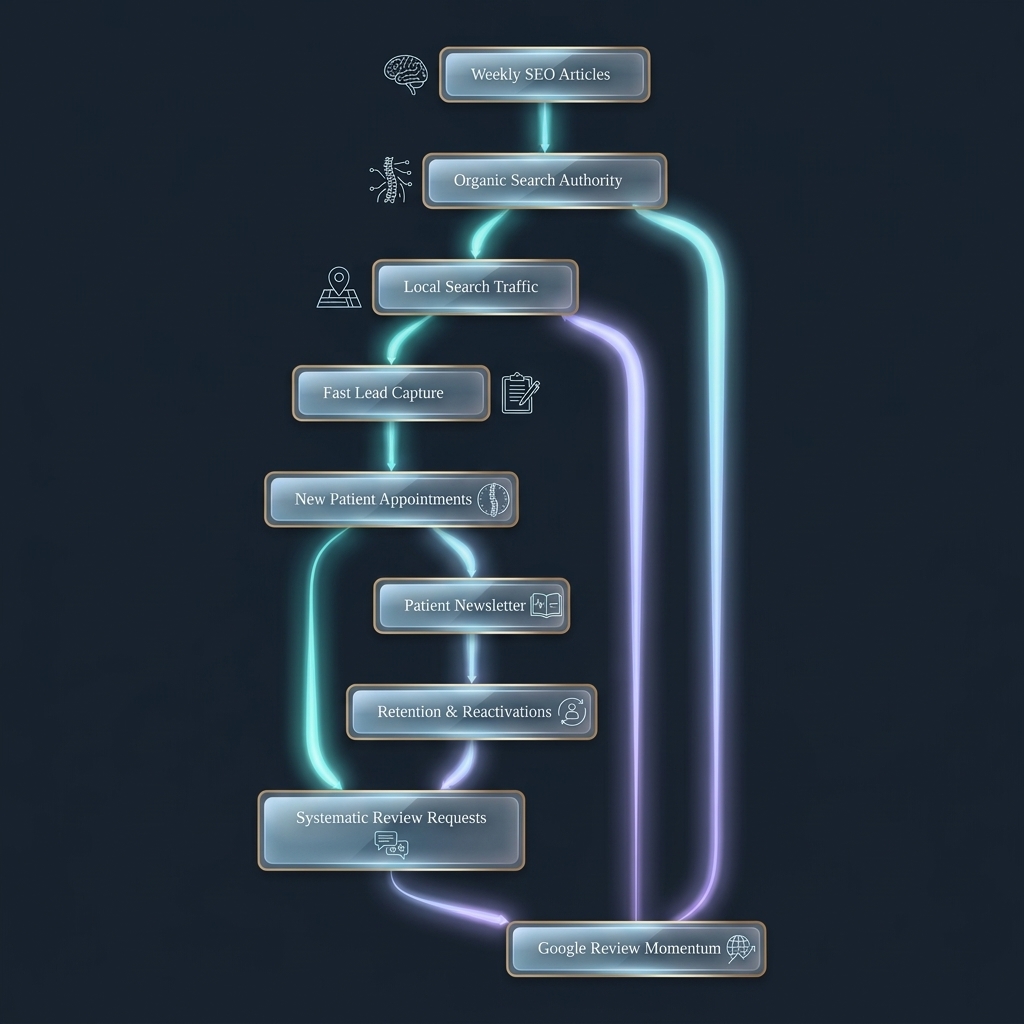
The Integrated Practice Growth Engine
True leverage requires a shift in perspective.
Effective done for you marketing is not a collection of isolated tasks: a blog post here, a Facebook post there. It is a single, unified system where every element feeds the next.
This is the Integrated Practice Growth Engine. It has four pillars.
The Four Pillars
1. Consistent Content Presence: Weekly, high-authority clinical SEO articles published directly to the practice website. These articles build organic search authority. They signal to search engines that your site is a trusted source of local health information.
2. Fast-Response Lead Capture: An automated mechanism that captures and nurtures local search traffic the moment they show intent. A 2025 industry analysis on patient discovery pathways indicates that 77% of patients begin their healthcare search on Google, and 46% use the search engine specifically to identify a new doctor. If your system cannot respond within minutes, the lead goes to the next clinic.
3. Review Momentum: A systematic process that continuously generates high-quality Google reviews from active, happy patients. According to a 2025 patient behavior report by rater8, 84% of patients check online reviews before booking care with a new healthcare provider. Furthermore, 61% state that negative online feedback would dissuade them from seeing a physician, even if the doctor was recommended by friends or family. Reviews are not vanity metrics. They are conversion infrastructure.
4. Steady Patient Communication: Consistent, educational newsletters that keep the practice top-of-mind, driving retention and reactivations. The newsletter is not promotional spam. It is clinical education that positions you as the trusted authority in your community.
Each pillar supports the others. The system is a loop, not a list.
The Flywheel Mechanism
Here is why this system compounds over time.
Algorithmic Trust: Search engines reward consistent, high-quality, localized health content. Every new clinical article signals authority to Google. The entire website's local ranking lifts. You are not buying ads. You are building an asset.
The Patient Journey Loop: A local resident searches for back pain relief. They land on a high-authority blog post on your site. They see a wall of recent, positive Google reviews. They book an appointment. They receive automated nurturing. They leave a review. That review fuels the next search query.
The loop feeds itself. Unlike paid ads that stop delivering leads the moment the budget is cut, a systematic content and review engine builds permanent digital equity for the practice. It is an asset that grows in value over time.
The compounding effect is real. But only if the system runs consistently. Which brings us to the new problem.
Why is Marketing Execution so Hard to Keep up With?
Marketing execution is difficult to maintain because it requires approximately 21 hours monthly of specialized work across multiple disciplines including copywriting, SEO, graphic design, and compliance. This demands being simultaneously a content creator, technical specialist, and software integrator while managing a full practice. When patient volume increases, the manual marketing system inevitably collapses due to time constraints and skill gaps.

The Execution Wall
You now understand the system. You see the logic. You want the flywheel.
But running this system manually is a second full-time job.
The Time Audit Protocol
Before we show the math, try this experiment.
Create a note on your phone titled "Marketing Time Log." For seven consecutive days, record every single minute spent on marketing-related tasks. Be specific.
- 9:00 AM - 9:15 AM: Trying to find a photo for Instagram.
- 2:00 PM - 2:30 PM: Writing patient email.
- 8:00 PM - 9:00 PM: Editing blog post draft.
At the end of the week, total the hours. Identify the top two time-sinks. Force-delegate or batch those two specific tasks into a single 30-minute block on Friday afternoon.
This protocol requires exactly 20 minutes of daily discipline for one week. It costs nothing but your attention. The math of this log is designed to embarrass the clinic schedule.
Most practice owners realize they are losing hours to minor, low-yield administrative tasks. The log proves that manual consistency is unsustainable.
The Real Cost of Manual System Maintenance
To run the complete, four-pillar system manually requires the following.
- Writing 4 high-quality, clinically accurate SEO articles per month: 8 hours.
- Designing, scheduling, and posting social media updates 3 times a week: 6 hours.
- Formatting, testing, and sending a monthly patient newsletter: 3 hours.
- Monitoring, requesting, and responding to Google reviews: 4 hours.
The total is 21 hours of highly disciplined, specialized work every single month. That is 5 hours per week. The same 5 hours we calculated earlier at a $6,300 monthly opportunity cost.
But the real issue is not just the hours. It is the skill gap.
Running this system requires being a copywriter, an SEO specialist, a graphic designer, a compliance officer, and a software integrator all at once. When patient volume spikes, this manual system inevitably collapses. The marketing gets dropped. The flywheel stops spinning.
You are back at the Sunday night kitchen table.
The AI Mirage
So you turn to the new tool everyone is talking about. You open ChatGPT. You ask it to write a blog post about sciatica treatment.
The output looks decent at first glance. But here is the problem.
The Non-Deterministic Output Trap: Generic AI tools are unpredictable. You cannot trust them to produce clinical content sight-unseen. They require complex prompting, editing, rewriting, and manual publishing. You are still stuck in the execution loop. You have just traded one tool for another.
According to a 2026 benchmark study by Digital Applied analyzing five frontier AI models, hallucination rates on factual recall and citation tasks range between 3.1% and 19.1%. They will confidently invent medical claims or fabricate citations if used unverified.
The Compliance and Liability Nightmare: Generic AI models have no concept of state board regulations, HIPAA guidelines, or national health-advertising laws. They will cheerfully write unsubstantiated clinical claims like "Chiropractic care cures asthma" that can put a practice license at risk.
You own 100% of the liability for whatever the AI writes. Every claim. Every assertion. Every patient-facing statement.
The Lack of Integration: ChatGPT does not publish to your blog. It does not format your newsletter. It does not sync with your patient database. It is just another tab open on your browser, consuming your time.
The AI mirage is seductive. But it does not solve the execution problem. It just automates the first draft. You still have to edit, verify, format, publish, and distribute.
You are still the bottleneck.
What is the Fifteen-minute Review Marketing Model?
The fifteen-minute review marketing model is an operational approach where practice owners spend only 15 minutes weekly reviewing finished, compliant, ready-to-publish content rather than creating it themselves. The system generates SEO articles, social posts, newsletters, and guides automatically in the practice's voice, requiring only final approval before publication, transforming hours of work into minimal oversight.

The Fifteen-Minute Review
Here is the ultimate realization.
The systematic marketing engine is the correct path for practice growth. But building and running it yourself is unsustainable. Generic AI tools do not solve the execution problem. They just shift the work.
True leverage is not finding a better tool to do the work. It is having the entire system operated for you. Your only input is your clinical voice and your final approval.
This is the Fifteen-Minute Review standard. The operational model where the practice owner spends 15 minutes per week reviewing finished, compliant, ready-to-publish content is not creating it, not formatting it, not troubleshooting the tech.
The system runs. You review. You approve. The content goes live.
That is the difference between passive delegation and true leverage. You are not managing the system. You are governing it.
What True Leverage Looks Like
Platforms that operate this whole loop end-to-end, like Omniply, which generates weekly SEO articles, social posts, patient newsletters, and lead-generation guides from the practice's own voice, exist to solve this exact problem. The practice owner reviews. The system executes.
The 5 hours per week becomes 15 minutes. The $6,300 monthly opportunity cost becomes a rounding error. The flywheel spins consistently, regardless of patient volume, staff turnover, or the practice owner's schedule.
The content is clinically accurate, compliance-aware, and written in the practice's voice. The reviews accumulate. The search rankings climb. The newsletter goes out on schedule.
The practice owner focuses on clinical leadership. The system handles the rest.
Should Chiropractors Outsource Their Digital Marketing?
Yes, chiropractors should outsource their digital marketing to reclaim clinical time and focus on patient care. Every hour spent on content creation and social media management diverts attention from adjustments, team leadership, and building referral networks. Partnering with marketing specialists allows practitioners to concentrate on revenue-generating clinical work while professionals handle the technical execution.
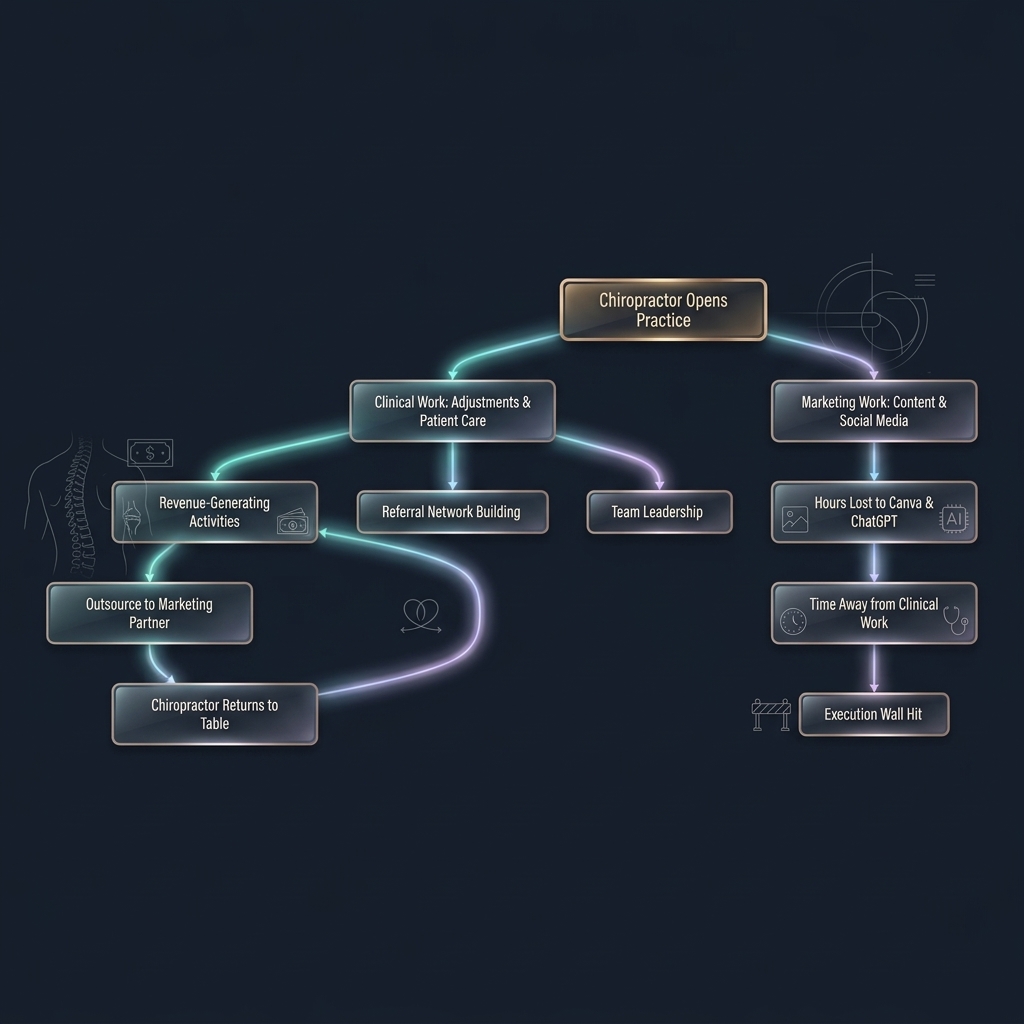
Stop Trading Adjustments for Algorithms
You did not open a practice to become a content marketer. You opened it to serve patients. To build a referral network. To lead a clinical team.
Every hour you spend wrestling with Canva or ChatGPT is an hour you are not doing the work only you can do. The work that built the practice in the first place.
The math is clear. The system is proven. The execution wall is real.
The question is not whether you need the system. The question is whether you are willing to stop running it yourself.
Stop trading adjustments for algorithms. Find a partner to operate the engine. Get back to the table.
Frequently Asked Questions
Can ChatGPT Write Blogs for a Practice?
ChatGPT can generate first drafts, but it cannot produce compliant, publication-ready clinical content without significant editing, fact-checking, and compliance review. According to benchmark studies analyzing frontier AI models, hallucination rates on factual tasks range between 3.1% and 19.1%. You own 100% of the liability for whatever gets published. Generic AI tools do not understand state board regulations or health-advertising laws. They will write claims you are not allowed to make.
Should a Chiropractor Hire a Marketing Agency?
Most generalist agencies do not understand clinical paradigms or compliance requirements. They produce templated, generic content that dilutes clinical authority. A specialized partner that operates the entire marketing system, content creation, SEO, review generation, patient communication, and understands healthcare regulations is a better fit than a low-cost generalist agency that requires constant supervision.
How Many Hours a Week Should Clinic Marketing Take?
If you are running the system manually, expect 5 hours per week minimum: writing content, designing posts, managing newsletters, and monitoring reviews. That is 21 hours per month. At a $300 per hour clinical rate, that is a $6,300 monthly opportunity cost. With true done-for-you execution, the practice owner's time drops to 15 minutes per week for review and approval.
Is Blogging HIPAA Compliant?
Blogging is compliant as long as you do not share protected health information (PHI) without patient authorization. Educational content about clinical topics, treatment approaches, and general health information is permissible. Case studies or patient stories require explicit written consent and de-identification. The Health Insurance Portability and Accountability Act governs how patient information is handled, not whether you can publish clinical education.
How Much Should a Small Clinic Spend on Marketing?
Industry benchmarks suggest 5-10% of gross revenue for established practices, and 10-15% for practices in growth mode. A practice generating $50,000 per month should allocate $2,500 to $5,000 for marketing. The key metric is not the spend; it is the return. A system that generates consistent new patient flow and retention at a predictable cost per acquisition is worth more than the dollar amount invested.
Can a Receptionist Handle Clinic Marketing?
Not sustainably. Front-desk staff are already managing phones, copays, insurance verifications, and patient intake. According to MGMA data, front-desk roles have the highest turnover in medical practices. Marketing becomes the first thing dropped when the clinic gets busy. Every time you lose a receptionist, you lose marketing momentum. Delegation only works when the person has the time, skill, and capacity to execute consistently.
How Do Practices Get New Patients?
Modern patient acquisition is driven by local search visibility, online reviews, and consistent content presence. According to 2025 industry data, 77% of patients begin their healthcare search on Google. Practices that rank well for local search terms, maintain a strong review profile, and publish regular clinical content capture the majority of inbound leads. Referrals still matter, but digital discovery is now the dominant channel for new patient flow.