
At 11:45 AM on a Tuesday, your front desk is checking out a patient, collecting a copay, and rescheduling an appointment. The phone rings twice and goes silent. That caller did not hang up to try again later. They called the clinic down the street.
Most owners view unanswered rings as minor operational friction. Your P&L proves otherwise. When you calculate the true cost of missed calls, you are not measuring front-desk overlap. You are measuring cash exiting your business.
Miss two calls a day. That is forty lost bookings a month. At an average care plan value of $2,000 and a 50% conversion rate, your practice forfeits $40,000 every four weeks. This is The Silent Intake Leak. It acts like a hairline stress fracture in your operations.
Below, we break down the exact math behind unanswered rings, explain why standard staffing fixes fail, and show you how to plug the leak.
Key Takeaways
- Revenue Loss Math: Healthcare practices miss 29% of inbound calls on average, costing a typical chiropractic clinic up to $125,280 annually as roughly three missed calls a day compound into lost bookings at $1,200 first-year patient value.
- Response Speed Dominance: Businesses responding to leads within 5 minutes are 21 times more likely to convert than those waiting 30 minutes, while 78% of customers buy from the first responder and 82% of consumers demand immediate responses.
- Voicemail Failure Rate: Eighty-six percent of callers abandon service business voicemails without leaving messages, and those who do leave voicemails convert below 20% because prospects book with competitors during callback delays.
- Compliance Exposure Risk: Standard SMS violates HIPAA Security Rule requirements for Protected Health Information transmission, with 2024 Tier 1 penalties starting at $141 per violation and annual caps reaching $2,134,831 under Federal Register inflation adjustments.
- Staffing Turnover Crisis: Front-office support staff turnover hit exactly 40% in 2022 according to Medical Group Management Association DataDive data, driven by structural capacity bottlenecks during peak clinical hours rather than personnel performance issues.
How Do Missed Calls Hurt a Chiropractic Practice?
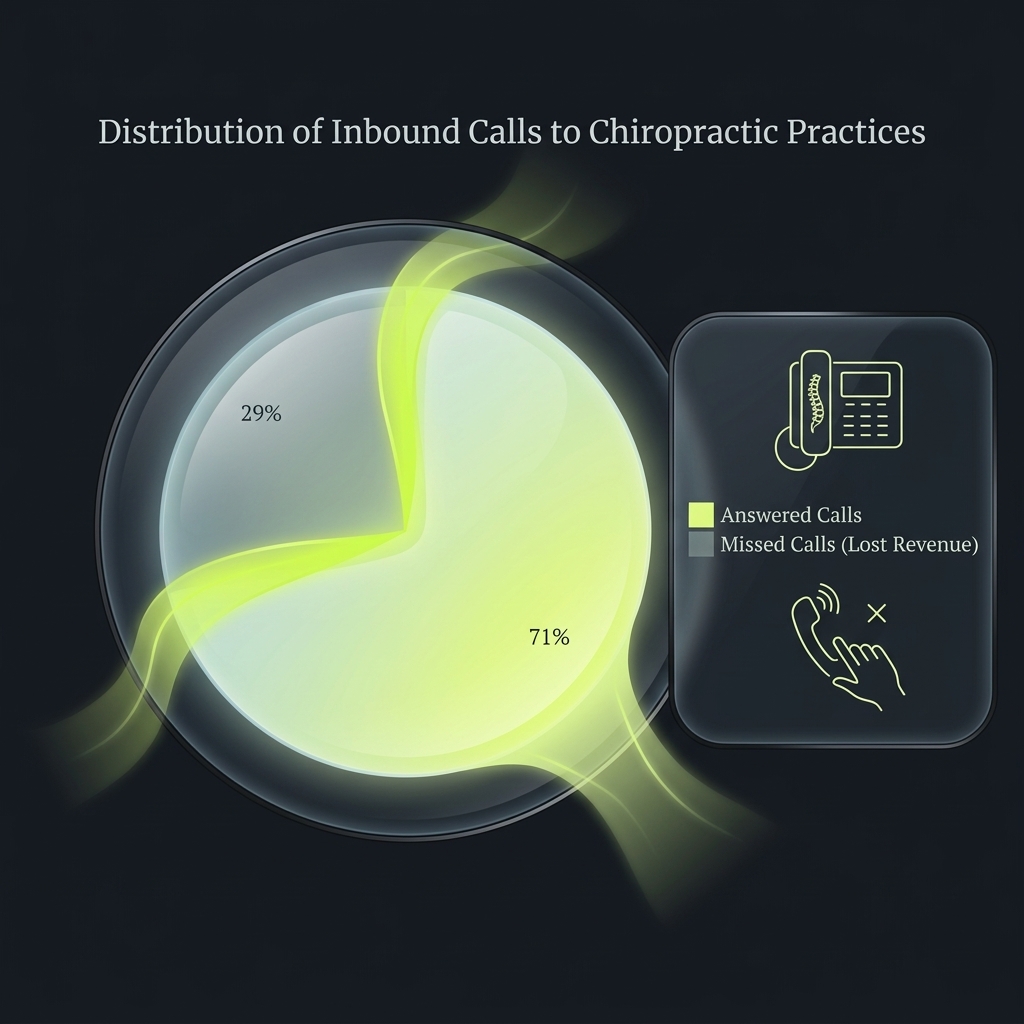
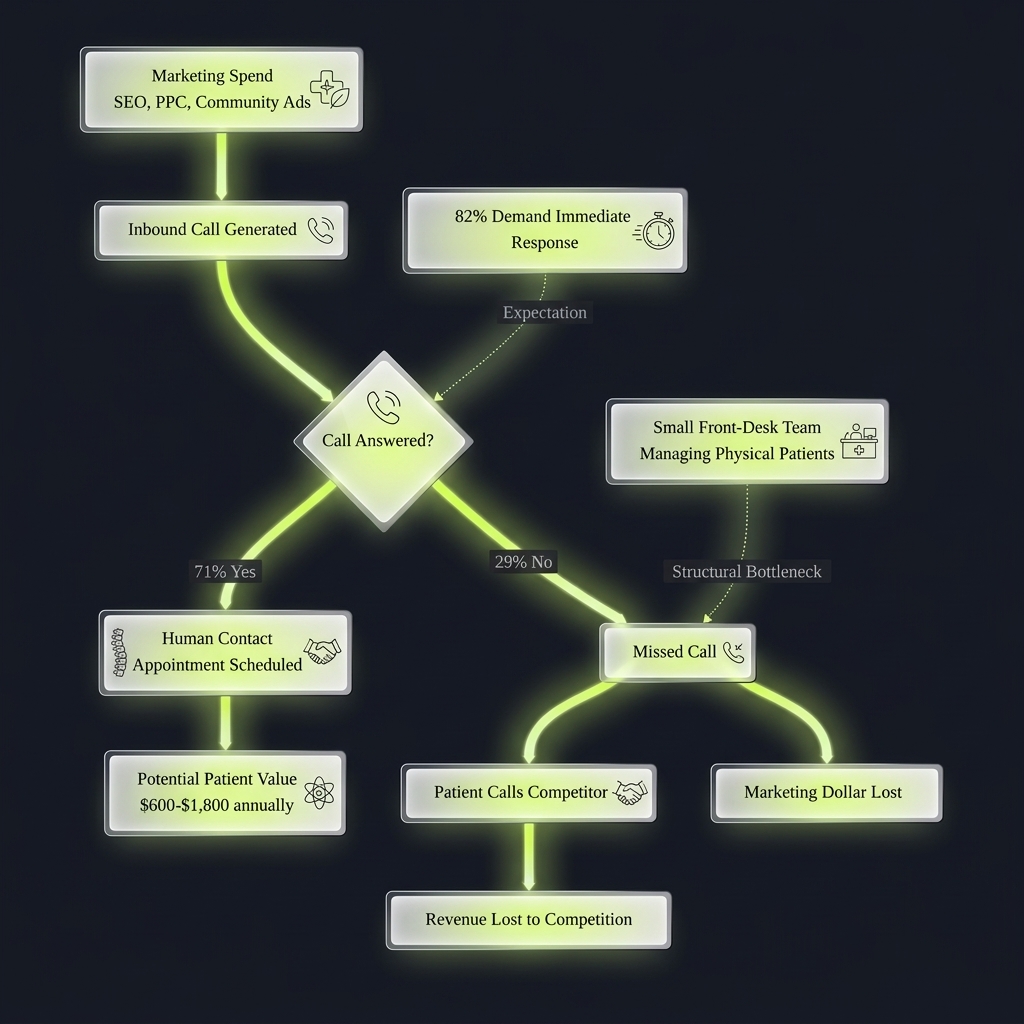
Missed calls directly erode chiropractic practice revenue by converting marketing dollars into lost opportunities. With healthcare practices missing 29% of inbound calls on average, prospective patients immediately contact competitors instead of waiting. Each missed call represents potential annual patient value of $600-$1,800, while 82% of consumers demand immediate responses, making call leakage a critical structural problem for small practices.
Understanding the Problem: the True Impact of Missed Calls on a Chiropractic Practice
Define the problem precisely first. Call leakage has three forms:
Unanswered incoming calls during clinical care hours. Delayed callbacks for prospective patients inquiring about initial exams. After-hours inquiries dropping into voicemail boxes that nobody monitors until morning.
Healthcare practices miss 29% of inbound calls on average, according to healthcare call-tracking data from Invoca. That is not a typo. Nearly one in three people who dial your number never reach a human voice. They hang up and move down the search results.
This hits hardest at 1–3 location practices with high clinical volume and small front-desk teams. Your staff is managing physical patient flow during the exact hours when the phone rings most. The bottleneck is structural, not a personnel problem.
Consumer behavior shifted. HubSpot research found that 82% of consumers rate an "immediate" response as important or very important when they have a marketing or sales-related question. Your prospective patient is not comparing chiropractic philosophies while waiting on hold. They are comparing response speed.
Meanwhile, your local advertising costs climb. Every dollar spent on SEO, pay-per-click ads, and community campaigns generates a phone call. When that call goes unanswered, the marketing dollar evaporates.
Run the math on direct revenue loss. Chiropractic industry benchmarks place the typical annual revenue per active patient in the United States between $600 and $1,800, depending on visit frequency and the clinic's Patient Visit Average. Take the conservative midpoint: $1,200 per year, or $100 per month per patient.
Assume your practice receives 10 inbound calls per day. At a 29% missed call rate, you lose roughly 3 calls daily. Over a 20-day work month, that is roughly 60 missed calls. If 30% of those callers would have booked an initial exam, you lost roughly 17 appointments. If half of those convert to ongoing care, you forfeited roughly 9 new patients. At $1,200 annual value, that is roughly $10,440 in first-year revenue walking away every month.
Scale that to a year: roughly $125,280.
Now calculate reduced return on investment for your marketing spend. If you invest $3,000 monthly in local ads and SEO, and those campaigns generate 200 calls per month, losing 29% means 58 calls never connect. At a $15 cost per call, you threw away $870 in marketing spend that month. Annually, $10,440 in wasted ad dollars.
The operational burden compounds. Front-desk staff spend hours playing phone tag instead of converting structured schedules. Callbacks stretch across days. Conversion rates drop with every hour of delay. A landmark Lead Response Management study published in the Harvard Business Review demonstrated that businesses responding to leads in 5 minutes or less are 21 times more likely to qualify and convert them than those that wait 30 minutes.
Retention risks appear downstream. Existing care-plan patients trying to reschedule hit the same busy phone lines. They experience the same friction. Some drop out of care plans. Others find another provider.
This is not a customer service issue. It is a revenue protection failure.
Why is My Front Desk Missing so Many Calls?
Front desks miss calls primarily due to capacity bottlenecks during peak hours when staff must prioritize in-person patients over ringing phones. Additionally, 86% of callers abandon calls reaching voicemail rather than leaving messages, and those who do leave voicemails convert below 20% because prospects book with competitors during callback delays.
Root Causes of Missed Calls and Lost Inquiries
Root Cause 1: Front-Desk Bottlenecks During Peak Patient Volume
The mechanism is simple. Front-desk staff must prioritize physical patient flow during high-density adjusting windows. Check-ins, copays, posture scans, scheduling next visits. These tasks happen at the counter, in real time, with a patient standing in front of the desk.
The phone rings at 8:15 AM. Your staff is mid-transaction with a patient checking out. The call goes to voicemail.
Peak adjusting blocks run 8:00 AM to 10:00 AM and 3:00 PM to 5:30 PM in most practices. Call drop-off rates spike during these exact windows. The pattern is consistent: high clinical volume creates a staffing deficit at the front desk, regardless of how many people you employ.
The common misconception blames front-desk personnel for poor productivity. The real problem is capacity. One person cannot simultaneously process a patient checkout and answer an inbound call with full attention to both. Attempting to do so degrades both interactions.
Root Cause 2: Reliance on Passive Legacy Voicemail Infrastructure
Voicemail was designed for asynchronous business communication between known parties. It fails catastrophically for prospective patient acquisition.
Telecom and call-tracking data, including studies by Invoca, show that approximately 86% of callers abandon the call when they reach a service business voicemail instead of leaving a message. They do not wait. They do not try again later. They call the next clinic on the list.
Prospective chiropractic patients are experiencing pain or seeking immediate care. The decision window is narrow. They are comparison shopping in real time, often with multiple browser tabs open.
Practices that do receive voicemails face a second problem: callback-to-appointment conversion rates below 20%. The delay kills intent. By the time your staff returns the call, the prospect has already booked elsewhere.
The common misconception assumes patients requiring specialized chiropractic care will wait 24 to 48 hours for a staff callback. Market behavior proves otherwise. Sales research from Lead Connect confirms that 78% of customers buy from the business that responds to their inquiry first.
Root Cause 3: the Gap in After-Hours and Weekend Lead Coverage
Inquiries submitted through digital channels, local listings, or evening phone calls sit unaddressed until the next business day. Lead interest decays rapidly during this gap.
Monday morning front-desk teams face a backlog of weekend inquiries. Connection rates plummet. The prospects who submitted forms on Saturday evening have already moved on by Monday at 9 AM.
Appointment conversions for leads submitted after 5:00 PM on weekdays drop significantly compared to business-hour inquiries. The delay between intent and contact extinguishes urgency.
The common misconception believes after-hours phone response requires hiring full-time evening staff or utilizing generic medical answering services. Neither option addresses the core problem: immediate engagement with inquiry intent.
Root Cause 4: Disjointed Manual Follow-Up and Non-Deterministic Generic AI Tools
Practices attempt to solve call leakage using manual staff texting or uncustomized AI chatbots. Both approaches fail.
Manual follow-up creates administrative burden. Staff spend hours writing individual follow-up messages across disparate channels. The work compounds during high-volume periods, exactly when the practice least has capacity to spare.
Generic AI tools like standard ChatGPT prompts introduce a different risk: non-deterministic output. The system generates unpredictable responses. It can produce inaccurate clinical promises, make treatment outcome claims, or violate healthcare advertising regulations.
Standard Short Message Service text messaging is unencrypted, lacks proper access controls, and does not provide the audit trails required by the HIPAA Security Rule to safely and legally transmit Protected Health Information. According to the HHS Office for Civil Rights Annual Report to Congress on Breaches of Unsecured Protected Health Information for Calendar Year 2024, the agency resolved 12 breach investigations with monetary settlements and civil money penalties totaling $7,813,831. These administrative enforcement actions and settlements by the HHS OCR represent what actually happened in these specific regulatory instances.
Under the 2024 inflation adjustments published in the Federal Register for HIPAA civil monetary penalties, Tier 1 ("Lack of Knowledge") penalties were set to a minimum of $141 per violation with an annual calendar year cap of $2,134,831. Because HIPAA fines are adjusted annually for inflation, these were the exact statutory figures applied in 2024.
Unregulated AI text outputs create compliance exposure. The tool does not know what a chiropractic practice is legally permitted to claim. It writes whatever sounds persuasive, regardless of regulatory boundaries.
The common misconception believes any off-the-shelf AI tool can handle front-desk operations safely. The reality: healthcare requires dedicated compliance guardrails and systemized oversight that generic tools do not provide.
When Should a Practice Hire Communication Support?
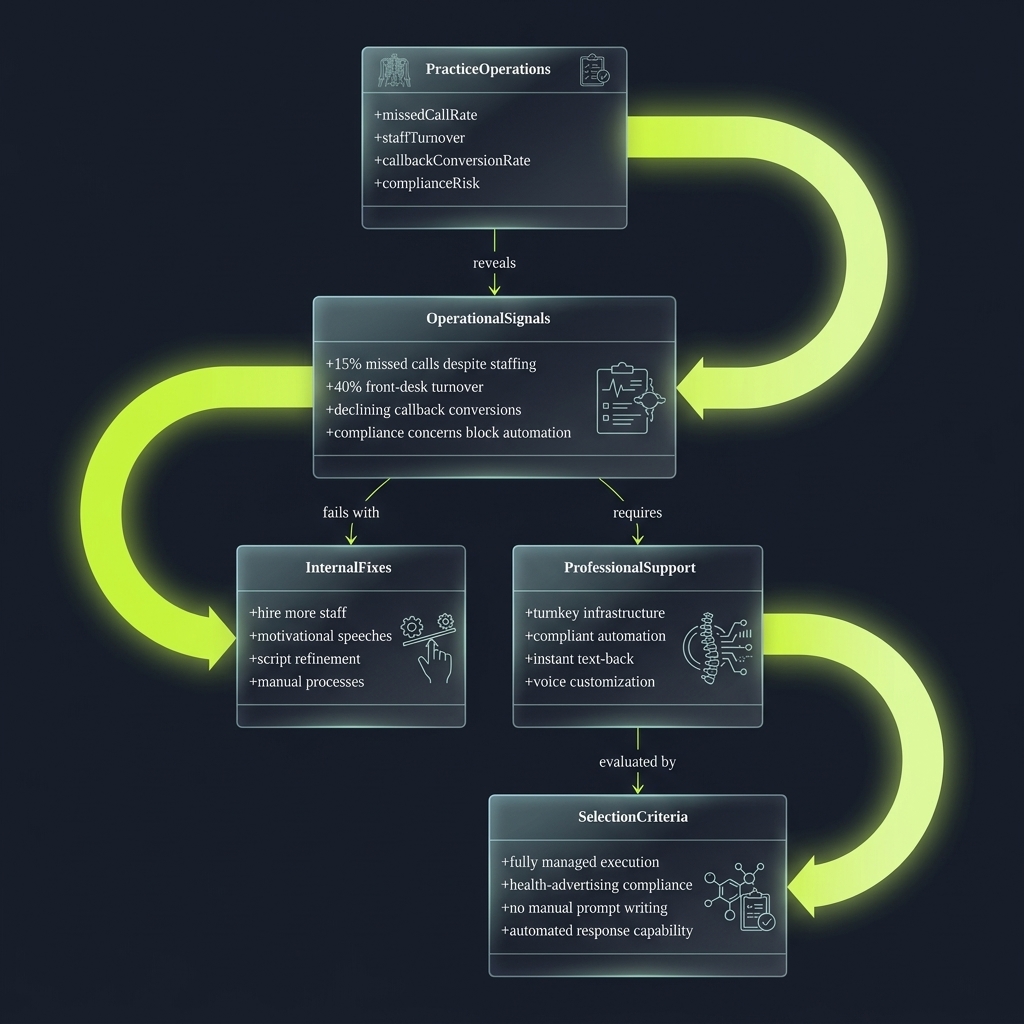
Practices should hire communication support when missed call rates exceed 15% despite adequate staffing, front-desk turnover reaches critical levels due to workflow interruptions, manual callback conversion rates decline from delayed responses, or compliance concerns prevent automation deployment. These operational signals indicate systemic issues requiring professional infrastructure rather than internal fixes or additional headcount.
When to Seek Professional Practice-Growth and Communication Support
Operational signals indicate when internal fixes stop working.
Your phone logs reflect a missed call rate exceeding 15% despite dedicated front-desk staffing. You have already hired enough people. The problem is not headcount. It is system design.
Front-desk staff report burnout or high turnover driven by constant interruptions during patient check-in. According to the 2023 Medical Group Management Association DataDive Practice Operations report, turnover for front-office support staff in medical practices hit exactly 40% in 2022. When your team cannot sustain the workload, the solution is not motivational speeches. It is operational redesign.
Attempts at manual callbacks yield declining conversion rates due to delayed response times. You are losing the race to first contact, and no amount of script refinement will change that.
Concerns regarding healthcare-advertising compliance or non-deterministic outputs from generic AI tools prevent you from deploying automation. You recognize the risk but lack a compliant alternative.
The type of professional solution required is turnkey, done-for-you infrastructure that combines health-compliant response automation with continuous practice content presence.
Selection criteria matter. Seek fully managed execution, health-advertising compliance guardrails, automated instant text-back capability, and voice customization reflecting your specific clinical approach. Avoid tools requiring you or your desk staff to write prompts, manage complex software workflows manually, or risk non-compliant clinical messaging.
How Do I Stop Losing Patients From Missed Calls?
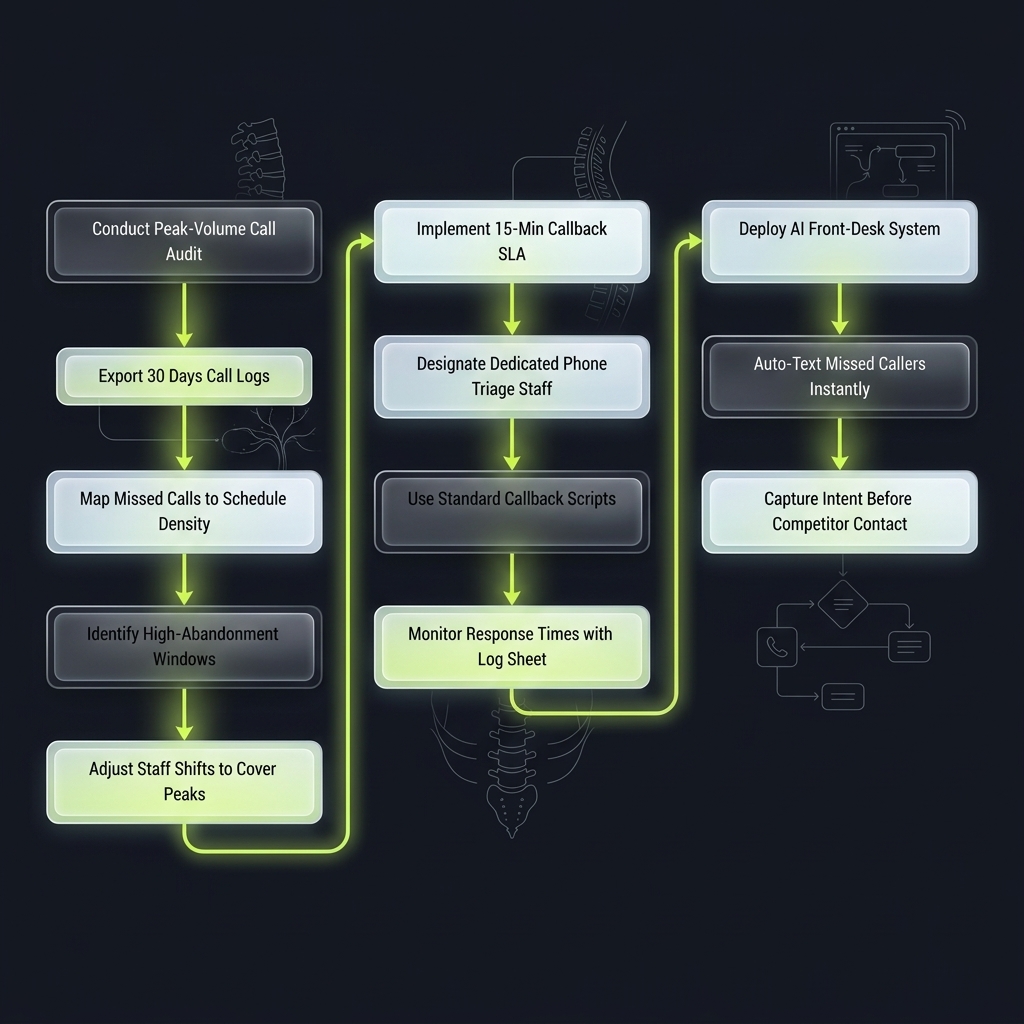
Healthcare practices can stop losing patients from missed calls by conducting peak-volume call audits to identify high-abandonment periods, implementing a 15-minute rapid-callback service agreement with dedicated phone triage staff during busy blocks, and deploying automated AI front-desk systems that immediately engage missed callers via text when lines are busy or after hours.
Proven Solutions to Eliminate Missed Call Losses
Solution 1: Conduct a Peak-Volume Call and Capacity Audit
Start with a systematic internal review of phone logs and clinic schedule density to map phone leakage patterns.
Export 30 days of inbound call logs from your current VoIP or telephone provider. Cross-reference missed call timestamps against clinical adjusting schedules and front-desk staffing levels. Identify the exact two-hour windows exhibiting the highest call abandonment rates. Adjust desk shift schedules or redistribute non-phone tasks away from those specific peak hours.
Implementation typically takes 1 to 2 weeks. Improvements in administrative visibility and minor reductions in missed calls vary by practice volume.
The common mistake: conducting the audit during an irregular holiday week or vacation period, producing unrepresentative data. Run the audit during a typical month.
Solution 2: Implement a Standardized Rapid-Callback Service-Level Agreement
Establish an internal service-level agreement for front-desk teams to return all missed business-hour calls within 15 minutes.
Designate a specific secondary front-desk team member responsible strictly for phone triage during peak clinical blocks. Create standard callback scripts focused on securing initial consultation schedules. Maintain a real-time callback log sheet at the front desk to monitor response lag times.
Protocol setup takes 1 to 3 weeks. Contact rate improvements vary based on existing response latency.
The common mistake: assigning callback responsibilities to a team member who is simultaneously handling physical patient check-ins. The dual assignment recreates the original bottleneck.
Solution 3: Deploy an Automated Immediate Response and AI Front-Desk System
Implement an automated, health-compliant text-back and interactive AI communication system that engages missed callers immediately when lines are busy or after hours.
This works because it prevents prospective patients from contacting competing clinics. The system captures inquiry intent instantly through automated SMS and interactive intake routing. The caller receives acknowledgment within seconds, not hours.
This solution fits practices running 1–3 locations with high adjusting volume where front-desk staff cannot consistently answer every ringing phone during peak hours.
Discuss with a professional provider: integration parameters with existing practice management software and business phone lines, safeguards ensuring messaging complies with healthcare advertising regulations, and automated routing logic for urgent patient care inquiries versus routine booking.
Expect technical setup of telephony triggers, script and tone calibration matching your practice voice, internal testing, and desk-team workflow orientation.
Ask before proceeding: Is the system's output deterministic and compliant with health advertising standards? Does this require my staff to manually write or approve every message, or is it operated automatically?
Implementation timelines range from 1 to 4 weeks. Lead engagement recovery rates vary based on clinic location, local market competition, and inbound call volume.
Solution 4: Implement a Done-For-You Practice Attraction and Retention Engine
Operate a comprehensive managed platform that pairs automated front-desk responsiveness with ongoing localized content, patient re-engagement workflows, and review management.
This systematizes both new patient capture and long-term care plan retention without requiring manual execution from the practice owner or front desk. Platforms that operate this whole loop end-to-end, like Omniply, extract your clinical philosophy to inform automated content and communication, then integrate across website publishing, local SEO content, newsletters, and automated lead response.
This fits practice owners who lack the time to run these systems manually, want a consistent local content presence, and need reliable lead capture.
Discuss with a professional provider: extraction of your clinical philosophy to inform automated content, integration across website publishing and local SEO content, and quarterly review updates.
Expect initial brand and clinical voice profiling, system configuration, automated content calendar setup, and quarterly review updates.
Ask before proceeding: How much time per week will my team need to spend managing this system? How does the platform ensure content and responses remain deterministic and compliant?
Full system integration ranges from 2 to 6 weeks. Sustainable shifts in patient inquiry volume and practice consistency vary depending on market factors and baseline clinical reputation.
Solution 5: Re-Architect Front-Desk Shift Schedules for Divided Focus
Reorganize administrative shifts to segregate physical patient management from phone intake duties.
Stagger front-desk shift start times to provide 30–45 minutes of uninterrupted phone administration before clinical hours begin. Establish silent focus blocks during mid-day gaps to complete follow-ups and appointment confirmations. Shift non-urgent administrative data entry tasks off the main front-desk counter.
Re-architecting schedules requires 1 to 2 weeks for implementation. Reductions in front-desk stress and call drops vary based on staffing levels.
The common mistake: allowing physical walk-in patients or casual interruptions to breach designated administrative focus blocks. Protect the time or the system fails.
How Can I Stop Missed Calls From Ruining Leads?
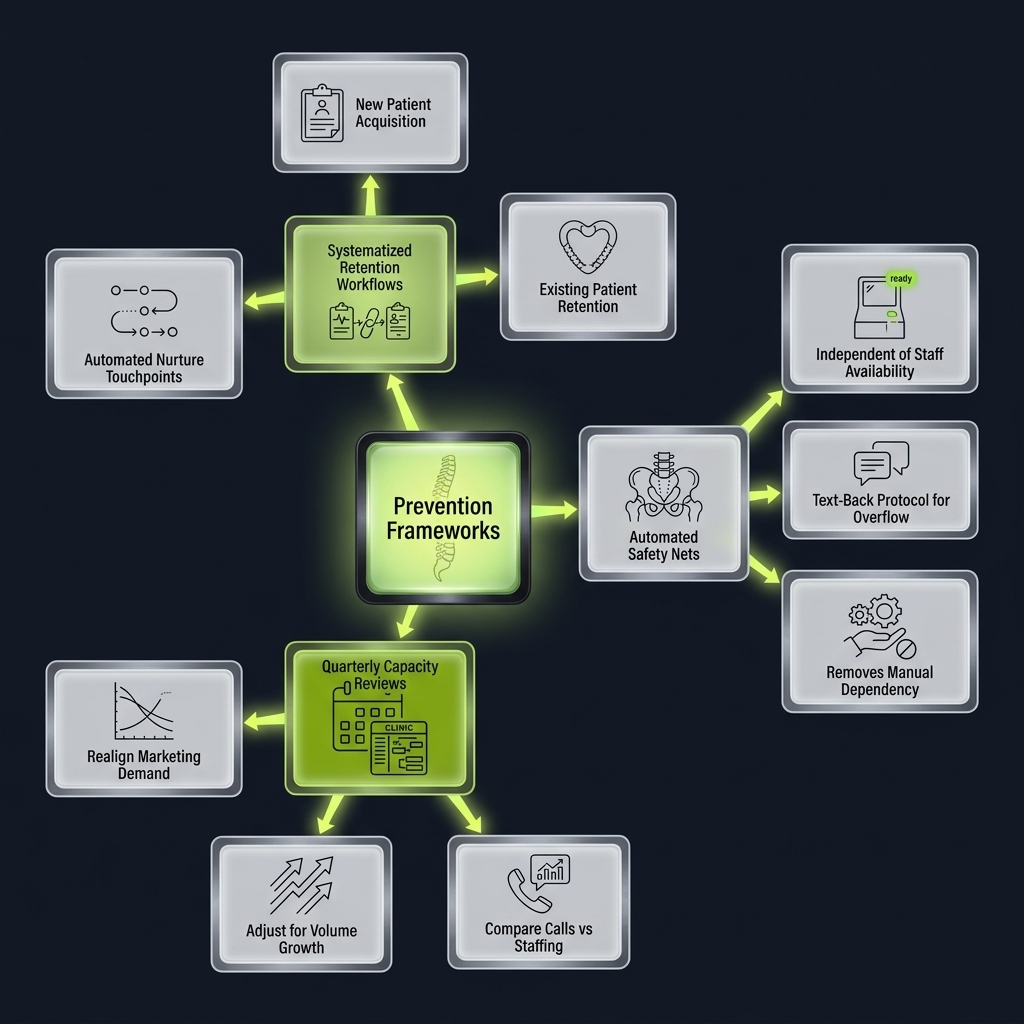
Stop missed calls from ruining leads by implementing three prevention frameworks: deploy automated text-back protocols that respond immediately when calls go unanswered, conduct quarterly capacity reviews to align staffing with call volume patterns, and establish systematized retention workflows that nurture leads automatically. These safety nets eliminate dependency on manual staff availability and protect revenue continuously.
Prevention: Stopping Missed Calls and Lead Decay From Recurring
Prevention operates through three frameworks.
First, automated safety nets. Maintain a continuously active automated text-back protocol to catch overflow calls during unexpected front-desk short-staffing. The system operates independently of human availability. A systematic review by Hasvold and Wootton published in the Journal of Telemedicine and Telecare evaluating the effectiveness of appointment reminders found that automated reminders successfully reduced non-attendance by a weighted mean of 28.9%. The same principle applies to initial contact: automation removes dependency on manual capacity.
Second, quarterly capacity reviews. Regularly compare inbound phone call metrics against front-desk staffing and adjusting block density. Patient volume grows. Marketing campaigns shift. What worked six months ago may no longer match current demand. Review the data every quarter and adjust staffing or automation accordingly.
Third, systematized retention workflows. Ensure prospective leads and existing patients receive automated nurture and reminder touchpoints that operate independently of manual staff bandwidth. These workflows protect revenue on both ends: new patient acquisition and existing patient retention.
Use this quick-reference practice protection checklist:
- Are peak call hours mapped against front-desk schedule coverage?
- Is an automated immediate-response mechanism enabled for unanswered inbound calls?
- Is after-hours phone inquiry follow-up automated?
- Are generic, non-deterministic AI tools excluded from prospective patient communications to maintain compliance?
- Is the overall patient growth and retention system operated automatically without adding manual steps for practice staff?
Each unchecked item represents active revenue leakage.
Frequently Asked Questions
What Percentage of Callers Leave a Voicemail?
Fourteen percent. Eighty-six percent of callers who reach a service business voicemail hang up without leaving a message. Voicemail functions as a dead end for prospective patient acquisition.
What is an Acceptable Missed Call Rate for a Clinic?
Below 10% is operational. Between 10% and 15% signals a capacity problem. Above 15% represents active revenue loss requiring immediate system intervention. The healthcare industry average of 29% is not acceptable; it is endemic failure.
Does Missed Call Text Back Actually Work?
Yes, when implemented with deterministic, compliant messaging. Seventy-eight percent of customers purchase from the company that responds first. Automated text-back converts a missed call into an immediate acknowledgment, preventing the prospect from moving to the next provider on their list.
Can ChatGPT Text Back Missed Phone Calls?
Not safely for healthcare practices. ChatGPT and similar generic AI tools produce non-deterministic output. They will write whatever sounds persuasive, including treatment outcome claims and clinical promises that violate healthcare advertising regulations. They consume your time to prompt and review, and they provide no compliance guardrails.
Is Automated Text Messaging HIPAA Compliant?
Standard SMS is not HIPAA compliant for transmitting Protected Health Information. Automated text systems designed for healthcare must use encrypted platforms with business associate agreements, access controls, and audit trails. Generic texting tools expose practices to penalties starting at $141 per violation.
Do People Answer Callback Phone Calls?
Less reliably than they respond to text messages. Callback phone calls introduce friction: the prospect must be available to answer at the exact moment you call. Text messages allow asynchronous response, increasing connection rates. Research shows practices responding in under 5 minutes via any channel are 21 times more likely to convert leads than those responding after 30 minutes.
How Do Front Desks Handle High Call Volume?
They do not, without system redesign. High call volume during peak clinical hours creates a structural bottleneck. Solutions include staggered shift schedules for divided focus, rapid-callback service-level agreements, or automated immediate-response systems that engage callers when staff cannot. Hiring more front-desk personnel without changing workflow design simply distributes the same bottleneck across more people.
Conclusion
Unanswered calls stem from front-desk operational bottlenecks during clinical hours. The problem is structural, not personnel-based. Resolving call leakage requires shifting from friction-heavy voicemail and manual follow-ups to automated, health-compliant response systems.
Managing a growing chiropractic practice while delivering exceptional patient care is demanding. You do not have to rely on unsustainable manual execution to capture every inquiry. The math is clear. The mechanisms are proven. The systems exist.
Assess your practice's phone responsiveness. Calculate the revenue exiting through missed calls. Explore automated communication infrastructure designed to operate independently of front-desk capacity. The decision is yours, and the data is in your phone logs.