
Key Takeaways
- Algorithmic Penalty Cost: Instagram's machine learning lowers "relationship strength scores" for inconsistent accounts, actively filtering future posts from followers' feeds and collapsing organic reach.
- Revenue Leak Math: Conservative estimates show inconsistent digital presence costs practices $126,000 annually through just three lost new patients monthly ($7,500) plus five missed reactivations ($3,000).
- Seven-Touchpoint Threshold: Behavioral psychology research confirms patients require exactly seven strategic touchpoints to progress from discovery to booking, making sporadic posting mathematically ineffective.
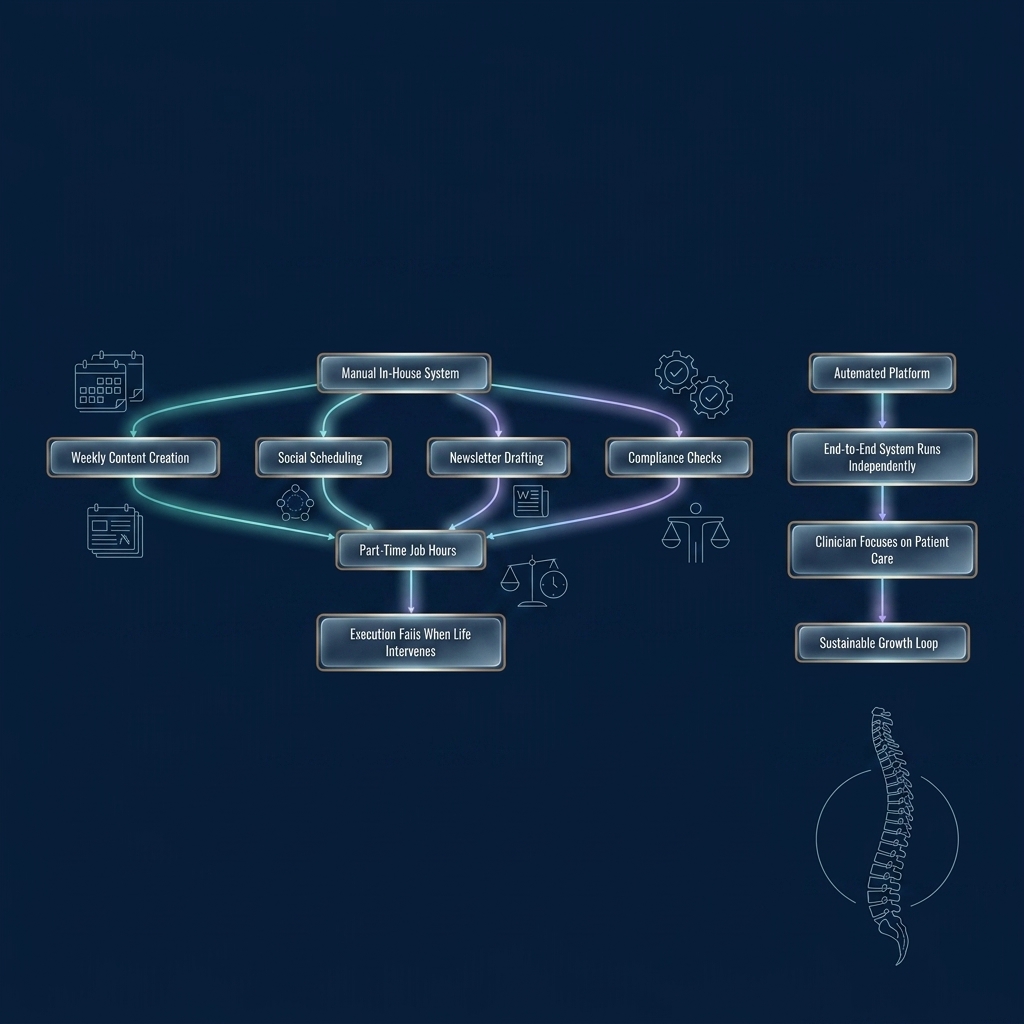
- Manual Execution Burden: Running the full integrated system, SEO articles, multi-platform social, newsletters, review management, requires 12 hours weekly of high-cognitive-load work, equivalent to a part-time job.
- FTC Compliance Liability: Generic AI tools lack clinical guardrails and generate outcome promises violating FTC health-advertising regulations; practices remain strictly liable for all AI-generated claims regardless of authorship.
Why Does Our Clinic's Social Media Always Go Silent?
Clinic social media goes silent because posting is treated as an extra task rather than a systematic operational process. When busy periods hit, posts get missed, triggering prolonged gaps. The problem stems from inadequate logistics and workflow design, not lack of creativity or effort. Without consistent systems, content creation becomes unsustainable and eventually stops entirely.
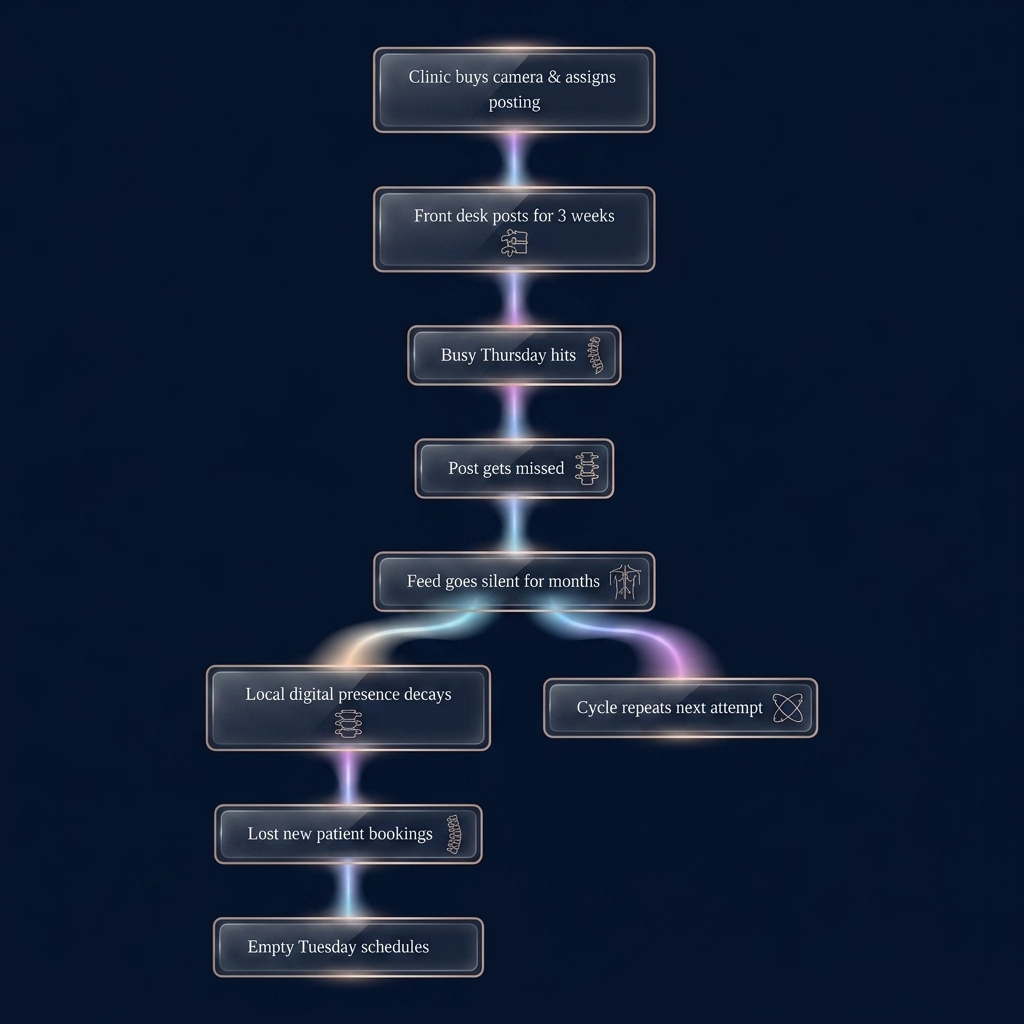
The Three-Week Wall: Why Your Social Media Goes Silent (and What It Costs)
Your front desk spent four hours last month filming videos, and your Tuesday afternoon schedule is still empty.
This is The Three-Week Wall.
Every clinic owner knows the cycle. You buy a nice camera. You task your front desk with posting daily. Then, a busy Thursday hits. A post gets missed. Your feed goes dark for three months.
Most social media campaigns for chiropractors fail from a lack of system, not effort. You treat content like an extra chore instead of an operational process.
When your posting stops, your local digital presence decays. It costs you new patient bookings.
The fix is not more creativity. The fix is better logistics.
This article breaks down the math of consistent posting. We will examine why your current setup is designed to fail. Finally, we will outline the reality of building a self-running content engine that protects your schedule.
Why Do Chiropractors Struggle to Keep up With Social Media?
Chiropractors struggle with social media because clinical demands create unsustainable friction between patient care and content creation. Initial enthusiasm fades as late patients, emergencies, and administrative tasks push posting times later and reduce quality. This inconsistency triggers algorithmic penalties, lowering relationship scores and collapsing organic reach, making sporadic efforts increasingly ineffective.
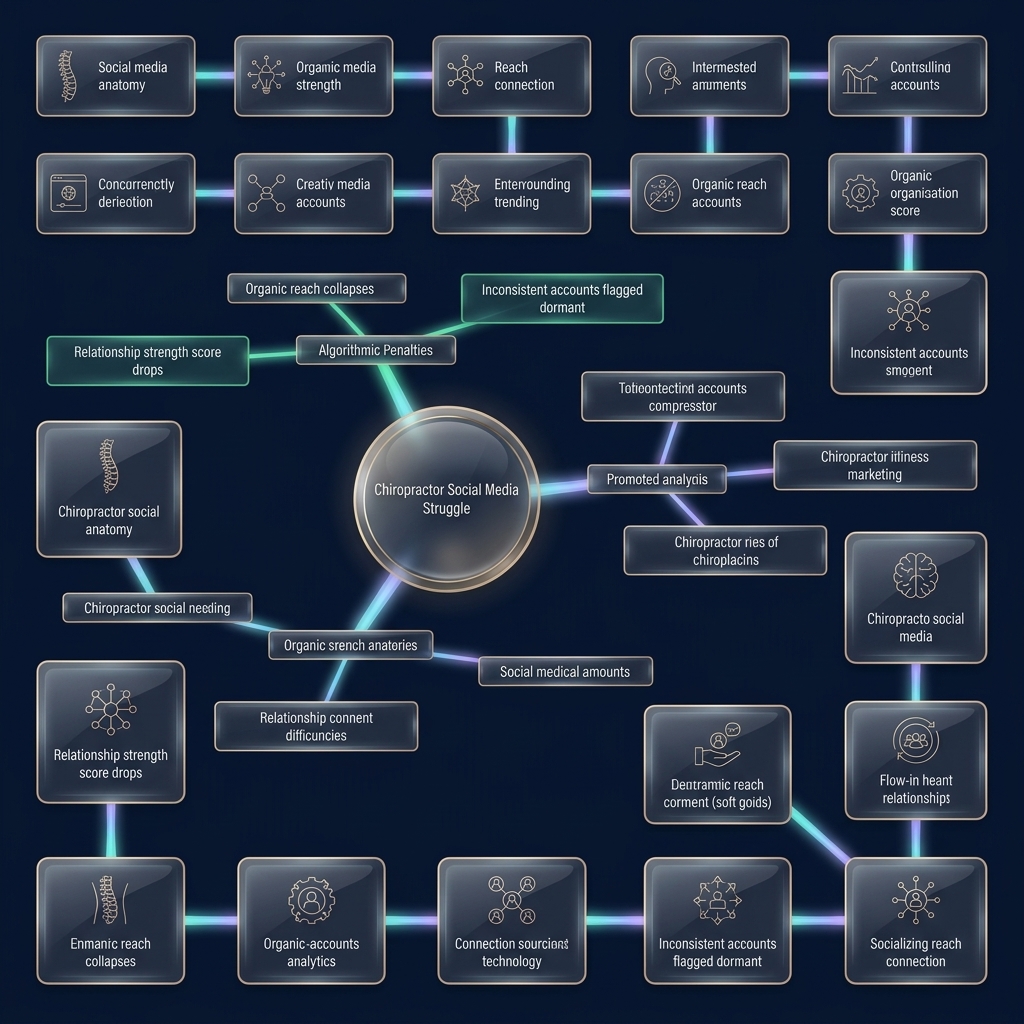
The Anatomy of the 8:00 PM Tuesday Meltdown
You are standing at the front desk. The adjustive table is still warm. The cleaning crew is vacuuming the lobby. You open Instagram and stare at an empty caption box.
Three weeks ago, you made a decision. You were going to take social presence seriously. You posted three times that first week: beautifully curated photos, thoughtful captions about spinal health, and even a short video explaining proper desk posture.
Then clinical reality reasserted itself.
Posting times slipped later into the evening. Caption quality dropped. You went from three posts a week to one, then none. The psychological guilt of missing a day turned into a week-long break. Now your feed looks like every other dead clinic profile: the last post dated November of last year.
This is not a creativity problem. This is the moment when the friction of being both clinician and copywriter becomes unsustainable.
The Sporadic-Posting Graph
The pattern repeats across thousands of practices.
Phase 1: Peak Enthusiasm (Week 1). You invest personal time. You take high-quality photos. You engage optimistically with comments.
Phase 2: The Decay (Weeks 2–3). Clinical emergencies push posting times later. Late patients compress your evening. Administrative bottlenecks pile up. Caption length shrinks. Quality drops.
Phase 3: The Silence (Week 4+). You close the app. You promise to do it tomorrow. Tomorrow becomes next week. Next week becomes never.
The algorithm notices.
Modern discovery algorithms classify inconsistent accounts as dormant. When an account goes quiet, machine learning systems lower the account's "relationship strength score" with its followers. Future posts get filtered out of feeds when the score falls below platform thresholds. Your organic reach collapses.
What does a prospective patient think when they visit a Facebook page whose last post was from six months ago? They think the practice might be closed. They call your competitor instead.
The Invisible Math: the True Revenue Cost of Inconsistency
The damage is not obvious because it compounds silently.
The Leaky Retention Bucket. ChiroSpring's July 2025 industry benchmark data documents a widespread problem: up to 25% of chiropractic patients drop out mid-care-plan. Lack of consistent digital touchpoints accelerates this dropout rate. Patients forget why they started care. They stop before the care plan finishes.
The Lost Reactivation Pool. Past patients experience a relapse. They cannot remember your clinic name. They assume you have closed because your digital presence is silent. They book with whoever appears active online.
Let's quantify the damage with conservative practice numbers.
Assume your average patient lifetime value is $2,500 across initial care and periodic maintenance. If inconsistent digital presence costs you just three new patient bookings per month, patients who found your profile, saw it was inactive, and chose a competitor, that is $7,500 in monthly lost opportunity cost.
Now add reactivations. If five past patients per month would have rebooked for a flare-up episode averaging $600 in care value, but they forgot your name or thought you were closed, that is another $3,000 per month.
Total invisible leak: $10,500 per month. $126,000 annually.
This is not revenue you see yourself losing. It is revenue that never arrives.
The Chiropractic Economics 2025 Salary and Expense Survey reported that the average U.S. Chiropractic practice billed $723,024 but only collected $450,425, a gap of over $272,000. When your digital presence goes silent, you widen that gap further by failing to capture high-intent local traffic.
Search engines devalue your site when you stop publishing fresh, localized content. Your organic search rankings drop. High-intent searches for "chiropractor near me" or "lower back pain treatment" send traffic to competitors who maintained consistent content output.
Why the Obvious Fixes Fail
You have tried the standard solutions. None of them worked. This is not your fault.
The "Assigned to the Front-Desk CA" Trap. You asked your chiropractic assistant to handle social media. They already manage clinical flow, answer phones, process insurance, and handle patient check-in. Expecting them to also write high-converting educational content about spinal biomechanics is organizational fantasy. They do not have the time, the training, or the clinical authority to create content that establishes expertise.
The "Friday Afternoon Block" Illusion. You blocked 2:00 PM to 5:00 PM on Friday to plan next week's content. Then patient volume spiked. A staff member called out sick. A billing error demanded immediate attention. The marketing block was the first thing sacrificed. It always is.
The "Cheap Local Intern" Disconnect. You hired a college student to manage your social media. They post generic wellness tips copied from other accounts. The content fails to establish clinical authority. It fails to resonate with patients in actual pain. It does not build the expertise signals that Google's E-E-A-T framework rewards.
The common thread: you treated content as an isolated task instead of an operational system.
How Do I Build an Integrated Healthcare Growth Engine?
Build an integrated healthcare growth engine by unifying four pillars into a self-reinforcing system: continuous local presence for visibility, frictionless response mechanisms to convert leads instantly, a reputation engine that transforms clinical wins into reviews, and retention loops that educate patients long-term. This creates compounding returns rather than isolated marketing tasks.
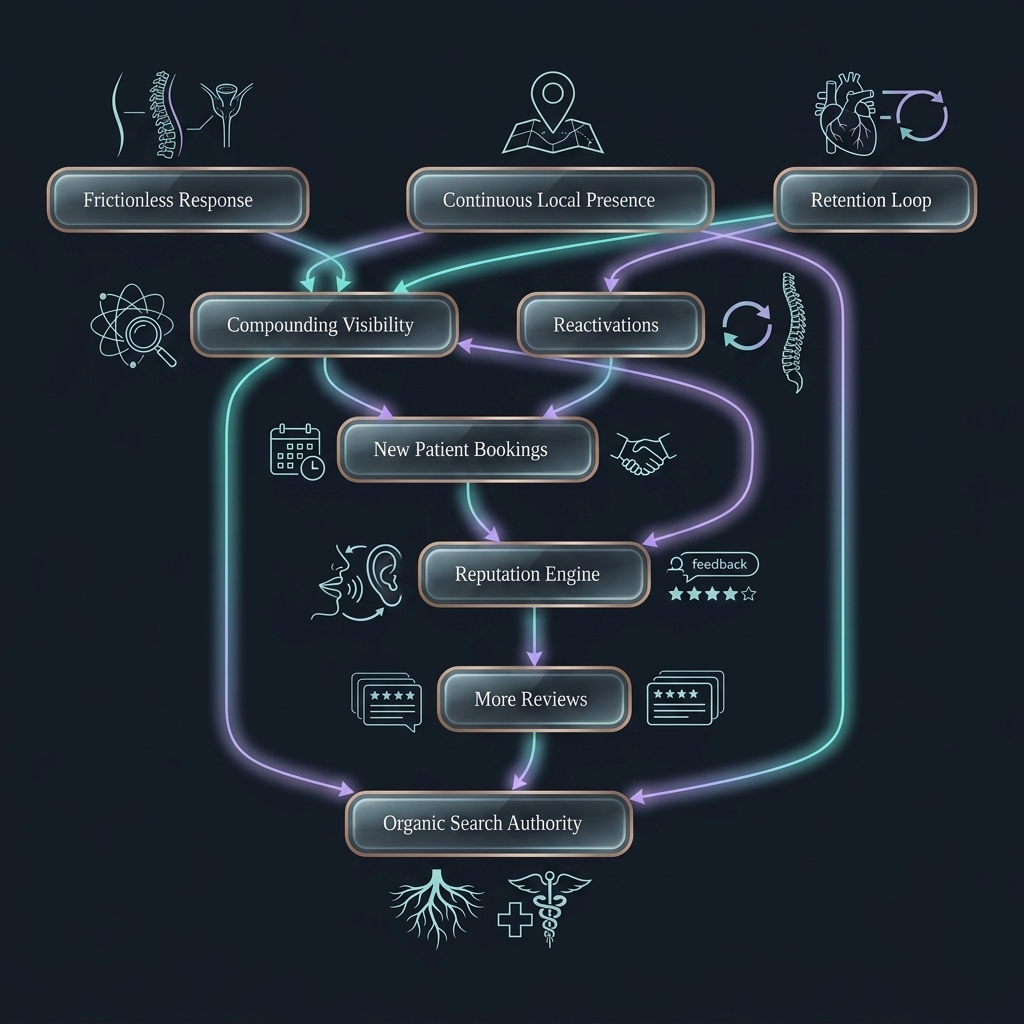
Moving Beyond the Checklist: the Integrated Growth Engine
The problem is not that you lack a content calendar. The problem is that you are treating digital presence as a standalone chore to cross off a list.
Revenue does not come from isolated posts. Revenue comes from a unified system where content presence, rapid lead response, review acquisition, and continuous patient education operate as a single, self-reinforcing loop.
The Four Pillars of the System:
1. Continuous Local Presence. Keeping the practice visible to prospective patients researching care options in your area.
2. The Frictionless Response. Instantly capturing and converting the attention generated by your content into booked appointments.
3. The Reputation Engine. Seamlessly translating in-clinic clinical wins into public Google reviews that compound your local search authority.
4. The Retention Loop. Keeping active and past patients educated on the long-term value of spinal health through regular newsletters and reactivation campaigns.
When these four pillars operate together, they create compounding returns. When you run them as disconnected tasks, they consume time without producing revenue.
The Compounding-Attention Mechanism: Why Consistency is the Entire Game
Running transactional ads is a temporary fix. You pay for visibility. When you stop paying, the visibility disappears.
Building an authoritative, consistent digital footprint creates an appreciating asset. Every article you publish, every educational post you share, every review you earn compounds into long-term organic visibility.
Divya Dugar's 2025 lifecycle marketing framework specifically cites behavioral psychology principles to assert that customers need exactly seven strategic touchpoints to progress successfully from the discovery stage to taking action. Patients rarely book on their first interaction. They choose the clinic that has been consistently educational for months.
This is The Psychology of Cumulative Exposure. A single post does not convert. A pattern of helpful, authoritative content builds trust over time.
Consistent posting also signals to search engines and social platforms that your business is active, healthy, and authoritative. Algorithms reward this with compounding organic impressions. Your reach grows without additional ad spend.
Organic content acts as free, perpetual retargeting for people who visited your website but were not ready to book. They see your posts in their feed. They remember your name. When their pain worsens, they call you instead of searching again.
The system works. The question is whether you can execute it.
Why Do Healthcare Providers Struggle to Execute Content Marketing?
Healthcare providers struggle to execute content marketing because they cannot consistently protect the required time blocks from clinical emergencies, staffing issues, and patient care demands. Even the leanest DIY approach requires three uninterrupted hours monthly plus weekly maintenance, demanding sustained discipline most practices cannot maintain while managing operational realities and expanding beyond social media to full-scope authority building.
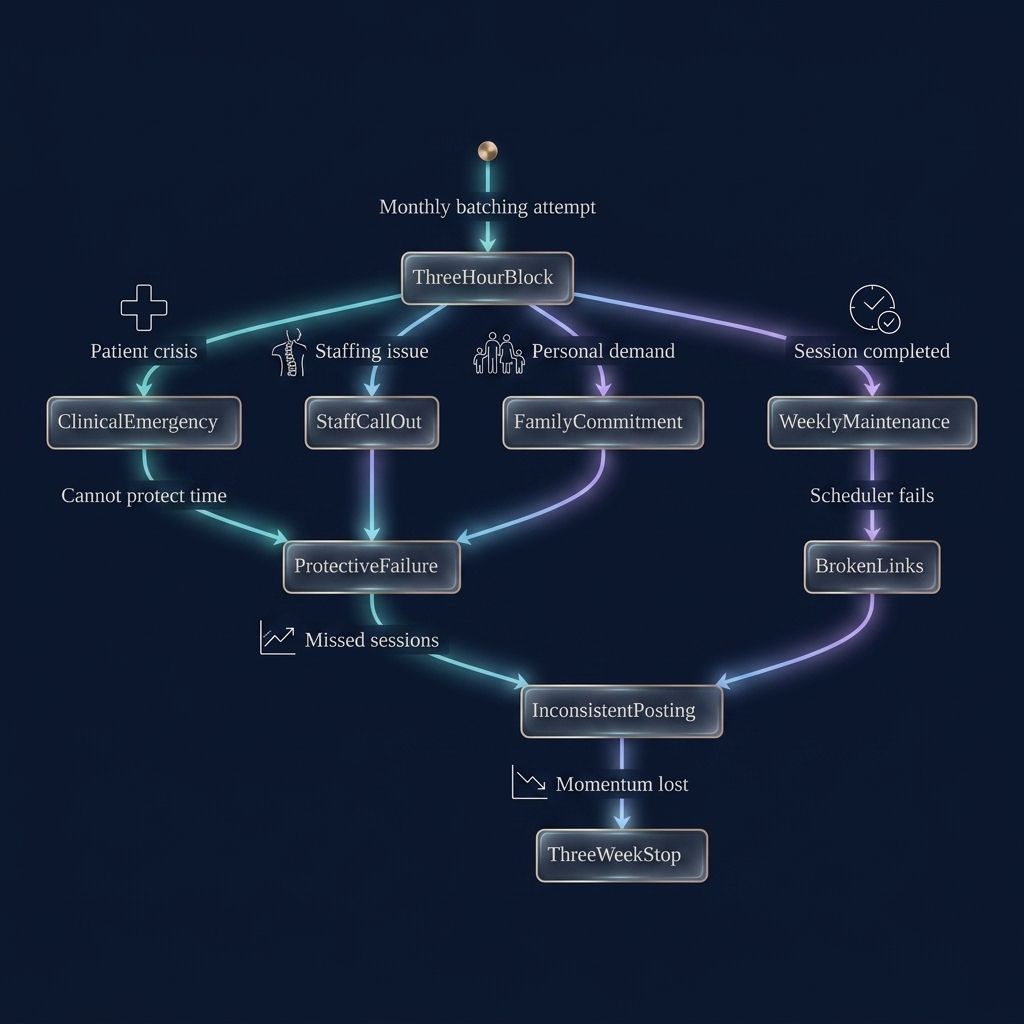
The Execution Wall and the Compliance Trap
You understand the system now. You see why consistency compounds. You recognize that isolated posting fails.
The new problem is execution.
The Honest Price of the DIY Protocol
Let's outline the cleanest possible DIY approach: a three-hour monthly batching session.
Hour 1: The Clinical Harvest. Review the last 30 days of patient files. Identify the four most common symptoms treated: L5-S1 disc herniation, tension headaches, desk posture syndrome, rotator cuff impingement. Write down the exact questions those patients asked.
Hour 2: The Voice-to-Text Draft. Use a phone recording app to dictate five-minute explanations answering each question as if speaking directly to a patient. This captures your clinical voice without the friction of writing.
Hour 3: The Formatting and Scheduling. Transcribe the audio. Split each transcript into one long-form educational post and two short-form social updates. Pair them with non-stock clinic photos. Schedule them using a free publishing tool.
This is the leanest possible version. It still requires three hours of uninterrupted, deep focus per month, plus 30 minutes every week to monitor comments, fix broken links, and ensure the scheduler did not fail.
The real friction is not the time. The real friction is the discipline required to protect those three hours from clinical emergencies, staff call-outs, family commitments, and patient care demands, month after month, with zero exceptions.
Most practices cannot sustain this.
The Operational Reality of Scale
The batching protocol only covers social media. It does not cover the full scope of what authority-based growth requires.
To run the entire system, you also need to:
• Write weekly, SEO-optimized articles for the practice website to capture high-intent Google searches.
• Format those articles into monthly email newsletters to prevent patient drop-off. BizIQ's 2026 Local Marketing Statistics report confirms that email marketing remains one of the highest-ROI channels for small businesses, delivering a return on investment of $36 to $42 for every $1 spent—making it one of the most effective retention tools available.
• Re-purpose that content for three separate social media platforms.
• Actively manage and respond to reviews and incoming direct messages.
The math of the manual burden:
Content creation, editing, and graphic design: 6 hours per week.
Distribution, scheduling, and formatting: 3 hours per week.
Review generation and patient communication follow-up: 3 hours per week.
Total weekly cost: 12 hours of non-clinical, high-cognitive-load work. The equivalent of a part-time job.
Buffer's 2026 State of Social Report documents that social media professionals spend up to 16 hours a week on content creation and scheduling alone. Constant Contact's Small Business Now report found that 73% of small businesses globally are unsure if their current marketing strategy is working, and 56% of SMB owners have one hour or less per day to spend on marketing.
A 12-hour weekly marketing burden is mathematically impossible for a clinician who only has five hours a week to spare.
The Tempting Shortcut: the ChatGPT Compliance Trap
Using generic AI tools to draft clinical content seems like a time-saving miracle at first glance.
It is not.
Generic AI outputs are non-deterministic. The same prompt produces different results each time. You still spend significant time prompting, editing, fact-checking, and rewriting to match your actual clinical voice.
The time paradox: the time spent wrestling with generic AI text ultimately consumes the very time savings the tool promised.
Worse, there is a severe legal risk.
Standard AI models lack clinical guardrails. They confidently write outcome promises, cure claims, and diagnostic guarantees that violate state chiropractic licensing boards, FDA guidelines, and FTC health-advertising regulations.
The FTC's Health Products Compliance Guidance strictly dictates that any health-related claims must be backed by "competent and reliable scientific evidence" (typically randomized, controlled human clinical testing). Furthermore, the FTC's recent AI enforcement guidelines (2023–2024) make it explicitly clear that businesses cannot blame the "black box" of AI; the business deploying the AI remains strictly liable for any deceptive claims, false promises, or hallucinations generated by the tool.
You own the risk. If an AI-generated post makes a claim you are not allowed to make, you are the one who faces regulatory consequences. The tool does not protect you. It does not review for compliance. It does not understand the legal boundaries of health advertising.
The mirage of the one-click solution collapses under operational and legal reality.
Should I Build My Own Practice Software or Outsource?
Outsourcing is the recommended approach for healthcare practices. Building and maintaining marketing software internally creates an unsustainable operational burden that consumes part-time job hours weekly. High-earning practices use automated, compliant platforms that run content generation, patient communication, and lead systems end-to-end, allowing clinicians to focus on patient care rather than technical infrastructure.
The Ultimate Decision: Ownership Vs. Operation
You now understand the system. Content presence, rapid response, review momentum, and steady patient communication must operate together as a compounding loop.
You also understand the execution wall. Building, maintaining, and policing this system yourself is an unsustainable operational burden.
The highest-earning practices do not ask their clinicians to build their own software or run their own infrastructure by hand. They recognize that the playbook of growth can only be sustained when it is built as an automated, compliant utility.
Platforms that operate this whole loop end-to-end, generating weekly SEO articles, formatting social posts, drafting patient newsletters, and running lead-generation systems with built-in compliance review, like Omniply, exist because the manual alternative consumes a part-time job's worth of hours every week.
You do not need another to-do list. You need an asset that runs when you are in the treating room.
The system works when it is executed. It fails when life gets in the way.
Frequently Asked Questions
Can ChatGPT Write Content for a Clinic?
Generic AI tools can draft content, but the output is non-deterministic and requires significant editing to match your clinical voice. More critically, standard AI models lack compliance guardrails. They will confidently write outcome promises and cure claims that violate FTC health-advertising regulations and state licensing board rules. You remain legally liable for every claim published under your name, regardless of who or what wrote it.
How Often Should a Clinic Post on Social Media?
Consistency matters more than frequency. Posting three times per week and maintaining that schedule for months outperforms posting daily for three weeks and then going silent. Algorithms penalize inconsistency by lowering your account's relationship strength score, which suppresses organic reach. A sustainable schedule you can maintain indefinitely beats an ambitious schedule you abandon.
What Are the HIPAA Rules for Social Media Posting?
Never post patient photos, names, or case details without explicit written authorization. Even with authorization, avoid including protected health information (PHI) such as diagnoses, treatment specifics, or visit dates. Testimonials and reviews are permissible if the patient initiates them voluntarily and you do not solicit them in a way that implies compensation or coercion. When in doubt, consult your compliance officer or legal counsel before publishing patient-related content.
Should My Front Desk Handle Social Media?
Only if they have protected time, clinical training, and content creation skills. Most front-desk staff already manage clinical flow, phones, insurance processing, and patient check-in. Adding social media management without removing other responsibilities guarantees failure. If they lack the clinical authority to write educational content that establishes expertise, the posts will be generic and ineffective.
How Long Before Social Media Brings in Patients?
Behavioral research indicates that consumers require an average of seven touchpoints to progress from discovery to booking. If you post inconsistently, those touchpoints never accumulate. With consistent posting, you may see initial inquiries within 60 to 90 days, but compounding organic reach typically takes six months of sustained effort. Social media is not a short-term tactic. It is a long-term asset that appreciates with consistency.
How Much Time Does Clinic Operations Take?
Running the full system, weekly SEO articles, social media for multiple platforms, email newsletters, review management, and lead response, requires approximately 12 hours per week of non-clinical, high-cognitive-load work. This is the equivalent of a part-time job. Most practice owners have one hour or less per day available for operational tasks, making manual execution unsustainable without dedicated staff or automation.
Is an Agency Worth It for a Clinic?
Traditional agencies charge retainers of $2,000 to $5,000 per month and still require significant owner input for content direction, review approval, and compliance oversight. They do not eliminate your time burden; they shift it. Platforms that generate content from your clinical voice and include compliance review reduce both cost and time investment. Evaluate whether the solution removes work from your plate or simply repackages it.