
It is 7:00 PM on a Tuesday. You are sitting at your desk, looking at the schedule for next week. Three open slots on Monday afternoon. Five on Wednesday morning. An entire Thursday that should be full but sits half-empty.
Your website cost $8,000. It looks professional. The photography is clean. The color palette matches your brand guidelines perfectly.
Your front desk has not mentioned it once this month.
This is The Static Brochure Syndrome: the condition where a practice website acts as a passive digital business card instead of an active revenue generator. The site exists. It has all the required pages. It tells visitors what you do and where you are located. Then it waits for someone who is already convinced to pick up the phone.
The paradox: a beautiful website actually masks the underlying failure. When something looks expensive and professional, you assume it is working. You do not question it. You certainly do not calculate what it is costing you in lost patient acquisition.
Key Takeaways
- Conversion Gap Cost: Brochure-style chiropractic websites convert at 1% versus the 4.8% healthcare average, costing practices with 500 monthly visitors approximately $432,000 annually in unrealized patient lifetime value at $1,800 per patient.
- Booking Friction Penalty: 80% of patients say online scheduling influences their provider choice, and nearly 25% will abandon practices requiring phone calls during business hours instead of offering frictionless digital booking tools.
- Compliance Liability Risk: The HHS Office for Civil Rights has imposed $144 million in HIPAA fines since 2003, and non-compliant tracking pixels on patient data capture pages constitute impermissible disclosure of protected health information.
- AI Content Danger: Generic AI tools like ChatGPT produce non-compliant medical claims and trigger Google's scaled content abuse penalties, risking up to 40% search visibility drops under E-E-A-T requirements for "Your Money or Your Life" healthcare topics.
- Execution Time Reality: Building a complete patient acquisition engine requires mastering five professional disciplines (SEO strategy, clinical copywriting, CRO design, marketing automation, healthcare compliance) demanding 10–15 focused hours weekly, while 70% of small business owners spend fewer than five hours total on marketing.
Why is My Brochure Website Losing Me Patients?
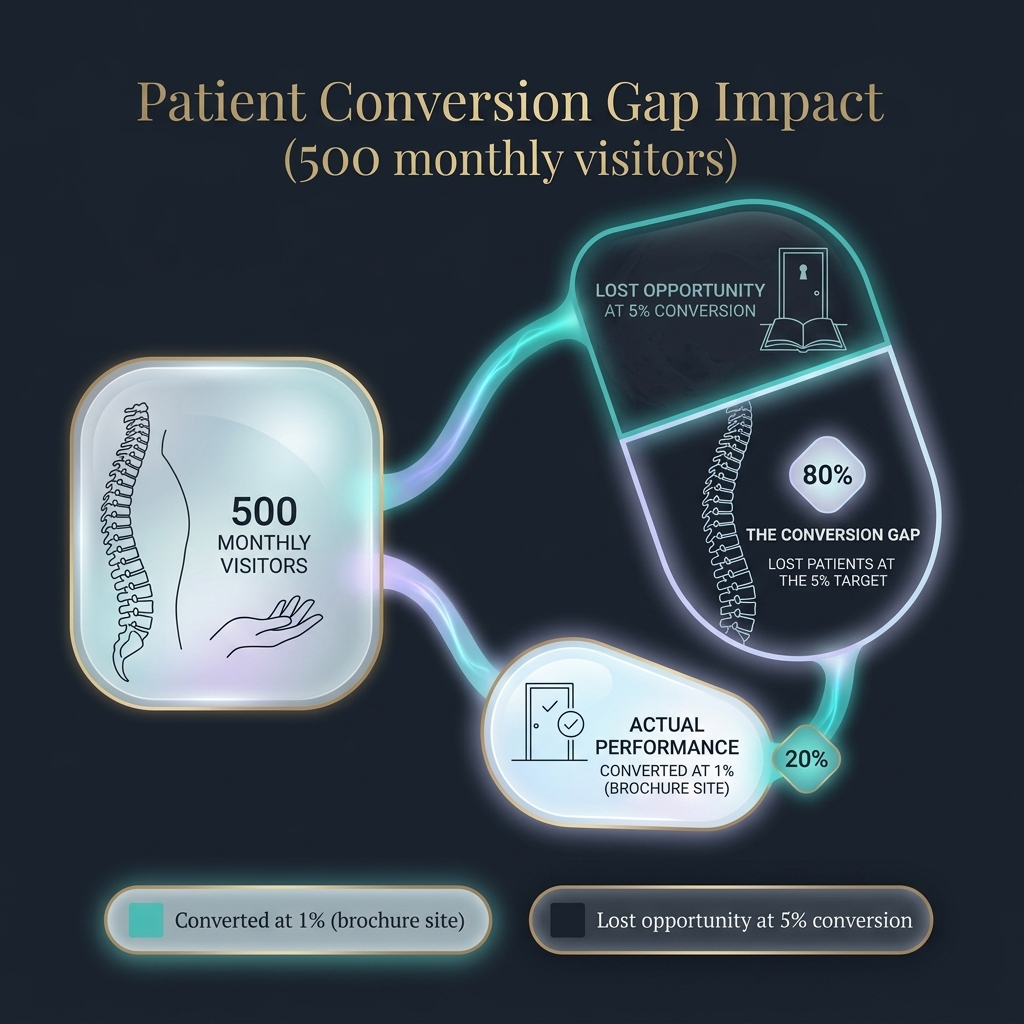
Brochure websites lose patients by failing to convert visitors into inquiries. A typical practice site converts only 1% of traffic compared to the healthcare average of 4.8%, creating a silent revenue leak. With 500 monthly visitors, this gap costs approximately $432,000 annually in unrealized patient lifetime value, as the site lacks conversion mechanisms beyond basic information display.
The Hard Math of the Brochure Leak
Start with a typical chiropractic practice website receiving 500 unique visitors per month. Not ambitious traffic. Just the baseline from local search, word of mouth, and the occasional social media mention.
A standard brochure-style site converts at roughly 1%. That means 5 new patient inquiries per month from 500 visitors. The average healthcare website conversion rate is 4.8%, and top performers reach 8.6%. But most practice sites are not built as healthcare conversion engines. They are built as digital brochures. So 1% is the reality.
Now run the same 500 visitors through a site engineered for conversion at 5%. That produces 25 new patient inquiries per month.
The difference is 20 patients.
The average chiropractic patient lifetime value sits between $1,500 and $5,000, depending on your treatment protocols and patient retention systems. Use the conservative middle: $1,800. That accounts for the initial exam, an 8-visit treatment plan, and periodic maintenance visits over 18 months.
Twenty patients at $1,800 each equals $36,000 per month in unrealized revenue. Annually, that is $432,000 walking past your practice because your website cannot close.
This number never appears on your P&L. It is not a line item. It is a silent leak that compounds month after month while you focus on the patients who did manage to find their way through.
Why the Obvious Fixes Fail
The Redesign Trap is the most expensive mistake. You spend $5,000 to $10,000 on a visual refresh. New fonts. Modern layout. Better mobile responsiveness. The conversion rate stays exactly the same because aesthetics were never the problem. The problem is mechanism. A beautiful brochure is still a brochure.
The Low-Intent SEO Trap is the second mistake. You hire a cheap agency to rank you for broad, national keywords like "chiropractic care" or "spinal adjustment benefits." You get traffic. The numbers in Google Analytics go up. But the visitors bounce within three seconds because they were researching general information, not looking for a local provider. Traffic without intent is noise.
The Aggressive Discount Mistake is the third trap. You plaster "$29 New Patient Specials" across your homepage, thinking price is the barrier. What you actually do is cheapen your clinical authority and attract transient shoppers who will leave the moment their Groupon expires. 94% of healthcare patients use online reviews to evaluate providers before booking. They are not looking for the cheapest option. They are looking for trust and competence. Discounting signals neither.
These fixes fail because they treat symptoms instead of addressing the core dysfunction: your website does not capture, nurture, or convert the people who land on it.
How Does a Patient Acquisition Flywheel Actually Work?
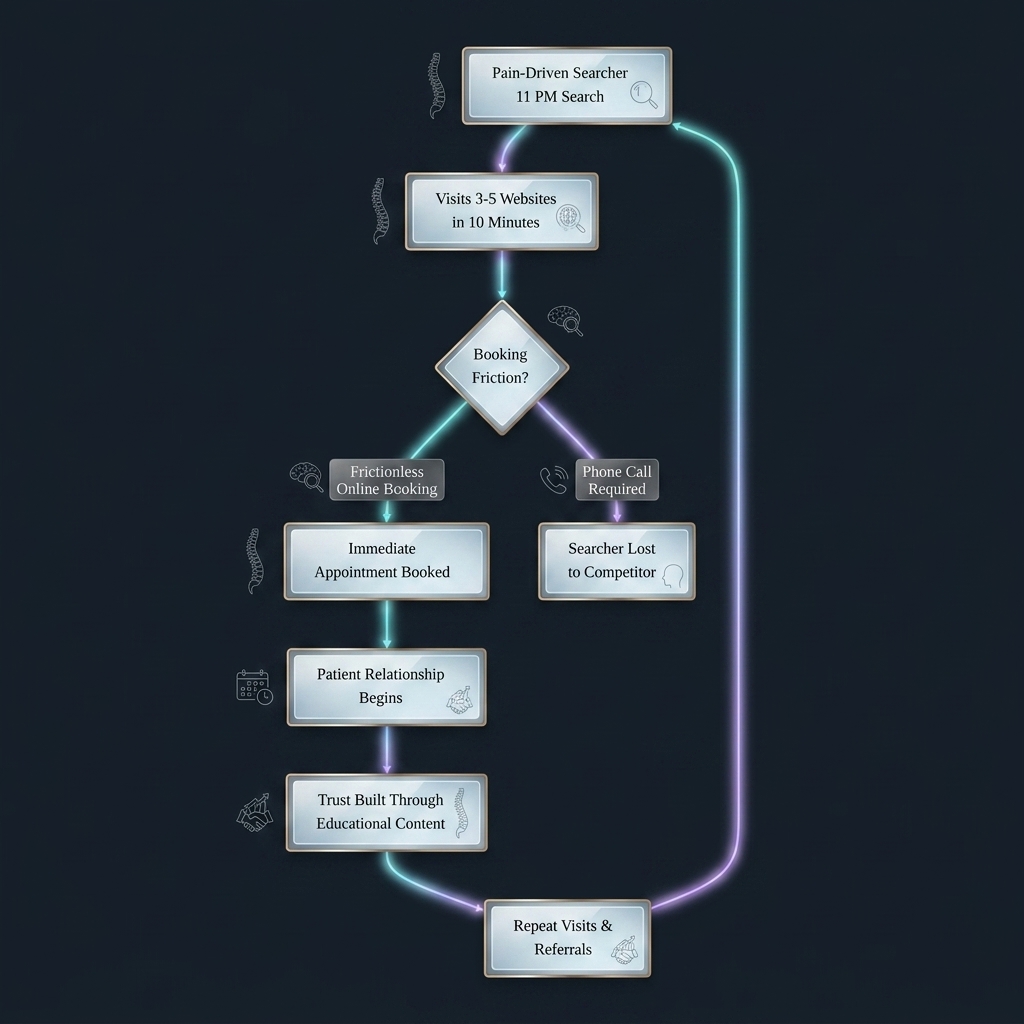
A patient acquisition flywheel works by transforming websites from static information sources into interactive conversion engines. It captures pain-driven searchers through condition-specific educational content that builds clinical trust, then converts them via frictionless digital booking tools. Practices that enable immediate online scheduling capture patients actively comparing multiple providers, while those requiring phone calls lose conversions.
The Patient Acquisition Flywheel
Shifting the Belief: From Digital Billboard to Interactive Funnel
High-converting practice websites do not just inform the already-convinced. They capture and nurture the curious.
The person searching "chiropractor near me lower back pain" at 11:00 PM is not browsing. They are in acute discomfort, looking for immediate relief, and evaluating whether you can help them. This is not a retail decision. It is a pain-driven, high-stakes choice made under time pressure.
That searcher will visit three to five websites in the next ten minutes. The practice that makes booking frictionless wins. The practice that requires a phone call during business hours loses.
The belief shift: your website is not a reference document. It is the first interaction in a patient relationship. It either moves that relationship forward or it ends it.
The Four Pillars of the Conversion Engine
Pillar 1: Consistent Content Presence. Publishing condition-specific educational content establishes immediate clinical trust. When someone searches "can a chiropractor help with sciatica," they want an answer from a local expert, not a generic health blog. A practice that publishes weekly articles answering real patient questions builds authority that shows up in search and converts on the page. Sites lacking E-E-A-T signals, particularly those relying on purely AI-generated content or scaled content abuse, saw up to a 40% drop in search visibility following recent Google core updates. Healthcare falls under "Your Money or Your Life" topics, making these trust signals especially critical. Content is not optional. It is the foundation of digital trust.
Pillar 2: The Frictionless Response Loop. 89% of patients say the ability to schedule appointments anytime using digital tools is important to their healthcare experience. 80% say online scheduling influences their choice of provider. Nearly a quarter will walk away to a competitor if booking is not easy. The conversion engine captures attention before the visitor clicks back to Google. That means visible scheduling buttons, embedded booking widgets, and instant response mechanisms that do not require a callback.
Pillar 3: Review and Social Proof Momentum. It takes reading just 1 to 6 online reviews for a potential patient to form an opinion about your practice. A systematic flow of fresh, authentic patient stories acts as a trust accelerator. But reviews sitting on Google do not convert on your website unless you pull them onto the page. The mechanism is simple: recent reviews displayed prominently on your homepage and service pages turn static testimonials into dynamic conversion assets.
Pillar 4: Steady, Low-Friction Patient Communication. Not every visitor is ready to book today. Some are researching. Some are waiting for their pain to escalate. Some are comparison shopping. The conversion engine maintains a continuous, non-intrusive dialogue with prospects through value-first email sequences. When their pain flares up again, your practice is the obvious choice because you have been the consistent voice of authority in their inbox.
The Compounding Flywheel Mechanism
These four pillars feed into one another. Consistent content improves search rankings, which brings more high-intent traffic. Frictionless scheduling converts that traffic into booked appointments. Reviews build trust that increases conversion rates. Steady communication brings back prospects who were not ready the first time.
The result is Customer Acquisition Cost reduction over time. Your cost to acquire a new patient drops as the system compounds. Month one, you might spend $200 per new patient in combined content, tools, and time. Month twelve, that number is $80 because your content library is working 24/7, your reviews are stacking, and your email sequences are converting prospects you captured six months ago.
This is the difference between a marketing expense and a revenue engine. Expenses stay flat or increase. Engines compound.
What is the Execution Wall in Business Conversion?
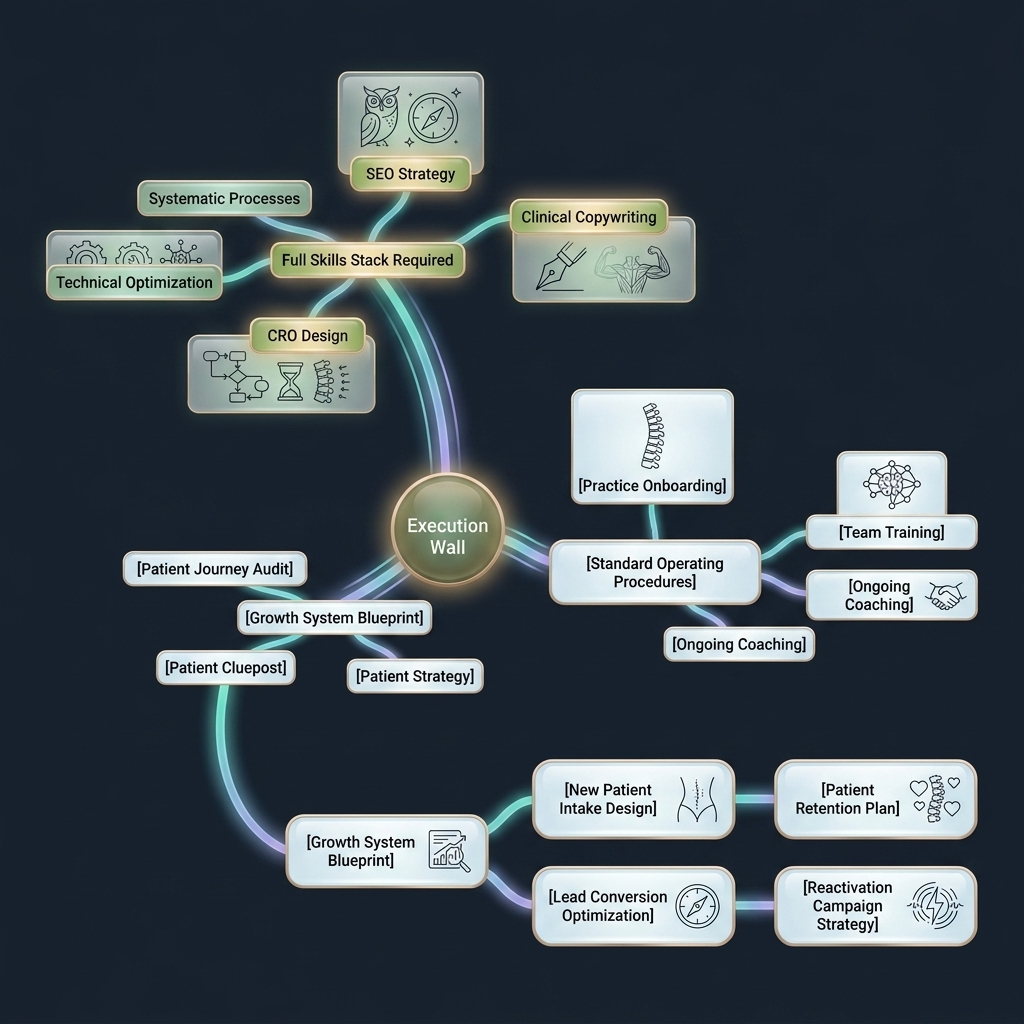
The execution wall in business conversion refers to the gap between knowing what marketing strategies work and actually implementing them effectively. It represents the barrier businesses face when they lack the complete skills stack, including SEO strategy, clinical copywriting, technical optimization, and systematic processes, needed to build a full patient acquisition engine that consistently converts prospects into customers.
The Execution Wall
The Monday Morning Protocol: Your First Step to Conversion
You can start fixing this on Monday morning with two changes that require no budget and no vendor.
Step 1: The One-Button Rule. Place a high-contrast "Schedule Your Assessment" button in the top-right header of your website. Make it visible on every single page. Use a color that contrasts with your brand palette. Test it on mobile. Confirm that it routes to a functional booking page, not a contact form. This single change can lift conversion rates by 15% to 20% because it removes the friction of hunting for a phone number or navigating to a buried contact page.
Step 2: The Front-Desk FAQ. Sit down with your front desk team and ask them to list the ten questions they answer on the phone every single week. Write those questions down verbatim. Then write clear, direct answers in plain language. Post that FAQ section on your homepage, above the fold. This does two things: it builds trust by demonstrating you understand patient concerns, and it answers objections before they become barriers.
The time cost: three hours of uninterrupted work to write, edit, and publish. The discipline cost: monthly audits to ensure the button still works and the questions remain accurate.
The reality: this protocol is one rung of a six-rung ladder. It will improve your conversion rate. It will not build the full engine.
The Full Skills Stack
Running a complete patient acquisition engine requires mastering five distinct professional disciplines.
1. SEO Strategy. Ongoing keyword research to identify what your local market is actually searching for. Technical on-page optimization to ensure Google can crawl and rank your content. Monitoring algorithm updates and adjusting your approach accordingly.
2. Clinical Copywriting. Writing content that balances empathy with medical authority. Explaining conditions in language a patient understands without sounding condescending. Addressing pain points without making clinical claims you are not licensed to make.
3. Conversion Rate Optimization Design. Structuring page layouts that naturally guide user behavior. Placing calls-to-action where the eye lands. A/B testing button colors, headline phrasing, and form length to incrementally improve performance.
4. Marketing Automation. Setting up email and SMS sequences that deliver value without feeling like spam. Maintaining list hygiene. Monitoring deliverability rates. Troubleshooting when a sequence breaks.
5. Healthcare Regulatory Compliance. Ensuring every word adheres to HIPAA, FTC, FDA, and state chiropractic board regulations. The HHS Office for Civil Rights has received over 374,000 HIPAA complaints since 2003 and has imposed $144 million in fines. Using non-HIPAA compliant tracking pixels on pages that capture patient data can constitute an impermissible disclosure of protected health information. One careless line of copy can trigger a regulatory investigation.
The honest time arithmetic: executing this system end-to-end demands 10 to 15 hours of focused work every single week. 70% of small business owners spend fewer than five hours per week on marketing total. The math does not work.
The Dangerous Shortcut: the Illusion of "Free" AI
The obvious solution is to use ChatGPT or another generic AI tool to write the content and automate the emails. This is a trap.
The Non-Deterministic Output Risk. Generic AI platforms generate unpredictable text. One prompt produces clear, empathetic copy. The next produces clinical jargon that alienates real patients. You cannot rely on consistency, which means you still have to review and rewrite every single output.
The Hidden Time Drain. Prompting, correcting, formatting, and publishing AI drafts still consumes hours of your time. You are not eliminating work. You are shifting it from writing to editing. For most practice owners, editing unfamiliar content is harder than writing from scratch.
The Compliance Nightmare. Generic AI tools are blind to health-advertising regulations. They will write claims like "our adjustments cure migraines" or "guaranteed pain relief in three visits." Those claims violate FTC guidelines and state chiropractic board rules. Google's spam policies and Helpful Content guidelines explicitly target "scaled content abuse," which is mass-producing content created primarily to manipulate search rankings. While Google does not ban AI content outright, it explicitly penalizes unedited, low-quality, or mass-produced AI text that lacks human oversight and genuine E-E-A-T. Publishing generic, unreviewed AI content on a medical site can trigger quality filters and severely lower search rankings.
The legal liability alone makes this shortcut untenable. One non-compliant claim can result in fines, board complaints, and loss of search visibility.
The Resolution
The conversion system is the key to practice growth. The math is clear. The mechanism is proven. But managing it manually is a demanding second job that requires skills most practice owners do not have and time they cannot spare.
The strategic choice: spend your weekends acting as a marketing technician, or let a specialized system operate the engine while you focus on patient care.
Platforms that operate this whole loop end-to-end, consistent content, automated patient communication, review momentum, compliance-checked copy, exist specifically to solve this execution wall. Omniply is one; it generates weekly SEO articles, social posts, patient newsletters, and lead-generation guides from your practice's own voice, reviewed before publication. The system runs whether you are in the office or not.
You went to school to heal patients, not to manage software.
The question is not whether the conversion engine works. The question is who operates it.
Frequently Asked Questions
Why is My Chiropractic Website Not Getting Patients?
Most practice websites are built as digital brochures, not conversion engines. They inform visitors but do not capture, nurture, or convert them. The typical issues: no visible scheduling button, no educational content that builds trust, no frictionless way to book without a phone call. The average healthcare website converts at 4.8%. Most practice sites convert at 1% or lower because they were designed to look professional, not to generate patient inquiries.
Can ChatGPT Write Website Copy for a Chiropractor?
Generic AI tools produce unpredictable output and are blind to healthcare advertising regulations. They will write non-compliant claims that promise cures or guaranteed outcomes, exposing your practice to legal liability and search ranking penalties. Editing and formatting AI-generated drafts still consumes hours of your time. For compliance-sensitive industries like chiropractic, unreviewed AI content is a risk, not a solution.
Should a Chiropractor Hire a Marketing Agency?
It depends on the agency's expertise and your budget. General marketing agencies often lack healthcare compliance knowledge and treat your practice like a retail business. Cheap SEO agencies rank you for low-intent national keywords that bring traffic but no bookings. Specialized agencies that understand patient acquisition systems, regulatory compliance, and local search can deliver results, but expect to pay $2,000 to $5,000 per month for competent execution.
Does a Chiropractor Website Need to Be HIPAA Compliant?
Yes, if your website captures any patient data through contact forms, scheduling widgets, or lead magnets. Using non-HIPAA compliant tracking pixels or analytics on pages that collect patient information can constitute an impermissible disclosure of protected health information. The HHS Office for Civil Rights has imposed over $144 million in fines for HIPAA violations. Compliance is not optional.
What is a Good Conversion Rate for a Chiropractic Website?
The average healthcare website conversion rate is 4.8%. Top-performing healthcare sites reach 8.6%. For local search with high patient intent, click-to-call conversions can reach 12.5%. If your site is converting below 3%, you have a structural problem, not a traffic problem. Focus on frictionless scheduling, trust-building content, and visible calls-to-action before spending money on more traffic.
How Many New Patients Should a Website Generate Monthly?
It depends on your traffic and conversion rate. A practice with 500 monthly visitors and a 5% conversion rate generates 25 new patient inquiries per month. If your close rate on inquiries is 60%, that is 15 new patients booked. The math scales with traffic, but conversion rate is the lever. Doubling traffic from 500 to 1,000 visitors at 1% conversion gives you 10 inquiries. Keeping traffic at 500 but improving conversion to 5% gives you 25 inquiries. Fix conversion before chasing traffic.
How to Handle Website Inquiries at the Front Desk
48.4% of consumers report encountering pre-appointment roadblocks like cumbersome scheduling and poor communication. Respond to inquiries within one hour during business hours. Use templated responses for common questions to save time. If your front desk is too busy to respond quickly, implement automated confirmation emails and SMS reminders so the prospect knows their inquiry was received. Better yet, use online scheduling that bypasses the front desk entirely and delivers confirmed appointments directly to your calendar.