
A prospect searches for local care at 9:14 PM. They click your website, read for twenty seconds, and close the tab. You paid $4.50 for that click, but your adjustment tables stay empty.
Every open slot on your calendar costs your practice $150. Yet, your front desk still spends hours chasing dead leads.
This leak is not a traffic problem. It is a friction problem.
Most clinics treat new-patient flow as a single, sudden leap from a Google search to a booked appointment. In reality, prospects climb a five-step Trust Ladder before they ever trust you with their spine. If a single rung is broken, they drop off.
Your front desk cannot fix this leak with friendlier phone manners. You need a systematic way to move high-intent searchers from cold online clicks to confirmed, paid visits.
This article breaks down the three critical friction points on the Trust Ladder and shows you how to plug the leaks in your booking pipeline.
Key Takeaways
- Trust Ladder Leaks: Chiropractic practices lose 99.4% of prospects between search impression and booked appointment due to five sequential friction points: search visibility, map pack presence, review recency, website experience, and booking friction.
- Review Velocity Dominance: Practices with 50 reviews (five written this week) outperform competitors with 200 stale reviews from 2021; review recency as a decision factor jumped from 8.42% in 2024 to 14.02% in 2025.
- After-Hours Booking Imperative: 40% of all appointments are booked after normal business hours, and 67% of patients prefer online scheduling; phone-only booking systems lose high-intent prospects searching at 10:37 PM with acute sciatica.
- Manual Marketing Cost: Operating the full Trust Ladder system manually requires 11 hours weekly, costing $34,320 monthly in lost clinical revenue at 120 patient visits per week and $65 per visit.
- AI Compliance Trap: GPT-3.5 fabricates 55% of medical citations and GPT-4 fabricates 18%; FTC penalties for deceptive AI-generated health claims reach $53,088 per violation, and 91.8% of clinicians have encountered medical AI hallucinations that could cause patient harm.
Why is My Website Losing Potential Patients?
Websites lose potential patients by failing critical trust tests during the decision journey. Common failures include slow mobile load times, generic stock imagery, unclear calls-to-action, poor search visibility outside the top three map results, outdated Google Business Profiles, and stale reviews. Prospects abandon sites lacking immediate booking options and fresh social proof within the first five seconds.
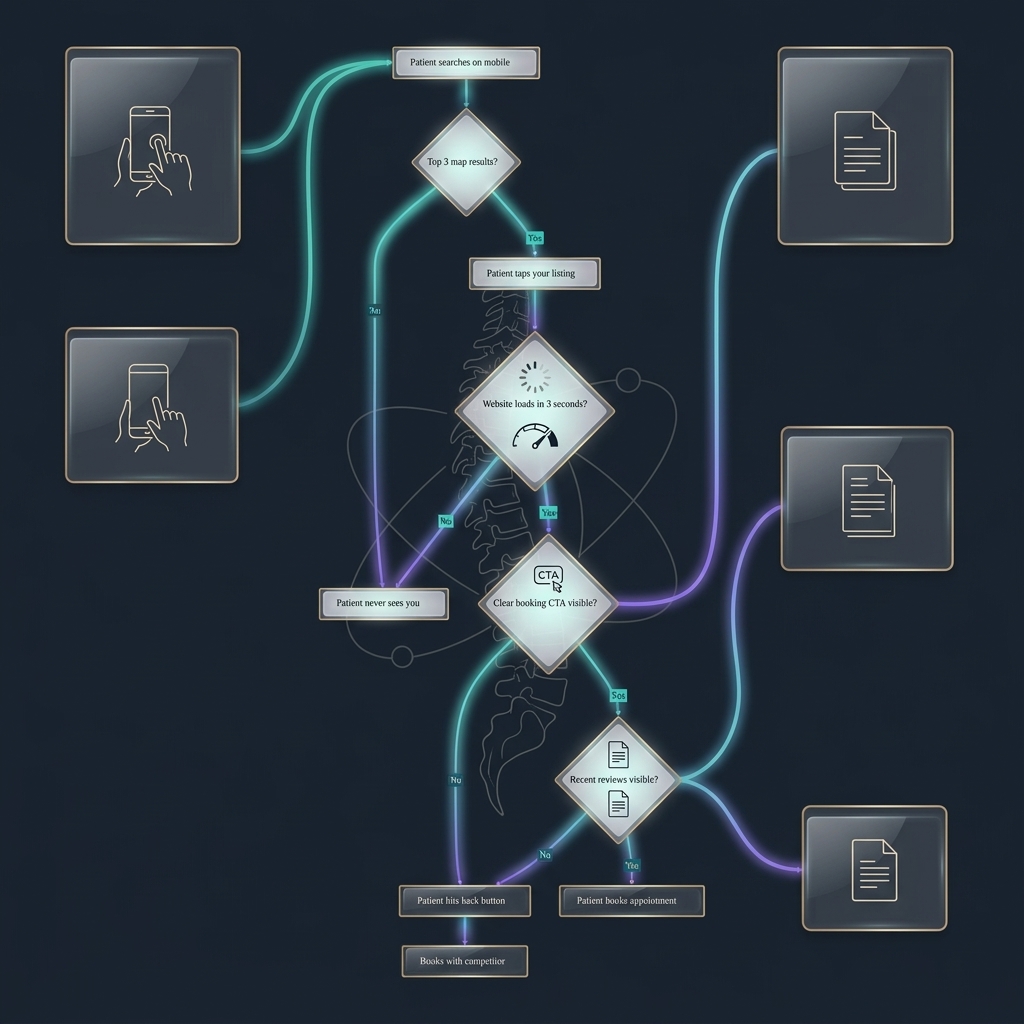
The Invisible Leaks in Your Trust Ladder
The Midnight Search
It is 10:37 PM on a Wednesday. A 42-year-old office manager wakes up with sciatica that radiates down her left leg. She cannot sleep. She cannot sit. She reaches for her phone.
She types "chiropractor near me" into Google.
Your practice appears third in the map pack. She taps your listing. Your Google Business Profile loads. She scrolls past your address, taps "Website," and waits three seconds for your homepage to render on her iPhone.
Your hero image is a stock photo of a spine model. Your headline reads "Welcome to [Practice Name]." She scrolls down. She sees a paragraph about your philosophy. She sees a button that says "Learn More."
She taps the back button and books with the practice that had "Book Online: Next Available: Tomorrow 9 AM" in the first five seconds.
You never knew she existed.
The Five Rungs of the Trust Ladder
Every prospect climbs the same sequence before they book. Each rung is a test. Fail one, and they disappear.
Rung 1: Search Visibility. You must appear where they are looking. Over 70% of health-related searches happen on mobile devices, and nearly 80% of those searches have local intent. If you are not in the top three map results for "chiropractor near me," you do not exist to the majority of high-intent searchers.
Rung 2: Map Pack Presence. Your Google Business Profile is your storefront. Prospects evaluate proximity, hours, and whether you look active. Practices that update their profiles weekly with fresh photos and posts win more local real estate than practices with static listings from 2021.
Rung 3: Review Recency and Velocity. 84% of patients visit online review sites before booking. But the number of reviews matters less than their freshness. A practice with 200 reviews from three years ago loses to a practice with 50 reviews, five of which were written this week. Patients cited review recency as a top decision factor 14.02% of the time in 2025, up from 8.42% in 2024.
Rung 4: Website Experience. Your site must answer the prospect's question in the first five seconds on mobile. If they have to scroll, squint, or guess where to click, they leave. 67% of patients prefer online booking. If your site does not offer it, you lose them to a competitor who does.
Rung 5: Booking Friction. Every extra form field, every phone-only booking requirement, every "We'll call you back to confirm" adds resistance. 80% of consumers say online scheduling influences their choice of provider. Nearly 25% will walk away if booking is not easy.
The ladder is sequential. A prospect who never makes it past Rung 2 never sees your beautiful website. A prospect who bounces at Rung 4 never gets to Rung 5.
The Math of the Leaky Funnel
Here is what a typical month looks like for a three-doctor practice with broken rungs:
500 local search impressions. Your practice appears in search results 500 times. 100 people click through to your map listing. That is an 80% drop-off at Rung 1 and Rung 2 combined.
30 of those 100 visit your website. That is a 70% drop-off at Rung 3 and Rung 4.
3 of those 30 book an appointment. That is a 90% drop-off at Rung 5.
Your conversion rate from impression to booked visit is 0.6%.
Now run the math on what a 5% improvement at each stage would deliver. If you reduce the Rung 2 drop-off from 80% to 75%, you get 125 map clicks instead of 100. If you reduce the Rung 4 drop-off from 70% to 65%, you get 44 website visits instead of 30. If you reduce the Rung 5 drop-off from 90% to 85%, you get 7 booked appointments instead of 3.
That is 4 additional new patients per month. If your average new patient is worth $1,800 in lifetime value, that 5% reduction in friction is worth $7,200 per month. Annualized, it is $86,400.
You are not losing prospects because your adjusting technique is inferior. You are losing them because your digital system has five invisible leaks, and every leak compounds the one before it.
Why the Obvious Fixes Fail
Most practices try to solve this problem by spending more money on the front end.
The PPC Trap. You pay $6 per click for Google Ads. You drive 200 clicks to your website. If your Rung 4 and Rung 5 conversion is still broken, you just spent $1,200 to book the same 3 patients you would have booked organically. Paid traffic does not fix a leaky funnel. It just makes the leak more expensive.
The Static Website Redesign. You spend $5,000 on a beautiful new site. It has clean typography, professional photos, and a mobile-responsive layout. It looks great. But if you are not publishing fresh content, generating new reviews, or offering frictionless booking, the new design changes nothing. A static brochure site, no matter how polished, does not signal vitality or authority to Google or to prospects.
The Sporadic SEO Sprint. You hire an agency to optimize your site once. They rewrite your meta descriptions, add some keywords, and submit your sitemap. Your rankings improve for six weeks, then decay back to baseline. Search rankings are not a one-time project. They require ongoing content creation, link building, and profile maintenance. A single optimization pass cannot counteract the algorithmic decay that happens when your competitors publish weekly and you publish nothing.
The common thread: these fixes all assume the problem is a single broken component. The real problem is that the Trust Ladder is a system, and systems fail when any part stops working.
What is the Integrated Trust-delivery System?
The integrated trust-delivery system is a framework where four interconnected marketing engines work together to build prospect confidence: consistent content presence that signals active expertise, review momentum demonstrating recent patient satisfaction, fast response times with zero-friction booking systems, and ongoing digital activity. When one engine weakens, it undermines the entire system's effectiveness in converting prospects.
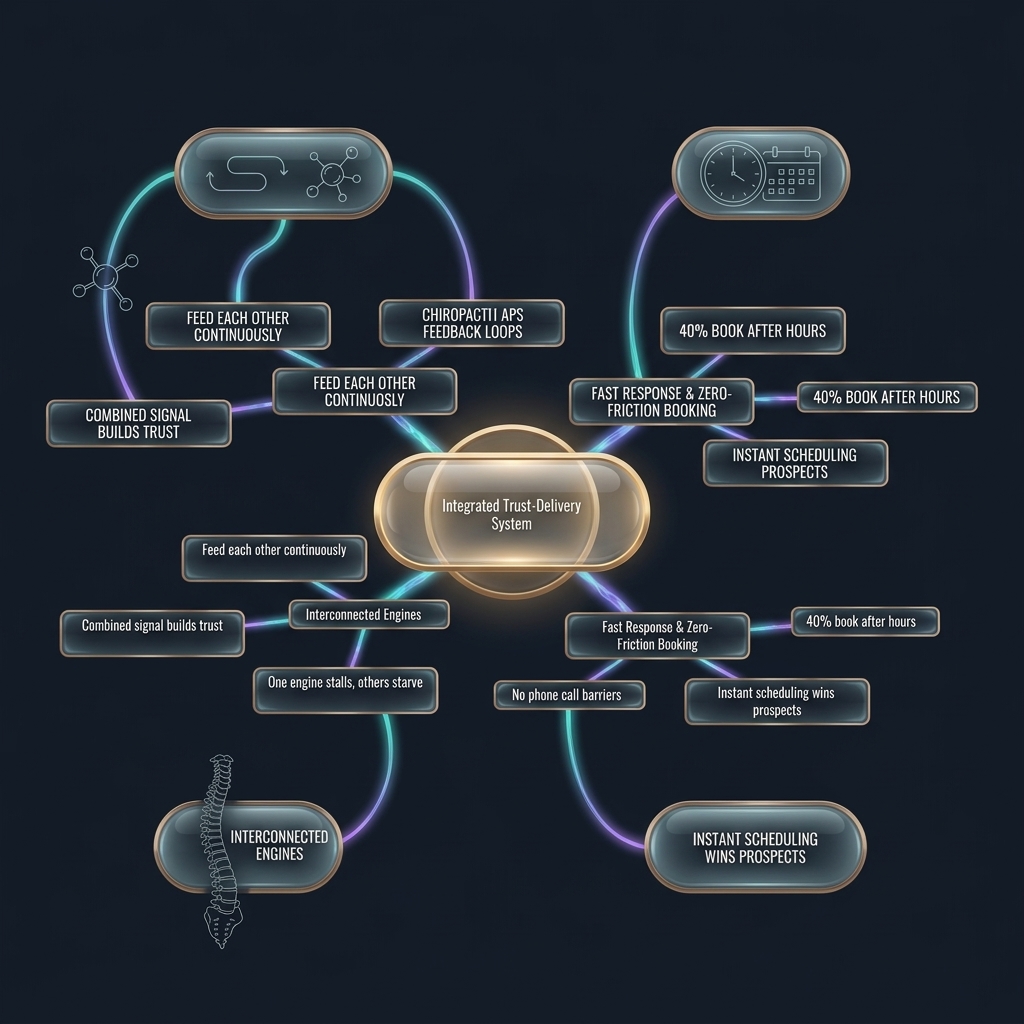
The Integrated Trust-Delivery System
The Belief Shift
Prospects do not choose you because of a single ad or a clean logo. They choose you because your entire digital presence signals that you are active, authoritative, and accessible.
Search presence, response times, review momentum, and ongoing content publication are not separate marketing tasks. They are interconnected engines that feed each other.
When one engine stalls, the others starve.
The Four Core Engines
Engine 1: Consistent Content Presence. Publishing authoritative, clinical-yet-accessible content signals active expertise to both Google's algorithms and to prospects. Every article you publish is a new entry point for prospects searching long-tail queries like "can a chiropractor help with migraines" or "sciatica relief without surgery." Static sites rank for 10 to 15 keywords. Sites that publish weekly rank for hundreds.
Engine 2: Review Momentum and Recency. The top 10% of healthcare facilities maintain an 89% response rate to negative reviews. They also generate fresh reviews consistently, not in sporadic bursts. A practice with 200 reviews from 2021 signals stagnation. A practice with 50 reviews, five of which were written this week, signals vitality.
Review velocity also feeds Google's local ranking algorithm. Practices that actively request reviews maintain a rating nearly one full star higher than practices that do not ask. That star difference is the margin between appearing in the map pack and disappearing into page two.
Engine 3: Fast Response and Zero-Friction Booking. 40% of all appointments are booked after normal business hours. If your booking system requires a phone call during office hours, you lose those prospects. Service businesses using online scheduling see 27% more revenue, largely because they capture intent when it is highest: late at night, when the prospect is in pain and ready to commit.
Over half of millennials and Gen Xers report they would switch providers if they could not book online. That is not a preference. It is a requirement.
Engine 4: Continuous Patient Nurture. Your existing patients are your highest-return marketing channel. They refer, they rebook, and they reactivate. But only if you stay in front of them. A monthly newsletter, a post-visit follow-up sequence, and a reactivation campaign for lapsed patients keep your practice top-of-mind when their pain returns or when a friend asks for a referral.
67% of Zocdoc bookers in 2025 were women, and women scheduled 76% of all appointments booked for someone else. Your nurture system must be calibrated to address the primary healthcare decision-maker in the household.
The Compounding Flywheel
Here is how the engines feed each other:
High-quality, regular content improves your search indexing and keyword reach. Improved visibility drives qualified traffic to a high-trust website. A frictionless booking process converts that traffic into active patients. Active patients generate fresh reviews and testimonials. Fresh reviews feed Google's local ranking algorithm, starting the loop over at a higher baseline.
Each cycle compounds the one before it. After six months of consistent operation, you are not just ranking better. You are ranking better for more keywords, converting traffic at a higher rate, and generating more reviews per new patient. The gap between you and your competitors widens every month.
This is not a campaign. It is a flywheel. Once it is spinning, it becomes self-reinforcing.
What Are the Execution Wall and Compliance Challenges?
The execution wall emerges when chiropractors attempt manual marketing maintenance requiring 11 hours weekly, costing $34,320 monthly in lost clinical revenue at typical practice volumes. The compliance trap involves using generic AI tools that merely shift work from writing to quality control rather than eliminating it, while practitioners already work nine unpaid 32-hour workweeks annually on administrative tasks.
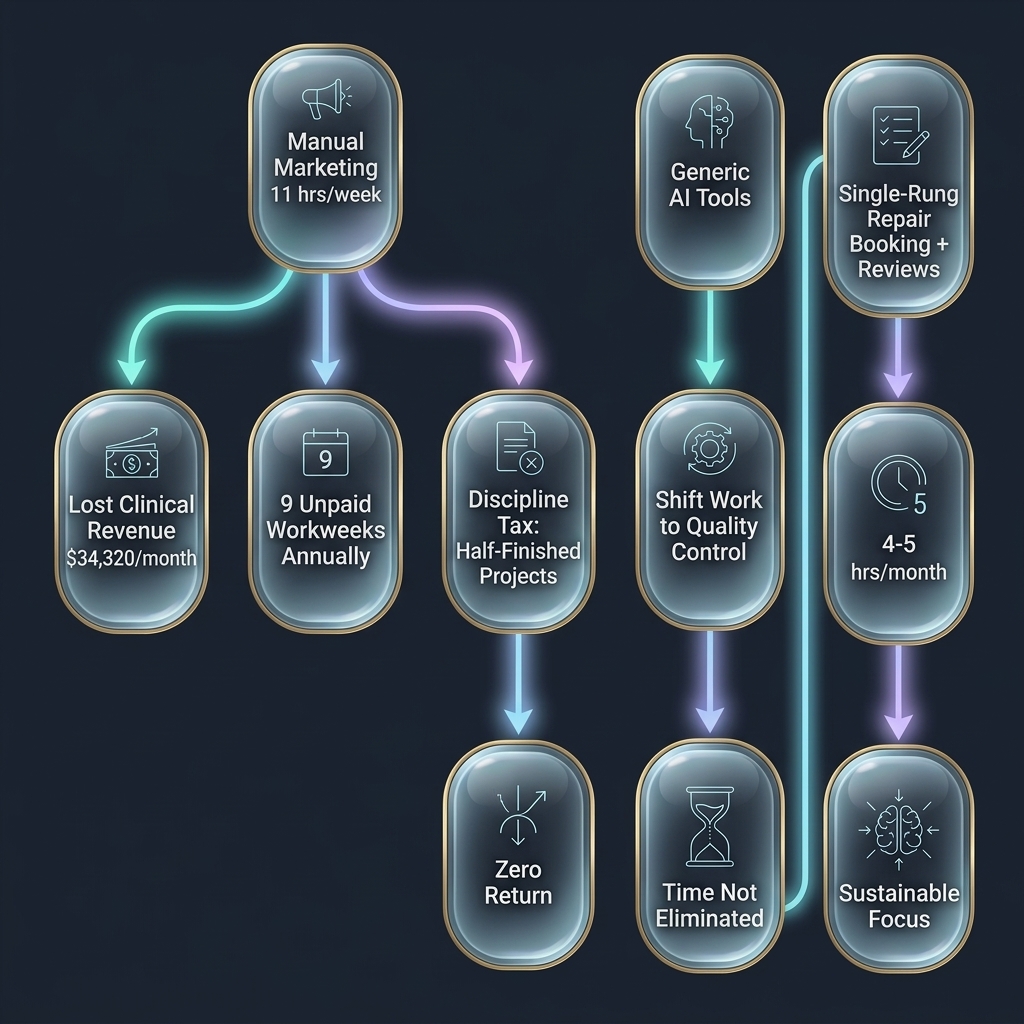
The Execution Wall and the Compliance Trap
The Single-Rung Repair
You can start by fixing one rung manually. Focus on Rung 5: Booking Friction and Review Recency.
Run a friction audit. Pull out your phone. Go to your website. Try to book an appointment as if you were a prospect. Count every tap, every form field, every slow-loading page. If it takes more than four taps to reach a calendar, you have friction.
Then run a manual review push. Send a personalized text to the last 10 patients you adjusted this week. Include a direct, deep-linked Google Review shortcut. Do not ask them to "leave a review if they have time." Ask them to share what changed after their visit.
This protocol works. It will take you 4 to 5 hours per month. The discipline tax is real: you must focus only on this single task and resist the urge to fix every other broken piece of your marketing at once. Half-finished projects deliver zero return.
The Math of Manual Maintenance
Now scale that discipline across the full system.
Drafting and publishing weekly SEO articles: 4 hours. Creating and scheduling social media posts: 3 hours. Building and sending patient newsletters: 2 hours. Managing reviews and local SEO updates: 2 hours.
Total weekly cost: 11 hours of non-clinical work.
If you see 120 patient visits per week at an average of $65 per visit, every hour you spend on marketing costs you $780 in lost clinical revenue. 11 hours per week is $8,580 in opportunity cost. Per month, that is $34,320.
Private practice providers already work an average of 9 unpaid 32-hour workweeks every year due to administrative tasks and documentation. Adding 11 hours per week of marketing work is not sustainable.
The Dangerous Shortcut
Generic AI tools like ChatGPT seem like the obvious solution. They are not.
The Non-Deterministic Output Problem. Generic AI still requires significant time to prompt, edit, format, and publish. You are not eliminating the work. You are shifting it from writing to quality control. And because the output is non-deterministic, you cannot trust it to stay within regulatory boundaries without manual review.
The Regulatory Nightmare. A global clinician survey found that 91.8% of respondents had encountered medical AI hallucinations, and 84.7% believed these errors could directly cause patient harm. When generating medical literature, GPT-3.5 fabricates 55% of bibliographic citations. GPT-4 fabricates 18%.
AI models are 34% more likely to use highly confident language when generating incorrect information than when stating facts. That means your AI-written blog post will confidently assert claims you are not allowed to make under state chiropractic board regulations or FTC advertising guidelines.
The FTC requires disclosure for AI-involved sponsored content, and violations carry penalties up to $53,088 per incident. In September 2024, the FTC's Operation AI Comply targeted five companies for deceptive AI marketing practices, including the generation of fake reviews and misleading claims about AI capabilities. These enforcement actions serve as clear examples that the FTC is actively pursuing deceptive trade practices involving AI-generated content. If AI-written content on your website makes unsupported treatment claims or fabricates expertise, it falls under the same regulatory scrutiny.
71% of healthcare workers use personal AI accounts for work purposes, and 81% of data policy violations in healthcare organizations involve regulated data like protected health information. Inputting patient data into public AI tools for marketing or communication is a direct HIPAA violation.
You bear 100% of the legal and professional liability for AI-generated content published under your name. Generic AI does not solve the execution problem. It creates a compliance problem.
The Ultimate Realization
The Trust Ladder system is the only predictable way to secure a steady stream of new patients. But managing it manually is an unsustainable part-time job. And generic AI tools do not eliminate the work; they just shift the risk.
Elite practices scale this system without sacrificing their time by using platforms that operate this whole loop end-to-end: weekly SEO articles published to the practice website, social posts, patient newsletters, and review-generation workflows, all generated from the practice's own voice and reviewed by the practice before publication. Omniply is one example of that category, built on 16 years of health-marketing expertise and designed to keep the clinician firmly in control of the final output.
The system is right. The question is whether you want to operate it yourself or have it operated for you.
Your clinical time is too valuable to spend acting as a digital marketer.
Frequently Asked Questions
Can ChatGPT Write Patient Emails for a Clinic?
ChatGPT can draft patient emails, but the output requires significant editing to ensure compliance with HIPAA, FTC advertising rules, and state health board regulations. Generic AI tools fabricate citations, use overconfident language when wrong, and will write unsupportable health claims. You bear full legal liability for anything published under your practice name. Without a clinician-reviewed, closed-loop system, using ChatGPT for patient communication creates more risk than it eliminates.
Should a Chiropractor Hire an Agency or Use Software?
Agencies deliver custom strategy but require ongoing management, monthly retainers, and long lead times. Software automates repeatable tasks like content publishing, review requests, and patient follow-ups without the management overhead. The right choice depends on whether you need custom campaign strategy or consistent execution of a proven system. Most practices need the latter.
How to Make Clinic Front Desk More Efficient
Reduce inbound call volume by offering online booking, automated appointment reminders, and self-service rescheduling. Train your front desk to handle only high-value interactions: new-patient intake, insurance verification, and complex scheduling. Automate everything else. Every minute your front desk spends answering "What are your hours?" is a minute they are not converting a high-intent prospect.
Are Online Booking Systems HIPAA Compliant?
Online booking systems can be HIPAA compliant if the vendor signs a Business Associate Agreement and the platform encrypts data in transit and at rest. Not all booking tools meet this standard. Verify compliance before implementation. Using a non-compliant tool exposes your practice to regulatory penalties and patient data breaches.
What is a Good Website Conversion Rate for Clinics?
A well-optimized clinic website converts 3% to 5% of visitors into booked appointments. If your conversion rate is below 2%, you have friction at Rung 4 or Rung 5. Audit your mobile experience, booking flow, and call-to-action clarity. Small improvements at each stage compound into significant gains in monthly new-patient volume.
How Do Patients Choose a Chiropractor?
Patients choose based on proximity, review recency, booking ease, and perceived authority. They evaluate all five rungs of the Trust Ladder in under 60 seconds. If any rung is broken, they move to the next result. Winning the search is not enough. You must win the entire sequence from search visibility to frictionless booking.
How Many New Patients Should a Chiropractor Get?
A healthy three-doctor practice should generate 40 to 60 new patients per month through organic search, referrals, and reactivations. If your new-patient volume is below 30 per month, you have a systemic problem in your Trust Ladder. Identify which rung is leaking and fix it before spending money on paid traffic.