
Look at your active patient roster. Specifically, look at the names of people who haven't booked an appointment in ninety days.
They did not miraculously heal. They simply stopped coming.
Over forty percent of your inactive patients are sitting in a competitor's waiting room right now because you let them forget you.
Your front desk is too busy managing today's schedule to chase yesterday's files. You do not have thirty hours a month to write blog posts.
The standard fix is a monthly email filled with generic wellness tips. These emails go straight to the spam folder. They waste your budget and yield zero bookings.
This article details the exact format that turns cold contacts into active appointments. We will show you the math behind a high-yield broadcast and how the system works.
Your revenue is leaking through the calendar. Here is how to plug it.
Key Takeaways
- Cognitive Drift Cost: Chiropractic practices lose approximately 15% of their patient base annually to memory erosion, not dissatisfaction, costing an 800-patient practice $144,000 in leaked revenue when average patient lifetime value is $1,200.
- Retention Economics: Acquiring new healthcare patients costs $247 to $1,435 per patient, five times more expensive than the $35 to $85 required to retain existing patients, while a 5% retention increase yields 25% to 95% profit growth.
- Email ROI Mechanics: Healthcare email marketing generates 3,600% ROI ($36 per $1 spent) with average open rates between 24% and 28%, but segmented campaigns achieve 100.95% higher click-through rates than generic wellness blasts.
- AI Hallucination Risk: Without human oversight, AI models fabricate medical information at rates up to 64.1% in case summaries and 18% in GPT-4 citations, exposing practices to HIPAA penalties ranging from $145 to $73,011 per violation with annual maximums exceeding $2.1 million.
- Manual Execution Reality: A basic monthly chiropractic newsletter requires two hours of uninterrupted work, while a comprehensive multi-channel system demands 12 hours weekly (48 hours monthly) for SEO articles, email scheduling, social media, and list management.
Why Are My Active Chiropractic Patients Stopping Their Visits?
Active chiropractic patients stop visiting due to Cognitive Drift: the gradual erosion of top-of-mind awareness after their pain resolves. They don't leave dissatisfied or switch to competitors; they simply forget as the memory of their discomfort fades into daily life. This silent attrition causes approximately 15% annual patient churn, costing practices significant revenue without any service failure.
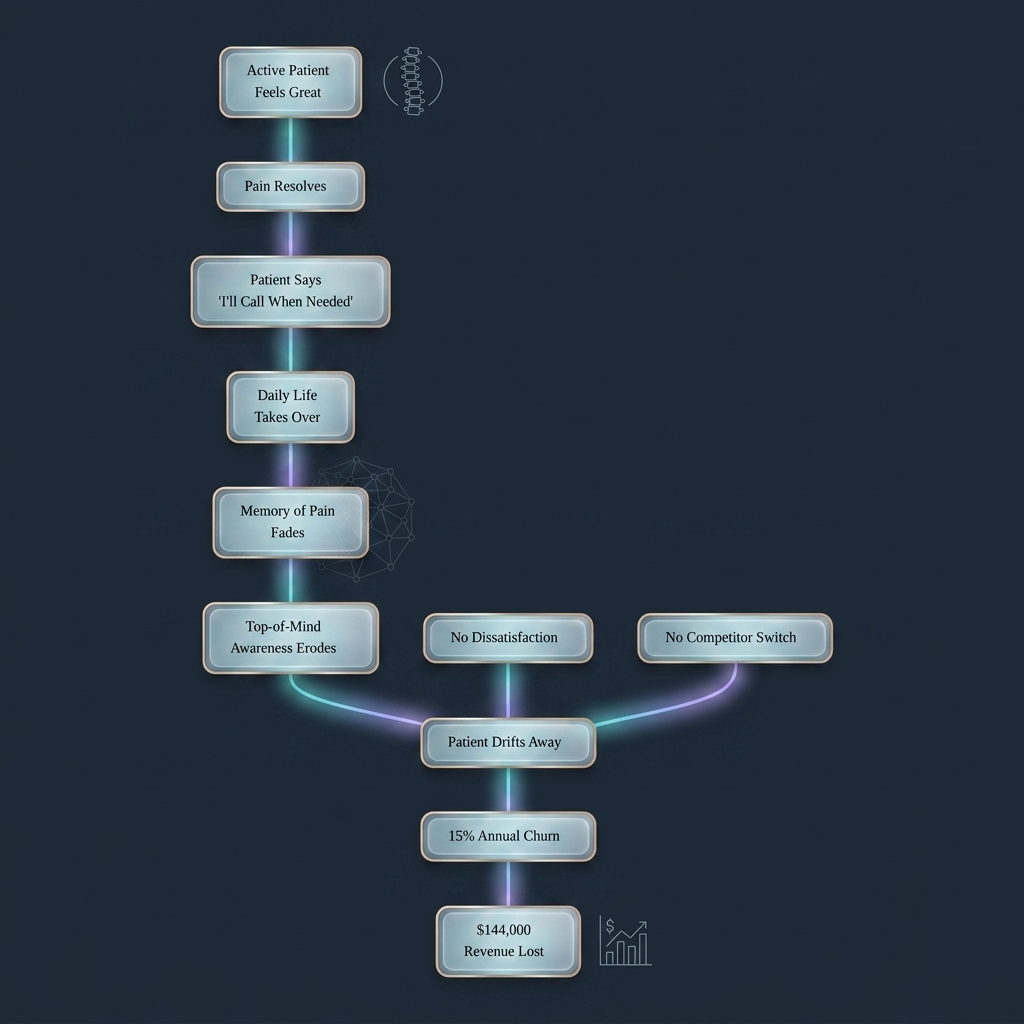
The Silent Leakage in the Modern Practice
The Front-Desk Epiphany
It is 4:30 PM on a Tuesday. You are standing at the front desk, looking at next week's calendar. White space punctuates the schedule. These gaps are not new-patient slots you deliberately left open. They are holes where regular patients used to sit.
Three months ago, these people walked out of your clinic feeling great. They thanked you. They said they would call when they needed another adjustment. They never called.
They did not leave angry. They did not choose a competitor because of price or convenience. They simply drifted into the noise of daily life. The pain you resolved became a memory. The memory faded. The relationship dissolved.
This is not a customer service failure. It is Cognitive Drift: the slow, silent erosion of top-of-mind awareness in your patient base.
The Arithmetic of Cognitive Drift
Let's make the invisible cost visible with real practice numbers.
You have 800 active patients in your database. The average five-year retention rate in physical therapy and chiropractic clinics sits around 43%, meaning practices lose more than half of their acquired patients over that span. Annualized, that translates to roughly 15% churn, not from dissatisfaction, but from memory.
Run the math:
800 patients × 15% annual churn = 120 patients lost to drift each year.
Your average patient lifetime value, calculated across visits, maintenance care, and occasional product purchases, is $1,200.
120 patients × $1,200 = $144,000 in leaked revenue annually.
Now compare that to what you spend acquiring new patients. Patient acquisition costs healthcare practices between $247 and $1,435 per new patient, depending on market and channel. Retaining an existing patient costs only $35 to $85.
You are spending thousands on Facebook ads and local SEO to replace the warm, trusting patients who already know your work. The math does not close. The practice becomes a leaky bucket where every new patient you pour in the top drains out the bottom before you capture their full value.
The root cause is a Patient Communication Deficit: a lack of structured touchpoints that keeps the relationship alive between visits.
Why the Obvious Fixes Fail
Most practices try to solve this with email. Most of those emails fail immediately.
The first trap is the pre-packaged template. You buy a subscription to a wellness newsletter service. It sends monthly emails about "Spinal Health Facts" or "Five Stretches for Lower Back Pain." The content reads like a high school biology textbook. It is generic, impersonal, and visually cluttered with stock photos of people doing yoga on beaches.
The average unsubscribe rate for healthcare emails is between 0.15% and 0.30%. If your rate exceeds that, you are causing patient fatigue. These template blasts routinely hit 1% or higher.
The second trap is the promotional blast. You send emails only when you need to fill slots. "10% off orthotics this week!" or "Book your adjustment before Friday!" These emails train patients to view your clinical expertise as a commodity rather than essential healthcare. You erode the authority that brought them to your practice in the first place.
The third trap is inconsistency. You send three emails in a burst of energy, then four months of radio silence. Inconsistent communication signals organizational disorganization. It quietly damages trust. The patient assumes you are either overwhelmed or indifferent.
All three approaches fail for the same reason: they treat email marketing for chiropractors as a broadcast tool rather than a relationship engine.
What is the Value-first Patient Flywheel?
The value-first patient flywheel is a self-reinforcing system where four interconnected pillars, consistent content presence, fast response infrastructure, review momentum, and steady patient communication, accelerate each other's effectiveness. By delivering life-adjacent education rather than promotional content, chiropractors build trust equity that converts into appointments, referrals, and loyalty, with each component amplifying the others' impact.
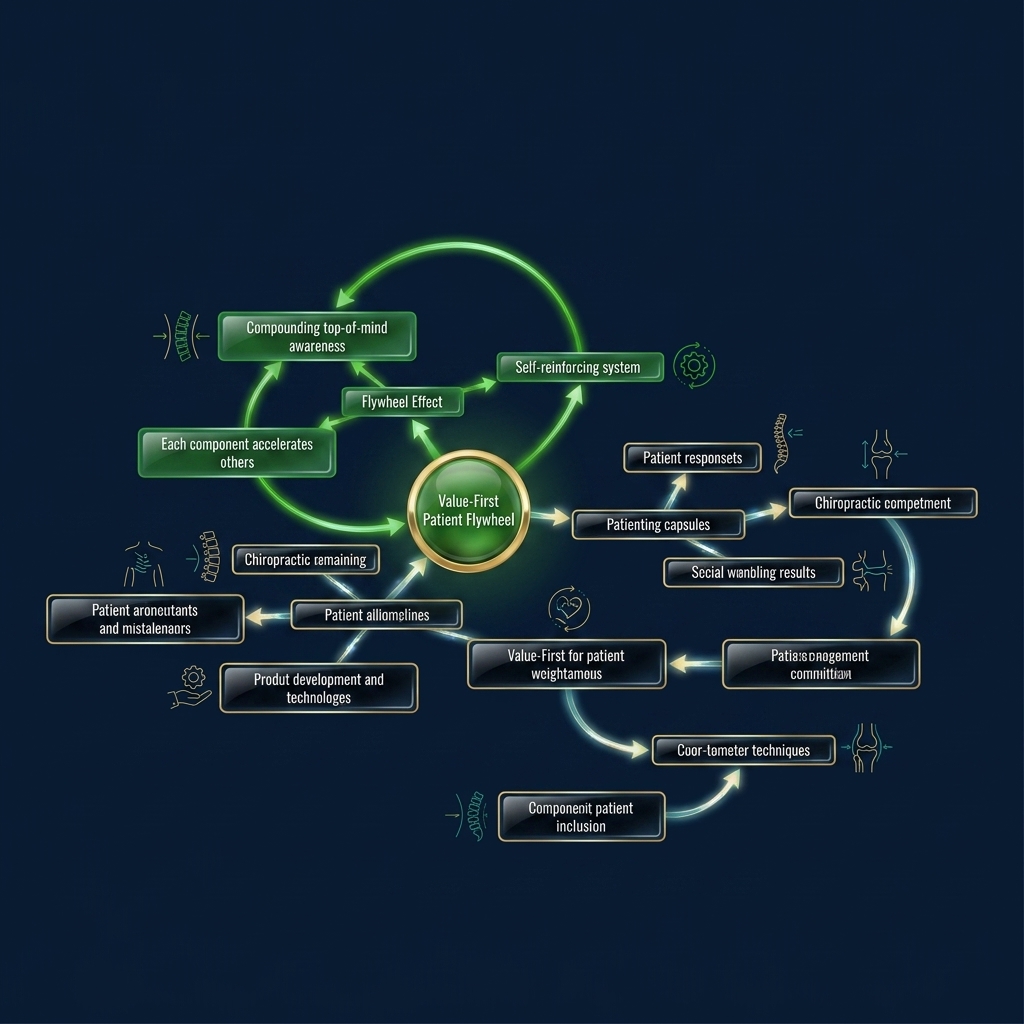
The Value-First Patient Flywheel
The Paradigm Shift
Patients do not want to read about chiropractic philosophy in their inbox. They do not care about subluxation theory or spinal biomechanics.
They want to read about their own lives. Their own pain. Their own daily physical performance.
The shift is from "promotional broadcast" to Life-Adjacent Education. Your email should read like a premium wellness publication, not a clinic advertisement. The goal is not to sell. The goal is to provide genuinely useful health intelligence that positions you as the ultimate local authority on physical well-being.
This builds Trust Equity, a psychological debt of gratitude. When a patient receives consistent value from you, they feel an obligation to reciprocate. That reciprocation takes the form of appointments, referrals, and long-term loyalty.
The Unified System of Modern Patient Communication
Email is one pillar in a four-part system. The pillars are:
1. Consistent Content Presence: High-quality, original clinical insights published weekly to your website, establishing organic search authority and giving you material to distribute.
2. Fast Response Infrastructure: Instantly capturing patient intent the moment they decide to re-engage—whether that is a phone call, a web form, or a direct reply to your email.
3. Review Momentum: Leveraging positive patient experiences to build a public fortress of social proof that converts cold prospects into booked appointments.
4. Steady Patient Communication: The quiet, reliable heartbeat of the practice that keeps the relationship alive between adjustments.
The pillars interlock. A great email fails without a fast-response mechanism to capture the patient who decides to book. SEO articles fail without an email distribution channel to drive immediate traffic. Reviews fail without content that demonstrates your expertise.
The system generates a Flywheel Effect. Each component accelerates the others.
The Compounding Math of Top-of-Mind Awareness
Here is how the flywheel turns in practice.
A former patient receives your weekly email. The subject line is: "The 20-20-20 Screen Rule for Neck Strain." She opens it. The email is short, plain-text, and written in first person. It explains a simple ergonomic habit: every 20 minutes, look at something 20 feet away for 20 seconds.
She implements it. Her neck feels better. Two weeks later, she receives another email: "Why Your Office Chair Is Lying to You About Lumbar Support." Again, immediately useful. Again, she applies it.
Three weeks after that, she wakes up with the familiar stiffness in her upper back. She immediately thinks of you. The cognitive barrier to booking is gone. She does not need to Google "chiropractor near me" or compare prices. She replies to your email or clicks the booking link you include in every message.
This is the Recall Trigger: the moment a life-adjacent tip causes a realization that clinical care is needed again.
The math compounds. Email marketing generates an average ROI of 3,600%, translating to $36 for every $1 spent. But that figure measures direct conversions. It does not capture the indirect value: the referrals, the extended lifetime value, the reduced acquisition cost for future patients.
Research from Bain & Company shows that increasing customer retention by just 5% can yield an increase in profits, not revenue, of 25% to 95%. Your email is not a marketing expense. It is a compounding asset.
How Do I Manually Run My Own Email Newsletter?
To manually run an email newsletter, write a plain-text, 300-word email monthly containing a practical tip, a personal practice update, and a soft call-to-action. This requires two hours of uninterrupted work per month with absolute consistency. Expanding to weekly content across multiple channels demands approximately 12 hours weekly, totaling 48 hours monthly.
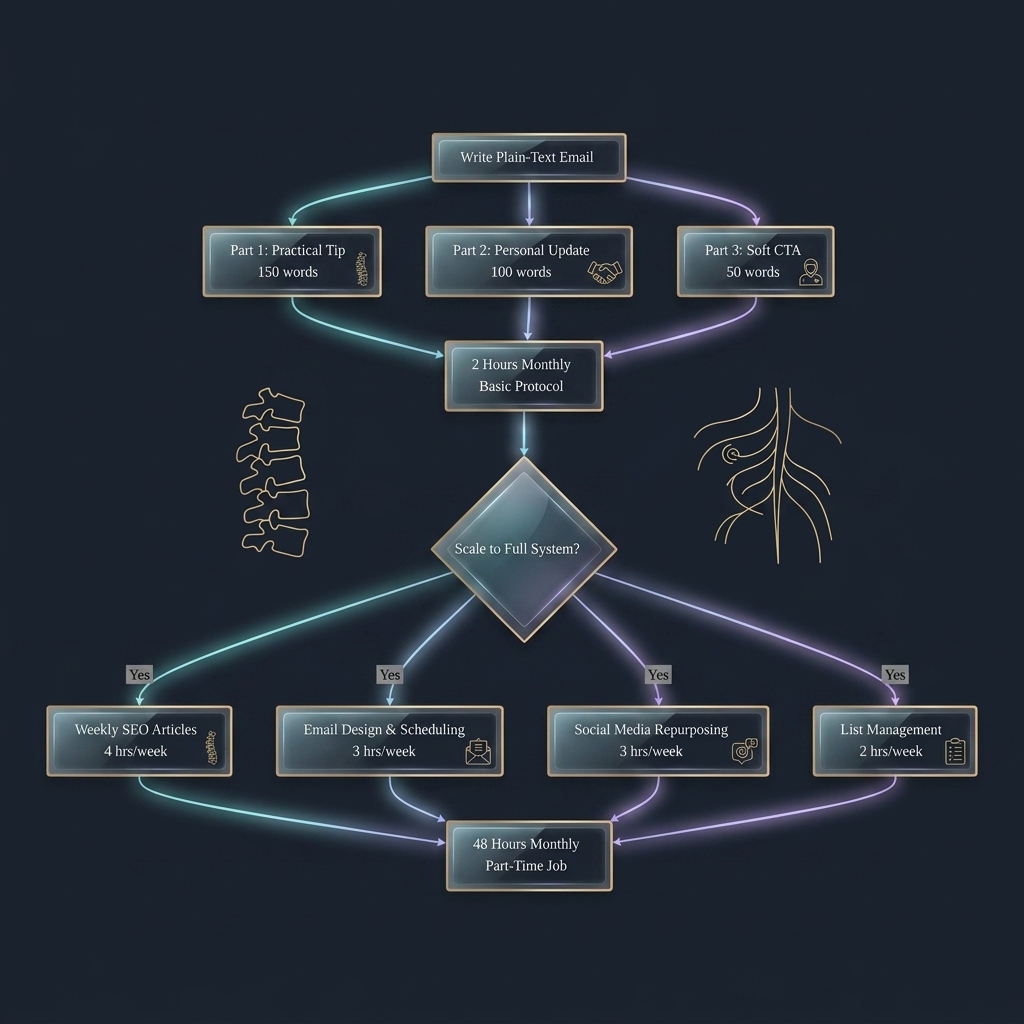
The Reality of Manual Execution
The Monday Morning Protocol
Let's assume you want to run this system yourself. Here is a genuinely effective starting point.
Abandon complex HTML layouts, stock photography, and heavy branding. Write a plain-text email that looks like it came directly from you. The format is 300 words, split into three parts:
Part 1 (150 words): One highly practical, immediately applicable lifestyle tip. Example: "The 20-20-20 Screen Rule for Neck Strain." Explain the mechanism. Tell them exactly what to do.
Part 2 (100 words): A personal, humanizing practice update. A new team member. Holiday hours. A local community event your clinic is supporting. This section signals that a human wrote the email.
Part 3 (50 words): A soft, non-salesy invitation to reply or schedule an adjustment if they need care. Example: "If you are dealing with stiffness that is not resolving on its own, hit reply or call the front desk. We will get you in this week."
The honest price tag: two hours of uninterrupted writing, editing, list management, and sending every single month.
The unforgiving bar: absolute consistency. If you miss a single month, the habit loop breaks. The cognitive drift begins again.
The Execution Wall
The Monday Morning Protocol is a starting point. It is not the full system.
Moving from a basic monthly note to a comprehensive, multi-channel patient communication system demands significantly more. Here is the real-world time ledger:
Researching and writing weekly, SEO-optimized clinical articles: 4 hours per week.
Designing, formatting, and scheduling weekly patient emails: 3 hours per week.
Repurposing long-form content into engaging social media touchpoints: 3 hours per week.
Managing list hygiene, bounces, and patient replies: 2 hours per week.
Total: 12 hours per week. 48 hours per month. That is a part-time job.
The skill gap is equally daunting. You need the rare intersection of clinical accuracy, persuasive copywriting, technical email deliverability, and graphic design to make the system look professional. Small business owners spend an average of 6.3 hours per week strictly on social media management, often pulling them away from core revenue-generating activities.
You opened a chiropractic practice to treat patients. You did not open a content studio.
The Dangerous AI Shortcut
The obvious solution is to hand the writing to ChatGPT or another generative AI tool. The output is fast, cheap, and grammatically correct.
It is also bland, robotic, and highly predictable. Patients recognize it immediately. They ignore it. The Homogenization Trap is real: when every practice uses the same AI tool, every email sounds identical.
Worse, managing an AI content workflow still requires hours of your personal time. You prompt the tool. You fact-check the output. You rewrite the sections that sound generic. You format the email. You schedule the send. The time sink remains.
The legal liability is the real danger.
Without active mitigation and human oversight, AI models hallucinate on medical case summaries at a rate of up to 64.1%. In literature reviews, GPT-3.5 fabricated 55% of bibliographic citations. GPT-4 reduced this to 18%, but that is still clinically unacceptable for health and wellness publishing without direct verification.
Generic AI tools routinely invent medical claims, guarantee outcomes, or cite unscientific data. They do not know what you are legally allowed to say. They do not understand the Health Insurance Portability and Accountability Act. They do not care about state chiropractic board regulations.
Under United States federal law, 2025 civil penalties for HIPAA violations range from a minimum of $145 to a maximum of $73,011 per individual violation, with annual maximums exceeding $2.1 million per violation category. In 2025, there were 170 email-related HIPAA breaches in the United States, impacting over 2.5 million people.
You remain 100% liable for every word published, regardless of who, or what, wrote it.
The Ultimate Choice
The value-first communication system is undeniably the correct engine for chiropractic practice growth. The math proves it. The retention data proves it. The ROI proves it.
Operating it yourself is a second full-time job.
The most successful clinics do not write their own copy or manage their own software. They partner with platforms that operate this whole loop end-to-end, weekly SEO articles, patient emails, social posts, and fast-response infrastructure, all generated from the practice's own voice and reviewed by the practice before it goes live, like Omniply does for chiropractic clinics.
The final equation is simple: your time is best spent at the table, delivering world-class care to patients who are actually in the room.
The schedule belongs to the clinician. The engine belongs to the operator.
Frequently Asked Questions
Can ChatGPT Write Emails for My Chiropractic Clinic?
ChatGPT can generate grammatically correct emails, but the output is generic, easily recognizable as AI-written, and carries significant legal risk. Without active oversight, AI models hallucinate on medical case summaries at rates up to 64.1%. They routinely invent medical claims, fabricate citations, and produce content that violates health-advertising regulations. You remain fully liable for every word published, regardless of who wrote it.
How Much Time Does Email Marketing Take?
A basic monthly email takes approximately two hours to write, edit, format, and send. A comprehensive system, weekly emails, SEO articles, social media repurposing, and list management, demands roughly 12 hours per week, or 48 hours per month. That is a part-time job on top of running your practice.
What is a Good Email Open Rate for Healthcare?
The average email open rate across the healthcare industry is between 24% and 28%. If your open rate falls below 20%, your subject lines or sender reputation need immediate attention. If your unsubscribe rate exceeds 0.30%, you are causing patient fatigue with overly promotional or irrelevant content.
Is Email Marketing HIPAA Compliant?
Standard email platforms are not HIPAA compliant by default. If your emails contain any Protected Health Information (PHI), such as appointment reminders with patient names or treatment details, you must use a HIPAA-compliant email service that includes a Business Associate Agreement (BAA). General wellness tips sent to your entire list do not require PHI protections, but any personalized communication does.
Do Email Newsletters Actually Bring in Patients?
Yes, when executed correctly. Email marketing generates an average ROI of 3,600%, or $36 for every $1 spent. Segmented healthcare email campaigns experience a 100.95% higher click-through rate than generic blasts. The mechanism is simple: consistent, value-first communication keeps you top-of-mind, so when a former patient experiences pain again, they think of you first rather than searching for a new provider.
Why Do Patients Unsubscribe From Email Lists?
Patients unsubscribe when emails are too frequent, overly promotional, or irrelevant to their lives. The average unsubscribe rate for healthcare emails is between 0.15% and 0.30%. If your rate exceeds that, you are likely sending generic wellness content that reads like a textbook, or promotional blasts that train patients to view your expertise as a commodity. The fix is to send life-adjacent education: practical tips they can apply immediately.
Should I Hire an Agency for Email Marketing?
Traditional marketing agencies require significant monthly retainers and still demand hours of your time for strategy calls, content approvals, and revisions. They rarely understand the clinical nuances of chiropractic care or the regulatory constraints of health-advertising law. A better approach is a specialized platform that operates the entire system, content creation, email scheduling, social media, and fast-response infrastructure, while capturing your unique clinical voice and ensuring compliance before anything publishes.