
Ninety-seven percent of the local traffic hitting your clinic's website leaves without booking. They have physical pain, but they lack consumer trust. Most agencies tell you to fix this with complex, multi-step marketing funnels. They are wrong.
Your front desk does not have time to chase cold internet leads. They are already busy managing the phones and greeting patients. Forcing them to follow up with unvetted web inquiries is a recipe for staff burnout.
Successful lead generation for healthcare practices does not require daily blogging. It requires one asset. This is a single-page resource that solves an immediate, high-value problem.
This article breaks down the exact three-part blueprint for creating clinical guides that prospects actually download. We will detail the High-Urgency Hook, the One-Page Protocol, and the Zero-Friction Follow-up. Then we will address the operational reality: why building this system by hand consumes more time than most practices can afford, and what the alternatives look like.
These assets respect your team's time. They turn silent website visitors into scheduled new patients. Here is how to build them for your practice.
Key Takeaways
- Revenue Leak Quantified: Generic lead magnets converting at 0.1% leave $151,200 annually on the table for practices with 1,200 monthly visitors, while problem-specific guides converting at 4% generate seven new patients monthly at $1,800 lifetime value each.
- Speed-to-Lead Imperative: Harvard Business Review and MIT research confirms responding within 5 minutes makes practices 100 times more likely to contact leads and 21 times more likely to qualify them, with conversion odds dropping 80% after the first 5 minutes.
- HIPAA Penalty Exposure: Unencrypted website forms capturing patient data trigger civil monetary penalties ranging from $145 to $73,011 per violation under federal regulations, with statutory annual maximum caps reaching $2,190,294 for a single violation tier.
- AI Hallucination Risk: Over 90% of clinicians in a 2026 survey encountered medical hallucinations from AI tools, with unmitigated models fabricating information up to 64.1% of the time on medical case summaries, creating FTC substantiation compliance liability.
- Execution Time Reality: Building one high-converting lead magnet requires 4 hours of focused work, while a full Patient Acquisition Corridor with 5–7 guides, landing pages, and automated email sequences demands 30–40 hours upfront plus 8–12 hours weekly maintenance.
Why is My Website Lead Magnet Not Getting Downloads?
Lead magnets fail to generate downloads due to an information-intent mismatch, where generic content doesn't address the visitor's immediate pain point or search intent. When prospects seeking urgent symptom relief encounter broad educational PDFs instead of specific, actionable solutions, they disengage. Generic PLR content further commoditizes the offering, making practices indistinguishable and resulting in conversion rates near 0.1%.
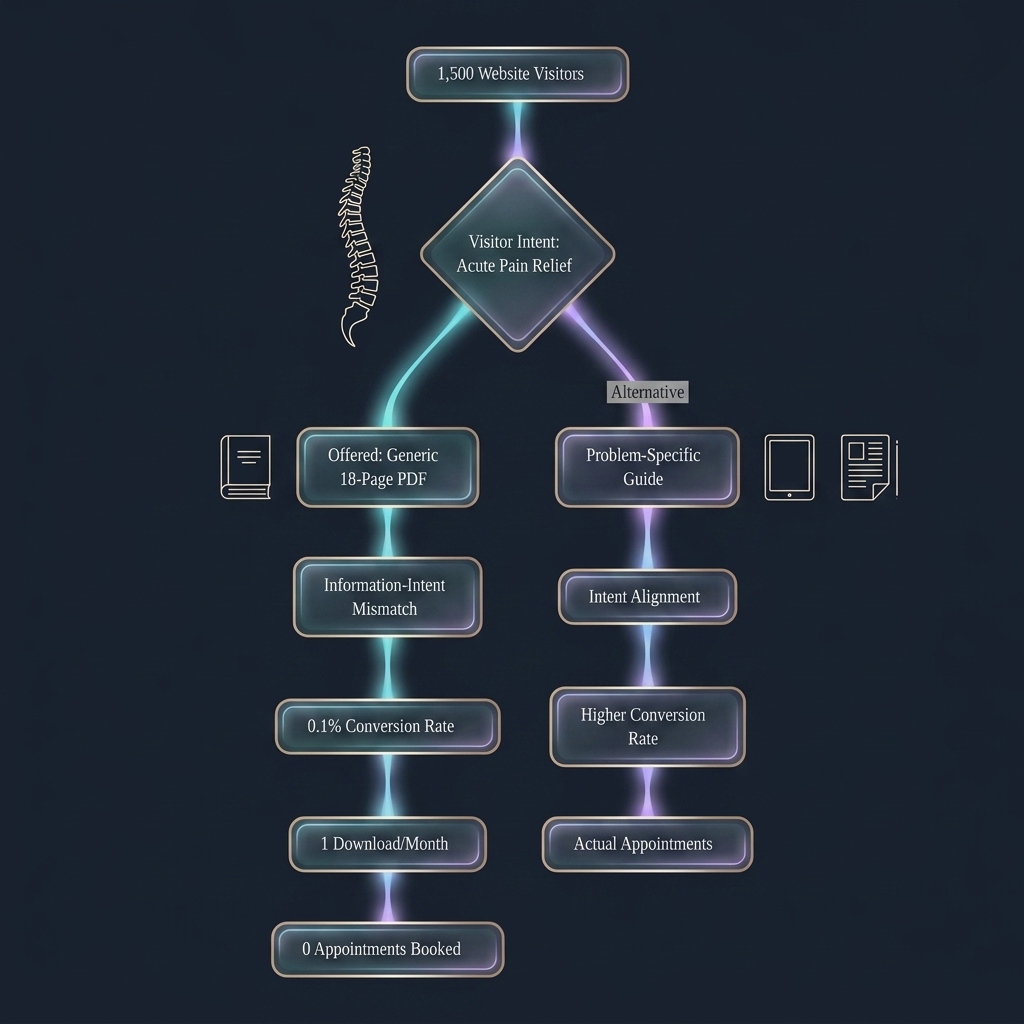
The Problem: the Invisible Leak of the "Dead PDF"
The 7:00 PM Dashboard Realization
You are sitting at the clinic desk after the last adjustment. The schedule shows 1,500 unique visitors to your website this month. The calendar shows empty slots for the next two weeks.
Somewhere on your homepage sits a PDF titled "Ultimate Guide to Spinal Health." Maybe it is 18 pages. Maybe it has a stock photo of a smiling patient on the cover. Maybe it cost you $300 on Upwork.
No one has downloaded it in 11 days.
The asset exists. The traffic exists. The connection does not. This is the diagnostic moment when clinical expertise fails to translate into digital hand-raisers.
The Mechanism of the "Information-Intent Mismatch"
A patient searches "lower back pain relief near me" at 9:00 PM on a Tuesday. They are in acute discomfort. They want immediate answers to immediate questions: Can I sleep on my side? Should I use ice or heat? Can I sit at work tomorrow?
Your website offers them a 20-page textbook on subluxation theory.
This is the Information-Intent Mismatch. The searcher has zero bandwidth for academic interest. They desperately seek symptom relief they can execute tonight. Your content speaks to a different person in a different moment.
The gap widens when you source that content from generic healthcare templates. Private Label Rights (PLR) content sanitizes your clinical voice into a commodity. Every wellness clinic in your zip code is offering the same repackaged paragraphs. The patient cannot tell you apart, so they choose based on price or proximity alone.
The Mathematics of Wasted Traffic
Let's work the numbers on a real practice.
You get 1,200 website visitors per month. Your generic brochure PDF converts at 0.1%. That is 1.2 downloads per month. Round it to one.
Of that one download, zero book an appointment. Zero dollars in new revenue.
Now run the same traffic through a high-performing, problem-specific guide. Industry data shows the top 25% of healthcare landing pages convert at 20.4% when they execute clear calls to action and highly relevant copy. Even at a conservative 4% conversion rate, well below the top quartile, that same 1,200 visitors yield 48 downloads.
Apply a 15% booking-to-visit rate. That is seven new patients.
The average lifetime value of a patient in a typical practice exceeds $1,000, representing 10 or more visits. Use a conservative $1,800 LTV to account for higher-value wellness plans.
Seven patients at $1,800 each: $12,600 in unrealized revenue. Every single month. That is the invisible leak.
Multiply by 12 months. You are leaving $151,200 on the table annually because your lead magnet does not match the searcher's intent.
Why the Obvious Fixes Fail
The first instinct is to make the PDF look better. You hire a designer on Fiverr to add graphics and brand colors. The conversion rate does not move. Visual polish cannot fix a psychological mismatch.
The second instinct is to offer a discount. "New Patient Special: $49 First Visit." This attracts bargain-hunters who drop out after two adjustments. They were never looking for ongoing care. They were looking for cheap relief. Your patient acquisition cost stays high while your average revenue per patient drops.
The third instinct is to buy PLR content in bulk. You upload 15 generic wellness guides to your site. Google's algorithm classifies health and medical information as "Your Money or Your Life" (YMYL) topics. The September 2025 update to Google's Search Quality Evaluator Guidelines makes clear: YMYL content requires the highest standard of Experience, Expertise, Authoritativeness, and Trustworthiness. Duplicate medical content from PLR libraries fails every test. Your local search rankings drop while your lead generation stays flat.
The fixes fail because they address symptoms, not structure.
What is the Patient Acquisition Corridor?
The Patient Acquisition Corridor is a structured, multi-channel communication system that transforms lead magnets from simple entry points into a complete conversion pathway. It functions through three sequential steps: the initial guide download, a strategic follow-up sequence, and booking conversion, creating a cohesive system that moves prospects from initial contact to scheduled appointments.
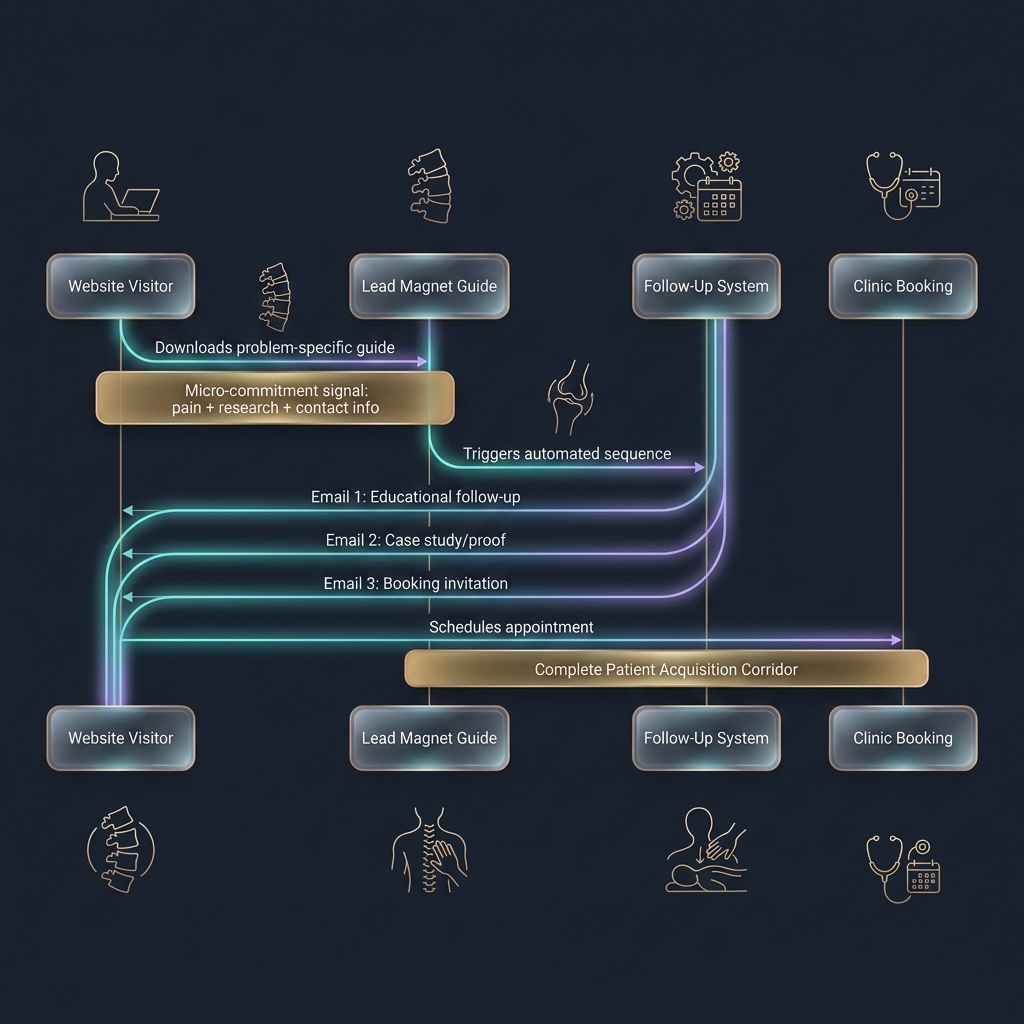
The Solution: the Patient Acquisition Corridor
Shifting the Belief: the Lead Magnet is Only the Door
A lead magnet is not a destination. It is the entry point of a structured, multi-channel communication system. Call this the Patient Acquisition Corridor.
The psychology works through micro-commitment. Solving a hyper-specific, immediate problem, "How to sit at a desk without lower back spasms", builds the initial bridge of clinical trust. The download is a signal: this person has pain, they are researching solutions, and they are willing to exchange contact information for help.
That signal only has value if you have a system to act on it. The guide itself is step one. The follow-up sequence is step two. The booking conversion is step three. The entire corridor must function or the door is just a door.
This is where the E-E-A-T framework moves from theory to mechanism. You demonstrate Experience by addressing the exact friction points your patients describe in the exam room. You demonstrate Expertise by offering protocols that work. You demonstrate Authoritativeness by publishing under your clinic's name and credentials. You demonstrate Trustworthiness by meeting patients exactly where their pain lives, not where your marketing budget wants them to be.
The Flywheel: the Interconnected System
Four pillars make the corridor function.
Pillar 1: Consistent Local Search Presence. Highly targeted, problem-focused content attracts high-intent local searchers. A 2025 study found that 80.81% of office workers experience work-related musculoskeletal disorders, primarily affecting the neck, lower back, and shoulders. If you publish a guide titled "The Desk Worker's 5-Minute Neck Reset," you are targeting an audience where 8 out of 10 people are actively experiencing the exact pain you treat. That content ranks. That ranking drives traffic. That traffic feeds the corridor.
Pillar 2: Rapid Response and Lead Capture. Research from Harvard Business Review and MIT's InsideSales study shows that responding to a new lead within 5 minutes makes you 100 times more likely to make contact and 21 times more likely to qualify the lead compared to waiting 30 minutes. After the first 5 minutes, conversion odds drop by 80%. The corridor requires instant delivery of the guide and instant notification to your team. A lead left unaddressed for an hour is a lead lost to the competitor who answered in three minutes.
Pillar 3: The Review Momentum Engine. Active patient communication naturally feeds back into online reviews. A patient who receives helpful follow-up emails after downloading your guide is more likely to leave a Google review after their first visit. Those reviews boost your local map pack rankings. Higher rankings drive more traffic to the lead magnet. The loop compounds.
Pillar 4: Continuous Patient Communication. Not every download books today. Some prospects are researching six weeks before they are ready to commit. A structured email sequence keeps your practice top-of-mind. When their neck locks up next Tuesday, you are the name they remember. This is how you convert cold traffic into warm leads over time.
The flywheel only spins when all four pillars operate simultaneously.
Part 1: the High-Urgency Hook
The hook is not a headline. It is the entire premise of the guide. The question it answers must be urgent, specific, and immediately actionable.
"How to Improve Your Posture" is not urgent. "How to Stop Neck Pain from Desk Work in 5 Minutes" is urgent. The first is aspirational. The second solves a problem the reader is experiencing right now.
The High-Urgency Hook targets a pain point that interrupts daily life. Morning stiffness that makes getting out of bed difficult. Neck tension that triggers headaches by 2:00 PM. Lower back spasms that flare up after 30 minutes of sitting.
These are not theoretical wellness goals. These are friction points your patients describe in the exam room every single day. When you convert those exact complaints into guide titles, you match searcher intent at the highest level.
The hook must promise a solution the reader can execute immediately. No equipment. No appointments. No waiting. "Three stretches you can do at your desk right now" beats "A comprehensive approach to spinal wellness."
Specificity creates urgency. Urgency drives downloads.
Part 2: the One-Page Protocol
Length kills conversion. A 20-page guide signals commitment the reader is not ready to make. A one-page protocol signals immediate relief.
The One-Page Protocol is a structured, step-by-step solution to the exact problem named in the hook. Three to five steps. Each step takes less than 60 seconds to execute. The entire protocol fits on a single page.
Example: "The Desk Worker's 5-Minute Neck Reset."
Step 1: Adjust your monitor height so the top of the screen sits at eye level. This reduces forward head posture.
Step 2: Set a timer for every 45 minutes. Stand up and roll your shoulders back 10 times.
Step 3: Place your hand on your forehead and gently press forward while resisting with your neck. Hold for 10 seconds. Repeat three times.
Step 4: Tilt your head to the right, bringing your ear toward your shoulder. Hold for 15 seconds. Repeat on the left.
Step 5: If pain persists after three days, book an assessment to address the root cause.
The protocol is simple. The language is plain. The reader can execute it in five minutes without leaving their desk. This is the architecture of high-converting lead magnets.
The final step is always a bridge to booking. "If this helps, schedule a full evaluation." The guide solves the immediate problem. The appointment solves the underlying cause.
Part 3: the Zero-Friction Follow-up
The download is not the conversion. The appointment is the conversion. The gap between the two is where most practices lose the lead.
The Zero-Friction Follow-up is an automated email sequence that moves the prospect from "interested" to "scheduled" without requiring manual effort from your team.
Email 1 arrives instantly. It delivers the guide and confirms the download. "Here's your Neck Reset Protocol. Try it today and let us know how it works."
Email 2 arrives two days later. It adds value without asking for anything. "Most desk workers also struggle with lower back tension. Here's a 60-second seated stretch that helps."
Email 3 arrives five days later. It shares a patient story. "Sarah, a software developer, used this protocol for a week. Her headaches dropped by 80%. We addressed the root cause in three visits."
Email 4 arrives ten days later. It reframes the problem. "If you're still experiencing neck pain after trying the protocol, the issue is likely structural. Here's what that means and how we fix it."
Email 5 arrives fourteen days later. It makes the ask. "Ready to address the root cause? Book a full assessment. We have openings this week."
The sequence is automated. The timing is strategic. The tone is helpful, not pushy. This is how you convert cold downloads into warm leads without burning out your front desk.
The follow-up must be instant and consistent. Leads contacted within five minutes convert 100 times better than leads contacted after 30 minutes. Manual follow-up breaks under clinical workload. Automation is not optional.
Designing Guides for Daily Friction Points
Specificity wins. Broad topics, "The Complete Guide to Wellness", convert at baseline rates. Narrow, practical topics outperform them by 400%.
The Desk Worker's Survival Guide targets the sedentary professional experiencing daily cervicogenic headaches. The guide walks through chair height, monitor placement, and a 90-second stretch sequence they can do at their desk. It solves a problem they experience five days a week.
The Morning Stiffness Protocol addresses the 50+ demographic who struggle to get out of bed without lower back pain. The guide covers sleep surface, pillow positioning, and a three-step morning routine. It meets them in the exact moment of discomfort.
The Sleep Position Blueprint solves the highly relatable problem of waking up in pain. Side sleeper versus back sleeper. Pillow thickness. Mattress firmness. These are questions patients ask in the exam room. Answering them in a downloadable guide builds trust before the first appointment.
Each guide is one to two pages. Each solves one problem. Each includes a clear next step: "If this protocol helps, book a full assessment to address the root cause."
This is the architecture of high-converting lead magnets for practices.
What is the Execution Wall in Business?
The execution wall in business refers to the breakdown point where manual systems and simple processes fail to scale. It occurs when initial low-cost implementations require expanding into complex technical infrastructure, automated workflows, and compliance requirements that demand significant resources, expertise, and ongoing maintenance beyond a business's operational capacity.
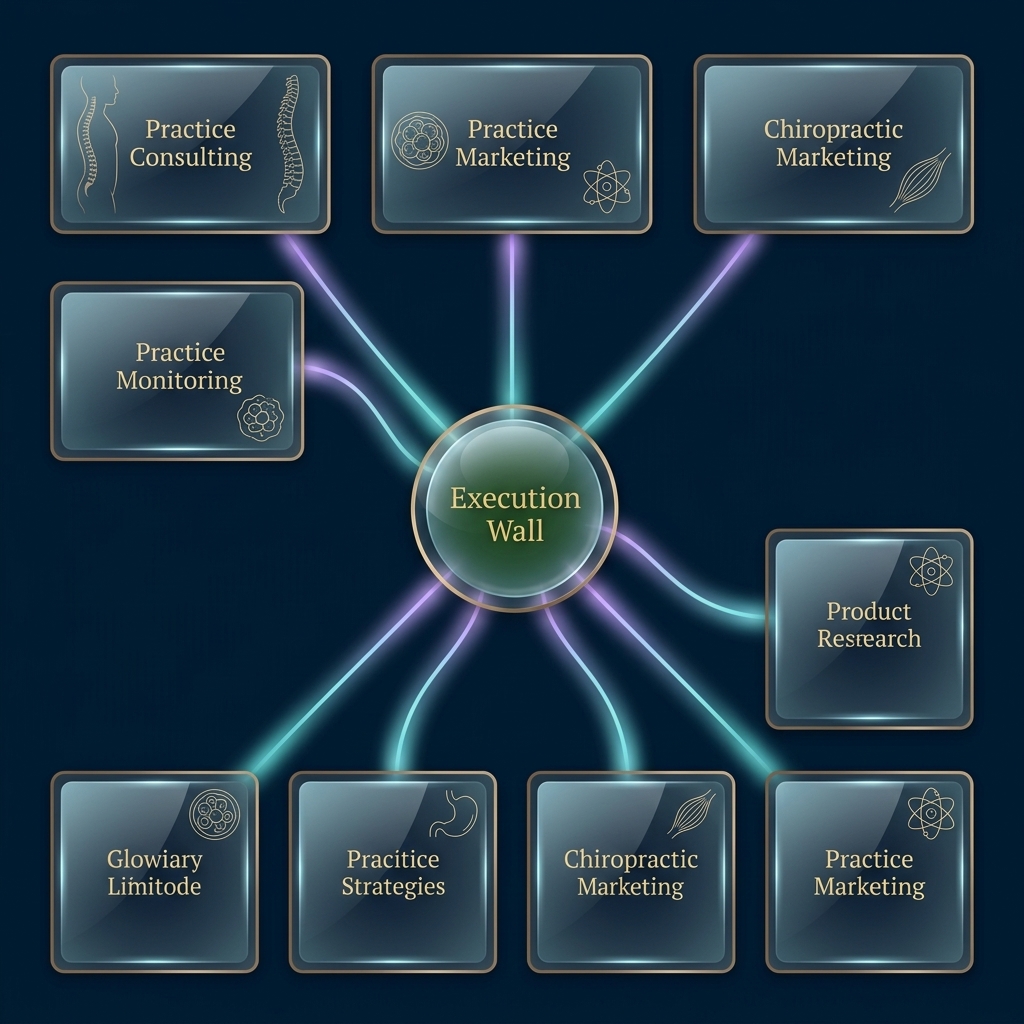
The New Problem: the Execution Wall
The Monday Morning Protocol: the Front-Desk FAQ One-Pager
You can build the simplest version of this system by hand. Start with a single-question PDF.
Ask your front desk coordinator for the number one question patients ask while checking in. "Should I use ice or heat for my back pain?" is a common one. Write a simple, one-page, authoritative answer. Save it as a PDF. Upload it to your website media library. Create a basic form on your homepage: "Get the Ice vs. Heat Answer Sheet."
Check your email daily for submissions. Manually email the PDF to each contact. Add a line: "If this helps, reply to schedule a full assessment."
The honest price tag: four hours of focused writing, formatting, and web setup. Then 15 minutes every morning checking, copying, pasting, and sending manual emails.
The system breaks the first day you have a packed clinical schedule. It breaks the day your front-desk manager calls in sick. Discipline cost is the hidden expense of manual systems.
Widening to the Full System: the Infrastructure Wall
One PDF is not a system. To dominate a local market, you need a library of targeted guides addressing different pain profiles. Lower back pain. Neck stiffness. Sciatica. Headaches. Each guide needs its own landing page, its own form, its own follow-up sequence.
The technical stack expands fast. You need landing page software that integrates with your CRM. You need automated email delivery sequences that trigger instantly. You need to write five-part email nurture sequences for every single guide to transition readers into scheduled appointments. You need to maintain SSL certificates, domain health, and compliance on lead capture forms.
Under federal HIPAA regulations in the United States, a single unintentional violation regarding protected health information, such as capturing patient data on an unencrypted website form, can result in civil monetary penalties ranging from $145 to $73,011 per violation, with a statutory annual maximum cap of $2,190,294 for a single violation tier. The financial risk of non-compliant DIY forms is not theoretical.
The true weekly overhead: 8 to 12 hours of ongoing technical maintenance, copywriting, and analytics monitoring. This is a part-time job you must run while simultaneously adjusting 40 patients a day.
The execution wall is not about capability. It is about bandwidth.
The AI Shortcut Illusion and the Regulatory Minefield
The temptation is obvious. Use ChatGPT to write all your guides and email sequences in an afternoon. Paste in a prompt. Copy the output. Upload to your site.
In a 2026 survey of clinicians, over 90% reported encountering medical hallucinations, fabricated citations, incorrect dosages, or invented symptoms, from AI tools. Unmitigated AI models have been shown to hallucinate up to 64.1% of the time on medical case summaries. The output is non-deterministic. You cannot predict when the model will invent a contraindication or recommend a protocol outside your scope of practice.
The Federal Trade Commission requires all objective claims about health benefits to be supported by "competent and reliable scientific evidence" before an ad is disseminated. Failing to adequately substantiate a health claim can result in civil penalties that have been adjusted annually for inflation and now exceed the previously published figures from several years ago. Generic AI tools do not know these rules. They will write "guaranteed relief" and "proven to eliminate pain" because those phrases appear in their training data. You are legally responsible for every word that goes live under your practice name.
The time sink of editing generic AI text to match your clinical voice and regulatory boundaries often takes longer than writing it from scratch. You still own the compliance risk. You still consume the hours.
This is why generic AI tools do not solve the execution problem. They shift the work, but they do not reduce it.
The Ultimate Operational Choice
You now hold the full picture. Building a patient acquisition corridor is the correct strategic path. The math proves it. The mechanism is sound. The system works.
Executing it by hand is an operational bottleneck. Your time is best spent at the table, not in the code.
The alternative: platforms that operate this whole loop end-to-end, like Omniply, which generates content, landing pages, and follow-up sequences in your clinic's own voice, with compliance review built in, run the entire machine while you focus on patient care.
The conclusion is yours to draw. Build the machine, or let it build you.
Frequently Asked Questions
Can I Use ChatGPT to Write a Lead Magnet?
You can, but the output carries legal risk. AI models hallucinate medical information up to 64% of the time in clinical contexts. They do not understand FTC substantiation requirements or state advertising rules. You are responsible for every claim the tool generates. Editing generic AI text to meet compliance standards often takes longer than writing from scratch.
Do Lead Magnets Need to Be HIPAA Compliant?
The lead magnet itself, a PDF guide, does not contain protected health information. The form that captures the download does. If your web form collects any patient data without encryption, you risk HIPAA violations with penalties that have been adjusted for inflation and now range from $145 to $73,011 per incident, with a statutory annual maximum cap of $2,190,294 for a single violation tier. Your hosting, your form software, and your email delivery system must all meet compliance standards.
Do Patients Actually Download PDF Guides?
Yes, when the guide solves an immediate, specific problem. Generic "wellness" guides convert at 0.1%. Problem-specific guides, "How to Sleep Without Neck Pain", convert at 4% to 20%. The difference is intent match. Patients download resources that address the exact friction point they are experiencing right now.
How Long Does It Take to Make a Clinic Lead Magnet?
A single one-page guide takes about four hours: writing, formatting, uploading, and setting up the form. Building a full library of five to seven guides, plus landing pages and email sequences, takes 30 to 40 hours of focused work. Maintaining the system adds 8 to 12 hours per week.
How Do I Follow up With Lead Magnet Downloads?
Speed matters. Leads contacted within five minutes convert 100 times better than leads contacted after 30 minutes. You need automated email delivery the moment someone downloads. Then a structured five-email sequence over two weeks: immediate delivery, day-two value add, day-five case example, day-ten reminder, day-fourteen booking prompt. Manual follow-up breaks under clinical workload.
What Are the Best Lead Magnet Topics for Clinics?
Target daily friction points. "The Desk Worker's Neck Reset" outperforms "Complete Spinal Health Guide" by 400%. "Morning Stiffness Protocol for Ages 50+" beats "Aging and Wellness." "Sleep Position Blueprint" beats "Better Sleep Habits." Specificity wins because it matches the searcher's immediate intent.
What is a Good Lead Magnet Opt-in Rate?
Industry benchmarks for healthcare landing pages show an average conversion rate of 8.18%. The top 25% convert at 20.4%. If your opt-in rate is below 4%, your content does not match searcher intent. If it is above 10%, you have a high-performing asset worth scaling.