
Your tables are full in October, but by December 15th, your daily patient volume drops by 40 percent.
You blame the holidays. You blame resetting deductibles.
But the real culprit is predictable. It is The Seasonal Dip.
Your front desk feels the chill first. Phones stop ringing, and your staff cleans shelves just to look busy.
Most owners react with panic. They run cheap promotions or buy expensive ads.
These quick fixes fail. They treat the symptom, not the cycle.
To stabilize your schedule, you must build a system that works three months ahead of the calendar. This is where strategic content calendar planning becomes your leverage.
It is not about writing blogs for fun. It is about matching your message to the physical shifts in your community.
This article delivers a three-step framework to map your outreach to the calendar. We will analyze your historical volume, build a 90-day content runway, and protect your revenue.
You will see how to stabilize your schedule before the dip starts.
Key Takeaways
- Seasonal Revenue Loss: Chiropractic practices lose $27,000 annually from predictable 20% volume drops during mid-summer, late November, and early January when 150 weekly visits drop to 120.
- 45-Day Content Lead: Search authority requires publishing seasonal clinical content 45-60 days before patient demand peaks, as healthcare decision cycles take 30-45 days from research to booking.
- Google YMYL Standards: Healthcare content falls under strict "Your Money or Your Life" guidelines where AI-generated posts without human clinical review receive the lowest quality ratings and active ranking penalties.
- Mobile Search Conversion: 76% of smartphone users who search for nearby healthcare services visit a related business within 24 hours, requiring frictionless booking and clickable contact information.
- Execution Time Tax: Running the full anticipatory content system manually demands 4-6 hours weekly of research, writing, SEO optimization, and compliance review while managing full clinical schedules.
Why is My Chiropractic Appointment Book Suddenly Empty?
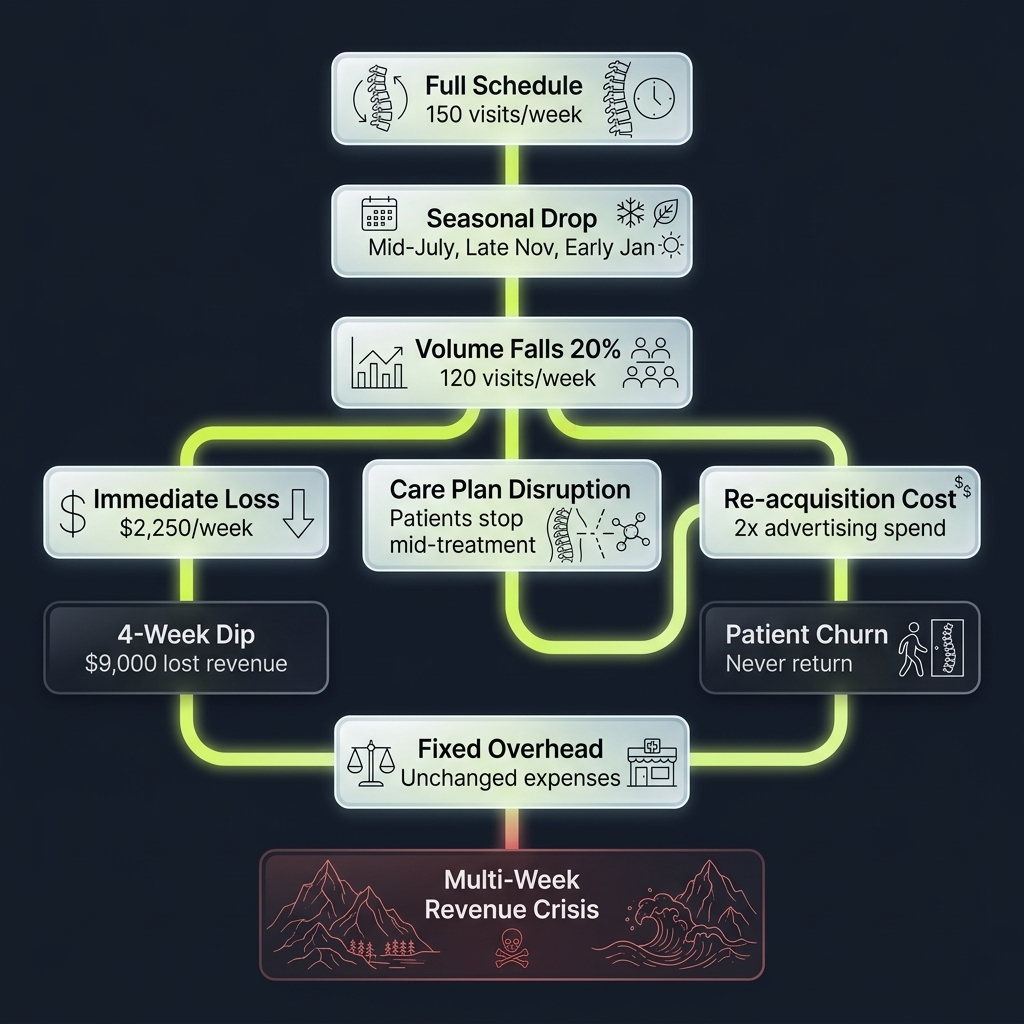
Chiropractic appointment books empty suddenly due to predictable seasonal patterns. Mid-summer vacation windows, late November holiday travel, and early January when patients await deductible resets cause patient volume to drop approximately 20 percent. These recurring seasonal contractions create multi-week revenue losses, disrupt care plan continuity, and force practices into costly patient re-acquisition cycles while fixed overhead expenses remain unchanged.
The Ghost in the Appointment Book
The Monday Morning Chill
Walk into your clinic on a mid-July Monday at 9:15 a.m.
The adjustment tables are clean. The phone is silent. Your front desk staff is reorganizing patient files to look productive.
Three weeks ago, you were triple-booked through lunch. Today, your 10 a.m. slot is empty, and your 11 a.m. is a maybe.
This is not random. It is chiropractic seasonality.
The same pattern repeats in late November, when families disappear into holiday travel. It repeats again in early January, when patients wait for deductibles to reset.
The emotional toll is worse than the financial one. You move from the high-energy chaos of a full schedule to the quiet anxiety of wondering if the phone will ever ring again.
It will. But by the time it does, you have already lost four weeks of revenue.
The Invisible Math
Let's make the damage concrete.
A healthy chiropractic practice runs at approximately 150 patient visits per week. With an average visit value of $75, that is $11,250 in weekly revenue.
During predictable seasonal contractions, the week before Thanksgiving, the last two weeks of December, the mid-summer vacation window, your volume drops by 20 percent.
You are now seeing 120 visits per week. That is a loss of 30 visits.
The immediate damage: $2,250 per week. Over a four-week dip, you lose $9,000.
But the real cost is invisible.
First, there is care plan churn. Clinical data shows that corrective or chronic conditions require 12 or more visits for measurable change. When patients miss appointments during busy personal seasons, they break momentum. They stop mid-plan. They never return.
Second, there is the re-acquisition tax. Winning back lost volume means spending twice as much on aggressive advertising later. You are not just replacing revenue. You are paying to rebuild the patient base you already had.
Third, there is overhead pressure. Your rent does not drop by 20 percent. Your staff salaries do not drop by 20 percent. Your equipment leases do not drop by 20 percent.
Fixed costs remain at 100 percent while clinical revenue drops by 20 percent. Your net profit margin collapses.
The average annual revenue for a chiropractic practice is approximately $580,000. A 20 percent contraction across just three seasonal windows per year costs you $27,000 in direct revenue, plus the compounding damage of patient churn and re-acquisition spend.
This is not a rounding error. This is the difference between a thriving practice and one that barely survives.
Why the Obvious Fixes Fail
Most owners reach for the panic button.
They run a last-minute "bring a friend" special. They offer a discount on new patient exams. They boost a Facebook post with $200 and hope for the best.
This is the reactive marketing trap.
First, discount promotions damage your authority. When you position yourself as the low-cost option, you attract price-sensitive patients who do not comply with care plans. They come in once, take the discount, and disappear.
Worse, these promotions erode your clinical credibility. Google evaluates healthcare content under strict "Your Money or Your Life" guidelines. The search engine actively penalizes unreviewed, thin medical content that lacks human clinical oversight. Running desperate promotions signals to both patients and search algorithms that you are not an authoritative source.
Second, there is the lag-time reality. Posting frantically on social media during a slow week is mathematically destined to fail.
Healthcare marketing data shows that the patient decision cycle for high-consideration medical choices takes 30 to 45 days from initial research to booking an appointment. A patient who books today was influenced by information they encountered six weeks ago.
Reactive marketing always arrives a month too late. You are fighting the last war.
Third, there is the distraction of ad-hoc effort. Starting and stopping your outreach based on current clinic volume creates an erratic brand presence. Search engine algorithms reward consistency. When you post three times in one week and then go silent for a month, you confuse both the algorithm and your prospective patients.
The system does not trust you. The patient does not remember you.
What is the Anticipatory Content Flywheel?
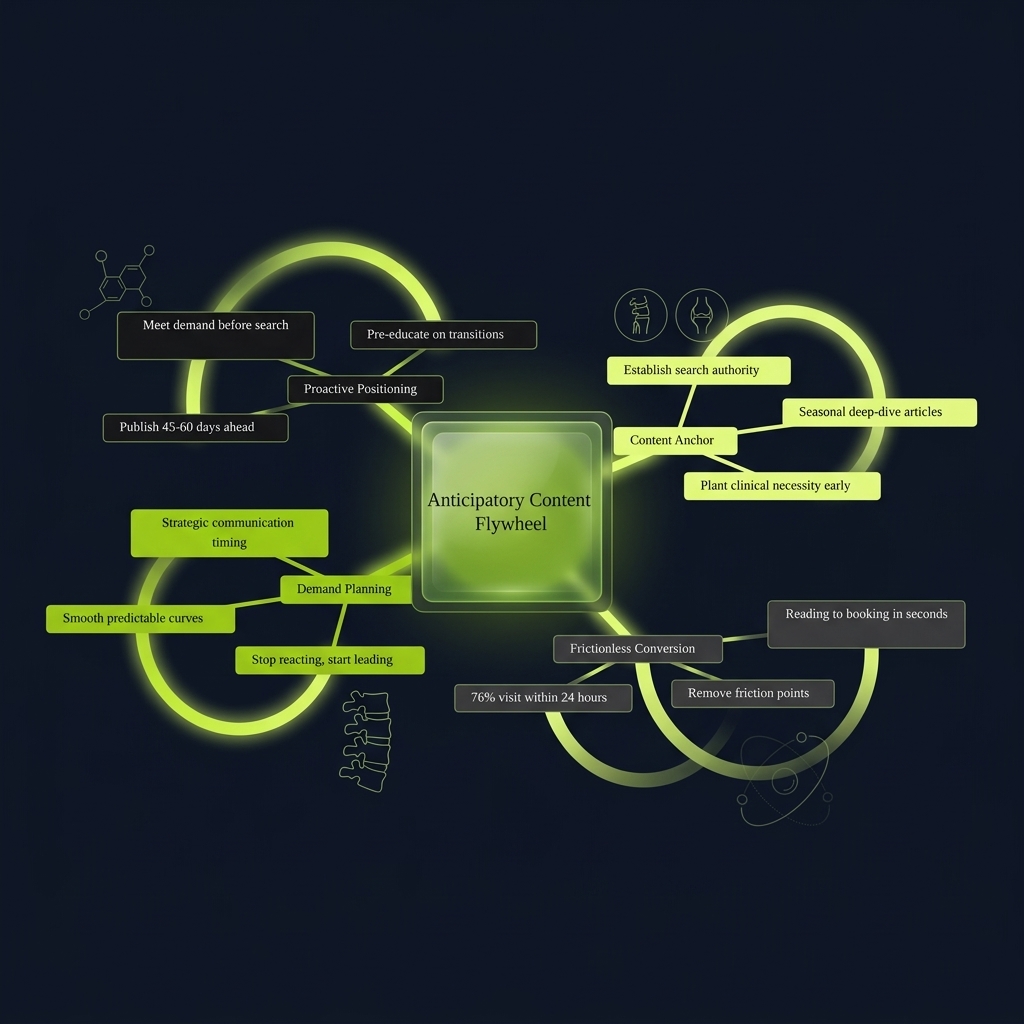
The anticipatory content flywheel is a proactive marketing system that positions chiropractic practices ahead of seasonal patient demand through strategic pre-education. Rather than reacting to patient needs, it uses predictable health patterns to publish relevant content 45-60 days before physical stressors peak, establishing search authority and meeting patients with timely information before they actively seek care.
The Anticipatory Content Flywheel
Shifting the Paradigm
The solution is not to react faster. The solution is to stop reacting at all.
This is practice demand planning.
You treat patient volume not as an uncontrollable weather pattern, but as a predictable curve that can be smoothed out with strategic, proactive communication.
The shift is from "selling adjustments" to "pre-educating on lifestyle transitions." You meet patients with relevant health information before their seasonal physical stressors peak.
In the United States, approximately 70,000 licensed chiropractors treat over 35 million Americans annually. The patient base is massive. The demand is real. The question is whether you position yourself in front of that demand before it crystallizes into a Google search.
The Anatomy of the Integrated System
The system has four core pillars. They function as a single, unified machine, not isolated tasks.
1. Consistent Content Presence (The Anchor)
You establish search authority by regularly publishing deep-dive, educational resources tailored to upcoming seasonal shifts.
Search engine optimization industry consensus states that well-structured, authoritative content can begin surfacing in search results in as little as 45 days. This validates the need for a 45-to-60-day lead time on seasonal content.
You write about desk ergonomics for winter remote work in October. You write about preventing yard-work lumbar strains in February. You write about the physical toll of long-distance holiday travel in September.
Each piece plants the seed of clinical necessity before the patient feels the pain.
2. Fast Response and Frictionless Conversion
When seasonal demand is triggered, prospective patients must be able to transition from reading to booking within seconds.
According to Google's search data, 76 percent of people who search for something nearby on their smartphone visit a related business within 24 hours. If your website loads slowly, if your contact form is buried, if your phone number is not clickable, you lose the patient.
3. Review Momentum
You use peak seasons to systematically gather clinical social proof. While 60 percent of US adults report watching health-related videos online, only 40 percent actually trust what they find.
Reviews act as a trust accelerator. When search traffic spikes, new patients see a wall of five-star testimonials and book immediately.
4. Steady Patient Communication (The Reactivation Engine)
You maintain a warm, value-first connection with your existing patient database. Approximately 60 percent of chiropractic patients are women, and 62 percent of patients seek treatment primarily for back pain.
You know who is in your database. You know what they need. You send them relevant, seasonal health information before they experience a severe relapse.
They return to care before they end up in the emergency room.
Why the System Works
The system works because of two mechanisms: compounding and lead time.
First, there is the compounding nature of organic content. Unlike paid ads that turn off when the budget stops, authoritative seasonal content ranks year after year. It builds a permanent traffic asset.
A McKinsey study found that 75 percent of consumers engage with health and wellness content at least once a week, and 56 percent use Google to find this information. Every piece of content you publish today continues generating patient inquiries at a declining cost per acquisition over time.
Second, there is the pre-need education mechanism. You educate patients on the physical strains of spring gardening in February. You educate them on the ergonomics of long-distance holiday travel in September.
This proactive positioning transforms you from an emergency "back mechanic" into an indispensable, long-term partner in preventative wellness.
The patient does not call you when they are desperate. They call you before they get hurt.
What is the Execution Wall?
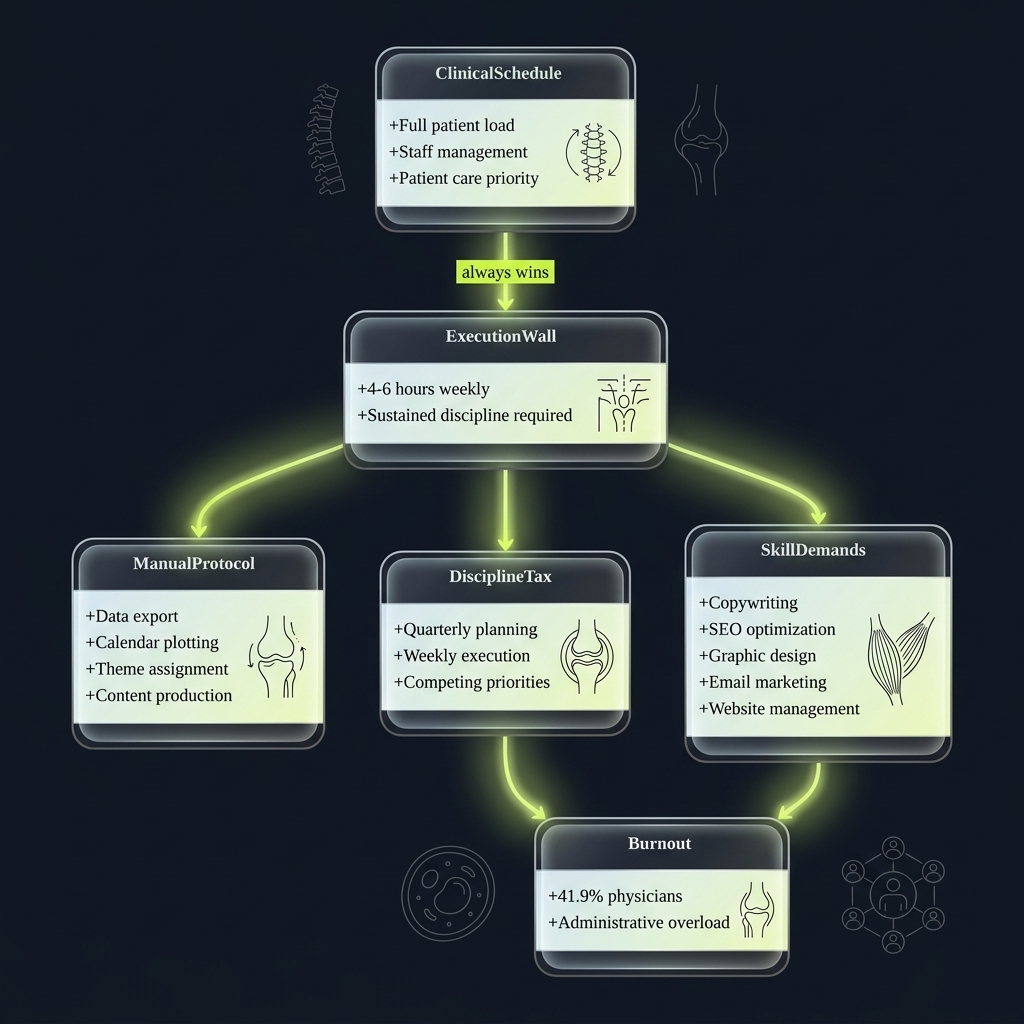
The Execution Wall refers to the significant time and skill barriers practitioners face when implementing revenue stabilization systems manually. It requires four to six hours weekly of focused content creation while managing full clinical schedules, demanding copywriting, SEO, design, email marketing, and website management expertise that most medical practices lack internally.
The Execution Wall
The Monday Morning Protocol
The system is mathematically correct. The question is whether you can execute it.
Here is the manual protocol.
Step 1: Open your EHR billing software and export your weekly patient visit volume for the past 24 months. Identify your exact, predictable revenue dips.
Step 2: Plot these dips on a physical calendar. Identify the exact four-to-six-week windows where volume historically drops.
Step 3: Look 45 days prior to each dip. Assign two specific, seasonal clinical themes. "Desk ergonomics for winter remote work." "Preventing yard-work lumbar strains." "Managing holiday travel stress on the spine."
Step 4: Commit to writing and publishing one authoritative, 1,500-word educational article for each theme. Send a dedicated email newsletter to your active patient database.
The planning block takes 30 minutes.
The execution demand is steep. It requires four to six hours of highly focused research, writing, formatting, and scheduling every single week.
You must produce high-quality content for next quarter while simultaneously managing a full clinical schedule, staff issues, and patient care in the current quarter.
This is the discipline tax.
The True Cost of Running the Full Flywheel Manually
Now widen the lens to the entire integrated system.
You need copywriting skills. You need SEO optimization knowledge. You need graphic design for social posts. You need email marketing software expertise. You need technical website management. You need review acquisition tracking.
The clinical schedule always wins. When the clinic gets busy, the content stops. When the content stops, the next seasonal dip is guaranteed.
In a 2026 report, the American Medical Association found that 41.9 percent of surveyed physicians reported experiencing at least one symptom of burnout in 2025. Administrative tasks, insurance paperwork, and EHR documentation are consistently ranked as the leading cause of burnout in physician surveys, often cited by over 50 percent of respondents.
A scoping review published in 2024 found that chiropractors who faced higher workloads and insurance mandates, administrative burdens by nature, experienced increased burnout risk, including depersonalization and lower feelings of personal accomplishment.
Adding manual content production to this workload is not sustainable. It is organizational suicide.
The Dangerous Shortcut
Some owners reach for generic AI tools.
ChatGPT seems like a silver bullet. You type a prompt, get a blog post in 30 seconds, and move on.
This is the illusion of efficiency.
First, there is the non-deterministic output problem. Generic AI models produce repetitive, uninspiring, and flat-out boring content that fails to capture the unique clinical voice of your practice.
You spend more time editing, rewriting, and manually copying-and-pasting across multiple platforms than you would have spent writing from scratch.
Second, there is the compliance and liability nightmare. Healthcare advertising regulations and state licensing boards have strict rules regarding clinical claims.
Generic AI tools, lacking clinical context, routinely write non-compliant, exaggerated claims. They promise to "cure" or "prevent" specific conditions. They make guarantees you are not allowed to make.
In the United States, state licensing boards and the Federal Trade Commission hold the practice owner legally and financially responsible for all advertising and website copy, regardless of whether it was written by an AI or a human.
You publish the blog post. Six months later, you receive a cease-and-desist letter from your state board. You are now defending claims you did not even know you made.
In recent algorithm updates, Google integrated its Helpful Content System directly into core algorithms and explicitly stated that content generated by AI in a "low-effort way" without human review or original value will receive the lowest quality rating.
The search engine will not rank you. The state board will not protect you. The patient will not trust you.
The Strategic Realization
The anticipatory content system is mathematically correct. It is vital for survival.
But executing it manually is a demanding, second part-time job.
Your highest-value, highest-revenue hour is spent adjusting patients and leading your clinical team. It is not spent writing SEO metadata or formatting email templates.
The most successful practices do not build this engine by hand. They recognize that the system is right and they want it operated for them.
Platforms that operate this whole loop end-to-end, content calendar planning, compliance-reviewed publishing, patient newsletters, and front-desk response automation, exist specifically to solve this execution wall; tools like Omniply run the seasonal-defense engine autonomously, capturing your unique clinical voice while managing the compliance guardrails, so the system never skips a week even when your clinic is slammed.
The final, simple truth of practice growth: You cannot treat patients and run a media company at the same time.
The question is not whether the system works. The question is whether you will execute it, or whether you will continue reacting to the same predictable dip every quarter.
The calendar does not care about your intentions. It only cares about what you published 45 days ago.
Frequently Asked Questions
When is the Slowest Month for Chiropractors?
The slowest periods typically fall in late November through December (holiday travel and family obligations), mid-July through August (summer vacations), and early January (patients waiting for deductibles to reset). The exact timing varies by region and patient demographics, but the pattern is highly predictable when you analyze your own historical visit data.
When is Chiropractic Busy Season?
Peak volume usually occurs in September and October (post-summer return to routine, back-to-school physical strain), and February through April (tax refunds, spring activity increases, and resolution of winter deductibles). Practices that plan content 45 days ahead of these windows capture the search traffic before competitors react.
Can ChatGPT Write Blog Posts for My Clinic?
Generic AI tools can generate text, but they create three serious problems: the output is non-deterministic and often repetitive, requiring significant editing time; they lack clinical context and routinely write non-compliant claims that violate state licensing board rules; and Google explicitly penalizes AI-generated content produced "in a low-effort way" without human review. You remain legally responsible for every word published under your practice name.
How to Plan a Year of Blog Posts Quickly?
Export 24 months of patient visit data from your EHR, plot the dips on a calendar, and look 45 days before each dip. Assign two seasonal clinical themes to each window (e.g., "holiday travel ergonomics" or "spring yard-work injury prevention"). This planning session takes 30 minutes. The execution, writing, formatting, publishing, and distributing, takes four to six hours per week.
Can a Receptionist Manage Our Clinic Blog?
A receptionist can manage the logistics (scheduling posts, uploading images), but producing healthcare content that satisfies Google's E-E-A-T guidelines (Experience, Expertise, Authoritativeness, Trustworthiness) requires clinical knowledge and regulatory awareness. Healthcare topics fall under "Your Money or Your Life" standards, meaning low-quality or non-compliant content actively harms your search rankings and legal standing.
Does Blogging Actually Bring in New Clients?
Authoritative, seasonally-timed content brings in new patients by capturing search traffic 45 days before demand peaks. According to Google data, 76 percent of people who search for something nearby on their smartphone visit a related business within 24 hours. The key is publishing content that ranks when patients are actively searching, not posting reactively after your schedule is already empty.
Can Chiropractors Make Medical Claims in Blogs?
State licensing boards and the Federal Trade Commission regulate healthcare advertising, and rules vary by jurisdiction. In general, you cannot promise to "cure" or "prevent" specific conditions, cannot make guarantees about outcomes, and must ensure all claims are supported by evidence. You remain legally and financially responsible for all content published under your practice name, regardless of who or what wrote it.