
Your front-desk assistant spent three hours this week drafting a single monthly update. That is eighty dollars of payroll for an email eighty percent of your list will delete. It is a bad trade. But until now, the alternative was paying an agency two thousand dollars a month to write generic clinic updates.
The math just changed.
The cost of producing written material has dropped by ninety-nine percent. Through artificial intelligence, a single clinician can now produce a year's worth of local updates in one afternoon. This is not about saving eighty dollars. It is about leverage.
If you run a one- to three-location practice, you cannot afford to ignore this shift. Your competitors are already using these systems to crowd you out of local searches.
This article outlines the exact three-step blueprint to scale your clinic's output without hiring a copywriter or distracting your front desk. We will look at the math, the tools, and the traps.
The era of the expensive agency retainer is dead.
Key Takeaways
- Cost Collapse Reality: AI content creation has reduced written material production costs by 99%, enabling a single clinician to produce a year's worth of local updates in one afternoon instead of paying agencies $2,000–$5,000 monthly.
- Patient Acquisition Math: Missing three new patients monthly due to poor local search visibility costs chiropractic practices $90,000 annually at the conservative $2,500 lifetime value per patient baseline.
- Compliance Liability Risk: Generic AI models like ChatGPT hallucinate 91.4% of medical references (Google Bard) and 55% of citations (GPT-3.5), exposing practices to FTC Health Products Compliance Guidance violations requiring randomized controlled human clinical testing for health benefit claims.
- Execution Time Requirement: Running a basic twice-weekly AI blog workflow demands 45–60 minutes per post (3–4 hours weekly), while full-system operation including SEO articles, social posts, newsletters, and review campaigns requires 15–20 hours weekly of doctor time.
- Local Search Dominance: Google Business Profile accounts for exactly 29.4% of all patient leads in healthcare practices (Direction.com study of 102,000+ leads), while 84% of patients check online reviews and 51% read minimum six reviews before selecting a provider.
Why is My Clinic Losing Patients to Competitors Online?
Clinics lose patients to competitors because they lack active digital visibility signals. Without published content and search presence, clinical expertise remains invisible to patients searching online for relief. Competitors leveraging low-cost content production now dominate local search results, capturing new patients worth thousands in lifetime value who never discover less-visible practices.
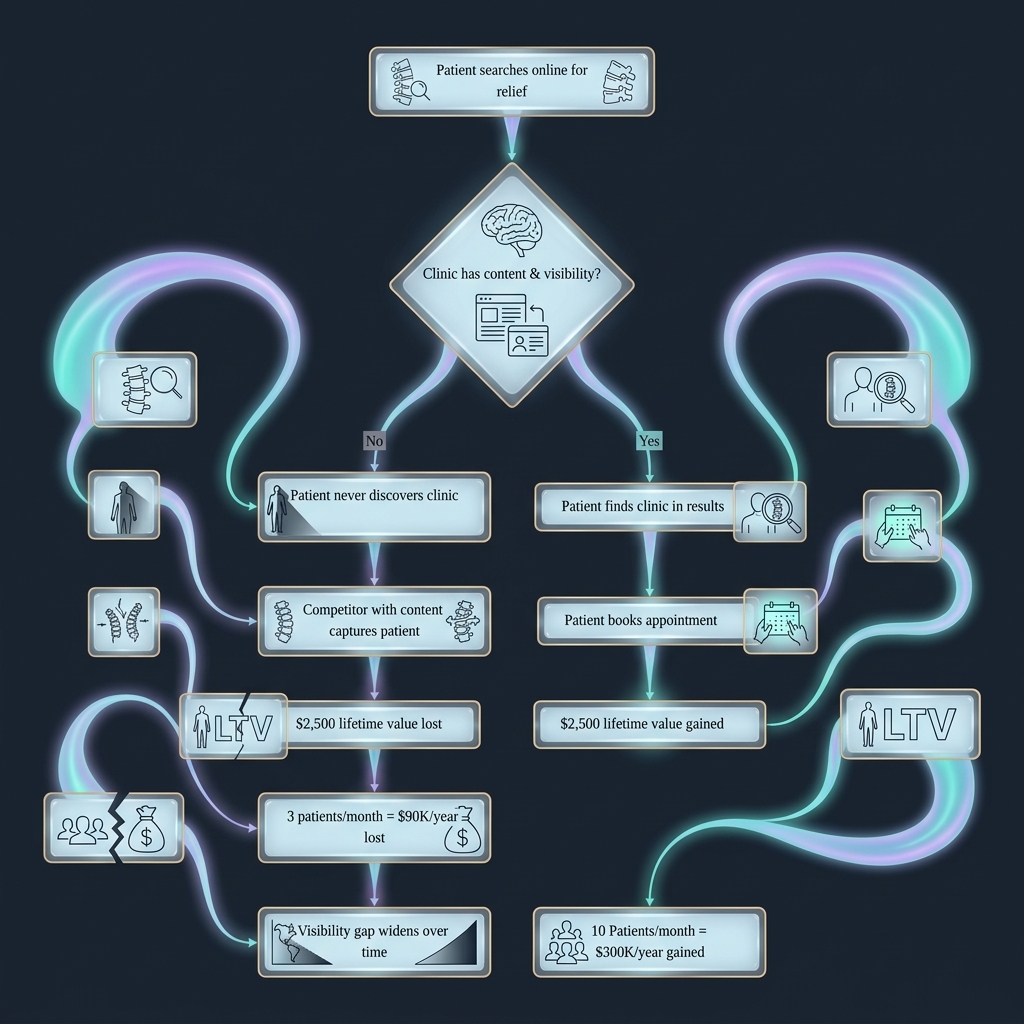
The Invisible Gravity of the Content Deficit
The Monday Morning Diagnostic
You wash your hands between patients and glance at the schedule. Tuesday has three gaps. Wednesday afternoon is empty from two o'clock onward. The physical fatigue of forty adjustments a week is manageable. The mental weight of a quiet phone is not.
The practice two blocks over appears constantly in local feeds. They publish articles. They show up when someone searches for sciatica relief. Your clinical expertise remains locked behind your clinic doors.
This is The Visibility Decay Curve. In a digital-first market, a practice's local authority decays daily without active signals going out. Clinical excellence is invisible to a patient searching for relief on a smartphone at nine o'clock at night.
The Mathematics of the Silent Leak
The average chiropractic patient generates between fifteen hundred and five thousand dollars in lifetime value. Use twenty-five hundred dollars as the conservative baseline: initial care plan, periodic wellness visits, occasional flare-ups over two years.
Missing three new patients per month due to poor local search visibility equals seventy-five hundred dollars in lost monthly revenue. Multiply by twelve. That is ninety thousand dollars annually walking past your door to a competitor who shows up in the search results.
The cost of producing written material just dropped by a factor of one hundred. Your competitors are leveraging that discount to flood local search channels. Standing still does not mean staying in place. It means actively sinking as the local digital baseline rises around you.
Why the Obvious Fixes Fail
The first instinct is to hire a digital agency. Full-service firms charge between two thousand and five thousand dollars per month. They fail for two reasons.
First, they lack clinical knowledge. They produce generic articles about "cracking backs" that alienate educated patients. Google's Search Quality Evaluator Guidelines explicitly classify medical and health-related information as YMYL—Your Money or Your Life content. Because inaccurate information in this category can negatively impact a person's health, safety, or financial stability, Google applies its highest standard for Experience, Expertise, Authoritativeness, and Trustworthiness to these topics. Generic content lacking recognized medical expertise is actively suppressed in search rankings. Generic agency copy does not meet that standard.
Second, they require constant hand-holding. You become an editor-in-chief, reviewing drafts, correcting anatomical errors, rewriting clinical explanations. The two-thousand-dollar retainer buys you a part-time job you did not want.
The second instinct is to delegate to your front-desk assistant. This fails because the assistant's primary role is patient experience and phone conversion. Writing tasks get pushed to the end of the day. Execution becomes inconsistent: one post every three weeks when the clinic is slow. That yields zero compounding Search Engine Optimization value.
The third instinct is the late-night grind. You attempt to write blog posts at nine o'clock after a ten-hour day of patient care. Clinical fatigue inevitably wins. The blog dies. The social media page goes dark. Unsustained willpower is not a system.
None of these approaches scale because they treat content as a checklist item rather than a business system.
What Does an Integrated Patient Acquisition Flywheel Mean?
An integrated patient acquisition flywheel is a unified, automated system where content presence, rapid lead response, reputation management, and patient retention work together as interconnected components. Rather than operating as isolated marketing tasks, each pillar continuously feeds and amplifies the others, creating a compounding growth engine that systematically captures, nurtures, and converts local healthcare search intent into booked appointments.
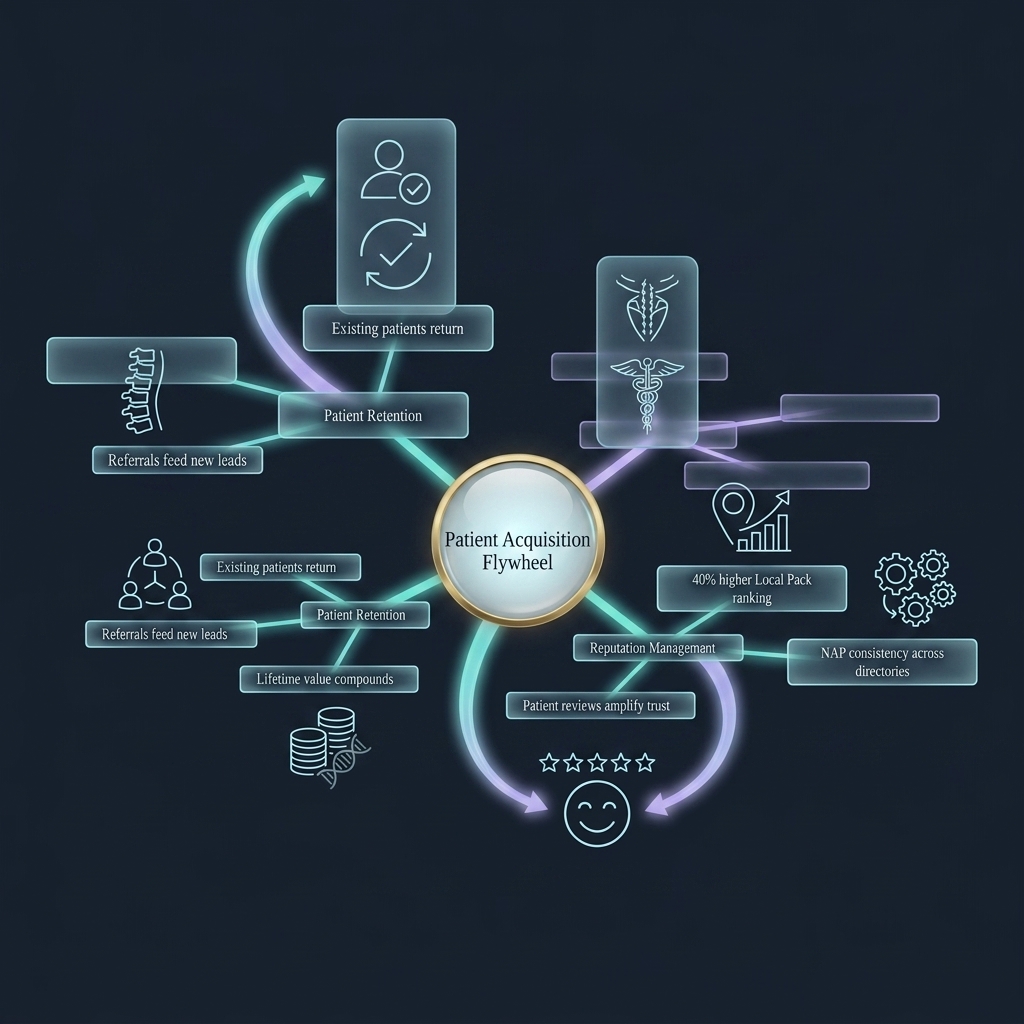
The Integrated Patient-Acquisition Flywheel
Shifting the Belief: From Sporadic Tasks to Systemic Presence
Growth does not come from a sporadic checklist of blog posts or random social updates. It comes from an integrated, automated system that continuously captures, nurtures, and converts local search intent.
This is the paradigm shift. Content, rapid response, reputation, and retention operate as a single unified machine. Each component feeds the others. The whole system compounds.
The Four Pillars of the Growth Engine
Pillar One: Consistent Content Presence. Highly localized, clinically accurate articles capture high-intent search queries. Someone searching for "herniated disc chiropractor" or "sciatica relief near me" is in acute pain and ready to book. If your practice does not appear in that search, you do not exist to that patient.
A 2026 study by Direction.com analyzing over 102,000 healthcare leads found that Google Business Profile, local search, accounts for exactly 29.4% of all patient leads, making it the single largest discovery and acquisition channel for health and wellness practices. Industry data from healthcare reputation platform Repugen shows that practices maintaining consistent NAP data, Name, Address, Phone number, across directories have a 40% higher likelihood of reaching the Google Local Pack, those top three map results that dominate local search.
Pillar Two: Rapid Lead Response. Driving traffic to a website is useless if patient inquiries sit unanswered in an email inbox for more than five minutes. The landmark MIT/InsideSales.com Lead Response Management Study led by Dr. James Oldroyd proved that calling an inbound lead within 5 minutes makes a representative 21 times more likely to enter them into the sales pipeline than if they waited 30 minutes. Meanwhile, 2026 data from Optifai and HubSpot shows that the average service business lead response time hovers between 42 and 47 hours. That is a structural failure, not a staffing problem.
Pillar Three: Unstoppable Review Momentum. A nationwide survey of U.S. adults conducted by healthcare reputation firm rater8 found that 84% of patients check online reviews prior to selecting a new provider, and 51% read a minimum of six reviews before making their decision. Clinical excellence must be translated into public social proof. Every satisfied patient who does not leave a review is a lost signal to the search algorithm and a lost trust indicator to the next prospective patient.
Pillar Four: Nurtured Patient Communication. Educational newsletters keep the practice top-of-mind. They drive retention, reactivate dormant patients, and generate word-of-mouth referrals. A patient who has not visited in six months is not lost. They are waiting for a reminder that you still exist.
The Compounding Flywheel Mechanism
Here is how the system operates as a loop.
High-quality Search Engine Optimization content attracts local searchers suffering from acute pain. Seamless, automated front-desk engagement converts searchers into scheduled patients within minutes. Exceptional clinical care combined with automated review requests generates local social proof. Enhanced review velocity signals authority to search engines, boosting the reach of the original content.
The loop feeds itself. Unlike paid ads that stop delivering the moment the budget is cut, an integrated content system builds permanent digital equity. Every compliant article published is an asset that yields traffic, trust, and patients for years.
This is the correct strategy. The question is execution.
What is the Execution Wall in Healthcare Marketing?
The execution wall in healthcare marketing refers to the time-intensive manual workflow required to create compliant content. Even with AI assistance, producing a single blog post demands 45-60 minutes for recording, drafting, compliance checking for FTC regulations and medical accuracy, formatting, and publishing—requiring three to four hours weekly for consistent twice-weekly posting.
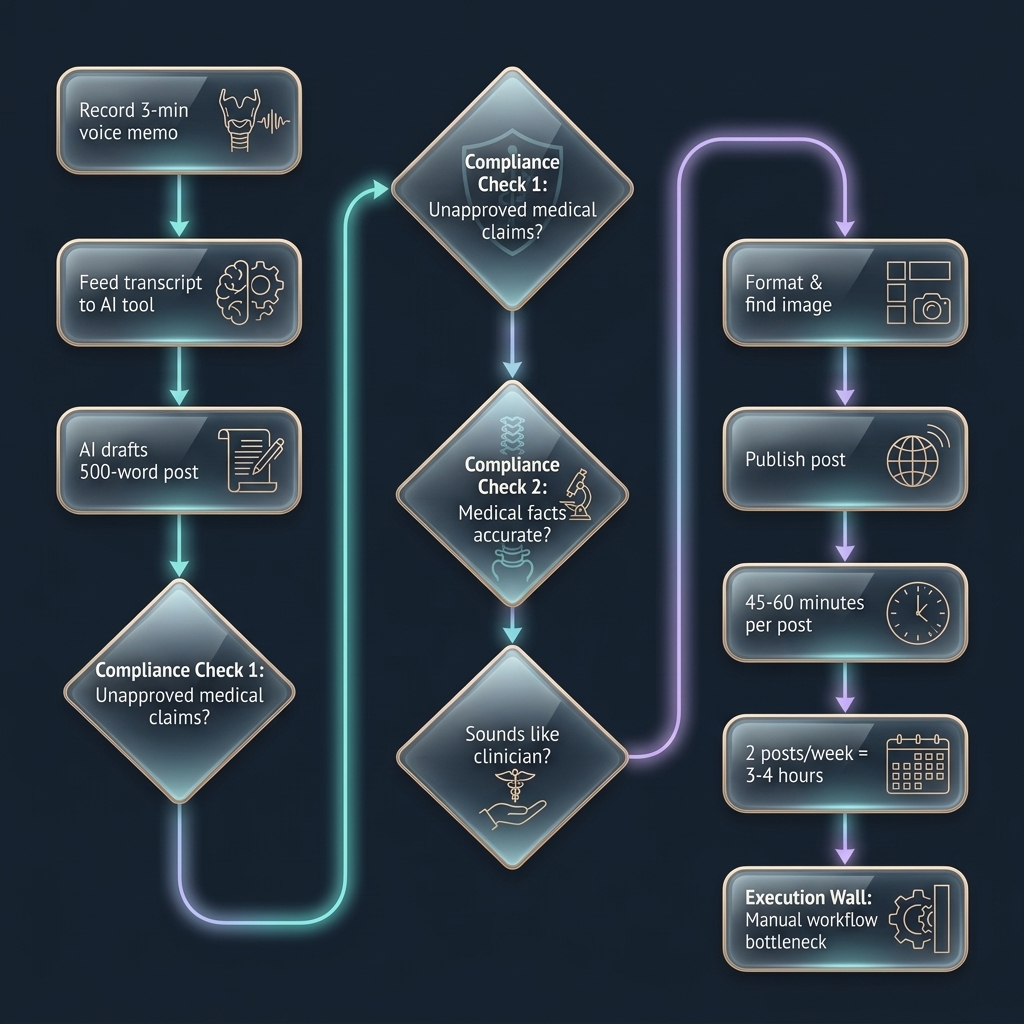
The Execution Wall
The Monday Morning Protocol: a Manual Workflow
You can build a basic version of this system yourself. Record a three-minute voice memo explaining a clinical concept. Feed the transcript into an artificial intelligence tool to draft a five-hundred-word blog post. Run a three-line compliance checklist.
First: Does this draft make unapproved medical claims or promise guaranteed cures? Under the FTC's updated Health Products Compliance Guidance issued in late 2022, the agency broadened its strict advertising rules to cover all health-related products and services. The FTC explicitly states that to meet the "competent and reliable scientific evidence" standard for a health benefit claim, the substantiation generally must be in the form of randomized, controlled human clinical testing. If an artificial intelligence tool drafts an article claiming a chiropractic adjustment "cures" asthma, you carry one hundred percent of the legal liability.
Second: Are the anatomical and biomechanical descriptions factually correct? Generic artificial intelligence models frequently invent plausible but entirely fake medical information. A May 2024 peer-reviewed study by Chelli et al., published in the Journal of Medical Internet Research, evaluated large language models on generating references for systematic medical reviews. The researchers found that Google's Bard hallucinated exactly 91.4% of its medical references. A 2023 peer-reviewed study by Walters and Wilder published in Scientific Reports analyzed citations generated by ChatGPT and found that GPT-3.5 completely fabricated 55% of its bibliographic citations. Relying on unfiltered output can instantly destroy credibility.
Third: Does this sound like a licensed clinician, or a generic robot?
Recording, prompting, formatting, running the checklist, finding an image, and publishing a single post takes forty-five to sixty minutes. To run this protocol consistently twice a week requires three to four hours of dedicated, highly focused doctor time per week.
That is the honest arithmetic of "free."
The Reality of Full System Scale
Scaling the full system, weekly Search Engine Optimization articles, daily social posts, monthly newsletters, review campaigns, and rapid lead response, requires a diverse skill stack. Search Engine Optimization optimization and keyword mapping. Graphic design for social platforms. Email deliverability management. Technical integration of lead capture tools.
Running the complete system manually demands fifteen to twenty hours per week. For a solo practitioner, this time must be stolen directly from patient care or personal life.
You cannot scale a practice by trading clinical hours for prompt engineering.
The Dangerous Shortcut: the Generic Artificial Intelligence Trap
The illusion is that a generic chatbot solves the execution problem. It does not.
Generic artificial intelligence models are inherently unpredictable. They generate plausible-sounding but medically inaccurate information. They have no understanding of HIPAA, state chiropractic board advertising regulations, or Federal Trade Commission guidelines on health claims.
They will confidently draft copy claiming chiropractic adjustments "cure" systemic inflammation or colic. That exposes the practice to severe legal penalties and license suspension. The practice owner carries one hundred percent of the liability for artificial intelligence-generated text published under their name.
Generic tools still consume the owner's time to prompt, review, and correct. They do not reduce the workload. They shift it from writing to editing and compliance checking. The bottleneck remains.
The Ultimate Realization
The strategy is correct. The one-hundred-times cost reduction of content is real. The compounding system is non-negotiable for survival in a digital-first market.
But wielding the tools is a specialized, full-time job. A chiropractor's highest-value activity is delivering clinical care in the adjustment bay, not acting as a prompt engineer, copyeditor, and compliance officer.
The system works best when it is operated for you. Platforms that operate this whole loop end-to-end, weekly articles, social posts, newsletters, review automation, and front-desk response, all generated from the practice's own voice and reviewed for compliance, solve the execution problem without creating a second job. Omniply is one example of this category, built specifically for chiropractic practices.
The era of the expensive agency retainer is dead. The era of the do-it-yourself grind is ending. What remains is the operated system: the right strategy, executed consistently, without consuming clinical time.
You cannot afford to ignore this shift. Your competitors are not waiting.
Frequently Asked Questions
Can ChatGPT Write Content for a Chiropractic Practice?
It can generate a draft. But generic artificial intelligence models have no understanding of health advertising regulations, frequently invent fake medical references, and produce content that fails Search Engine Optimization quality standards for medical topics. You carry full legal liability for anything published under your name. Using it requires significant time to prompt, review, and compliance-check every output.
Is Hiring an Agency Worth It for a Chiropractor?
Most full-service agencies charge between two thousand and five thousand dollars per month. They typically lack clinical knowledge, produce generic content that does not meet Google's Experience, Expertise, Authoritativeness, and Trustworthiness standards for health topics, and require constant oversight from the practice owner. The retainer buys you a part-time editing job, not a solved problem.
How Much Time Does Running a Content System Actually Take?
A basic twice-weekly blog workflow using artificial intelligence tools takes three to four hours per week. Running the full system, weekly articles, daily social posts, monthly newsletters, review campaigns, and rapid lead response, demands fifteen to twenty hours per week. For a solo practitioner, that time must come from patient care or personal life.
Can a Receptionist Handle Clinic Content?
Only if their primary responsibilities are deprioritized. The front desk's highest-value activity is patient experience and phone conversion. Writing tasks get pushed to the end of the day. Execution becomes inconsistent, yielding zero compounding Search Engine Optimization value. Delegation without a system is a recipe for abandoned projects.
Do Blog Posts Need to Be HIPAA Compliant?
The Health Insurance Portability and Accountability Act Privacy Rule applies strictly to Protected Health Information. If a clinic's blog post contains purely educational, clinical, or generic information without any individually identifiable health information, or unconsented patient photos or scenarios, it does not fall under HIPAA restrictions. But blog posts must comply with Federal Trade Commission guidelines on health claims, state chiropractic board advertising regulations, and Google's quality standards for medical content. Generic artificial intelligence tools do not enforce these rules and will confidently write claims a practice is not allowed to make.
How Much Should a Small Clinic Spend on Digital Presence?
The question is not budget. It is return. Missing three new patients per month due to poor local search visibility costs ninety thousand dollars annually at a conservative twenty-five-hundred-dollar lifetime value per patient. The cost of solving that problem, whether through time, tools, or an operated system, must be measured against that leak, not against an arbitrary marketing budget percentage.
How Do Clinics Track Where Patients Come From?
Ask every new patient at intake how they found the practice. Track responses in a simple spreadsheet: search engine, referral, social media, drive-by, existing patient recommendation. Run the numbers monthly. If fewer than thirty percent come from search and more than half come from word-of-mouth, you have a visibility problem. Word-of-mouth does not scale without a baseline of local search presence to amplify it.